

Robotics
Robotics is an interdisciplinary branch of science and engineering that involves the design, construction, operation, and use of robots. The primary goal of robotics is to create machines that can assist humans, perform repetitive or dangerous tasks, and operate autonomously in various environments.
To understand robotics, we must first look at its history and the fundamental rules that guided its early concepts.
Origin of the Term
- The word “robot” was first introduced to the public in 1920 by the Czech writer Karel Čapek in his science fiction play R.U.R. (Rossum’s Universal Robots). It comes from the Czech word robota, which translates to “forced labor” or “drudgery.”
- The term “robotics” (the study of robots) was coined later by the famous science fiction author Isaac Asimov in his 1941 short story “Liar!”.
Asimov’s Three Laws of Robotics
As scientists began imagining a future with intelligent machines, Isaac Asimov proposed three foundational rules to ensure robots would always remain safe and beneficial to humanity. These are known as Asimov’s Three Laws of Robotics:
- The First Law: A robot may not injure a human being or, through inaction, allow a human being to come to harm.
- The Second Law: A robot must obey the orders given to it by human beings, except where such orders would conflict with the First Law.
- The Third Law: A robot must protect its own existence as long as such protection does not conflict with the First or Second Law.
While these laws started in fiction, they continue to deeply influence modern discussions about Artificial Intelligence (AI) ethics and robot safety.
Anatomy of a Robot: Key Components
While robots vary wildly in their shape and purpose, almost all functional robotic systems are built using the same fundamental building blocks.
- Structure: This is the physical body or framework of the robot. It provides mechanical support and protects the internal parts. It can be made from heavy metals, lightweight plastics, or advanced composite materials.
- Actuators: These are the “muscles” of the robot. Actuators convert stored energy into actual physical motion. They can be powered by electricity (motors), hydraulics (pressurized liquids), or pneumatics (compressed air) to move the robot’s limbs or wheels.
- Sensors: These act as the robot’s “eyes and ears.” They constantly gather information about the surrounding environment. Common types include light sensors, cameras, proximity sensors (to avoid crashing), and force sensors (to know how hard to grip an object).
- Power Supply: Every robot needs a reliable energy source to function. Depending on the size and task, this could be an internal battery pack or a direct electrical plug-in.
- Controller: This is the robot’s “brain.” It is a centralized computer that receives data from the sensors, processes the information, and sends exact command signals to the actuators to trigger movement.
- Programming: The controller relies on software to function. This includes the core code, operating algorithms, and Artificial Intelligence (AI) that allow the robot to make independent decisions and interact with humans safely.
- End Effectors: These are the specialized “hands” or tools attached to the very end of a robotic arm. Depending on the job, an end effector could be a mechanical gripper, a welding torch, a paint sprayer, or a surgical scalpel.
Types of robotics
Robots come in many shapes and sizes, each designed for a specific environment or task. They are generally classified into the following categories:
- Industrial Robots: Heavy-duty machines used in factories and manufacturing plants. They perform repetitive tasks like welding, painting, and assembling car parts with high speed and extreme precision.
- Service Robots: Designed to assist humans in daily tasks outside of industrial settings. Examples include automated vacuum cleaners (like Roombas) or robots that deliver food in restaurants.
- Medical Robots: Highly precise machines used in healthcare. The most famous example is the da Vinci Surgical System, which allows doctors to perform complex, minimally invasive surgeries with robotic arms.
- Autonomous Vehicles: Machines that can navigate and drive themselves without human intervention, such as self-driving cars, automated delivery trucks, and unmanned drones.
- Humanoid Robots: Robots designed to resemble the human body in shape and movement. Eg: Sophia
Sophia is a social humanoid robot developed by Hong Kong-based Hanson Robotics in 2016, known for her realistic human expressions and conversational abilities. She is designed for research, education, and entertainment, gaining global fame as the first robot to receive Saudi Arabian citizenship and a UN Innovation Champion title.
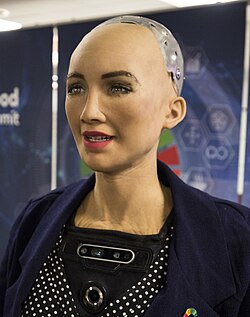
- Real-Life Indian Example: Vyommitra is a female-looking humanoid robot developed by the Indian Space Research Organisation (ISRO) to fly aboard unmanned test missions for the Gaganyaan space project.
- Cobots (Collaborative Robots): Unlike traditional industrial robots that are kept in safety cages, cobots are specifically designed to work safely alongside human workers in a shared workspace.
- Agricultural Robots: Also known as Agribots, these are used to automate farming tasks like harvesting crops, picking fruits, or using drones to spray nano fertilizers evenly over large fields.
- Exploration and Space Robots: Built to survive extreme environments where humans cannot safely go. A proud example is the Pragyan Rover, which successfully explored the lunar surface during India’s Chandrayaan-3 mission.
- Defense and Military Robots: Used by armed forces for surveillance, search and rescue, and bomb disposal (such as India’s Daksh remotely operated vehicle).
- Educational and Entertainment Robots: Used in schools to teach students programming and STEM (Science, Technology, Engineering, and Mathematics) concepts, or designed simply as interactive toys.

Applications of Robotics
Because they are so versatile, robots are transforming nearly every major sector of the global economy:
- Manufacturing and Assembly: Heavy industrial robots dominate automotive assembly lines. They perform tasks like high-speed welding, painting, and quality control much faster than human workers.
- Healthcare: Robotic arms assist doctors in performing delicate, minimally invasive surgeries. Furthermore, robotic exoskeletons (wearable robotic suits) help paralyzed patients regain mobility. Telemedicine robots allow city doctors to remotely examine patients in rural villages.
- Logistics and Warehousing: Modern warehouses use Autonomous Mobile Robots (AMRs) to automatically sort, package, and transport heavy inventory, drastically improving delivery speeds.
- Agriculture: “Agribots” and agricultural drones are driving the rise of precision farming. They can autonomously plant seeds, harvest delicate fruits, and spray fertilizers only on plants that need them.
- Education: Interactive robots (like the Nao model) are used in schools to teach STEM subjects and even help young children learn second languages through hands-on play.
- Space Exploration: Robots survive where humans cannot. NASA’s Curiosity Rover safely explores the harsh surface of Mars, collecting soil samples and scientific data.
- Smart Cities: In futuristic urban centers, humanoid robots offer wayfinding services in malls, while AMRs conduct routine security patrols and deliver groceries.
Challenges Associated with Robotics
Despite their incredible benefits, the rapid rise of intelligent robots presents several serious global challenges that governments and societies must solve.
- Safety Concerns: Industrial robots are massive and move very fast. Without proper safety protocols, accidents can be fatal. (For example, in 2015, a worker at a Volkswagen factory in Germany was tragically crushed by an automated machine).
- Ethical Dilemmas: The creation of AI-powered autonomous weapons (military drones that can choose to fire without a human pressing the button) raises severe moral questions about the value of human life.
- Data and Algorithmic Bias: A robot is only as smart as the data used to train it. If the training data is biased, the robot will make biased decisions. (For example, early facial recognition software struggled to accurately identify certain genders and minority groups).
- Cybersecurity Risks: Because modern robots are connected to the internet, they can be hacked. In 2017, a global ransomware attack (“WannaCry”) completely shut down several highly automated manufacturing facilities.
- Socio-Economic Job Loss: This is perhaps the biggest immediate threat. As robots become cheaper and smarter, they replace human workers. Financial institutions like Goldman Sachs estimate that up to 300 million jobs globally could be lost or severely diminished by automation.
- Cost and Accessibility: High-quality robotics research is incredibly expensive. This limits advanced robotic tools to wealthy corporations and developed nations, leaving smaller industries behind.
- Lack of Regulatory Frameworks: Technology is moving faster than the law. Many countries currently lack standardized, clear legal guidelines regarding who is responsible if an autonomous robot makes a mistake and causes property damage or injury.
