Why in News?
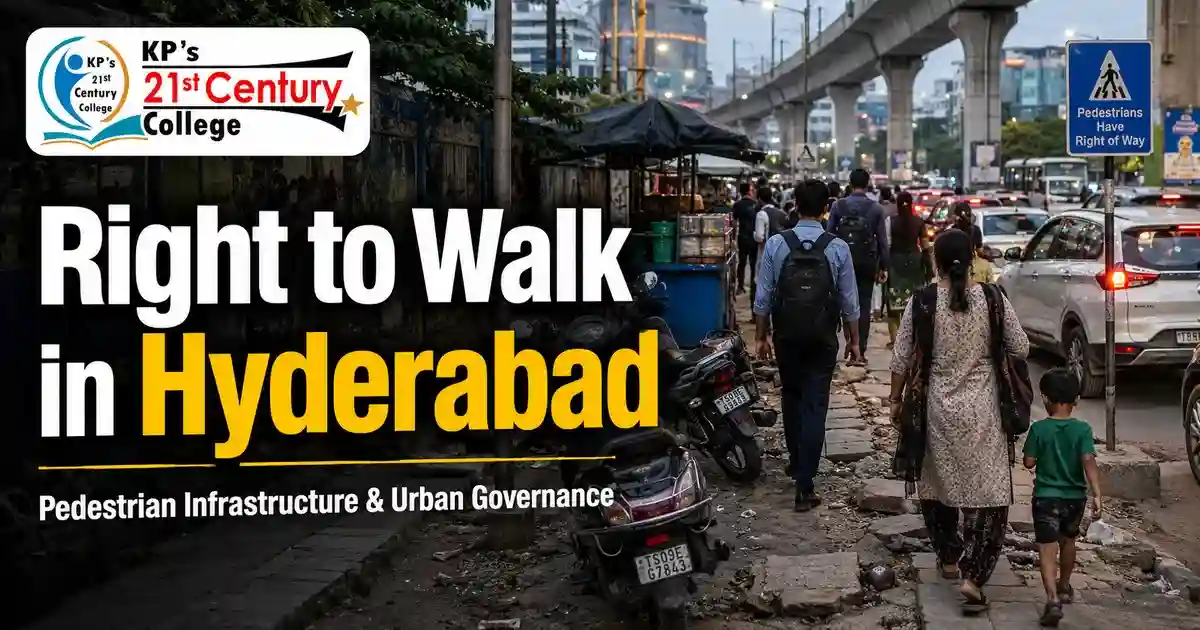
The Supreme Court has recognised the right to walk on demarcated and well-maintained footpaths as a fundamental right connected with the right to life.The judgment has drawn attention to Hyderabad, where missing, narrow, damaged and encroached footpaths force pedestrians to walk amid vehicular traffic.

What is the Right to Walk?
The Supreme Court held that the freedom to walk safely on properly maintained footpaths must receive priority over motorised vehicles.
The Court also suggested creating a statutory regulatory mechanism to protect pedestrian rights.
This places an obligation on governments and urban local bodies to provide:
- Continuous footpaths
- Safe road crossings
- Accessible pathways
- Encroachment-free walking space
- Infrastructure for persons with disabilities
|
What is the Condition of Footpaths in Hyderabad?
Pedestrian routes in Hyderabad are frequently obstructed by:
- Parked vehicles
- Utility poles and cables
- Construction debris
- Commercial establishments
- Food stalls and vendors
- Bus shelters and public utilities
- Damaged or incomplete pavements
Even roads near major administrative institutions, Metro stations and the State Legislative Assembly lack continuous and safe pedestrian facilities.
Earlier estimates indicated that nearly 1,600 km of footpaths were required along major roads, while only about 430 km existed, much of it narrow or encroached.
Why Has Hyderabad Become Less Walkable?
Vehicle-Centric Planning
Urban infrastructure has focused mainly on:
- Road widening, Flyovers, Underpasses, Signal-free corridors,Faster movement of private vehicles
Under the Strategic Road Development Plan, Hyderabad added several flyovers, underpasses and bridges. However, pedestrian and public-transport infrastructure did not receive comparable priority.
Rise in Private Vehicles
The number of vehicles in Greater Hyderabad increased from around 50 lakh in 2016 to more than 94 lakh by August 2025.
Between 2011 and 2024:
- Public-transport use declined from 42% to 25%.
- The share of cars increased from 4% to 16%.
Two-wheelers also rose sharply, reflecting growing dependence on private transport.
Induced Demand
- Building wider roads often attracts additional vehicles instead of permanently reducing congestion. Greater road capacity encourages private vehicle use and makes roads more difficult for pedestrians to cross.
Weak Planning Regulations
- The TS-bPASS Act, 2020 refers to footpaths mainly in relation to utility ducts and does not clearly mandate them as essential pedestrian-safety infrastructure.
What are the Consequences?
Pedestrian Deaths
- In 2025, 390 pedestrians were killed in Hyderabad and Cyberabad, accounting for about 35% of road accident fatalities.
- Pedestrians have consistently formed a significant proportion of road deaths.
Reduced Public-Transport Use
Unsafe walking conditions discourage people from reaching:
- Metro stations, Bus stops, Workplaces, Educational institutions,MPublic facilities
Since every public-transport journey begins and ends with walking, poor footpaths weaken the entire public-transport system.
Social Exclusion
The absence of accessible pathways disproportionately affects:
- Persons with disabilities, Senior citizens, Children, Pregnant women, Street vendors, Low-income citizens without private vehicles
Environmental Impact
Dependence on private vehicles contributes to:
- Traffic congestion, Air pollution, Fuel consumption, Greenhouse-gas emissions, Loss of public space
What Standards Apply to Footpaths?
Indian Road Congress guidelines require continuous and accessible footpaths on roads where vehicle speeds exceed 15 kmph.
A footpath should include:
- Walking zone: Uninterrupted space for pedestrians
- Frontage zone: Space near buildings and property entrances
- Multi-utility zone: Space for trees, poles, vendors, bus stops and street furniture
The pedestrian zone should ideally be at least two metres wide, allowing wheelchair users to pass safely.
Footpaths must also include:
- Kerb ramps, Tactile pathways, Safe crossings, Proper lighting, Drainage, Universal accessibility
What Reforms are Proposed?
CURE Act
The proposed CURE Act includes provisions requiring urban local bodies to create and maintain:
- Footpaths, Pedestrian crossings, Kerb ramps, Tactile pathways, Bus stops, Street furniture, Non-motorised transport corridors
- Tender SURE Model It also seeks to provide inclusive infrastructure in accordance with the Rights of Persons with Disabilities Act, 2016.
Bengaluru’s Tender SURE model demonstrates integrated street planning through:
- Wide footpaths, Cycle tracks, Organised vending spaces, Utility corridors, Public spaces, Accessible Street design
A similar approach can be adapted for Hyderabad.
Way Forward
- Enact a statutory framework protecting the right to walk.
- Make footpaths mandatory in urban layout and building regulations.
- Conduct a city-wide pedestrian-infrastructure audit.
- Ensure continuous footpaths near Metro stations and bus stops.
- Remove encroachments without displacing vendors unfairly.
Conclusion
The right to walk cannot be realised merely through judicial recognition. Hyderabad must shift from vehicle-centred road planning to a people-centred mobility system.
Safe and continuous footpaths would reduce accidents, improve public-transport use, support persons with disabilities and make the city more sustainable. Pedestrian infrastructure must therefore be treated as an essential public service rather than leftover road space.