

Why in News?
The Sports Authority of Andhra Pradesh (SAAP) inaugurated Andhra Pradesh’s first international-standard boxing ring at the Srinivasa Sports Complex in Tirupati on 29 June 2026.
The indoor boxing facility was developed with the support of Junior Chamber International (JCI). It aims to provide continuous training facilities to boxers and develop a pool of skilled athletes for national and international competitions.

What is an International-Standard Boxing Ring?
A boxing ring is a specially designed square platform used for boxing training and competitions. It normally includes:
- A properly padded floor;
- Protective ropes and corner posts;
- Adequate space for boxers and officials;
- Safety arrangements to reduce the risk of injuries;
- A separate training and warm-up area; and
- Facilities suitable for organised competitions.
An international-standard boxing ring is expected to follow recognised norms relating to the dimensions of the ring, quality of equipment, athlete safety and competition management.
The Tirupati facility has been described as an international-standard ring because of its specialised infrastructure, training space and safety arrangements.

Key Features of the Tirupati Boxing Facility
1. First Facility of its Kind in Andhra Pradesh
- The facility is the first international-standard boxing ring established in the State. It represents an important addition to Andhra Pradesh’s sports infrastructure.
2. Located at Srinivasa Sports Complex
- The boxing ring has been established at the Srinivasa Sports Complex in Tirupati, providing aspiring boxers in the region with access to organised training facilities.
3. Indoor Training Hall
- The ring is located inside an indoor boxing hall. This allows athletes to train throughout the year without being affected by heat, rainfall or other adverse climatic conditions.
4. Safety-Oriented Infrastructure
- The facility includes a designated boxing ring, training area and safety arrangements. Such infrastructure is necessary to reduce injuries and provide a disciplined training environment.
5. Support from Junior Chamber International
- The boxing hall was developed with the support of Junior Chamber International, demonstrating the role of cooperation between public institutions and community-based organisations in developing sports infrastructure.
6. Creation of a Talent Pool
- The facility will be used to identify and train promising boxers. It is expected to create a pool of athletes capable of participating in national and international sporting events.
Institutional Arrangement
The project reflects a coordinated institutional approach involving different stakeholders.
- Sports Authority of Andhra Pradesh: SAAP inaugurated the facility and inspected its infrastructure, safety standards and training arrangements.
- Junior Chamber International: JCI supported the development of the indoor boxing hall.
- District Sports Administration: The District Sports Development Officer is expected to support the local implementation and functioning of sports programmes.
- Coaches and Sports Associations: Their participation will be necessary for talent identification, regular coaching and competition preparation.
Such cooperation can reduce infrastructure gaps and improve the quality of sports training at the district level.
Conclusion
The establishment of Andhra Pradesh’s first international-standard boxing ring in Tirupati is an important step towards strengthening the State’s sports ecosystem. The indoor facility can provide safe and uninterrupted training, identify local talent and prepare athletes for higher-level competitions.
However, infrastructure must be supported by qualified coaching, sports science, regular competitions, inclusive access and proper maintenance. With sustained institutional support, the facility can become a major centre for developing competitive boxers from Andhra Pradesh.
Why in News?
The visit of South Korean President Lee Jae Myung to India gave fresh momentum to bilateral cooperation in shipbuilding.Leading Korean companies have announced partnerships, investments and technology collaboration with Indian shipyards, strengthening India’s ambition to become a major global shipbuilding nation.
India’s Shipbuilding Sector
- India’s maritime tradition dates back to the Indus Valley Civilisation. Archaeological evidence from Lothal in Gujarat indicates the existence of an early dockyard and organised maritime trade. Lothal’s dock is regarded as one of the earliest known tidal docks in the world.
- The sector has a strong multiplier effect. Investment in shipbuilding generates additional employment and demand across several linked industries. It can also create large-scale livelihood opportunities in coastal, rural and remote regions.
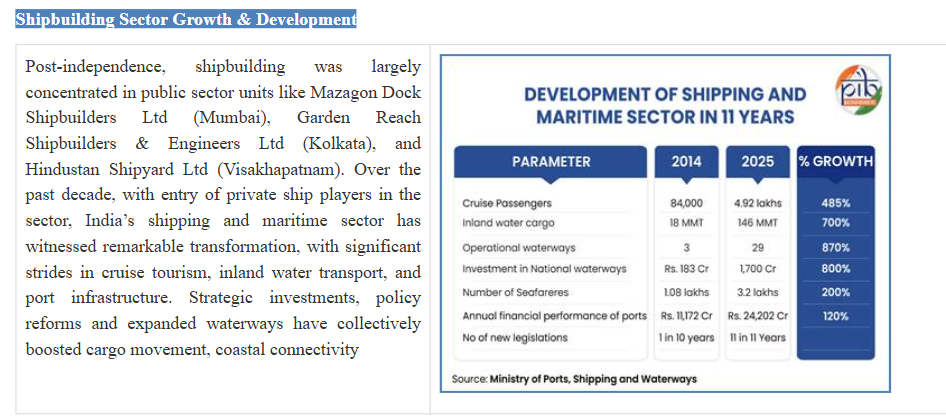
- After Independence, Indian shipbuilding was mainly concentrated in public-sector yards such as:
- Mazagon Dock Shipbuilders Limited, Mumbai
- Garden Reach Shipbuilders & Engineers Limited, Kolkata
- Hindustan Shipyard Limited, Visakhapatnam
- In recent years, private-sector participation, maritime reforms and investments in ports, inland waterways and coastal shipping have expanded the scope of the industry.
- A stronger shipbuilding sector is central to Atmanirbhar Bharat because it can reduce dependence on foreign vessels, strengthen domestic manufacturing and improve national security.
Why is Shipbuilding Important for India?
Shipbuilding is known as the “mother of heavy engineering” because it supports industries such as steel, electronics, machinery, logistics and marine equipment.
Its strategic importance arises from the following:
- Nearly 95% of India’s trade by volume moves through maritime routes.
- Domestic shipbuilding reduces dependence on foreign-built vessels.
- It supports naval preparedness and maritime security.
- It generates skilled employment and promotes coastal industrialisation.
- It strengthens supply-chain resilience.
- It can help India enter high-value global manufacturing networks.
India’s Shipbuilding Ambitions
India seeks to become:
- One of the top 10 shipbuilding nations by 2030
- One of the top five shipbuilding nations by 2047
These targets are part of the Maritime India Vision 2030 and Maritime Amrit Kaal Vision 2047.
However, India currently accounts for less than 1% of global shipbuilding output and remains far behind China, South Korea and Japan.
How Can South Korea Support India?
1. Development of Mega Shipyards
South Korean participation can help India build large greenfield shipyards with modern dry docks, automated production systems and advanced fabrication facilities.
The proposed project at Thoothukudi, Tamil Nadu, is expected to support large-scale ship construction and create substantial direct employment.
2. Technology Transfer
Korean companies such as HD Hyundai, Samsung Heavy Industries and Hanwha Ocean possess expertise in:
- Ship design
- Yard automation
- Modular construction
- Green propulsion
- Offshore engineering
- High-value commercial vessels
Such collaboration can help Indian yards improve quality, reduce construction time and build sophisticated ships.
3. Localised Marine Supply Chains
The Korea Marine Equipment Association, representing over 300 firms, has established a presence in Mumbai.
This can support domestic production of:
- Marine engines
- Navigation equipment
- Propulsion systems
- Shipbuilding-grade steel
- Electrical and control systems
Supplier localisation can reduce import dependence and lower production costs.
4. Cluster-Based Development
India can adapt South Korea’s Ulsan model, which integrates:
- Shipyards
- Ancillary industries
- Ports
- Training institutions
- Research centres
- Logistics networks
Such clusters create economies of scale and improve coordination across the value chain.
5. Skill Development and Research
Partnerships involving Indian and Korean maritime institutions can strengthen training in:
- Naval architecture
- Marine engineering
- Automated ship design
- Advanced welding
- Green propulsion
- Shipyard management
This is essential for India to absorb transferred technology rather than remain dependent on foreign expertise.
6. Defence Manufacturing
Joint work in naval and amphibious vessel construction can strengthen indigenous defence production under Make in India and improve India’s maritime security capabilities.
Major Government Initiatives
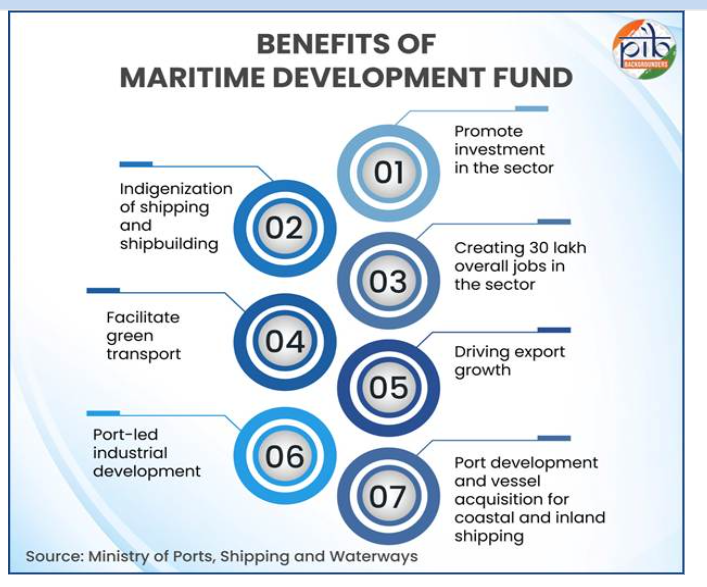
Maritime Development Fund
The proposed ₹25,000-crore Maritime Development Fund aims to provide long-term and affordable capital.
It includes:
- Maritime Investment Fund: Equity support to attract institutional and private capital
- Interest Incentivisation Fund: Support for reducing borrowing costs on long-tenure loans
This is important because shipbuilding projects require large working capital and long repayment periods.
Shipbuilding Financial Assistance Scheme
- The scheme provides graded assistance to Indian yards to offset cost disadvantages against heavily subsidised foreign competitors.It supports domestic vessel construction and improves bidding competitiveness.
Shipbuilding Development Scheme
This scheme focuses on:
- Greenfield shipbuilding clusters
- Modernisation of existing yards
- Common infrastructure
- Credit-risk support
- Establishment of an India Ship Technology Centre
It aims to expand India’s commercial shipbuilding capacity and promote indigenous technology.
Sagarmala Finance Corporation Limited
- The Sagarmala Finance Corporation Limited is India’s first dedicated maritime-sector NBFC.
- It is intended to finance shipping, ports, shipbuilding and related infrastructure.
Green Tug Transition Programme
The programme encourages alternative propulsion systems such as:
- Battery-electric
- Hydrogen
- Methanol
- LNG
- Other low-emission fuels
India’s Ship Recycling Advantage
India is a major global ship-recycling centre, led by the Alang Ship Recycling Yard in Gujarat.
Its global share in ship recycling increased significantly in 2025.
Policy support includes:
- Recycling of Ships Act, 2019
- Alignment with the Hong Kong Convention
- Modernisation of recycling yards
- Expansion of internationally compliant facilities
Major Challenges
1. Low Production Capacity
India’s shipbuilding capacity remains small compared with global leaders.
The concentration of new orders among China, South Korea and Japan makes market entry difficult.
2. High Cost of Finance
Indian shipbuilders face:
- High interest rates
- Large working-capital requirements
- Limited long-term credit
- Weak sovereign guarantee mechanisms
This reduces competitiveness in international tenders.
3. Dependence on Imported Components
India imports a large share of critical marine equipment.
This increases costs, delays production and exposes shipyards to global supply disruptions.
4. Infrastructure Constraints
Many Indian shipyards lack:
- Mega dry docks
- Large fabrication areas
- Automated systems
- Integrated logistics
This prevents them from building ultra-large vessels.
5. Weak Domestic Demand
Indian shipping companies often purchase cheaper second-hand foreign vessels instead of ordering newly built ships from domestic yards.
Without a steady domestic order book, Indian yards cannot achieve scale.
6. Underdeveloped Ship Repair Market
India has a very small share in the global maintenance and repair market.
Indian vessels often go to Singapore, Dubai or Colombo for faster and more reliable servicing.
7. Skill Shortages
India lacks adequate numbers of specialists in:
- Advanced marine engineering
- Automated design
- Green propulsion
- Shipyard planning
- High-end vessel construction
8. Regulatory Delays
Land acquisition, environmental clearances, legal uncertainty and inconsistent regulations can slow greenfield projects and discourage investors.
How Can India Strengthen the Sector?
Build Integrated Shipbuilding Clusters
- Shipyards, suppliers, research institutions, ports and training centres should be developed together to reduce costs and improve efficiency.
Localise Critical Components
Foreign partnerships should include:
- Local value addition
- Technology transfer
- Joint design capability
- Domestic supplier development
- Skill creation
India should aim to become a technology owner, not merely an assembly base.
Link Recycling with Manufacturing
Steel and equipment recovered from recycled ships should feed domestic shipbuilding supply chains.
This can reduce costs and support resource efficiency.
Create a Stable Domestic Order Book
The Right of First Refusal for Indian-built and Indian-flagged vessels should be effectively implemented in government and public-sector cargo contracts.
Expand Maritime Finance
Long-term, low-cost finance and risk guarantees are essential because shipbuilding has long gestation periods.
Develop Skilled Human Capital
Maritime universities, IITs, research institutes and industry should jointly design specialised programmes in naval architecture, green propulsion and ship automation.
Promote Green Shipbuilding
India should target vessels powered by hydrogen, methanol, ammonia and battery systems instead of competing only in conventional shipbuilding.
Improve Centre–State Coordination
State governments must facilitate land, port connectivity, utilities, clearances and investor support for large shipyard projects.
Significance of India–South Korea Cooperation
Industrial capacity:
Korean expertise can accelerate the modernisation of Indian shipyards.
Employment:
Shipbuilding creates jobs across steel, engineering, logistics and marine services.
Technology absorption:
Joint ventures can strengthen domestic design and manufacturing capability.
Maritime security:
A stronger domestic shipbuilding base supports naval and commercial requirements.
Export competitiveness:
Modern shipyards can help India enter global vessel and repair markets.
Green transition:
Collaboration can position India in the emerging low-emission shipping industry.
Conclusion
South Korea’s rapid rise as a shipbuilding power demonstrates that success requires more than individual shipyards. It depends on integrated clusters, affordable finance, skilled workers, local suppliers and sustained policy support. India has the coastline, market, labour force and strategic need to emerge as a major maritime manufacturing nation. Korean cooperation can accelerate this process, but lasting success will depend on domestic capacity-building, technology absorption and supplier localisation.India’s shipbuilding ambitions will succeed only when foreign collaboration is converted into a strong and self-reliant maritime industrial ecosystem.
Why in News?
The Digital India Programme completed 11 years on July 1, 2026.Over this period, India developed one of the world’s largest Digital Public Infrastructure ecosystems, covering identity, payments, welfare, health, education, agriculture, commerce, skilling and public-service delivery.India has also emerged as a global leader in real-time digital payments and citizen-centric digital governance.
What is Digital India?
Digital India is a flagship programme launched in 2015 to transform India into a digitally empowered society and knowledge economy.
Its core objectives are to:
- Expand digital connectivity and infrastructure
- Deliver public services electronically
- Promote digital literacy and inclusion
- Improve administrative transparency and efficiency
- Strengthen electronics manufacturing
- Generate technology-based employment
- Build secure and interoperable digital platforms
The programme has evolved from improving connectivity to creating a large, integrated system of digital identity, payments, data exchange and service-delivery platforms.
Evolution and Economic Impact
- Before 2015, many citizens depended on paperwork, physical verification and repeated visits to government offices.
Digital India accelerated the shift towards:
- Online applications and certificates
- Paperless document verification
- Direct Benefit Transfers
- Digital payments
- Telemedicine
- Online education
- Electronic taxation
- Digital procurement
- GIS-based infrastructure planning
- India now handles nearly 49% of the world’s real-time digital-payment transactions through UPI.
- The digital economy contributes approximately 12–14% of India’s GDP and is expected to account for nearly one-fifth of GDP over the coming decade.
- Digital India has also supported start-ups, innovation, cloud computing, cybersecurity and Artificial Intelligence.
Nine Pillars of Digital India
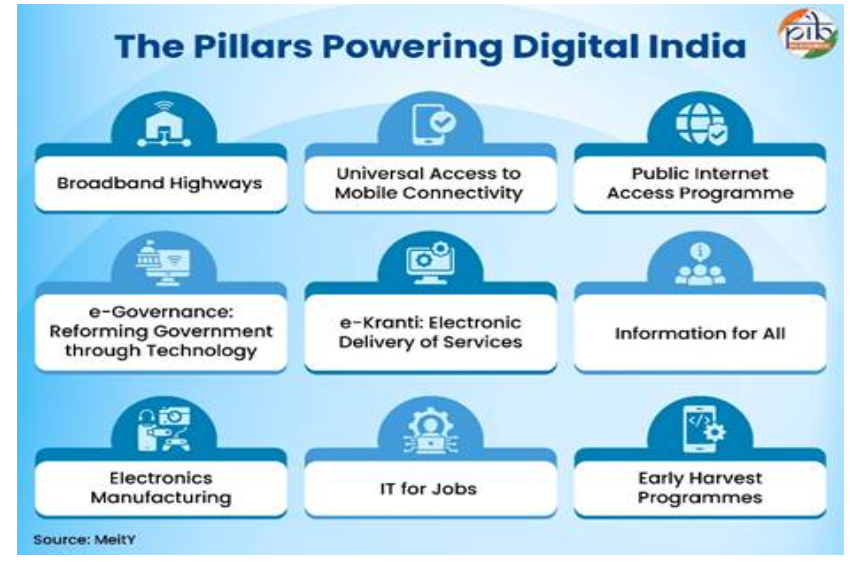
1. Broadband Highways
Under BharatNet, more than 2.22 lakh Gram Panchayats were targeted for broadband connectivity.
By January 2026:
- Around 2.15 lakh Gram Panchayats, nearly 97%, had been connected.
- Close to 7 lakh kilometres of optical fibre had been laid.
This infrastructure supports rural e-governance, telemedicine, education, digital payments and entrepreneurship.
2. Universal Access to Mobile Connectivity
- India’s broadband internet subscriber base reached approximately 106.58 crore by March 2026.Wider mobile access has strengthened last-mile delivery of digital services.
3. Public Internet Access Programme
More than:
- 6.5 lakh Common Service Centres
- 1.6 lakh post offices
provide e-governance, banking and citizen services, particularly in rural and underserved areas.
4. e-Governance
Digital tools have made administration more integrated, paperless and citizen-oriented.
Platforms such as DigiLocker and national sign-on systems simplify access to certificates, applications and public services.
5. e-Kranti
e-Kranti promotes electronic delivery of services through platforms such as:
- e-Hospital
- eSanjeevani
- e-Courts
- Online certificates
- Electronic welfare platforms
Under the e-Courts Mission Mode Project, more than 660 crore pages have been digitised and over 1.07 crore cases filed electronically.
6. Information for All
Platforms such as MyGov and Open Government Data improve public access to government information and promote participatory governance.
7. Electronics Manufacturing
India’s electronics production increased from approximately ₹1.9 lakh crore in 2014–15 to around ₹12 lakh crore by March 2026.
India has also become the world’s second-largest mobile-phone manufacturer.
8. IT for Jobs
The IT and ITeS sector generated an estimated $283 billion in revenue in FY 2024–25.
India’s more than 2,100 Global Capability Centres employ around 26 lakh professionals in engineering, analytics, cybersecurity and AI-related roles.
9. Early Harvest Programmes
Early initiatives included:
- Biometric attendance
- Secure government email
- Public Wi-Fi
- e-Books
- SMS-based weather alerts
- Digital communication systems
These demonstrated the immediate value of technology-led governance.
Flagship Initiatives That Powered an Inclusive Decade
JAM Trinity: Foundation of Digital Governance
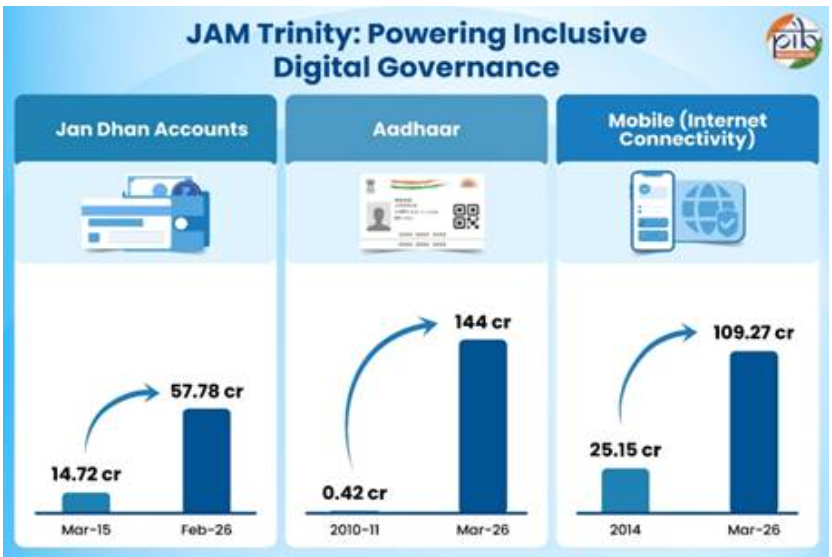
The JAM Trinity combines:
- Jan Dhan bank accounts
- Aadhaar
- Mobile connectivity
Together, they provide the foundation for digital identity, financial inclusion and welfare delivery.
Jan Dhan Yojana
Jan Dhan accounts increased from 14.72 crore in March 2015 to 57.78 crore by February 2026. Deposits increased from approximately ₹15,670 crore to ₹2.94 lakh crore.
Aadhaar
- Aadhaar provides a portable biometric identity for authentication, banking and welfare delivery.By March 2026, Aadhaar enrolments had crossed 144 crore.
- More than 98% of foodgrain distribution under the Public Distribution System is Aadhaar-authenticated, while thousands of schemes and services use Aadhaar-based verification.
Direct Benefit Transfers
By June 2026, benefits worth more than ₹51 lakh crore had been transferred directly through digital systems.
DBT reduces intermediaries, leakage and delays in welfare delivery.
Major Digital Public Infrastructure Platforms
Aadhaar
Aadhaar enables:
- Digital identity verification
- Bank-account opening
- e-KYC
- Welfare authentication
- Paperless service delivery
Its model is being studied by several countries as a scalable form of digital identity infrastructure.
DigiLocker
DigiLocker provides a secure digital wallet for official records.
By March 2026, it had:
- More than 70 crore registered users
- Over 850 crore issued documents
It reduces physical paperwork, duplication and verification delays.
Unified Payments Interface
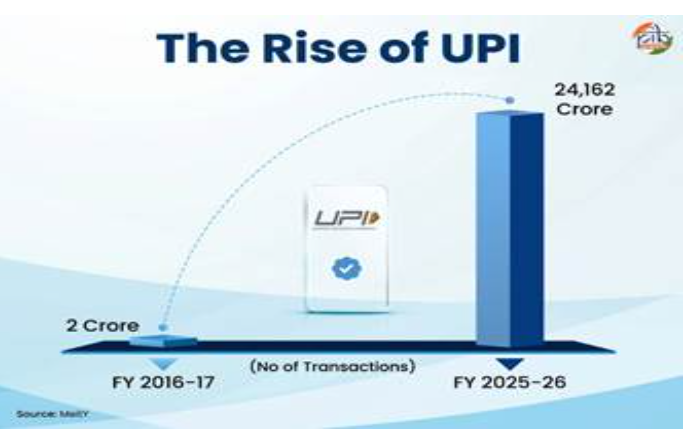
- UPI enables instant, interoperable and low-cost digital payments.
- Transactions increased from around 2 crore in FY 2016–17 to more than 24,000 crore in FY 2025–26.
- UPI has also expanded internationally, strengthening India’s digital and fintech diplomacy.
BHIM
BHIM, developed by the National Payments Corporation of India, is a government-backed UPI application that enables instant bank-to-bank payments.
Sector-wise Digital Transformation
Digital Health
eSanjeevani
The telemedicine platform has expanded remote access to doctors and specialists.
By June 2026, it had facilitated more than 48 crore consultations and onboarded over 2.3 lakh healthcare providers.
Online Registration System and e-Hospital
These platforms enable online appointments and digital hospital administration, reducing queues and paperwork.
CoWIN
CoWIN managed more than 220 crore vaccine doses and became an international example of digital public-health infrastructure.
Aarogya Setu
Initially developed for pandemic-related health services, it later evolved into a broader national health application.
Tele MANAS
Tele MANAS provides free mental-health counselling through a nationwide tele-support system.
MANAS
MANAS enables anonymous reporting of drug trafficking and also supports counselling and rehabilitation services.
Digital Education
DIKSHA
DIKSHA provides:
- Curriculum-linked digital content
- QR-coded textbooks
- Teacher training
- Indian Sign Language resources
- Accessible learning material
SWAYAM
SWAYAM offers online courses from Class IX to postgraduate level.
SWAYAM Prabha
SWAYAM Prabha delivers educational content through dedicated DTH channels, supporting learners with limited internet access.
PM e-Vidya
PM e-Vidya integrates DIKSHA, SWAYAM, television, radio and other digital-learning platforms under a common framework.
APAAR
APAAR provides students with a unique digital academic identity.
By June 2026, over 33 crore APAAR IDs had been generated.
Digital Agriculture
AgriStack
AgriStack integrates farmer, land and crop information to improve access to:
- Credit
- Insurance
- Subsidies
- Procurement
- Personalised advisories
By March 2026, more than 9 crore Farmer IDs had been generated.
Kisan e-Mitra
It is an AI-enabled platform providing information on agricultural schemes and services.
Kisan Sarathi
Kisan Sarathi connects farmers with Krishi Vigyan Kendras, ICAR institutions and agricultural universities for real-time guidance.
e-NAM
e-NAM improves electronic trading, market access and price discovery for agricultural produce.
Digital Commerce and Public Procurement
Government e-Marketplace
GeM has made public procurement paperless, transparent and competitive.
By June 2026:
- Cumulative Gross Merchandise Value exceeded ₹18 lakh crore.
- More than 11 lakh MSMEs had access to government markets.
Open Network for Digital Commerce
- ONDC is an open and interoperable digital-commerce network connecting buyers, sellers and service providers.
- It reduces dependence on closed digital marketplaces and expands access for small businesses.
eSaras and Indiahandmade
These platforms connect self-help groups, artisans and weavers directly with digital markets.
Digital Public Services and Welfare
UMANG
UMANG provides a unified digital gateway to government services. By June 2026, it offered more than 2,500 services and had facilitated hundreds of crore transactions.
POSHAN Tracker
It supports real-time monitoring of nutrition services through more than 13 lakh Anganwadi Centres and covers women and children across the country.
GST Network
GSTN digitises tax registration, return filing, tax payment and e-invoicing.
PM GatiShakti
PM GatiShakti uses GIS technology to coordinate infrastructure planning across ministries and sectors.
MY Bharat
MY Bharat connects youth with:
- Volunteering
- Internships
- Experiential learning
- Skill development
- Leadership opportunities
- National programmes
It has registered more than 2 crore young people.
Digital Skills, Employment and Manufacturing
PMGDISHA
PMGDISHA trained rural citizens in:
- Smartphone use
- Internet access
- Digital payments
- Online public services
By March 2024, it had trained more than 6 crore rural citizens.
FutureSkills Prime
The platform provides training in:
- Artificial Intelligence
- Cloud computing
- Cybersecurity
- Data analytics
Skill India Digital Hub
SIDH integrates skilling, certification and employment services on a common platform.
IndiaAI Mission
The IndiaAI Mission supports:
- AI infrastructure
- AI education and skilling
- Innovation
- Responsible AI adoption
- Research datasets and platforms
India also hosted the IndiaAI Impact Summit in 2026, strengthening its role in global AI discussions.
India’s Global DPI Leadership
- India’s Digital Public Infrastructure is increasingly influencing global digital-governance models.
- By February 2026, India had signed agreements with around 24 countries for cooperation on India Stack and DPI systems.
Indian platforms attracting international interest include:
- Aadhaar
- UPI
- DigiLocker
- CoWIN
- GeM
- DIKSHA
- UMANG
- eSanjeevani
- India also launched the India Stack Global platform and the Global DPI Repository during its G20 Presidency.
- This has made DPI an important instrument of India’s development partnership and digital diplomacy.
Significance of Digital India
Inclusive service delivery:
Digital platforms expand access to banking, healthcare, education and welfare.
Reduction of leakages:
DBT and digital authentication reduce intermediaries and improve targeting.
Ease of living:
Citizens can access documents, appointments, payments and certificates remotely.
Economic formalisation:
Digital transactions and taxation platforms improve transparency in economic activity.
Support for innovation:
Open digital infrastructure enables start-ups, fintech firms and technology enterprises to build new services.
Rural empowerment:
Connectivity, CSCs and digital platforms bring services closer to remote communities.
Global influence:
India’s DPI model is becoming a reference point for inclusive digital transformation.
Key Challenges
Digital divide:
Access to devices, connectivity and electricity remains unequal.
Digital literacy:
Many citizens cannot independently use digital services or identify online fraud.
Cybersecurity risks:
Growing digital dependence increases vulnerability to data theft, ransomware and financial fraud.
Privacy concerns:
Large-scale personal-data collection requires consent, accountability and data-protection safeguards.
Exclusion errors:
Authentication failures or incorrect records may prevent eligible citizens from receiving benefits.
Language and accessibility barriers:
Platforms must serve regional-language users and persons with disabilities effectively.
Platform concentration:
Digital ecosystems must avoid excessive dependence on a few dominant intermediaries.
Institutional coordination:
Data silos and non-interoperable systems can reduce administrative efficiency.
Way Forward
- Expand high-quality broadband and mobile connectivity in underserved regions.
- Strengthen digital literacy and cyber-awareness at the community level.
- Ensure multilingual, accessible and user-friendly digital platforms.
- Preserve assisted and offline service options for vulnerable citizens.
- Improve grievance redressal for authentication and service-delivery failures.
- Enforce strong data-protection and cybersecurity standards.
- Promote open standards and interoperability.
- Strengthen domestic electronics, cloud and semiconductor capabilities.
- Build advanced skills in AI, cybersecurity and data science.
- Ensure digital technology remains a means of empowerment rather than exclusion.
Conclusion
Digital India has transformed the relationship between citizens, markets and the State. Identity, payments, health, education, agriculture and welfare services are increasingly delivered through integrated digital infrastructure.Its next phase must move beyond scale towards trust, safety, inclusion and accountability. Digital India will contribute to Viksit Bharat 2047 only when every citizen can access technology affordably, use it confidently and obtain services without exclusion.