Why in News?
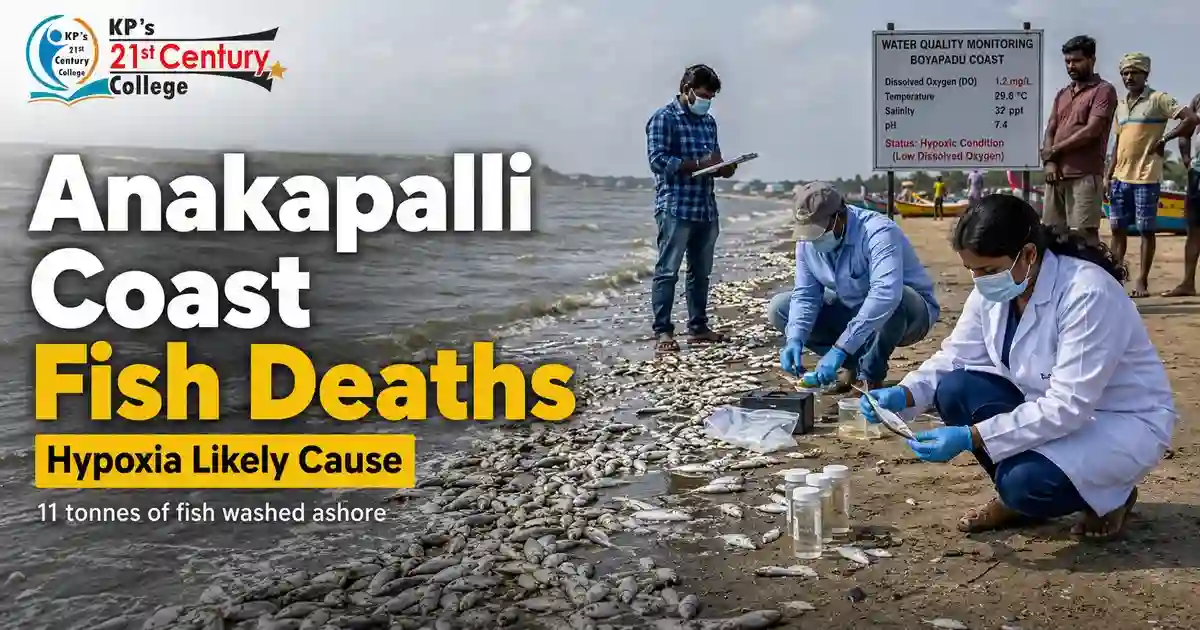
A preliminary study by the ICAR–Central Marine Fisheries Research Institute (CMFRI) has suggested that hypoxia, or severe oxygen depletion, likely caused the mass death of fish along the Boyapadu coast in Anakapalli district.Nearly 11 tonnes of fish, mostly pony fish, washed ashore along a 1,500-metre coastal stretch.
What Happened at Boyapadu?
The incident was reported on June 20, 2026, near the Boyapadu Fish Landing Centre in Nakkapalli mandal.
Major observations included:
- Around 94% of the dead fish were pony fish belonging to the Leiognathus group.
- Fish were reportedly washed ashore alive before dying.
- Most specimens had open mouths, indicating respiratory stress.
- No external lesions or signs of disease were found.
- Seabirds and scavenging birds were absent from the affected stretch.
The estimated economic value of the dead fish was nearly ₹5 lakh.
What Did the CMFRI Study Find?
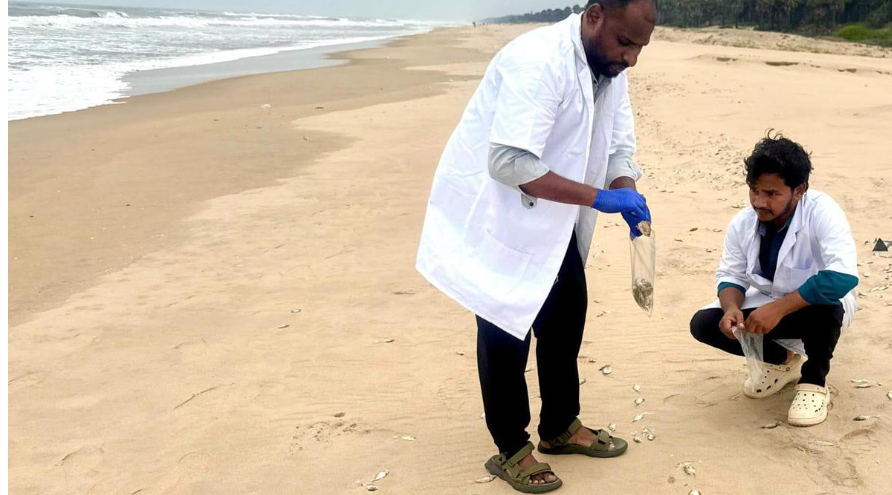
- Water samples showed a high concentration of Trichodesmium, a cyanobacterium commonly associated with algal blooms.
- The concentration was recorded at around 380 cells per millilitre.
The preliminary assessment linked the mortality to:
- Dense algal bloom
- Oxygen depletion
- Hypoxic or anoxic water
- Possible eutrophication
- Formation of near-shore oxygen-dead zones
How Can Algal Blooms Cause Fish Deaths?
An algal bloom is the rapid growth of algae or cyanobacteria in water.
Its likely sequence is:
- Nutrient-rich water promotes rapid algal growth.
- The bloom forms a dense layer near the coast.
- Algae die and decompose.
- Microorganisms consume dissolved oxygen during decomposition.
- Oxygen levels fall sharply, creating hypoxic or anoxic conditions.
- Fish experience respiratory stress and may die.
Intermittent rainfall and a sudden rise in temperature may also have created stratified water layers, accelerating the bloom and oxygen depletion.
Why Were Pony Fish Affected?
- Pony fish are commonly found in shallow coastal waters and close to the seabed.
- When oxygen-deficient bottom water moved towards the shore during high tide, the fish may have become trapped and unable to escape.
- This explains the observed open-mouth condition and the eyewitness account that fish reached the shore alive but in a distressed state.
Could Industrial Pollution Be Responsible?
Local fishermen suspected wastewater discharge from nearby bulk-drug industries.
They alleged that offshore industrial discharge pipelines may have created polluted zones affecting marine life.
However, the CMFRI study stated that available observations were insufficient to establish industrial effluents as the definitive cause.
Further investigations are required into:
- Industrial discharge points
- Effluent-treatment plants
- Toxic substances
- Nutrient pollution
- Long-term water-quality changes
Role of Institutions
ICAR-CMFRI
- Conducted field investigation
- Collected fish and water samples
- Examined disease and oxygen-stress indicators
- Submitted a preliminary report
Andhra Pradesh Pollution Control Board
- Initiated the inquiry
- Sought scientific investigation
- Is examining possible industrial pollution
Fisheries Department
- Assessed the scale of fish mortality
- Recorded fishermen’s concerns
- Participated in the investigation
Way Forward
- Conduct continuous water-quality and toxicological monitoring.
- Examine industrial discharge pipelines and effluent-treatment plants.
- Monitor dissolved oxygen, nutrients and phytoplankton.
- Establish an early-warning system for harmful algal blooms.
Conclusion
The Boyapadu fish mortality appears to have been caused primarily by oxygen depletion associated with a Trichodesmium algal bloom. However, the role of industrial pollution has not yet been ruled out.A definitive conclusion requires long-term water-quality, toxicological and phytoplankton studies. The incident underlines the importance of stronger coastal monitoring, pollution control and protection of marine livelihoods.