Why in News?
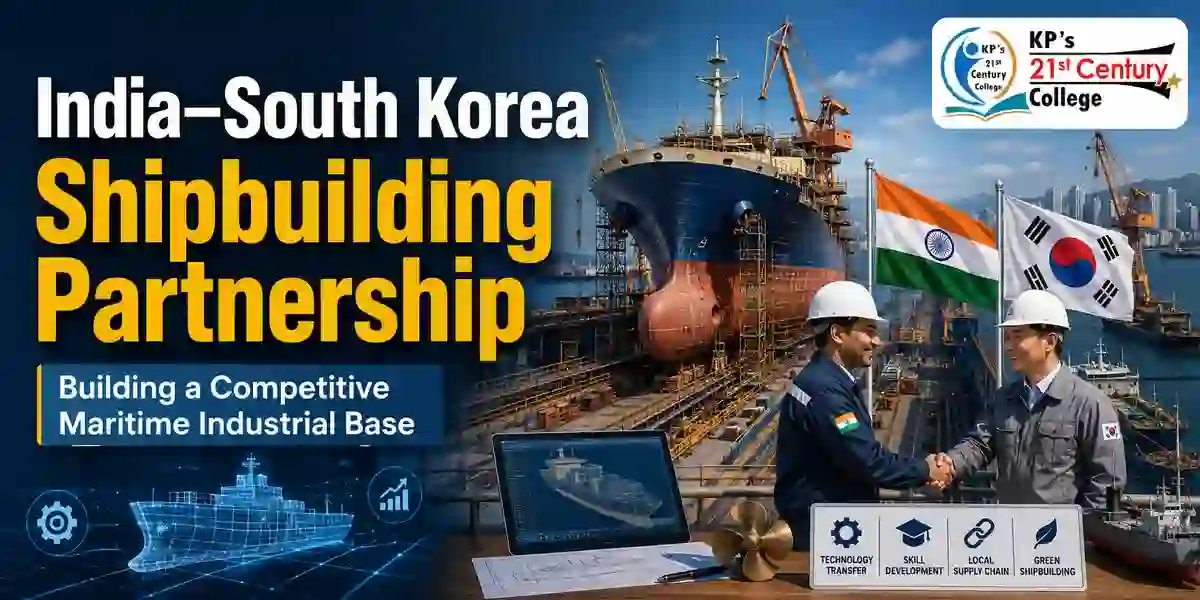
The visit of South Korean President Lee Jae Myung to India gave fresh momentum to bilateral cooperation in shipbuilding.Leading Korean companies have announced partnerships, investments and technology collaboration with Indian shipyards, strengthening India’s ambition to become a major global shipbuilding nation.
India’s Shipbuilding Sector
- India’s maritime tradition dates back to the Indus Valley Civilisation. Archaeological evidence from Lothal in Gujarat indicates the existence of an early dockyard and organised maritime trade. Lothal’s dock is regarded as one of the earliest known tidal docks in the world.
- The sector has a strong multiplier effect. Investment in shipbuilding generates additional employment and demand across several linked industries. It can also create large-scale livelihood opportunities in coastal, rural and remote regions.
- After Independence, Indian shipbuilding was mainly concentrated in public-sector yards such as:
- Mazagon Dock Shipbuilders Limited, Mumbai
- Garden Reach Shipbuilders & Engineers Limited, Kolkata
- Hindustan Shipyard Limited, Visakhapatnam
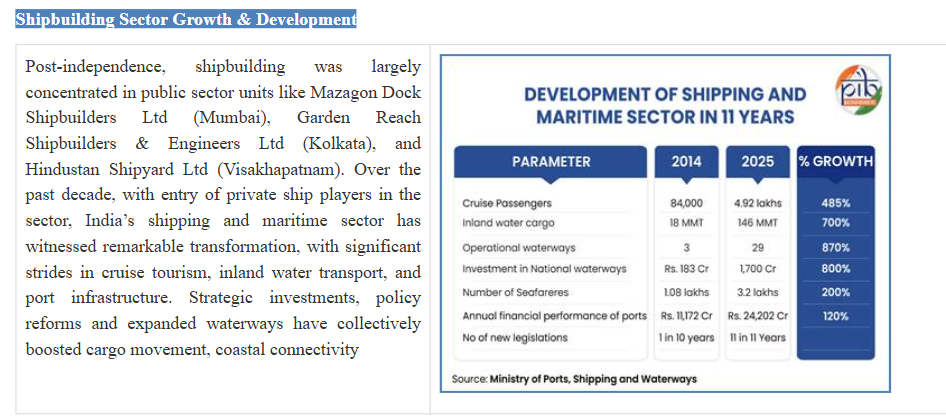
- In recent years, private-sector participation, maritime reforms and investments in ports, inland waterways and coastal shipping have expanded the scope of the industry.
- A stronger shipbuilding sector is central to Atmanirbhar Bharat because it can reduce dependence on foreign vessels, strengthen domestic manufacturing and improve national security.
Why is Shipbuilding Important for India?
Shipbuilding is known as the “mother of heavy engineering” because it supports industries such as steel, electronics, machinery, logistics and marine equipment.
Its strategic importance arises from the following:
- Nearly 95% of India’s trade by volume moves through maritime routes.
- Domestic shipbuilding reduces dependence on foreign-built vessels.
- It supports naval preparedness and maritime security.
- It generates skilled employment and promotes coastal industrialisation.
- It strengthens supply-chain resilience.
- It can help India enter high-value global manufacturing networks.
India’s Shipbuilding Ambitions
India seeks to become:
- One of the top 10 shipbuilding nations by 2030
- One of the top five shipbuilding nations by 2047
These targets are part of the Maritime India Vision 2030 and Maritime Amrit Kaal Vision 2047.
However, India currently accounts for less than 1% of global shipbuilding output and remains far behind China, South Korea and Japan.
How Can South Korea Support India?
1. Development of Mega Shipyards
South Korean participation can help India build large greenfield shipyards with modern dry docks, automated production systems and advanced fabrication facilities.
The proposed project at Thoothukudi, Tamil Nadu, is expected to support large-scale ship construction and create substantial direct employment.
2. Technology Transfer
Korean companies such as HD Hyundai, Samsung Heavy Industries and Hanwha Ocean possess expertise in:
- Ship design
- Yard automation
- Modular construction
- Green propulsion
- Offshore engineering
- High-value commercial vessels
Such collaboration can help Indian yards improve quality, reduce construction time and build sophisticated ships.
3. Localised Marine Supply Chains
The Korea Marine Equipment Association, representing over 300 firms, has established a presence in Mumbai.
This can support domestic production of:
- Marine engines
- Navigation equipment
- Propulsion systems
- Shipbuilding-grade steel
- Electrical and control systems
Supplier localisation can reduce import dependence and lower production costs.
4. Cluster-Based Development
India can adapt South Korea’s Ulsan model, which integrates:
- Shipyards
- Ancillary industries
- Ports
- Training institutions
- Research centres
- Logistics networks
Such clusters create economies of scale and improve coordination across the value chain.
5. Skill Development and Research
Partnerships involving Indian and Korean maritime institutions can strengthen training in:
- Naval architecture
- Marine engineering
- Automated ship design
- Advanced welding
- Green propulsion
- Shipyard management
This is essential for India to absorb transferred technology rather than remain dependent on foreign expertise.
6. Defence Manufacturing
Joint work in naval and amphibious vessel construction can strengthen indigenous defence production under Make in India and improve India’s maritime security capabilities.
Major Government Initiatives
Maritime Development Fund
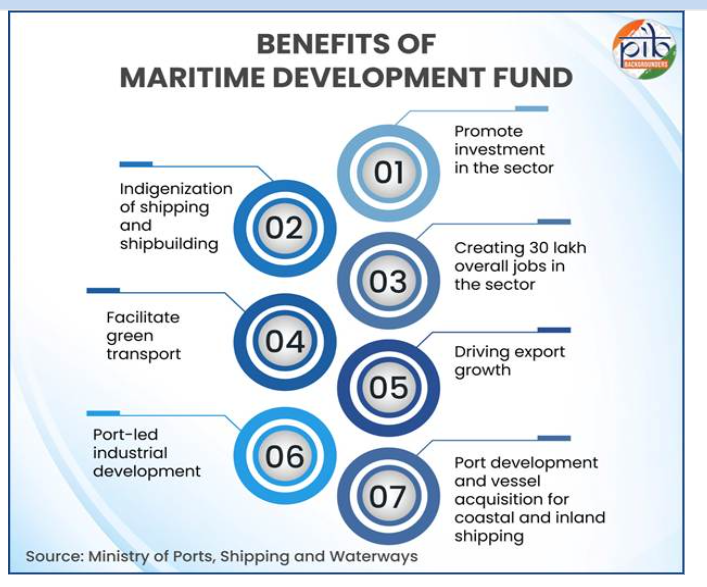
The proposed ₹25,000-crore Maritime Development Fund aims to provide long-term and affordable capital.
It includes:
- Maritime Investment Fund: Equity support to attract institutional and private capital
- Interest Incentivisation Fund: Support for reducing borrowing costs on long-tenure loans
This is important because shipbuilding projects require large working capital and long repayment periods.
Shipbuilding Financial Assistance Scheme
- The scheme provides graded assistance to Indian yards to offset cost disadvantages against heavily subsidised foreign competitors.It supports domestic vessel construction and improves bidding competitiveness.
Shipbuilding Development Scheme
This scheme focuses on:
- Greenfield shipbuilding clusters
- Modernisation of existing yards
- Common infrastructure
- Credit-risk support
- Establishment of an India Ship Technology Centre
It aims to expand India’s commercial shipbuilding capacity and promote indigenous technology.
Sagarmala Finance Corporation Limited
- The Sagarmala Finance Corporation Limited is India’s first dedicated maritime-sector NBFC.
- It is intended to finance shipping, ports, shipbuilding and related infrastructure.
Green Tug Transition Programme
The programme encourages alternative propulsion systems such as:
- Battery-electric
- Hydrogen
- Methanol
- LNG
- Other low-emission fuels
India’s Ship Recycling Advantage
India is a major global ship-recycling centre, led by the Alang Ship Recycling Yard in Gujarat.
Its global share in ship recycling increased significantly in 2025.
Policy support includes:
- Recycling of Ships Act, 2019
- Alignment with the Hong Kong Convention
- Modernisation of recycling yards
- Expansion of internationally compliant facilities
Major Challenges
1. Low Production Capacity
India’s shipbuilding capacity remains small compared with global leaders.
The concentration of new orders among China, South Korea and Japan makes market entry difficult.
2. High Cost of Finance
Indian shipbuilders face:
- High interest rates
- Large working-capital requirements
- Limited long-term credit
- Weak sovereign guarantee mechanisms
This reduces competitiveness in international tenders.
3. Dependence on Imported Components
India imports a large share of critical marine equipment.
This increases costs, delays production and exposes shipyards to global supply disruptions.
4. Infrastructure Constraints
Many Indian shipyards lack:
- Mega dry docks
- Large fabrication areas
- Automated systems
- Integrated logistics
This prevents them from building ultra-large vessels.
5. Weak Domestic Demand
Indian shipping companies often purchase cheaper second-hand foreign vessels instead of ordering newly built ships from domestic yards.
Without a steady domestic order book, Indian yards cannot achieve scale.
6. Underdeveloped Ship Repair Market
India has a very small share in the global maintenance and repair market.
Indian vessels often go to Singapore, Dubai or Colombo for faster and more reliable servicing.
7. Skill Shortages
India lacks adequate numbers of specialists in:
- Advanced marine engineering
- Automated design
- Green propulsion
- Shipyard planning
- High-end vessel construction
8. Regulatory Delays
Land acquisition, environmental clearances, legal uncertainty and inconsistent regulations can slow greenfield projects and discourage investors.
How Can India Strengthen the Sector?
Build Integrated Shipbuilding Clusters
- Shipyards, suppliers, research institutions, ports and training centres should be developed together to reduce costs and improve efficiency.
Localise Critical Components
Foreign partnerships should include:
- Local value addition
- Technology transfer
- Joint design capability
- Domestic supplier development
- Skill creation
India should aim to become a technology owner, not merely an assembly base.
Link Recycling with Manufacturing
Steel and equipment recovered from recycled ships should feed domestic shipbuilding supply chains.
This can reduce costs and support resource efficiency.
Create a Stable Domestic Order Book
The Right of First Refusal for Indian-built and Indian-flagged vessels should be effectively implemented in government and public-sector cargo contracts.
Expand Maritime Finance
Long-term, low-cost finance and risk guarantees are essential because shipbuilding has long gestation periods.
Develop Skilled Human Capital
Maritime universities, IITs, research institutes and industry should jointly design specialised programmes in naval architecture, green propulsion and ship automation.
Promote Green Shipbuilding
India should target vessels powered by hydrogen, methanol, ammonia and battery systems instead of competing only in conventional shipbuilding.
Improve Centre–State Coordination
State governments must facilitate land, port connectivity, utilities, clearances and investor support for large shipyard projects.
Significance of India–South Korea Cooperation
Industrial capacity:
Korean expertise can accelerate the modernisation of Indian shipyards.
Employment:
Shipbuilding creates jobs across steel, engineering, logistics and marine services.
Technology absorption:
Joint ventures can strengthen domestic design and manufacturing capability.
Maritime security:
A stronger domestic shipbuilding base supports naval and commercial requirements.
Export competitiveness:
Modern shipyards can help India enter global vessel and repair markets.
Green transition:
Collaboration can position India in the emerging low-emission shipping industry.
Conclusion
South Korea’s rapid rise as a shipbuilding power demonstrates that success requires more than individual shipyards. It depends on integrated clusters, affordable finance, skilled workers, local suppliers and sustained policy support. India has the coastline, market, labour force and strategic need to emerge as a major maritime manufacturing nation. Korean cooperation can accelerate this process, but lasting success will depend on domestic capacity-building, technology absorption and supplier localisation.India’s shipbuilding ambitions will succeed only when foreign collaboration is converted into a strong and self-reliant maritime industrial ecosystem.