Table of Contents
Relevance: : GS Paper III (Economy, Infrastructure, Industrialisation) | GS Paper II (Governance) | AP Economy
For Prelims:
Hyperscale Data Centre, Submarine Cable, Anchor Investment, Deemed DISCOM, Open Access, Industrial Corridor
For Mains:
Industrial diversification, regional planning, investment-led growth, policy continuity, sustainability
Why in News?
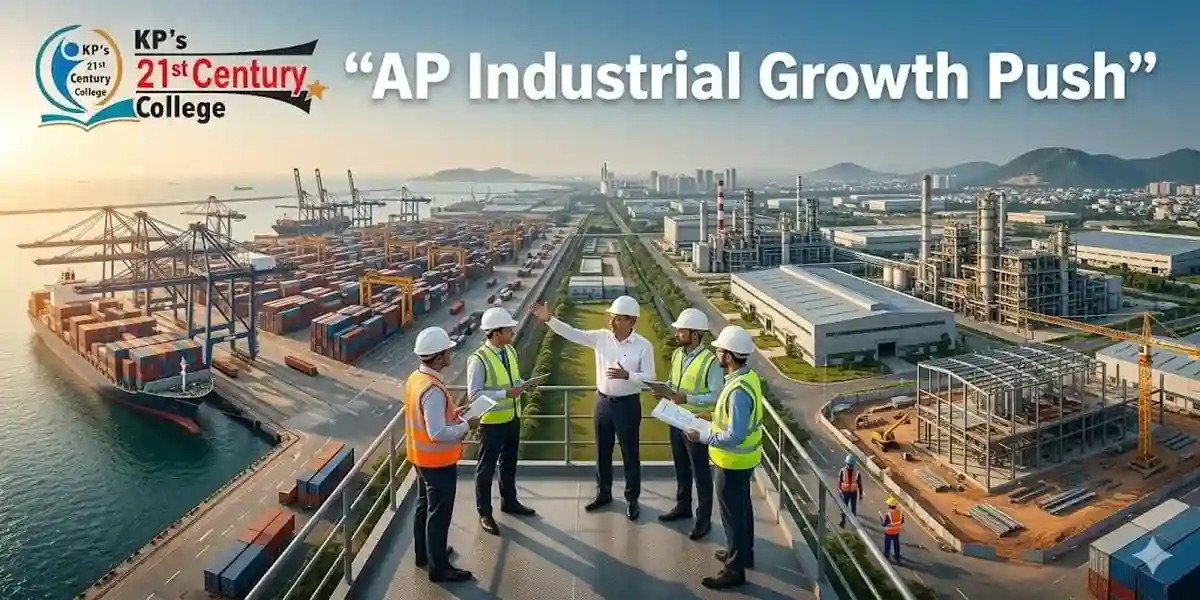
The Government of Andhra Pradesh under N. Chandrababu Naidu is undertaking a major industrial push by attracting large-scale investments in data centres, steel, renewable energy, and manufacturing sectors, aiming to transform the State into a diversified economic hub.
Evolution of Industrial Model
- The current strategy represents a transition from the earlier success of developing Hyderabad as a global IT hub to a distributed industrial model in Andhra Pradesh.
- The Hyderabad model was based on agglomeration economies, where industries concentrated in a single urban centre, benefiting from skilled labour, infrastructure, and network effects.
- After bifurcation, Andhra Pradesh lost this economic core and adopted a multi-node development strategy, where different regions such as Visakhapatnam, Tirupati, and Rayalaseema are assigned sector-specific industrial roles. This reflects the static concept of balanced regional development.
Digital Core and Infrastructure Advantage
- The central feature of the industrial push is the development of hyperscale data centres, marking a shift from IT services to digital infrastructure economy.
- Visakhapatnam’s coastal location enables the establishment of submarine cable landing stations, which carry more than 95% of global internet traffic and provide low-latency connectivity essential for AI, fintech, and cloud computing.
- The State is also adopting innovative power mechanisms such as the Deemed DISCOM model, allowing industries to procure electricity through open access and captive generation. This reflects broader power sector reforms and renewable integration.
Industrial Geography and Regional Planning
- The industrial strategy follows the principle of location-based industrialisation.
- Coastal Andhra is suited for port-based industries such as steel and data centres due to maritime connectivity.
- The Tirupati region, including Sri City, benefits from proximity to major industrial corridors, enabling manufacturing growth.
- Rayalaseema is being positioned for emerging sectors such as defence, drones, and space industries, reflecting the concept of specialised economic zones and industrial corridors.
- This spatial diversification reduces regional imbalance and aligns with the objectives of economic planning.
Investment Model and Ecosystem Building
- The State is using anchor investments to trigger industrial ecosystems. Large projects such as hyperscale data centres act as catalysts for attracting ancillary industries, generating forward and backward linkages.
- The model relies heavily on foreign direct investment (FDI) and public–private partnerships, indicating a shift from state-led industrialisation to market-driven growth supported by policy facilitation.
- Such investments contribute to capital formation, technology transfer, and integration into global value chains.
Structural Challenges
- The industrial push faces several structural constraints.
- Resource-intensive projects such as data centres require large quantities of electricity and water, raising concerns about sustainability and environmental impact.
- The capital-intensive nature of these industries may result in limited employment generation, highlighting the issue of jobless growth.
- A critical challenge is policy discontinuity, where changes in political leadership lead to reversal or delay of projects, affecting investor confidence and long-term planning.
Way Forward
- The State must ensure that industrial expansion is aligned with environmental sustainability through efficient resource management, renewable energy integration, and ecological safeguards.
- There is a need to strengthen skill development initiatives so that local populations can benefit from emerging industries.
- Institutional mechanisms should be developed to ensure policy continuity across political regimes, thereby improving investor confidence.
- Balanced regional development should be maintained by linking industrial growth with infrastructure and social development.
Conclusion
The industrial push in Andhra Pradesh reflects a strategic shift towards a diversified, infrastructure-driven growth model integrating digital and core sectors. While the approach has significant transformative potential, its success will depend on sustainable resource use, inclusive employment generation, and stability in governance and policy implementation.
CARE MCQ
Q.Consider the following statements:
- Submarine cables carry the majority of global internet traffic.
- Deemed DISCOM allows industries to procure and manage electricity independently.
- Capital-intensive industries necessarily generate high employment.
Which of the statements given above are correct?
(a) 1 and 2 only
(b) 2 and 3 only
(c) 1 and 3 only
(d) 1, 2 and 3
Ans: (a)
Explanation:
Statement 1 is correct: Submarine fibre-optic cables laid under oceans transmit more than 95% of global internet data. They provide high-speed and low-latency communication, making them the backbone of international connectivity.
Statement 2 is correct: Under the Deemed DISCOM concept, large industries (such as data centres) can independently generate or procure electricity and manage its distribution for their own use. This ensures reliable power supply and operational efficiency.
Statement 3 is incorrect: Capital-intensive industries depend more on machines and technology rather than labour. Hence, they do not necessarily generate high employment; instead, they create limited direct jobs but may generate indirect employment.
Q.Which of the following best explains the key advantage of Air-Independent Propulsion (AIP) in conventional submarines?
(a) Enables submarines to achieve supersonic speeds underwater
(b) Allows submarines to remain submerged for longer durations without surfacing
(c) Eliminates the need for any onboard fuel
(d) Makes submarines detectable by radar systems
Ans: (b)
Explanation: AIP allows non-nuclear submarines to stay underwater for extended periods (up to ~2 weeks) without surfacing, enhancing stealth and endurance.
Q . Which of the following correctly distinguishes SSBN submarines from other types?
(a) They are primarily used for coastal defence and reconnaissance
(b) They operate only on diesel-electric propulsion
(c) They are designed to carry and launch submarine-launched ballistic missiles (SLBMs)
(d) They cannot remain submerged for long durations
Ans: (c)
Explanation: SSBNs are nuclear-powered submarines equipped with ballistic missiles, forming a key component of nuclear deterrence.
Q. Which of the following Indian submarine classes is indigenously developed under Project 75?
(a) Shishumar class
(b) Sindhughosh class
(c) Kalvari class
(d) Akula class
Ans: (c)
Explanation: The Kalvari class submarines are indigenously built in India under Project 75, based on Scorpene design with technology transfer from France.
Mains Practice Question
Q. Discuss the industrialisation strategy of Andhra Pradesh under recent policy initiatives. Examine its potential for economic transformation while highlighting the structural challenges associated with sustainability, employment, and governance. [250 words]
FAQs
Q. What is the key feature of Andhra Pradesh’s industrial strategy?
Ans: It focuses on multi-sector, multi-region industrialisation supported by large anchor investments.
Q. Why are submarine cables important for data centres?
Ans: They provide high-speed, low-latency global connectivity essential for digital infrastructure.
Q. What is the Deemed DISCOM concept?
Ans: It allows large industries to independently procure and manage electricity supply.
Q. What is the biggest challenge in the industrial push?
Ans: Ensuring policy continuity and balancing growth with environmental sustainability.