Why in News?
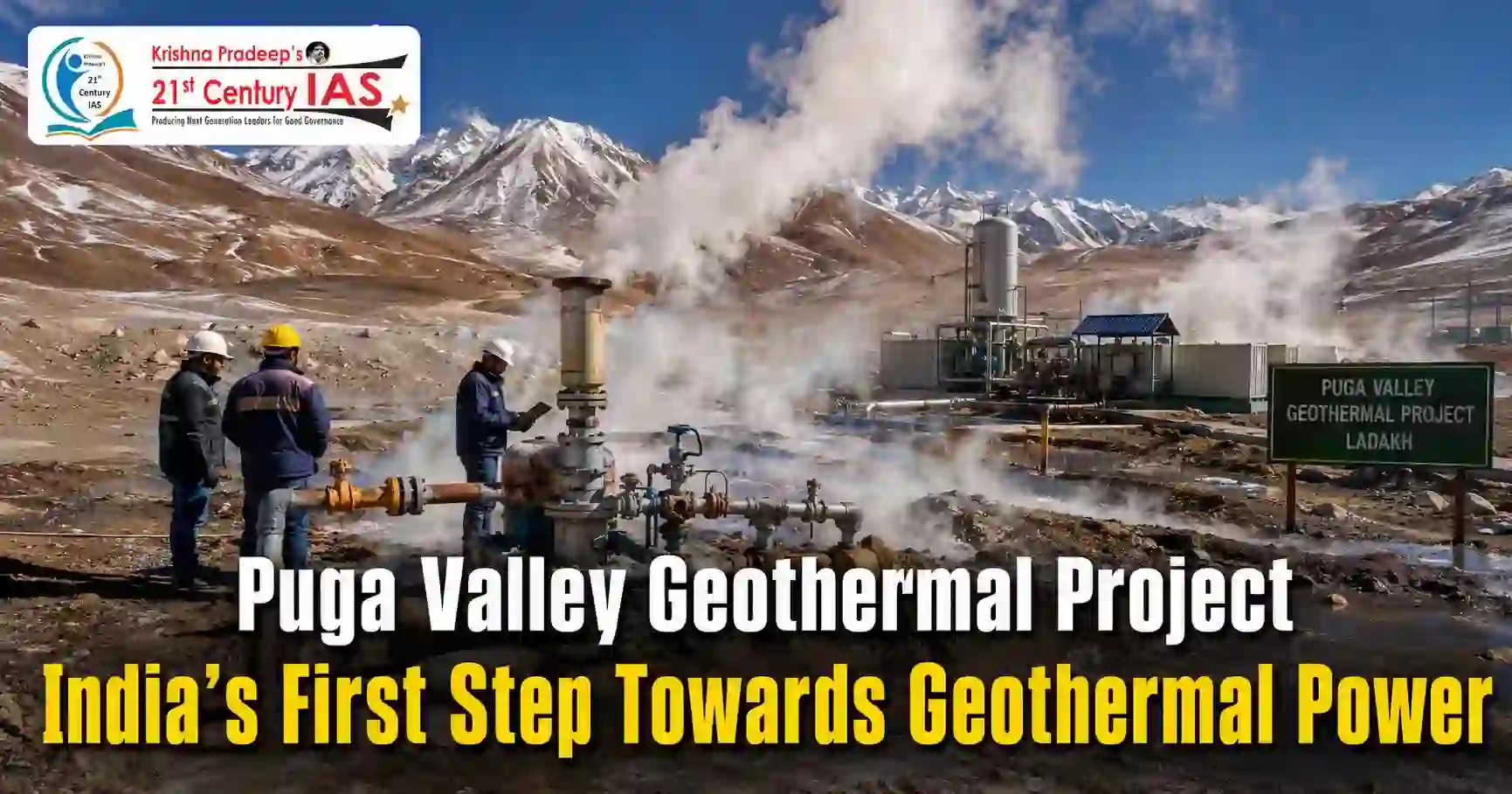
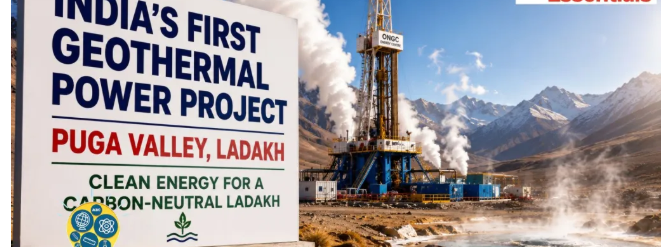
India’s first and deepest geothermal wells have become operational at Puga Valley in Ladakh. The wells are around 1,000 metres deep and are critical for the proposed 1 MW pilot geothermal power project, which is expected to become India’s first demonstration-scale geothermal power project.
The project is being executed by the ONGC Energy Centre and is linked to the broader goal of developing Carbon-Neutral Ladakh and expanding India’s clean energy basket.
What is Geothermal Energy?
- Geothermal energy is the heat energy obtained from the interior of the Earth.
- The Earth becomes progressively hotter with increasing depth. This rise in temperature with depth is called the geothermal gradient. In areas where the geothermal gradient is high, usable heat can be found at relatively shallow depths.
- When groundwater comes into contact with hot rocks underground, it absorbs heat and may turn into hot water or steam. This steam or hot fluid can be used to rotate turbines and generate electricity.
- Geothermal energy is a site-specific renewable energy source, especially useful for remote and interior areas where grid connectivity and conventional fuel supply may be difficult.
Why Puga Valley is Important
Puga Valley in Ladakh is one of India’s most important geothermal sites.
Its importance lies in four points:
1. India’s First Geothermal Wells
The operational wells at Puga mark the beginning of India’s practical geothermal power journey.
2. Demonstration-Scale Project
The wells will support a 1 MW pilot project, making it India’s first demonstration-scale geothermal power project.
3. Remote-Area Energy Access
Ladakh’s terrain and climate make decentralised renewable energy important. Geothermal energy can provide stable power in such regions.
4. Carbon-Neutral Ladakh Vision
The project supports India’s clean energy transition and the goal of reducing fossil-fuel dependence in ecologically sensitive regions.
How Geothermal Power Works
The process is simple:
- Heat from the Earth warms underground water.
- Hot water or steam is brought to the surface through wells.
- Steam or vapour drives a turbine.
- The turbine generates electricity.
- The remaining fluid may be reinjected underground in some systems.
Unlike solar and wind, geothermal energy is not dependent on sunlight or wind speed. This makes it useful for round-the-clock electricity generation.
Types of Geothermal Power Plants
1. Dry Steam Plants
- Use steam directly from underground fractures.
- The steam directly drives the turbine.
2. Flash Plants
- Bring high-pressure hot water from deep underground to lower pressure.
- The sudden pressure drop produces steam, which drives the turbine.
3. Binary Plants
- Hot geothermal water transfers heat to a secondary fluid with a lower boiling point.
- The secondary fluid vaporises and drives the turbine.
Binary plants are important because they can operate even where geothermal temperatures are moderate.
National Policy on Geothermal Energy
The Ministry of New and Renewable Energy released the National Policy on Geothermal Energy, 2025 after a task force on geothermal energy was formed in 2024.
The policy aims to:
- establish geothermal energy as a pillar of India’s renewable energy mix
- support India’s 2070 Net Zero goal
- strengthen energy security
- encourage exploration and technology development
- promote cooperation with States, research institutions and energy companies
This policy gives institutional direction to geothermal energy development in India.
India’s Geothermal Potential
- India has several geothermal sites, especially in Himalayan and tectonically active regions.
- The Geological Survey of India has mapped several hot springs across the country. India’s estimated geothermal potential is around 10.6 GW, and it may increase with further exploration.
Important Geothermal Regions in India
- Ladakh: Puga, Chumathang, Demchok, Nubra
- Himachal Pradesh: Manikaran, Kasol, Tattapani
- Uttarakhand: Tapoban, Joshimath, Yamunotri, Ganganani
- Arunachal Pradesh: Tawang region
- Sikkim: Yumesamdong
- Gujarat: Dholera, Tuwa, Tulsishyam
- Telangana: Manuguru
- Andaman and Nicobar Islands: geothermal potential zones
The Himalayan Geothermal Province, the Cambay Graben in Gujarat, and the Andaman and Nicobar Islands are important from the exploration perspective.
Advantages of Geothermal Energy
1. Round-the-Clock Renewable Power
Geothermal energy can generate power continuously, unlike solar and wind which depend on weather conditions.
2. Energy Security
It can reduce dependence on imported fossil fuels and support domestic clean energy production.
3. Suitable for Remote Areas
It is useful for remote Himalayan and interior regions where power supply is difficult.
4. Low Land Footprint
Geothermal plants usually require less surface land compared to many other renewable projects.
5. Supports Climate Goals
It can contribute to India’s clean energy targets, including non-fossil electricity capacity expansion and the Net Zero 2070 goal.
6. Employment Potential
According to the cited World Bank reference in the source, geothermal energy generates high employment per unit of installed renewable capacity.
Enhanced Geothermal Systems
Enhanced Geothermal Systems (EGS) are advanced geothermal technologies that use heat from hot dry rocks deep underground.
How EGS Differs from Conventional Geothermal Systems
Conventional Geothermal System
- Uses naturally occurring underground hot water or steam.
- Requires permeable rocks and natural hydrothermal reservoirs.
- Usually found near tectonic plate boundaries or volcanic hotspots.
Enhanced Geothermal System
- Creates artificial permeability where natural reservoirs do not exist.
- Uses advanced drilling techniques, including horizontal drilling and controlled fracturing.
- Fluid is injected underground to open fractures in hot rocks.
- The circulating fluid absorbs heat and returns to the surface for power generation.
EGS is important because it can expand geothermal energy beyond naturally occurring hydrothermal locations.
Challenges
1. Site-Specific Nature
Geothermal energy can be developed only where underground heat conditions are suitable.
2. High Exploration Risk
Drilling deep geothermal wells is expensive, and success is not guaranteed.
3. Technical Complexity
Projects need specialised knowledge of geology, drilling, reservoir behaviour and power systems.
4. Environmental Concerns
Improper handling of geothermal fluids or induced seismicity risks must be carefully managed.
5. Limited Indian Experience
India is still at the pilot stage, so commercial scaling will require data, expertise and investor confidence.
Way Forward
India should treat Puga Valley as a technology demonstration and learning platform. The project should generate reliable data on geothermal reservoirs, drilling performance, cost, environmental safety and power generation. India should also strengthen mapping of geothermal sites, encourage public-private participation, and promote collaboration among MNRE, ONGC, GSI, research institutions and State governments.
For future expansion, India should explore binary cycle plants for moderate-temperature reservoirs and carefully assess Enhanced Geothermal Systems where conventional hydrothermal resources are limited.
Conclusion
The Puga Valley project marks a major milestone in India’s renewable energy journey. It shows that geothermal energy can support clean, reliable and round-the-clock power, especially in remote regions like Ladakh. While India is still at an early stage, geothermal energy can become an important part of the country’s future energy mix if backed by scientific exploration, policy support, environmental safeguards and technology development.