Why in News?
The Telangana government has accelerated tourism development works at Bhongir Fort, including the construction of a passenger ropeway and restoration of heritage structures.Tourism Minister Jupally Krishna Rao inspected the ongoing works and directed officials to complete them by October 2, 2026.The project is being developed as the “Development of Bhongir Fort Experiential Zone” under the Union government’s Swadesh Darshan Scheme 2.0, with an approved cost of ₹56.81 crore.
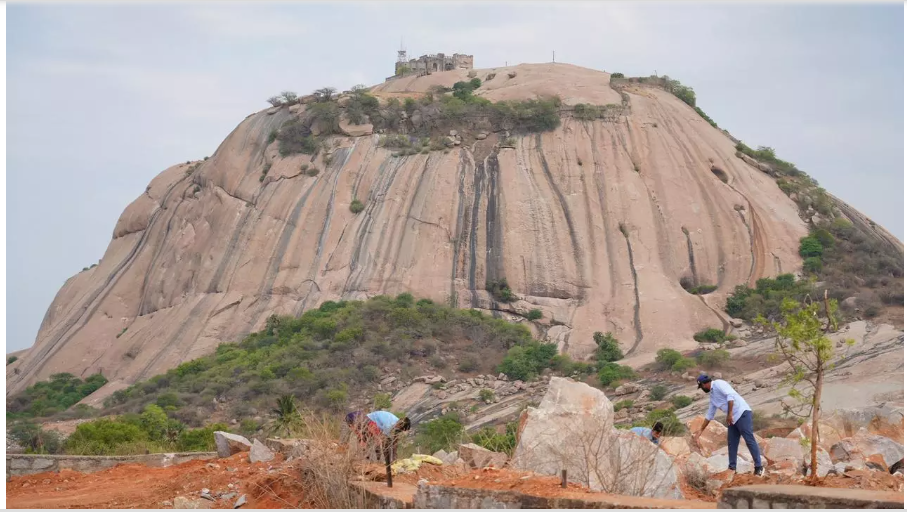
About Bhongir Fort
- Category: Historic Fort
- Location: Yadadri Bhuvanagiri district, Telangana
- Built on a huge oval-shaped monolithic rock.
- The hill is about 610 metres high.
- It appears like a tortoise from the south and a sleeping elephant from the west.
Historical Background
- The region shows evidence of Neolithic and medieval human settlements.
- Archaeological remains include:
- Stone axes, Arrows and swords, Tombs,Ancient habitational remains
- Coins of the Vishnukundin period are also said to have been found.
Dynastic Association
- The fort is associated with Vikramaditya VI of the Western Chalukya dynasty.
- It became prominent during the Kakatiya period.
- It later remained under the Qutb Shahis.
- After the Mughal conquest of Golconda in 1687, it came under Mughal control.
- Sarvai Pandu reportedly captured Orugallu in 1708 and later occupied Bhuvanagiri.
Architectural Features
- High defensive walls and spacious rooms
- Fortified gateway
- Royal palaces and courtyards
- Stables, granaries and military quarters
- Caves and secret underground tunnels
- Chalukya and Kakatiya-style sculptures
- Islamic architectural influence in gateways and walls
What is the Bhongir Fort Experiential Zone?
The project aims to transform Bhongir Fort into a modern heritage tourism destination by combining:
- Heritage conservation
- Improved visitor access
- Tourism amenities
- Digital interpretation
- Safety and surveillance systems
- Environment-friendly transport
- Improved waste and water management
The project seeks to modernise the tourism experience without affecting the fort’s historic character.
Major Components of the Project
1. Passenger Ropeway System
A passenger ropeway will be constructed to improve access to the hilltop fort.
Key Features
- Project cost: ₹17.91 crore
- Ropeway system: Monocable Jig-Back System
- Length: Approximately 1,020 metres
- Elevation difference: Around 180 metres
- Number of cabins: 6 operational cabins and 1 additional cabin
- Cabin capacity: Six persons per cabin
- Passenger capacity: 250–300 passengers per hour
- Maximum line speed: Six metres per second
The work includes design, supply, installation, testing and commissioning on a turnkey basis.
2. Restoration of Heritage Structures
Heritage structures located on the hill will be restored to preserve the fort’s historical character.
The restoration programme includes:
- Repair and conservation of old structures
- Renovation of stone pathways and steps
- Chiselling and levelling of pathways
- Stone masonry works
- Improvement of viewing areas
- Tensile roofing for the interpretation centre
3. Roads, Parking and Accessibility
The project provides for access roads and organised parking infrastructure.
Major works include:
- Access road development, Parking facilities, Stormwater drains, Box culverts, Retaining walls, Footpaths,Roads around the ropeway’s lower station, Parking infrastructure over approximately 2.9 acres
Twenty-six-seater electric vehicles will also be provided for visitor movement, supported by charging facilities.
4. Entrance Plaza and Visitor Amenities
The entrance zone will be developed as the main reception and visitor-management area.
Facilities include:
- Administrative block, Entrance gate and compound wall, Renovated and newly constructed restrooms, Children’s play area, Sculpture zone, Pergolas and seating areas, Food kiosks
These facilities are intended to increase visitor comfort and encourage longer stays.
5. Interpretation Centre
An interpretation centre will help visitors understand the fort’s history, architecture and cultural significance.
It may use:
- Displays and models, Maps and historical timelines,Audio-visual presentations, Digital storytelling, Information on local traditions and heritage
6. Utility and Environmental Infrastructure
The project includes basic utility systems required for safe and sustainable tourism.
These include:
- Internal and external electrification, Outdoor and street lighting,Water-supply network, Water-storage sump, Wastewater treatment through biodigester tanks, Solid-waste collection through designated dustbins, Sanitary facilities
Such infrastructure is essential to prevent pollution and protect the fort’s surroundings.
7. Visitor Safety and Digital Surveillance
The project includes advanced security and crowd-management systems.
Major provisions include:
- CCTV cameras, Emergency call boxes, Camera poles and supporting infrastructure, 32-channel Network Video Recorder, Video storage capacity of 45 days,Uninterrupted power supply with one-hour backup, Crowd-management and surveillance systems, X-ray baggage scanning, 100 Mbps internet leased line for video transmission
Integrated Heritage and Spiritual Tourism Circuit
The Telangana government plans to create an integrated tourism circuit connecting:
- Yadadri
- Bhongir Fort
- Kolanupaka
Importance of the Circuit
- Yadadri: Major spiritual and pilgrimage destination centred on the Sri Lakshmi Narasimha Swamy Temple.
- Bhongir Fort: Historical and adventure tourism destination.
- Kolanupaka: Important religious and heritage centre, particularly known for its ancient Jain temple.
What is Swadesh Darshan Scheme 2.0?
- The Swadesh Darshan Scheme is a Central Sector Scheme of the Ministry of Tourism.
- The original scheme focused on developing theme-based tourism circuits.
- Swadesh Darshan 2.0 adopts a destination-centred and sustainable approach. It emphasises:
- Sustainable tourism development
- Destination management
- Local community participation
- Improved tourist experience
- Heritage conservation
- Employment generation
- Public and private investment
- Responsible use of natural and cultural resources
Under the scheme, the Bhongir Fort project has received an approved cost of ₹56.81 crore.
Significance of the Project
- Improved accessibility: The ropeway will make the hilltop fort more accessible to elderly persons, children and tourists with mobility difficulties.
- Heritage conservation: Restoration works can protect the fort’s historic structures and prevent further deterioration.
- Tourism diversification: The project combines heritage, spiritual, recreational and adventure tourism.
- Regional development: Increased tourist arrivals can benefit hotels, transport services, guides, artisans and local businesses.
- Employment generation: Construction, maintenance, hospitality, security and tourism services can create direct and indirect jobs.
- Longer tourist stays: Linking Yadadri, Bhongir and Kolanupaka may encourage visitors to spend more time in the region.
- Visitor safety: Surveillance, emergency systems and regulated movement can improve safety at the hill fort.
- Sustainable mobility: Electric vehicles and organised visitor transport can reduce congestion and pollution.
Conclusion
The Bhongir Fort Experiential Zone has the potential to transform the historic fort into a major heritage tourism destination in Telangana. The ropeway, restoration works, visitor facilities and integrated Yadadri–Bhongir–Kolanupaka circuit can improve accessibility, generate employment and strengthen the regional economy. However, the project’s success will depend on maintaining a careful balance between modern tourism infrastructure and the preservation of Bhongir Fort’s historic grandeur.