Karnataka’s Lesser-Known Hoysala Monuments: A Legacy in Stone
Table of Contents
Relevance (UPSC)
(GS Paper I – Art & Culture)
For Prelims:
- Vesara Style, Soapstone (Chloritic Schist), Stellate (Star-Shaped) Jagati, Trikuta / Panchakuta Plan, Belur–Halebidu–Somanathapura, Sacred Ensembles of the Hoysalas (UNESCO 2023)
For Mains:
- Medieval Temple Architecture, Religious Pluralism (Shaiva–Vaishnava–Jain), Sculptural Narrative Friezes, Regional Architectural Identity, Hydraulic Architecture (Hulikere Kalyani), Heritage Conservation & UNESCO Recognition
Why in News?
A number of relatively lesser-known Hoysala-era temples dating from the 11th to 13th centuries in Karnataka are receiving renewed scholarly and public attention for their intricate soapstone craftsmanship and distinctive star-shaped architectural plans.
Historical Background
- The Hoysala dynasty flourished between the 11th and 14th centuries CE in present-day Karnataka.
- The early Hoysala rulers were initially feudatories of the Western Chalukyas, but gradually emerged as an independent power.
- Their political and cultural centres included Belur (Velapuri) and later Halebidu (Dwarasamudra).
- The dynasty reached its zenith under rulers such as Vishnuvardhana, Veera Ballala II, and Vira Someshwara, who expanded territorial control and patronised large-scale temple construction.
- The period witnessed remarkable growth in temple architecture, sculpture, trade networks, and urban centres across regions such as Hassan, Mandya, Mysuru and surrounding areas.
- The Hoysalas promoted religious pluralism, supporting Shaivism, Vaishnavism, and Jainism, reflected in the construction of both temples and basadis.
- Their architectural style evolved into a distinctive Vesara tradition, blending northern (Nagara) and southern (Dravida) elements.
- By the early 14th century, the Hoysala kingdom gradually declined following invasions and political shifts, eventually giving way to the rise of the Vijayanagara Empire.
Defining Features of Hoysala Architecture
Hoysala builders preferred chloritic schist (soapstone), a material soft enough to allow intricate carving when freshly quarried and capable of hardening over time. This enabled artisans to sculpt extremely fine details such as ornaments, curls of hair, and even fingernails with remarkable precision.
Innovative Ground Plans
Temple layouts evolved into multiple structural types:
- Ekakuta – Single sanctum
- Dvikuta – Two shrines
- Trikuta – Three shrines
- Chatushkuta / Panchakuta – Four or five shrines
Many of these were constructed on elevated stellate (star-shaped) platforms, known as jagati. This geometry created multiple projections and recesses, greatly increasing surface area for decorative sculptural work.
Narrative Sculpture
The outer walls serve as continuous narrative panels, depicting:
- Rows of elephants, cavalry, and mythical creatures
- Celestial dancers (madanikas)
- Scenes of divine combat and mythological symbolism
The overall emphasis lies in layered ornamentation, both externally and within pillared halls.
Shikhara Form
The superstructures above sanctums are articulated through horizontal mouldings and rhythmic tiers, creating a structured yet ornate vertical composition.
Important Yet Under-Recognised Monuments
Koravangala Temple Cluster
Koravangala, once a flourishing Hoysala centre, contains three temples attributed to three brothers:- Nageshwara and Govindeshwara Temples (c. 1160 CE) – Represent an earlier stage of stylistic development, showing relative restraint in ornamentation.
- Bucheshwara Temple (1173 CE) – Built in honour of King Veera Ballala II, this shrine demonstrates mature craftsmanship, dense sculptural detailing, and a refined star-shaped base.
Hoysala Dynasty
- Period: Flourished between the 11th and 14th centuries CE.
- Initial Status: Began as feudatories of the Western Chalukyas of Kalyana before emerging as an independent power.
- Founder: Established by Nripa Kama II, who initially served as a vassal under the Western Chalukyas.
- Capital:
- Initially at Belur (11th century).
- Later shifted to Dwarasamudra (modern Halebidu).
- Territorial Extent: Controlled large parts of present-day Karnataka and parts of Tamil Nadu for over three centuries.
- Important Rulers:
- Vishnuvardhana (Bittideva)
- Veera Ballala II
- Veera Ballala III
- Vishnuvardhana:
- Considered one of the greatest Hoysala rulers.
- Expanded the kingdom significantly.
- Patronised large-scale temple construction.
- Initially a Jain, later converted to Vaishnavism under the influence of Ramanuja.
- Architectural Style: Developed the distinct Hoysala (Vesara) style, blending Nagara and Dravida elements.
- UNESCO Tag (2023): Chennakeshava (Belur), Hoysaleswara (Halebidu) and Keshava (Somanathapura) inscribed as “Sacred Ensembles of the Hoysalas.”
Lakshminarasimha Temple (c. 1250 CE), Javagal
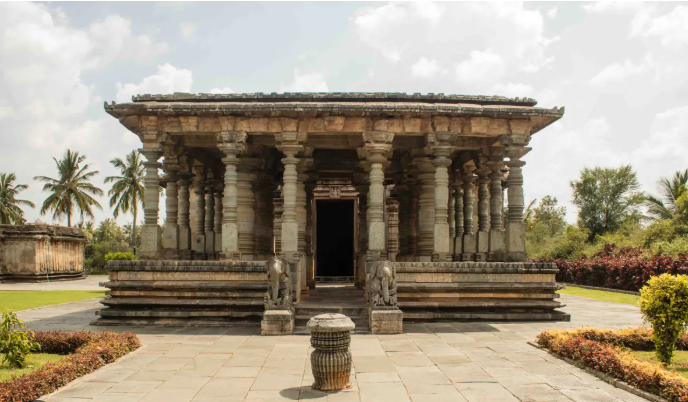
Constructed during the reign of Vira Someshwara, this trikuta temple is known for its polished pillars and graceful elephant friezes. Javagal itself was an important commercial hub during the medieval period.
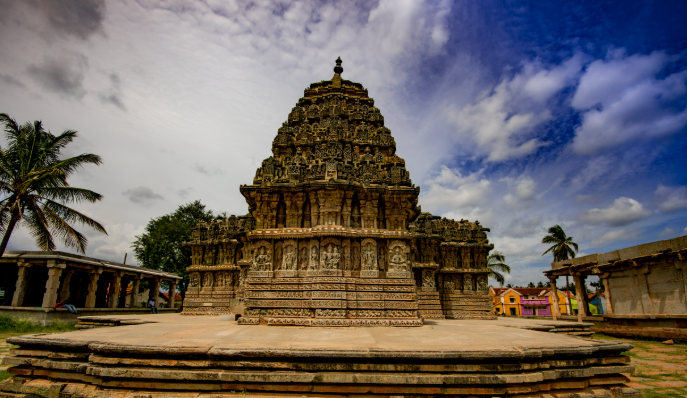
Lakshmidevi Temple (1114 CE), Doddagaddavalli
Among the earliest surviving Hoysala temples, this structure was commissioned by the merchant Sahaja Devi.
Notable features include:
- A rare four-shrine configuration dedicated to Lakshmi, Shiva, Vishnu and Kali
- A distinctive Mahakali sanctum guarded by skeletal betalas
- Architectural simplicity compared to later Hoysala exuberance, indicating an experimental phase
Panchalingeshwara Temple, Mandya
This 13th-century shrine presents a rare Panchakuta plan, consisting of five east-facing Shiva sanctums aligned in a row and connected by a shared pillared hall.
Jain Basadi Complex, Halebidu
Located near the ornate Hoysaleswara Temple, the Jain shrines of Parshvanatha (1133 CE), Shantinatha (1192 CE) and Adinatha exhibit architectural restraint. Their cleaner lines and uncluttered interiors contrast sharply with the decorative richness of Hoysala Hindu temples, reflecting Jain spiritual ideals of simplicity and contemplation.
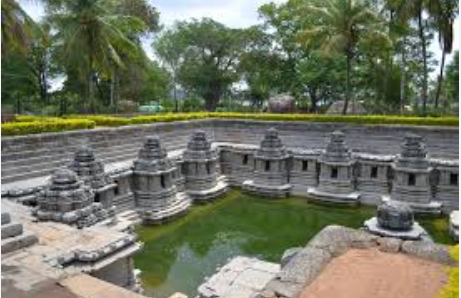
Hulikere Kalyani (12th Century)
The Hulikere stepwell stands as a fine example of Hoysala hydraulic architecture. Built below ground level with symmetrical stairways on all four sides, it integrates shrines symbolically associated with zodiac signs and nakshatras. This structure demonstrates the dynasty’s ability to blend cosmological symbolism with functional water management.
Celebrated Monuments of the Hoysala Period
- Hoysaleswara Temple, Halebidu – A monumental Shaiva temple renowned for narrative friezes and layered sculptural panels.
- Chennakeshava Temple, Belur – Dedicated to Vishnu and commissioned by King Vishnuvardhana.
- Keshava Temple, Somanathapura – A 13th-century trikuta Vaishnava temple known for elaborate carvings.
- Veera Narayana Temple – Distinguished by its expansive mandapa and rows of intricately carved elephants.
UNESCO Recognition
In 2023, the Chennakeshava Temple (Belur), Hoysaleswara Temple (Halebidu) and Keshava Temple (Somanathapura) were collectively inscribed as a UNESCO World Heritage Site under the title “Sacred Ensembles of the Hoysalas.”
Conclusion
The lesser-known Hoysala temples scattered across Karnataka reveal a broader architectural narrative beyond the well-known monuments of Belur and Halebidu. From star-shaped platforms and narrative friezes to Jain austerity and stepwell design, these monuments demonstrate the technical sophistication and artistic ambition of the Hoysala period.
Together, they offer a vivid glimpse into a medieval kingdom where architecture, devotion and sculpture were intricately intertwined — leaving behind a legacy that continues to shape India’s cultural heritage.
UPSC PYQ
Q. The Nagara, the Dravida and the Vesara are the: (IAS 2012)
- three main racial groups of the Indian subcontinent
- three main linguistic divisions into which the languages of India can be classified
- three main styles of Indian temple architecture
- three main musical Gharanas prevalent in India
- Northern Indian temple architecture
- Region: Between Himalayas and Vindhyas
- Features:
- Curvilinear Shikhara
- Square sanctum
- No elaborate boundary walls
- Absence of large gopurams
- Southern Indian temple architecture
- Features:
- Pyramid-shaped Vimana
- Large gateway towers (Gopurams)
- Enclosed temple complex
- Water tanks within premises
- Hybrid style
- Developed mainly in Deccan region
- Fusion of:
- Nagara elements
- Dravida elements
- Example: Hoysala Architecture
CARE MCQ
- With reference to the Hoysala Dynasty, consider the following statements:
- Belur served as the initial capital of the Hoysalas before the capital was shifted to Dwarasamudra.
- The Hoysala kingdom was confined only to present-day Karnataka and did not extend into Tamil Nadu.
- Veera Ballala II was one of the prominent rulers under whom the Hoysala kingdom expanded significantly.
Answer: A
Explanation:
Statement 1 – Correct
Belur (also known as Velapuri) was the early capital of the Hoysalas in the 11th century.
Later, the capital was shifted to Dwarasamudra (modern Halebidu), which became the political and cultural centre of the empire.
Dwarasamudra developed into a major temple-building centre and is home to the famous Hoysaleswara Temple.
Statement 2 – Incorrect
The Hoysala kingdom was not confined to Karnataka.
Additional Fact:
- Their territory extended into parts of Tamil Nadu.
- The dynasty ruled for over three centuries (11th–14th century CE).
- They emerged from being feudatories of the Western Chalukyas of Kalyana to independent rulers.
Statement 3 – Correct
Veera Ballala II was a powerful and expansionist ruler.
- Under him, the Hoysala kingdom reached its political peak.
- He strengthened administrative control and patronised temple architecture.
- His reign saw consolidation of power in southern India.