India Releases First Anti-Terror Policy – PRAHAAR
Table of Contents
Relevance (UPSC)
Terrorism, Cyber Security, Organised Crime–Terror Nexus, Emerging Technologies & Security.
For Prelims:
- PRAHAAR, Zero Tolerance Policy, CBRNED, Sleeper Cells, Whole-of-Society Approach, Counter-Radicalisation.
For Mains:
- Sponsored Terrorism, Intelligence-Led Prevention, Cyber Warfare, Drone-Based Terrorism, Standardised Anti-Terror Structure, Transnational Terrorism.
Why in News?
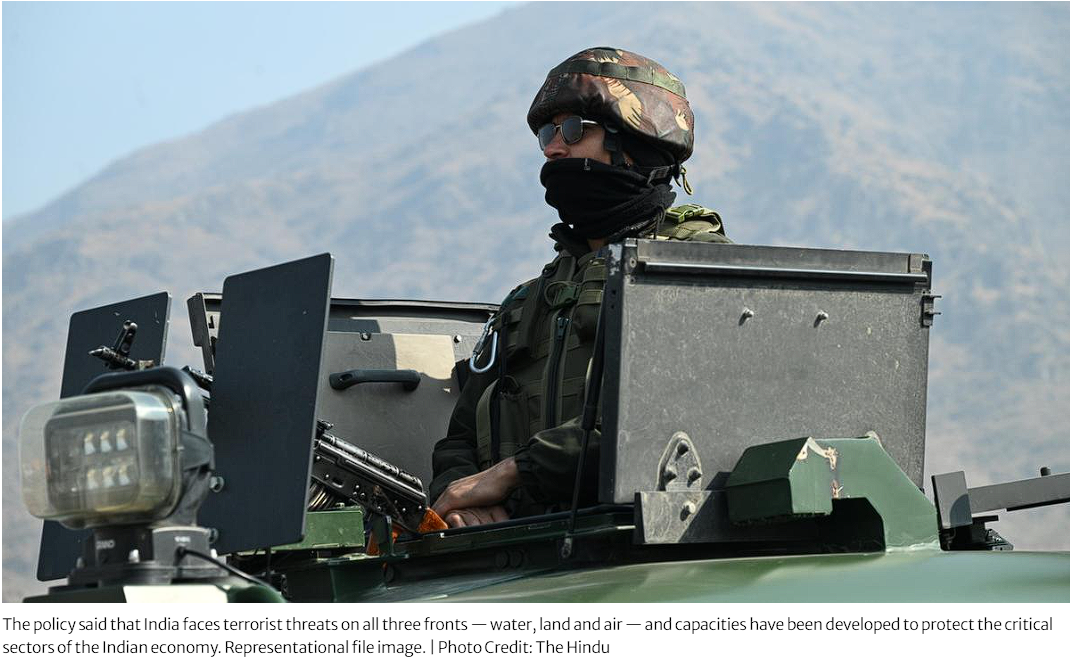
The Ministry of Home Affairs (MHA) released India’s first-ever national counter-terrorism policy titled “PRAHAAR” on February 23, 2026. The policy provides a comprehensive framework to combat terrorism, including cyber-attacks by criminal hackers and nation-states, and cross-border sponsored terror activities.
Background
- Announcement for drafting a National Counter Terrorism Policy was made in November 2024.
- A National Policy and Action Plan for Left Wing Extremism (LWE) had been introduced in 2015.
- The April 22, 2025 Pahalgam terror incident accelerated coordination between the National Investigation Agency (NIA) and State anti-terror units.
- Growing misuse of encryption, social media, dark web, and crypto wallets by terror groups necessitated a modernised approach.
Key Provisions of PRAHAAR
1. Seven-Pillar Framework
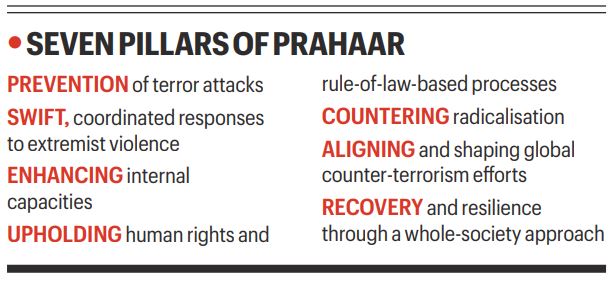
The policy is structured around:
- Prevention
- Response
- Aggregating internal capacities
- Human rights and rule-of-law-based processes
- Countering radicalisation
- Alignment with global efforts
- Recovery and resilience through a whole-of-society approach
2. Zero Tolerance Doctrine
- Criminalisation of all terrorist acts.
- Denial of funds, weapons, safe havens to terrorists and supporters.
- No justification for violence under any pretext.
3. Multi-Domain Threat Recognition
India faces threats across:
- Land – infiltration, sleeper cells
- Air – drone-assisted smuggling/attacks
- Water – maritime infiltration
Critical sectors protected:
- Power, Railways, Aviation, Ports
- Defence, Space, Atomic Energy
4. Technology and Cyber Dimension
The policy recognises:
- Cyber-attacks by criminal hackers and hostile nation-states
- Use of social media and instant messaging apps for recruitment and propaganda
- Anonymous funding through crypto wallets
- Encryption and dark web usage
- Misuse of drones and robotics
- Risks involving CBRNED (Chemical, Biological, Radiological, Nuclear, Explosive, Digital) materials
5. Counter-Radicalisation Strategy
- Graded police response depending on radicalisation level.
- Engagement of NGOs, moderate religious leaders, psychologists.
- Prison de-radicalisation programmes.
- Multi-stakeholder rehabilitation approach.
6. Legal and Institutional Strengthening
- Inclusion of legal experts from FIR stage to prosecution.
- Standardisation of anti-terror structures across States.
- Enhanced coordination between intelligence agencies and State units.
7. International Cooperation
- Recognises transnational nature of terrorism.
- Calls for regional and global coordination.
- Subtle reference to state-sponsored terrorism without naming specific countries.
Emerging Threat Landscape Highlighted
- Sponsored terrorism from across the border.
- Global terror outfits such as Al-Qaeda and ISIS targeting India.
- Organised crime–terror nexus.
- Drone-based attacks in Punjab and Jammu & Kashmir.
- Digital anonymity shielding extremist networks.
Significance
- First Unified National Counter-Terror Doctrine
- Integration of Cyber & Physical Security Frameworks
- Protection of Critical Infrastructure
- Community-Centric Prevention Model
- Standardised Federal Response
Challenges
- Encryption limiting surveillance capability.
- Balancing human rights with enhanced security measures.
- Rapid evolution of terror technologies.
- Interstate coordination complexity.
- Cross-border safe havens beyond domestic jurisdiction.
Way Forward
- Strengthen AI-based intelligence analytics.
- Upgrade cyber forensics and counter-UAV capabilities.
- Regular review and updating of the policy.
- Enhance international intelligence-sharing.
- Capacity building of State police forces.
Conclusion
PRAHAAR marks a comprehensive shift towards intelligence-led, technology-integrated counter-terrorism. By combining prevention, legal reform, cyber preparedness, and community engagement, it aims to build a resilient national security architecture capable of responding to evolving hybrid threats.
CARE MCQ
Q. With reference to PRAHAAR, consider the following statements:
- It recognises cyber-attacks by nation-states as part of the terrorism spectrum.
- It associates terrorism with specific religions for identification purposes.
- It emphasises denial of funds, weapons and safe havens to terrorists.
- It includes measures to counter misuse of CBRNED materials.
Which of the statements given above is/are correct?
A. 1, 3 and 4 only
B. 1 and 2 only
C. 2 and 3 only
D. 1, 2, 3 and 4
Answer: A
Explanation
Statement 1 is Correct. The policy explicitly includes cyber-attacks by nation-states as a threat.
Statement 2 is Incorrect. It clearly states that India does not link terrorism to any religion, ethnicity, or civilisation.
Statement 3 is Correct. A core aim is to deny terrorists access to funds, weapons and safe havens.
Statement 4 is Correct. The policy flags challenges in preventing access to CBRNED materials.