Why in News?
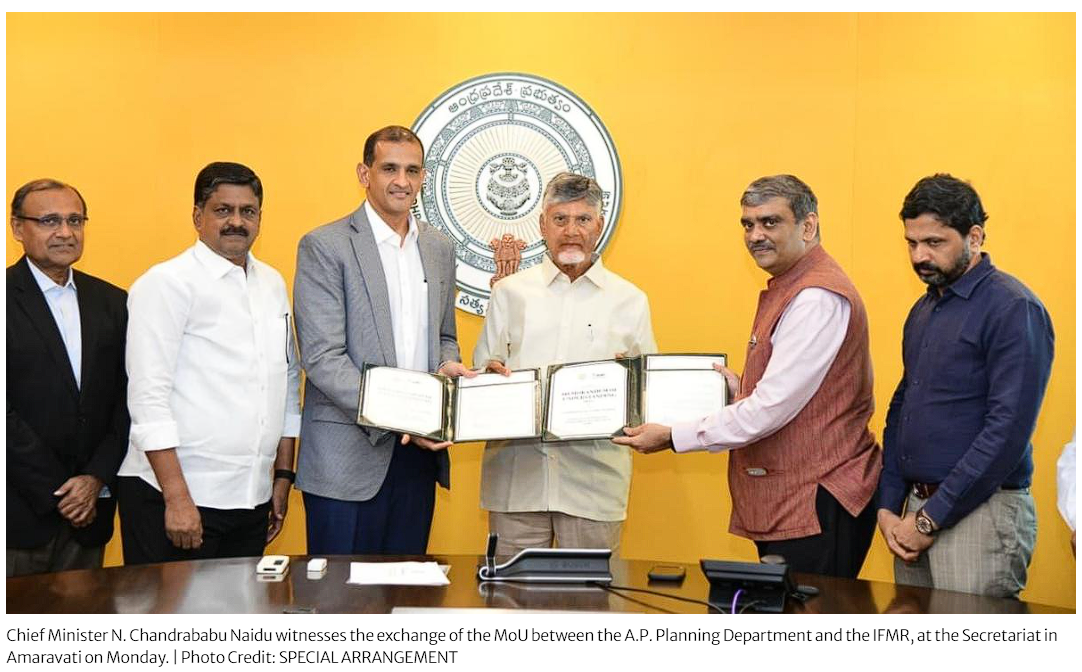
The Andhra Pradesh government signed a Memorandum of Understanding with the Institute for Financial Management and Research, a constituent institution of Krea University, to support the implementation of the Swarna Andhra 2047 Vision.
The partnership seeks to provide research, policy and institutional support for transforming Andhra Pradesh into a high-growth and inclusive economy over the next two decades.
The MoU was exchanged in the presence of Chief Minister N. Chandrababu Naidu at the State Secretariat in Amaravati.
What is the AP–IFMR Partnership?
The partnership brings together the Andhra Pradesh Planning Department and IFMR to strengthen long-term development planning.
IFMR will provide:
- Policy support
- Research inputs
- Institutional expertise
- Field-level evidence
- Programme evaluation
- Innovative governance recommendations
The collaboration is intended to help translate the broad goals of Swarna Andhra 2047 into implementable programmes and measurable outcomes.
What Growth Target Has Andhra Pradesh Set?
- Andhra Pradesh has set a target of achieving an annual economic growth rate of 15% under the Swarna Andhra 2047 Vision.
- The Chief Minister noted that the State recorded a compound annual growth rate of 13.5% between 2014 and 2019.
- The government believes that focused planning and effective implementation can help the State exceed its previous growth performance.
What Role Will IFMR Play?
Establishing Mission Cells
- IFMR will assist the State Planning Department in creating specialised mission cells for accelerating GSDP growth.
- These cells are expected to provide dedicated institutional attention to priority development objectives.
Monitoring Strategic Principles
- The institution will help monitor programmes linked to the government’s 10 strategic principles.
Conducting Field Studies
- IFMR will undertake field-level studies to understand implementation conditions and development outcomes.
Providing Policy Recommendations
- Evidence generated through research and field studies will be used to suggest suitable policy interventions.
Evaluating Programme Outcomes
- IFMR will work with government departments to assess whether programmes are achieving their intended objectives.
Supporting Governance Innovation
- The partnership will identify innovative governance practices that may improve implementation efficiency and development outcomes.
Which Missions Will Receive Initial Focus?
The collaboration will initially concentrate on three priority missions.
Zero Poverty Mission
- The mission seeks to support the State’s broader objective of inclusive growth by focusing on the elimination of poverty.
Water Security Mission
- It will focus on strategies and programmes connected with ensuring water security.
Deep Tech Mission
- The mission will promote the use and development of advanced and emerging technologies.
- IFMR will work with the concerned government departments to formulate strategies, evaluate programme performance and provide evidence-based recommendations for these missions.
How Does Technology Fit into the Vision?
Andhra Pradesh aims to position itself as a hub for emerging technologies and advanced manufacturing.
The priority areas identified include:
- Artificial intelligence
- Quantum technologies
- Drone mapping
- Semiconductors
- Defence manufacturing
- Automobiles
- Metals and steel
- Rare-earth minerals
The Chief Minister particularly highlighted the role of artificial intelligence and quantum technologies in shaping the State’s future economy.
The approach seeks to connect economic growth with technology, industrial development and improved governance.
What is the Significance of the Partnership?
Evidence-Based Planning
- Research and field studies can help ensure that policy decisions reflect actual development conditions rather than relying only on administrative assumptions.
Mission-Mode Implementation
- Dedicated mission cells can improve focus, coordination and monitoring of priority programmes.
Higher Economic Growth
- The partnership is expected to support policies aimed at accelerating GSDP growth and achieving the State’s 15% target.
Inclusive Development
- The focus on the Zero Poverty and Water Security Missions indicates that economic growth is intended to be accompanied by social and developmental outcomes.
Technology-Led Economy
- The Deep Tech Mission and investments in emerging sectors can support innovation, industrial growth and future employment opportunities.
Institutional Capacity
- Collaboration with IFMR can strengthen the Planning Department’s capacity in research, programme evaluation and policy formulation.
What Will Effective Implementation Require?
The objectives outlined under the partnership will require:
- Close coordination between IFMR and government departments
- Clear responsibilities for mission cells
- Reliable field-level data
- Regular evaluation of programme outcomes
- Timely translation of research into policy action
- Effective monitoring of the 10 strategic principles
- Alignment between technology investments and inclusive development
- Focused planning to achieve the targeted growth rate
Conclusion
The Andhra Pradesh–IFMR partnership seeks to provide an institutional and evidence-based foundation for implementing the Swarna Andhra 2047 Vision. Mission cells, field research, programme evaluation and policy recommendations can help the State pursue its ambitious 15% growth target.
Its success will depend on converting research and technological ambition into coordinated government action that produces measurable, inclusive and sustainable development outcomes.