Why in News?
The Great Nicobar Project has again come into focus after a debate on how India should balance national security, maritime development and ecological responsibility.
The issue became important because Great Nicobar is located close to some of the world’s most important sea routes in the Indo-Pacific region. The project is being projected as a major step to strengthen India’s presence in the Andaman Sea, Malacca Strait region and wider Indian Ocean Region.
At the same time, concerns have been raised regarding deforestation, tribal rights, biodiversity loss, environmental clearance and disaster vulnerability.
Background: Why Great Nicobar Matters
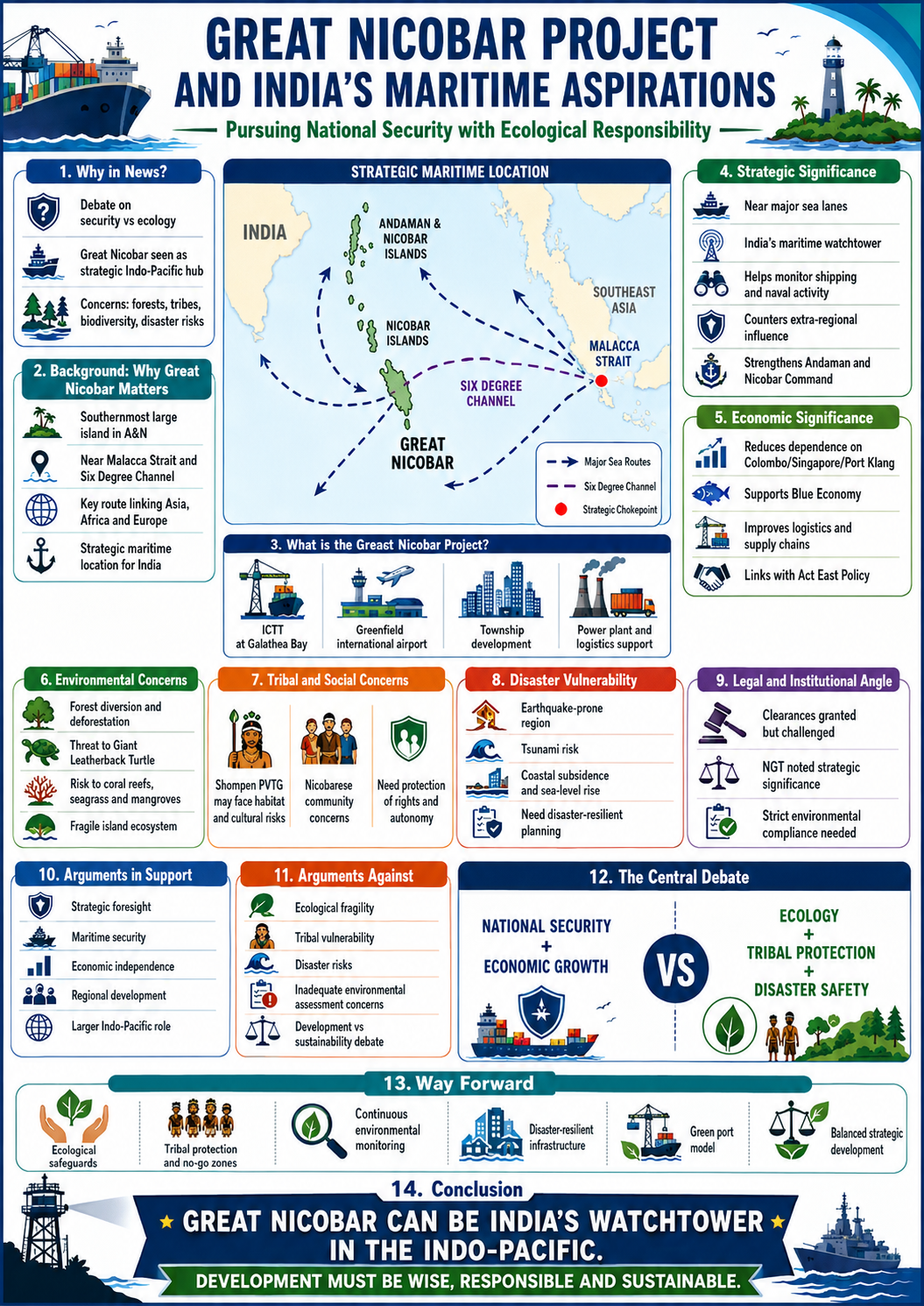
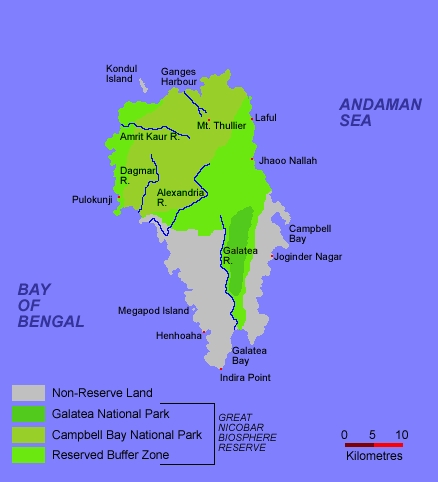 Great Nicobar is the southernmost and one of the largest islands in the Andaman and Nicobar archipelago. It is located close to the Malacca Strait, one of the busiest maritime chokepoints in the world.
The island lies near important shipping routes connecting:
- West Asia
- Africa
- South Asia
- Southeast Asia
- East Asia
- Europe
This means ships carrying oil, gas, containers and other goods pass close to this region.
In simple words, Great Nicobar is not just a remote island. It is a strategic maritime location that can help India monitor and influence important sea routes.
What is the Great Nicobar Project?
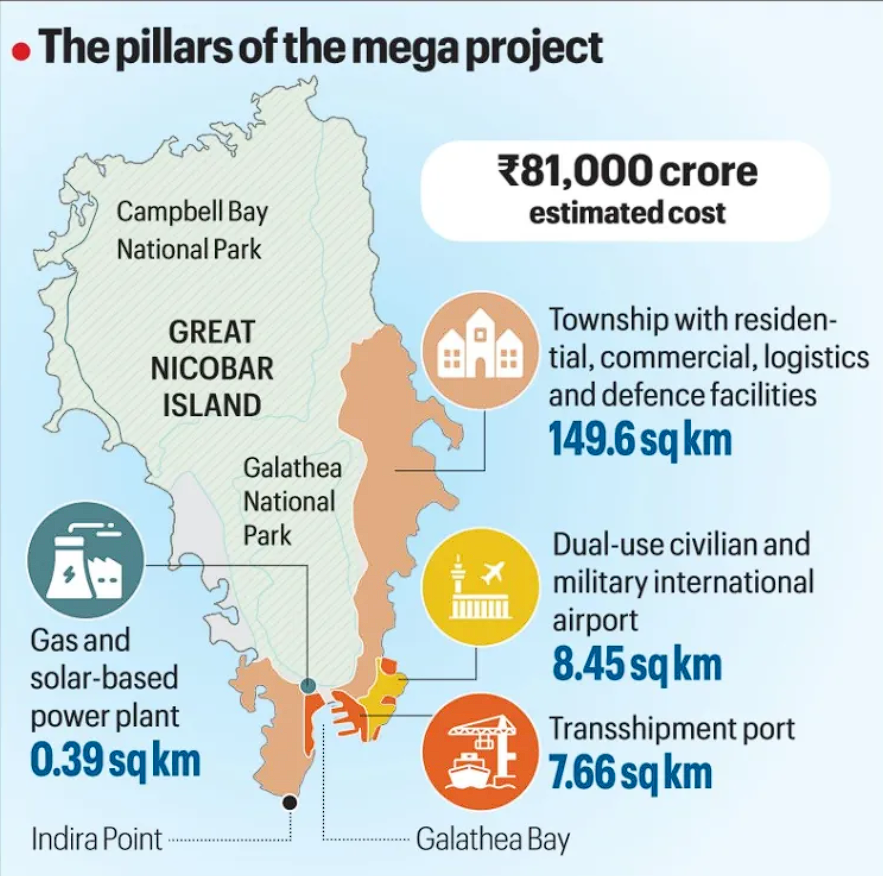
The Great Nicobar Project is a proposed mega infrastructure and strategic development project.
It includes:
- International Container Transshipment Terminal at Galathea Bay
- Greenfield international airport
- Township development
- Power plant
- Supporting logistics and infrastructure facilities
The aim is to develop Great Nicobar as a major maritime, economic and strategic hub.
The project is often described as a combination of economic development, maritime security and strategic infrastructure.
Strategic Significance of the Project
1. Location Near Malacca Strait
The Malacca Strait is one of the world’s most important maritime chokepoints. It connects the Indian Ocean with the Pacific Ocean.
A large volume of global trade and energy movement passes through this route.
Great Nicobar’s Galathea Bay is located close to the Six Degree Channel, which is linked with the Malacca route. This gives India a strong geographical advantage.
2. India’s Maritime Watchtower
Great Nicobar can act as India’s maritime watchtower in the Indo-Pacific.
It can help India monitor:
- Commercial shipping
- Naval movements
- Submarine activity
- Strategic sea lanes
- Energy routes
- Maritime security threats
In the Indo-Pacific century, control and monitoring of sea routes are extremely important for national security.
3. Countering China’s Growing Presence
The Indian Ocean Region is witnessing increasing activity by major powers, especially China.
China has expanded its maritime presence through ports, logistics facilities, naval visits and strategic partnerships. This is often discussed in the context of the String of Pearls strategy.
Developing Great Nicobar can help India strengthen its presence near critical sea lanes and counterbalance extra-regional influence.
4. Strengthening Andaman and Nicobar Command
The Andaman and Nicobar Command is India’s only tri-service command, involving the Army, Navy and Air Force.
Better infrastructure in Great Nicobar can improve India’s ability to conduct:
- Surveillance
- Maritime patrol
- Naval logistics
- Air operations
- Disaster response
- Strategic monitoring
This will improve India’s defence preparedness in the eastern Indian Ocean.
Economic Significance
1. Reducing Dependence on Foreign Transshipment Hubs
At present, much of India’s container cargo is transhipped through foreign ports such as:
- Colombo
- Singapore
- Port Klang
This increases logistics cost and creates dependence on external hubs.
The proposed International Container Transshipment Terminal at Galathea Bay can help India reduce dependence on foreign ports.
It can support Indian exporters, reduce cargo movement costs and improve supply-chain resilience.
2. Boost to Blue Economy
The project can support India’s Blue Economy, which means sustainable economic use of ocean resources.
It may promote:
- Port-led development
- Logistics services
- Maritime trade
- Shipping services
- Tourism
- Marine-based industries
- Employment generation
3. Link with Act East Policy
India’s Act East Policy aims to strengthen relations with Southeast Asia and East Asia.
Great Nicobar is geographically close to Southeast Asia. Developing it can help India strengthen trade, logistics and strategic cooperation with countries such as Indonesia, Thailand, Singapore and other ASEAN members.
Thus, the project gives physical meaning to India’s Act East vision.
Environmental Concerns
Great Nicobar is an ecologically sensitive island. Any large project here must be handled carefully.
1. Deforestation
- A major concern is the diversion of forest land.
- The project involves clearing a significant area of tropical rainforest. Critics argue that this may affect local biodiversity, endemic species and ecological balance.
- Reports have raised concerns over the possible felling of several lakh trees and the difficulty of replacing island biodiversity through compensatory afforestation elsewhere.
2. Threat to Giant Leatherback Turtle
- Galathea Bay is known as an important nesting ground for the Giant Leatherback Sea Turtle, an endangered species.
- Construction of a port, dredging and increased ship movement may affect its nesting habitat.
- This is one of the most serious environmental concerns related to the project.
3. Impact on Coral Reefs and Marine Ecosystems
The island has fragile marine ecosystems, including coral reefs and coastal habitats.
Port construction, sedimentation, dredging and pollution may damage:
- Coral reefs
- Seagrass beds
- Turtle nesting areas
- Mangroves
- Coastal biodiversity
Such ecosystems are difficult to restore once damaged.
Tribal and Social Concerns
1. Impact on Shompen Tribe
The Shompen are a Particularly Vulnerable Tribal Group living in Great Nicobar. They are largely forest-dependent and live in relative isolation.
A large external population, construction activity and forest diversion may affect their:
- Habitat
- Health
- Culture
- Traditional livelihood
- Autonomy
Critics argue that their protection must be central to any development plan.
2. Impact on Nicobarese Community
The Nicobarese community also has deep cultural and historical links with the island.
Any project must ensure that development does not lead to displacement, cultural erosion or loss of community rights.
Disaster Vulnerability
Great Nicobar lies in a highly seismic zone.
It is vulnerable to:
- Earthquakes
- Tsunami
- Coastal subsidence
- Sea-level rise
- Cyclonic events
The 2004 Indian Ocean tsunami severely affected the Andaman and Nicobar region.
Therefore, infrastructure in Great Nicobar must be designed with strong disaster-resilient planning.
This includes elevated construction, natural buffers, tsunami warning systems and strict disaster risk assessment.
Legal and Institutional Angle
The Great Nicobar Project has received environmental and coastal regulation approvals, but these clearances have been challenged by environmental groups and activists.
The National Green Tribunal considered challenges to the project. Reports state that the NGT refused to interfere with the environmental clearance after noting safeguards and strategic importance, while also requiring strict compliance with environmental conditions.
This shows that the project lies at the intersection of:
- Development
- Environment
- National security
- Tribal rights
- Judicial scrutiny
Arguments in Support of the Project
Supporters argue that the project is necessary for India’s long-term national interest.
1. Strategic Foresight
- India cannot ignore its maritime geography when the Indo-Pacific is becoming the centre of global politics and trade.
- Great Nicobar gives India a rare strategic advantage near critical sea lanes.
2. Maritime Security
- The project can strengthen India’s ability to monitor the Malacca route and nearby chokepoints.
3. Economic Independence
- A transshipment terminal can reduce India’s dependence on foreign ports and improve logistics efficiency.
4. Regional Development
- Infrastructure can generate jobs, attract investment and improve connectivity.
5. Global Maritime Role
- The project can help India become a major maritime power in the Indo-Pacific.
Arguments Against the Project
Critics argue that the project may cause irreversible ecological and social damage.
1. Ecological Fragility
- Great Nicobar has unique biodiversity that cannot be easily replaced.
2. Tribal Vulnerability
- The Shompen and Nicobarese communities may face cultural and health risks due to external population inflow.
3. Disaster Risk
- The island is located in a high seismic and tsunami-prone region.
4. Questionable Environmental Assessment
- Some experts have criticised the Environmental Impact Assessment process as inadequate for a project of this scale.
5. Development vs Sustainability
- There is concern that economic and strategic benefits may come at a high ecological cost.
The Central Debate
The debate is not simply “development vs environment”.
The real question is:
Can India develop Great Nicobar for national security and economic growth while protecting ecology, tribal communities and disaster safety?
Way Forward
1. Ecological Responsibility
The project must be implemented with strict ecological safeguards.
This includes:
- Minimum forest diversion
- Protection of turtle nesting sites
- Coral reef conservation
- Mangrove restoration
- Scientific biodiversity monitoring
2. Protection of Tribal Communities
The Shompen and Nicobarese communities must be protected through:
- No-go zones
- Health safeguards
- Cultural protection
- Legal protection of tribal reserves
- Prior consultation and transparency
3. Strong Environmental Monitoring
There should be continuous and independent monitoring of:
- Forest loss
- Marine pollution
- Turtle nesting
- Coral health
- Water quality
- Noise pollution
The data should be made publicly available.
4. Disaster-Resilient Infrastructure
All infrastructure must be designed for earthquakes and tsunamis.
Natural buffers such as mangroves should be protected and restored.
5. Green Port Model
The port should follow green port standards.
This may include:
- Shore-side electricity for ships
- Renewable energy use
- Waste recycling
- Low-emission logistics
- Strict pollution control
6. Balanced Strategic Development
India must pursue national security, but not through uncontrolled construction.
The right approach is strategic development with ecological responsibility.
Conclusion
The Great Nicobar Project is one of India’s most important maritime development proposals.
It can help India strengthen its position in the Indo-Pacific, reduce dependence on foreign transshipment hubs and improve maritime security.
However, Great Nicobar is also ecologically fragile and socially sensitive. The presence of tribal communities, rare biodiversity, turtle nesting sites and seismic risks makes the project highly challenging.
India’s task is not to choose blindly between development and environment. The real task is to pursue national security with ecological responsibility.
In the Indo-Pacific century, Great Nicobar is not merely the edge of India. It can become India’s watchtower at the gateway of the future — but only if it is developed wisely, responsibly and sustainably.