
Why in News?
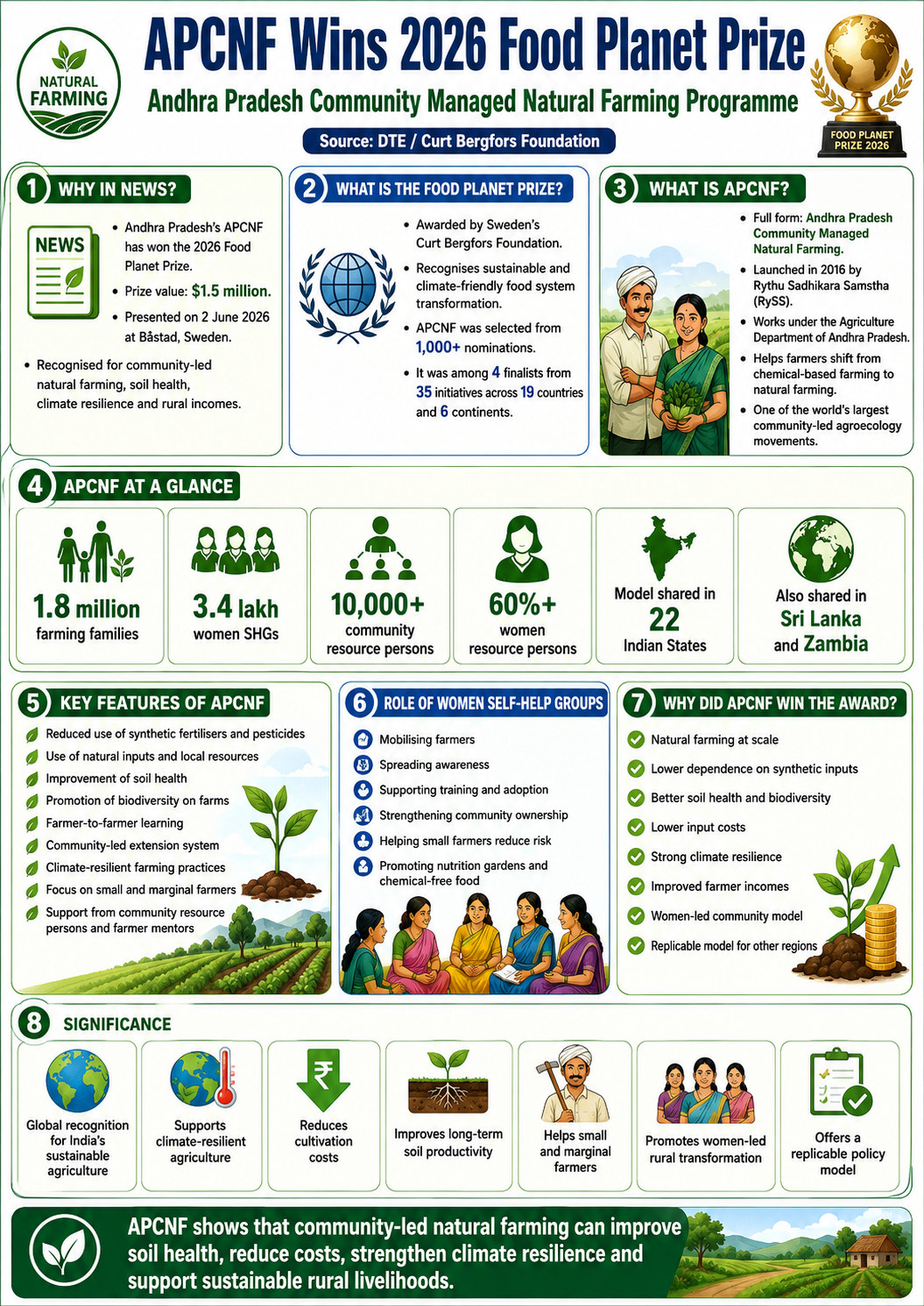
Andhra Pradesh’s Andhra Pradesh Community Managed Natural Farming programme (APCNF) has won the 2026 Food Planet Prize, one of the world’s major environmental awards focused on transforming food systems. The prize, worth $1.5 million, was presented in Båstad, Sweden, on 2 June 2026.
The programme was recognised for promoting community-led natural farming, reducing dependence on synthetic inputs, improving soil health, strengthening climate resilience and supporting rural incomes.
What is the Food Planet Prize?
The Food Planet Prize is awarded by Sweden’s Curt Bergfors Foundation. It recognises initiatives that can transform food systems in a sustainable and climate-friendly manner.
For 2026, APCNF was selected from more than 1,000 nominations from across the world. It was among four finalists selected from a longlist of 35 initiatives across 19 countries and six continents.
What is APCNF?
APCNF stands for Andhra Pradesh Community Managed Natural Farming.
It was launched in 2016 by Rythu Sadhikara Samstha (RySS) under the Agriculture Department of Andhra Pradesh. Its aim is to help farmers shift from chemical-based farming to natural farming practices.
It is described as one of the world’s largest community-led agroecology movements, working with about 1.8 million farming families and 3.4 lakh women’s self-help groups across Andhra Pradesh.
Key Features of APCNF
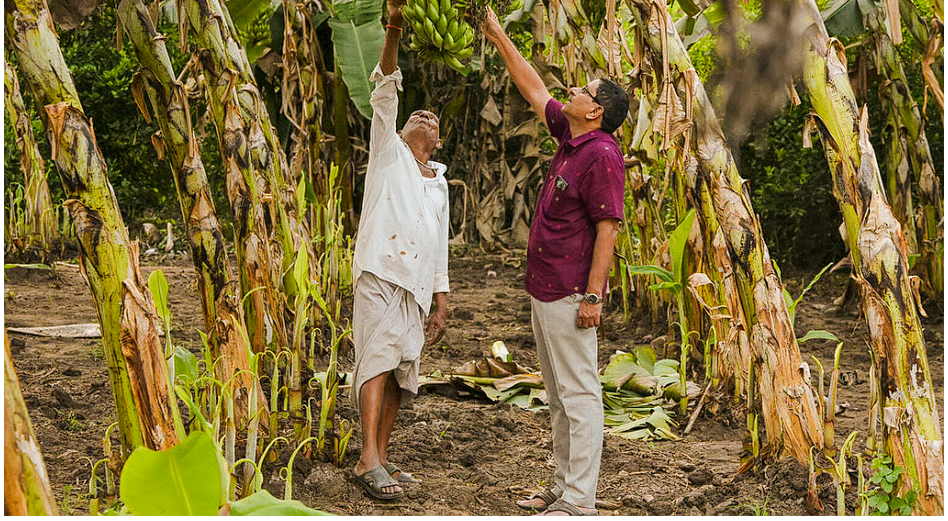
The programme promotes farming practices that work in harmony with nature.
Important features include:
- Reduced use of synthetic fertilisers and pesticides.
- Use of natural inputs and local resources.
- Improvement of soil health.
- Promotion of biodiversity on farms.
- Farmer-to-farmer learning.
- Community-led extension system.
- Climate-resilient farming practices.
- Focus on small and marginal farmers.
- Support from community resource persons and farmer mentors.
More than 10,000 community resource persons support farmer-to-farmer learning under the programme.
Role of Women Self-Help Groups
Women’s self-help groups are central to the APCNF model.
The programme works with nearly 3.4 lakh women’s self-help groups, making women important agents of agricultural transformation.
Their role includes:
- Mobilising farmers.
- Spreading awareness about natural farming.
- Supporting training and adoption.
- Strengthening community ownership.
- Helping small farmers reduce risk.
- Promoting nutrition gardens and chemical-free food.
More than 60% of community resource persons involved in training farmers are women, showing the strong role of women in rural leadership.
Why APCNF Won the Award
APCNF won the 2026 Food Planet Prize because it demonstrated that large-scale farming transformation is possible through community participation.
The award recognised APCNF for:
- Promoting natural farming at scale.
- Reducing dependence on synthetic inputs.
- Improving soil health.
- Supporting biodiversity.
- Reducing input costs.
- Strengthening climate resilience.
- Improving farmer incomes.
- Building a women-led community farming model.
- Creating a replicable model for other regions.
The model is now being shared across 22 Indian States, as well as countries such as Sri Lanka and Zambia.
Significance
1. Global Recognition for India
- The award is a major international recognition for India’s sustainable agriculture efforts. Andhra Pradesh’s Chief Minister described it as a “first for India”.
2. Climate-resilient Agriculture
- Natural farming can help farmers deal with climate risks such as drought, erratic rainfall and soil degradation.
3. Reduction in Input Costs
- By reducing dependence on chemical fertilisers and pesticides, farmers can reduce cultivation costs and improve net incomes.
4. Soil Health Improvement
- Natural farming improves soil organic matter, microbial activity and long-term land productivity.
5. Support to Small Farmers
- The programme is useful for small and marginal farmers because it reduces cash dependence on external inputs.
6. Women-led Rural Transformation
- The involvement of women’s self-help groups makes APCNF a strong example of community-led and gender-sensitive rural development.
7. Replicable Model
- The spread of APCNF methods to other Indian States and countries shows that the model has wider policy relevance.
Challenges
- Farmers may initially hesitate to shift from chemical-based farming.
- Natural farming needs regular training and handholding.
- Yield concerns during the transition period must be addressed.
- Market linkages for natural farming produce need strengthening.
- Certification and branding systems must be improved.
- More scientific documentation is needed to prove long-term results.
- Scaling up requires strong institutional and financial support.
- Climate risks may still affect small farmers without crop insurance and irrigation support.
Way Forward
- Expand farmer-to-farmer training through community resource persons.
- Strengthen women self-help groups as local farming institutions.
- Improve market access and price support for natural farming produce.
- Promote nutrition gardens and local food security.
- Document scientific evidence on soil health, yields and incomes.
- Link APCNF with climate adaptation policies.
- Encourage school and community awareness on chemical-free food.
- Support natural farming through credit, insurance and procurement systems.
- Promote Andhra Pradesh’s target of becoming 100% natural farming State by 2047.
Conclusion
The 2026 Food Planet Prize for APCNF is a landmark recognition for Andhra Pradesh and India. It shows that sustainable agriculture can be built through community participation, women’s leadership and farmer-to-farmer learning.
APCNF is not only an agriculture programme. It is a model for climate resilience, soil health, rural livelihoods and food system transformation. If supported with markets, scientific validation and policy continuity, it can become an important pathway for sustainable farming in India and other countries.