Why in News?
Myanmar’s President U Min Aung Hlaing paid his first official visit to India from 30 May to 3 June 2026 at the invitation of Prime Minister Narendra Modi.
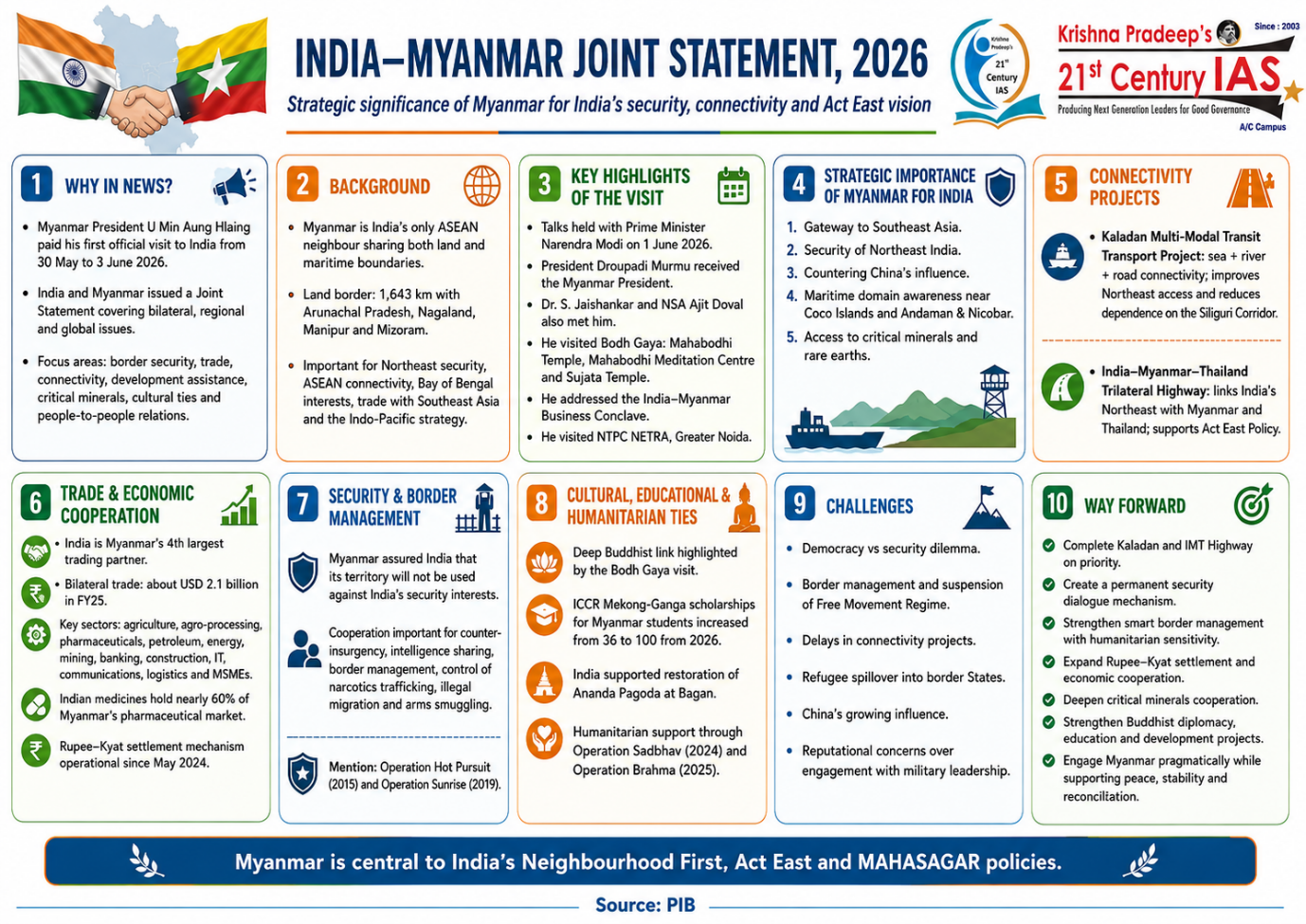
During the visit, India and Myanmar issued a Joint Statement covering bilateral, regional and global issues. The discussions focused on border security, trade, connectivity, development assistance, critical minerals, cultural ties and people-to-people relations.
The visit is significant because Myanmar is a critical pillar of India’s Neighbourhood First Policy, Act East Policy and MAHASAGAR approach. It is also vital for Northeast security, ASEAN connectivity, maritime interests and balancing China’s influence in the region.
Background of India–Myanmar Relations
India and Myanmar share old civilisational, cultural and religious ties. Buddhism is a strong cultural bridge between both countries.
Myanmar is India’s only ASEAN neighbour that shares both a land boundary and maritime boundary with India. It shares a 1,643 km land border with India across Arunachal Pradesh, Nagaland, Manipur and Mizoram.
Myanmar is important for India’s:
- Northeast security
- ASEAN connectivity
- Bay of Bengal maritime interests
- Counter-insurgency cooperation
- Trade with Southeast Asia
- Act East Policy
- Indo-Pacific strategy
Key Highlights of the Visit
- Myanmar President U Min Aung Hlaing visited India from 30 May to 3 June 2026.
- He held talks with Prime Minister Narendra Modi on 1 June 2026.
- President Droupadi Murmu received the Myanmar President.
- External Affairs Minister Dr. S. Jaishankar and National Security Adviser Ajit Doval separately called on him.
- The Myanmar President visited Bodh Gaya, including:
- Mahabodhi Temple
- Mahabodhi Meditation Centre
- Sujata Temple
- He addressed the India–Myanmar Business Conclave jointly organised by UMFCCI and CII.
- He visited the NTPC Energy Technology Research Alliance (NETRA) complex in Greater Noida to observe work in clean energy, renewable energy integration, energy efficiency and grid resilience.
Strategic Importance of Myanmar for India
1. Gateway to Southeast Asia
Myanmar is India’s geographical bridge to Southeast Asia. India’s physical connectivity with ASEAN depends heavily on stable transit routes through Myanmar.
2. Security of Northeast India
Myanmar shares a long and porous border with India’s northeastern States. Insurgent groups such as NSCN-K and ULFA have historically used Myanmar’s border regions.
Therefore, cooperation with Myanmar is important for:
- Counter-insurgency
- Intelligence sharing
- Border management
- Control of narcotics trafficking
- Prevention of illegal migration
- Control of small arms smuggling
3. Countering China’s Influence
China has expanded its presence in Myanmar through the China–Myanmar Economic Corridor and the Kyaukpyu deep-sea port.
India’s engagement with Myanmar helps balance China’s growing strategic presence in the Bay of Bengal and Indo-Pacific region.
4. Maritime Domain Awareness
Myanmar’s Coco Islands are located close to India’s Andaman and Nicobar Islands. Continuous engagement is important to ensure that these areas are not used by hostile external actors.
5. Critical Minerals
Myanmar has important mineral resources, including rare earth elements. These are useful for India’s semiconductor, defence, clean energy and advanced manufacturing sectors.
Connectivity Projects
Connectivity was one of the major themes of the Joint Statement.
1. Kaladan Multi-Modal Transit Transport Project
Both sides agreed to work closely for the completion of the Kaladan Multi-Modal Transit Transport Project.
This project connects India’s eastern coast with Myanmar and India’s Northeast through:
- Sea route
- River route
- Road route
It is important because it can improve access to the Northeast and reduce dependence on the Siliguri Corridor.
2. India–Myanmar–Thailand Trilateral Highway
Both sides reaffirmed commitment to the India–Myanmar–Thailand Trilateral Highway.
This highway aims to connect India’s Northeast with Myanmar and Thailand. It supports India’s Act East Policy and strengthens economic links with Southeast Asia.
Trade and Economic Cooperation
India and Myanmar agreed to expand bilateral trade and investment.
Important areas include:
- Agriculture, Agro-processing, Pharmaceuticals, Petroleum, Energy, Mining
Banking, Construction, IT, Communications, Logistics, MSMEs.
India is Myanmar’s 4th largest trading partner, with trade valued at about USD 2.1 billion in FY25.
India exports:
- Pharmaceuticals, Machinery, Vehicles, Cotton, Cereals, Electrical equipment
Myanmar exports:
- Pulses
- Agricultural products
- Wood products
Indian medicines hold nearly 60% of Myanmar’s pharmaceutical market, making pharmaceuticals an important area of cooperation.
Rupee-Kyat Settlement Mechanism
Both sides agreed to facilitate bilateral trade through the Rupee-Kyat settlement mechanism, which became operational in May 2024.
This mechanism helps:
- Reduce dependence on third-country currencies
- Promote direct trade transactions
- Support local currency settlement
- Improve financial integration
- Facilitate trade through Special Rupee Vostro Accounts
Security and Border Management
Security cooperation was a major focus of the visit.
Myanmar assured India that its territory would not be allowed to be used against India’s security interests. This is important because anti-India insurgent groups have historically used areas across the border.
Earlier, India and Myanmar cooperated through operations such as:
- Operation Hot Pursuit, 2015
- Operation Sunrise, 2019
Critical Minerals Cooperation
India and Myanmar agreed to strengthen cooperation in critical minerals and rare earths.
This is important because rare earths are used in:
- Semiconductors
- Defence equipment
- Electric vehicles
- Renewable energy systems
- Electronics
- Strategic technologies
Such cooperation can support India’s technology security and reduce dependence on limited external sources.
Cultural and People-to-People Ties
The Myanmar President’s visit to Bodh Gaya highlighted the deep Buddhist and spiritual connection between India and Myanmar.
India also announced that Mekong-Ganga ICCR scholarships for Myanmar students would be increased from 36 to 100 from 2026 onwards.
This will strengthen:
- Educational cooperation
- Cultural exchange
- Youth linkages
- Buddhist diplomacy
- Long-term goodwill
India has also supported restoration of the Ananda Pagoda at Bagan, reflecting shared Buddhist heritage.
Humanitarian and Development Cooperation
India has acted as a first responder during crises in Myanmar.
Important examples include:
- Operation Sadbhav, 2024
- Operation Brahma, 2025
Through these efforts, India provided disaster relief and medical assistance to Myanmar.
India also supports development and welfare projects through:
- Border Area Development Programme
- Rakhine State Development Programme
- Health and education support
- Digital infrastructure cooperation
Major Challenges
1. Democracy vs Security Dilemma
India faces the difficult task of balancing democratic values with national security interests. While many Western countries maintain sanctions on Myanmar after the 2021 military coup, India’s geographic proximity requires continued engagement.
2. Border Management and Free Movement Regime
The Free Movement Regime, which allowed tribal communities to travel up to 16 km across the India–Myanmar border without a visa, has been suspended by India due to concerns over illegal migration, narcotics trafficking and insurgent infiltration.
However, local communities often view the border as an artificial colonial boundary that separates ethnic and ancestral ties.
3. Delays in Connectivity Projects
Projects such as the Kaladan corridor have faced delays due to difficult terrain, security risks and the presence of ethnic armed organisations.
4. Refugee Spillover
Internal conflict in Myanmar after the 2021 coup has led to refugee inflows into Indian border States such as Mizoram and Manipur.
5. China’s Influence
China’s infrastructure and port projects in Myanmar increase India’s strategic concerns in the Bay of Bengal and Indo-Pacific region.
6. Reputational Concerns
India’s engagement with Myanmar’s military leadership creates criticism from human rights groups. India must balance strategic interests with humanitarian sensitivity.
Way Forward
- Complete the Kaladan Project and IMT Trilateral Highway on priority.
- Create a permanent security dialogue mechanism for real-time intelligence sharing.
- Strengthen border management through technology and local coordination.
- Deploy smart border systems while maintaining humanitarian sensitivity.
- Expand Rupee-Kyat trade settlement for smoother bilateral trade.
- Promote cooperation in pharmaceuticals, agriculture, energy, mining and MSMEs.
- Strengthen critical minerals and rare earth cooperation.
- Deepen Buddhist cultural diplomacy and educational exchanges.
- Support development projects in health, education and digital infrastructure.
- Engage Myanmar pragmatically while supporting peace, stability and reconciliation.
Conclusion
Myanmar remains a critical partner for India’s security, connectivity and regional strategy. It is central to India’s Neighbourhood First, Act East and MAHASAGAR policies.
The 2026 visit strengthened cooperation in trade, border security, connectivity, critical minerals, education and cultural ties. However, India must carefully balance strategic engagement with democratic values, humanitarian concerns and regional stability.
A practical policy based on security cooperation, connectivity, economic development and soft power can help India protect its Northeast, connect with ASEAN and maintain influence in the Bay of Bengal region.