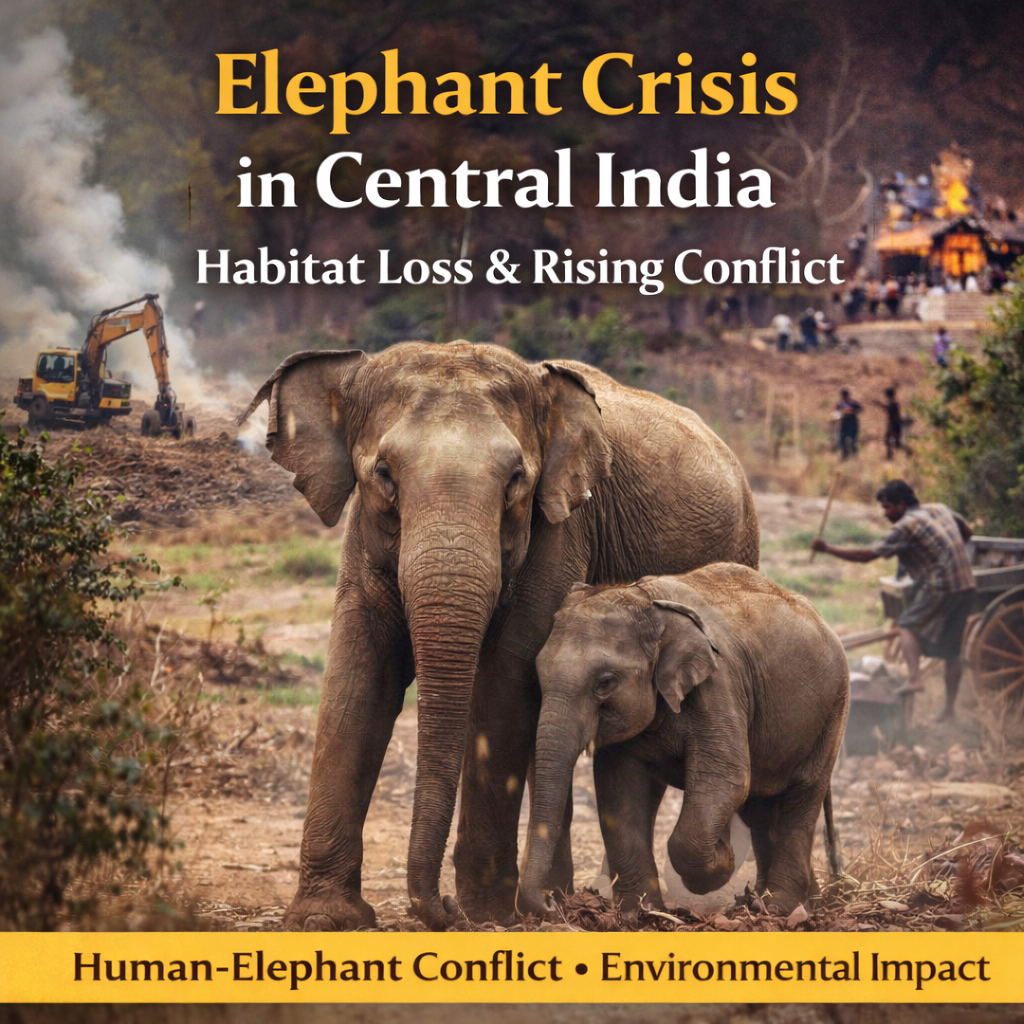
Elephant Crisis in Central India: Habitat Loss, Migration, and Rising Human–Elephant Conflict
Table of Contents
Relevance: GS Paper III – Environment & Ecology
For Prelims:
- Asian Elephant (Elephas maximus), Human–Elephant Conflict (HEC), Habitat fragmentation, Elephant corridors, Jangalmahal landscape, Hasdeo Arand forests, Dalma elephant range, Elephant migration vs dispersal, Linear infrastructure impact, Mining-induced habitat loss
For Mains:
- Human–wildlife conflict management, Habitat fragmentation and biodiversity loss, Landscape-level conservation, Development vs conservation debate, Forest degradation impacts, Climate change and wildlife migration, Compensation policy for wildlife conflict victims, Sustainable land-use planning
Why in News?
Recent elephant attacks in Jharkhand, West Bengal, and Odisha have resulted in multiple deaths, prompting authorities to declare an “elephant emergency.” The crisis reflects a growing pattern of human–elephant conflict in central India driven by habitat loss, mining, and forest fragmentation.
Key Facts and Data
- India has 22,446 elephants, but less than 8% of elephants cause nearly 50% of conflict casualties.
- Central India (West Bengal, Chhattisgarh, MP, Maharashtra) historically had negligible elephant populations before the 1980s.
- Elephant populations in these regions increased due to migration from Jharkhand and Odisha.
- Crop-dependent elephants now rely heavily on agricultural lands for survival.
Shift from Migration to Immigration
Historically, elephant movements in India were seasonal migrations, driven by rainfall patterns and availability of natural forage. These migrations were part of natural ecological cycles, allowing elephants to move between habitats without permanently settling in human-dominated landscapes.
However, since the 1980s, this pattern has shifted from seasonal migration to permanent immigration, due to multiple environmental and human-induced disruptions.
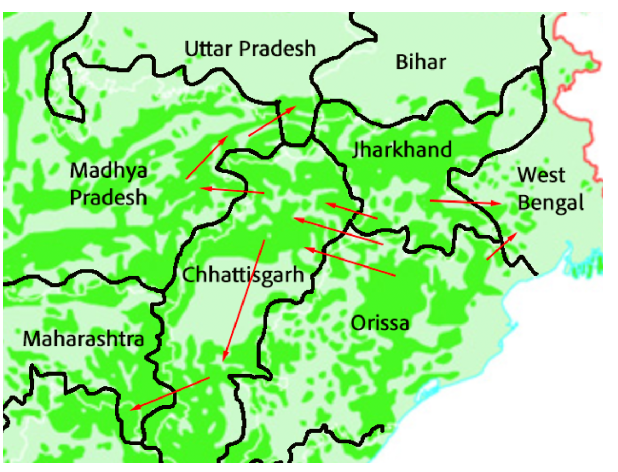
Key Causes of Migration Disruption
Severe Droughts (El Niño Events)
- Major droughts during 1982–83 and 1986–87 reduced water and food availability.
- Forest ecosystems in Jharkhand and Odisha became unsuitable for sustaining elephant populations.
Mining Expansion and Habitat Destruction
- Rapid mining expansion in:
- Singhbhum forests (Jharkhand)
- Keonjhar and Sundargarh forests (Odisha)
- Mining led to permanent habitat loss and fragmentation.
- Rapid mining expansion in:
Reservoir Construction and Submergence of Forests
- Large dams such as the Rengali Dam (1985) submerged extensive riverine forest habitats.
- These forests were critical feeding and migration areas for elephants.
Linear Infrastructure and Fragmentation
- Expansion of roads, railways, and industrial infrastructure blocked traditional elephant corridors.
- This prevented elephants from returning to their original habitats.
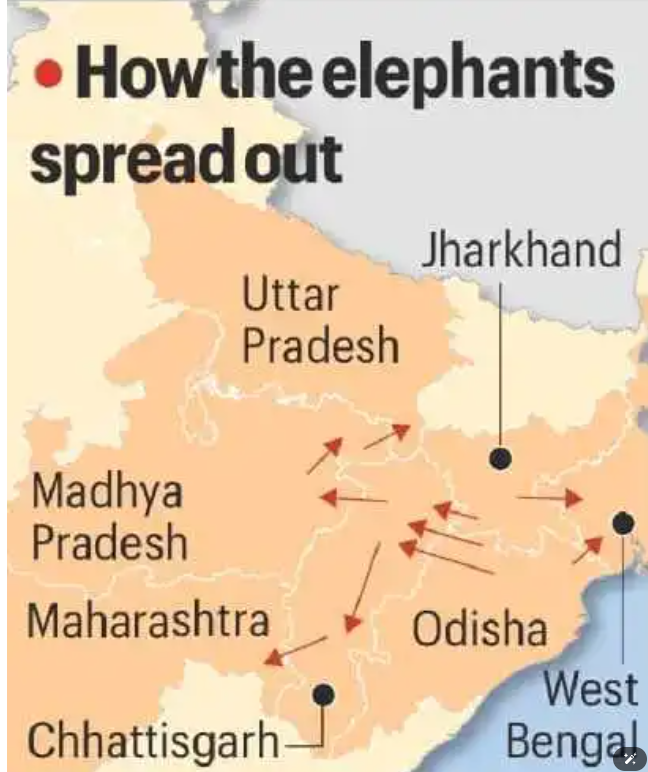
Spread of Elephants in Central India
Eastward Expansion (West Bengal)
- First movement recorded in 1986 from Dalma forests (Jharkhand).
- Now approximately 200 elephants permanently reside in Jangalmahal region.
- Crop raids and breeding confirm permanent settlement.
Westward Expansion (Chhattisgarh)
- Elephants from Odisha migrated into Surguja, Surajpur, and Hasdeo Arand forests.
- Conflict intensified due to permanent elephant settlement.
Expansion into Madhya Pradesh
- Elephants entered Bandhavgarh and Sanjay-Dubri reserves.
- Human deaths doubled between 2016 and 2021.
Expansion into Maharashtra
- Elephants moved into Gadchiroli and Tadoba-Andhari landscape.
- Conflict incidents and human fatalities increased.
Ecological and Behavioural Impacts
Shift from Migration to Permanent Settlement
- Elephants previously migrated seasonally.
- Habitat loss has forced permanent dispersal into agricultural landscapes.
Crop Dependency
- High-nutrient crops increase reproduction rates.
- New generations of elephants rely on crops rather than forests.
Habitat Unsuitability
- Central India lacks year-round water and fodder.
- Forest fragmentation prevents natural migration.
Government and Policy Response
The 2025 elephant population report recommended:
- Uniform compensation policy for conflict victims.
- Landscape-level conservation strategies.
- Habitat restoration initiatives.
- Measures to reduce human–elephant interface.
Forest departments have begun:
- Joint forest management
- Fodder regeneration programmes
- Corridor restoration efforts
Significance
Biodiversity Conservation
- Elephants are keystone species and ecosystem engineers.
Ecological Balance
- Help maintain forest ecosystems and biodiversity.
Indicator of Forest Health
- Elephant migration patterns reflect ecosystem stress.
Challenges
- Habitat restoration requires 20–40 years.
- Increasing elephant population in degraded habitats.
- Expansion of mining and infrastructure.
- Rising human casualties and crop losses.
- Inter-state coordination challenges.
Way Forward
Habitat Restoration
- Restore forest corridors and habitats.
Landscape-Level Planning
- Integrate conservation with development planning.
Conflict Mitigation
- Early warning systems and barriers.
- Community-based conservation.
Compensation and Livelihood Support
- Strengthen compensation schemes.
- Promote alternative livelihoods.
Conclusion
The elephant crisis in central India reflects the consequences of habitat loss and development pressures. Long-term conservation requires habitat restoration, landscape-level planning, and conflict mitigation to ensure coexistence between humans and elephants.
UPSC PYQ
Q. With reference to Indian elephants, consider the following statements: (IAS 2020)
- The leader of an elephant group is a female.
- The maximum gestation period can be 22 months.
- An elephant can normally go on calving till the age of 40 years only.
- Among the States in India, the highest elephant population is in Kerala.
Which of the statements given above is/are correct?
- 1 and 2 only
- 2 and 4 only
- 3 only
- 1, 3 and 4 only
Answer: A.
Explanation:
Statement 1: The leader of an elephant group is a female.
Correct
- Elephant herds follow a matriarchal social structure.
- The group is led by the oldest and most experienced female, called the matriarch.
- She guides the herd in:
- Finding food and water
- Migration routes
- Protection from threats
This is an important behavioural feature of Asian elephants (Elephas maximus).
Statement 2: The maximum gestation period can be 22 months.
Correct
- Elephants have the longest gestation period among all mammals.
- Gestation period ranges between 18 to 22 months.
- This long period allows for advanced brain development of calves at birth.
Statement 3: An elephant can normally go on calving till the age of 40 years only.
Incorrect
- Elephants can reproduce well beyond 40 years.
- Female elephants can give birth even up to 50–60 years of age, although fertility declines with age.
- Therefore, limiting calving to 40 years is incorrect.
Statement 4: Among the States in India, the highest elephant population is in Kerala.
Incorrect
- According to the Elephant Census (2017):
- Karnataka has the highest elephant population in India.
- Followed by Assam and Kerala.
Hence Kerala is not the highest.
CARE MCQ
Q. The nationwide DNA-based synchronous population estimation of elephants in India was conducted by which of the following organisations under Project Elephant?
- Zoological Survey of India
- Wildlife Institute of India
- Forest Survey of India
- National Biodiversity Authority
Answer: B
The exercise was conducted by the Wildlife Institute of India (WII) under Project Elephant (1992).
WII prepared the report titled:
“Status of Elephants in India: DNA-based Synchronous All-India Population Estimation of Elephants (SAIEE 2021–25)”.
Additional information:
- Estimated population: 22,446 elephants, compared to 29,964 in 2017, indicating a decline (about 25% as per the news summary).
- Major methodological shift: From older visual counts / dung-based counts to a DNA mark–recapture technique, which is scientifically more reliable.
- Why DNA method matters: Elephants often lack distinctive physical features, so genetic markers help identify individual elephants, similar to methods used in tiger estimation.
- Scale of field work:
- 188,030 trails walked, covering 6.66 lakh km
- 3.19 lakh dung plots examined
- 21,056 dung samples collected
- DNA profiles generated for 4,065 individual elephants
- Estimation model used: Spatially Explicit Capture–Recapture (SECR) model integrating genetic + habitat data for better accuracy.
- State-wise highest counts:
- Karnataka (6,013)
- Assam (4,159)
- Tamil Nadu (3,136)
- Kerala (2,785)
- Uttarakhand (1,792)
- Regional trend: Declines reported in major landscapes like the Western Ghats and Northeastern Hills & Brahmaputra Plains, while Shivalik–Gangetic Plains remained nearly unchanged.