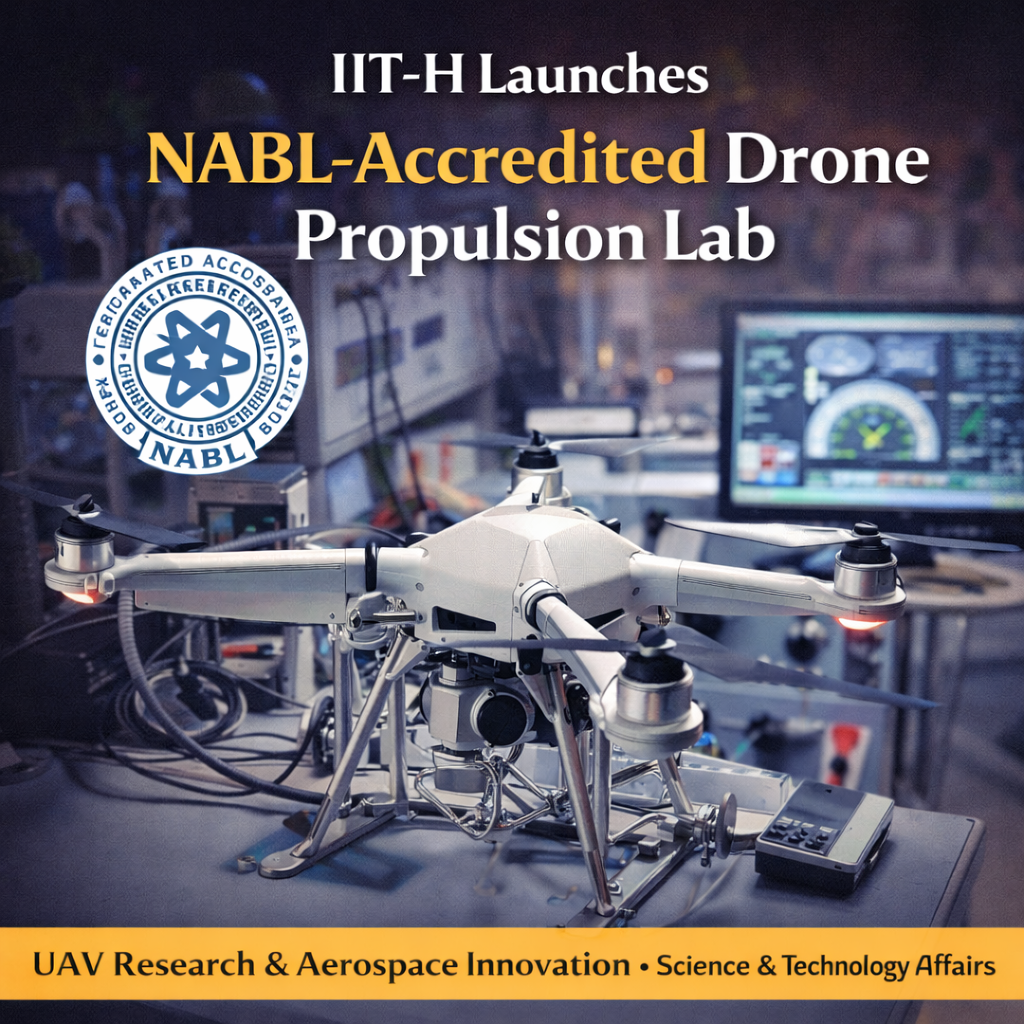
IIT-H Launches NABL-Accredited Drone Propulsion Lab
Table of Contents
Relevance: Paper–V: Science & Technology
Prelims
• IIT-Hyderabad, TiHAN Foundation, NABL accreditation, ISO/IEC 17025 standard, eVTOL (Electric Vertical Take-Off and Landing), UAV propulsion testing, BLDC motors, thrust measurement (kg-force), propulsion configurations (single, coaxial, staggered), RPM and thrust efficiency
Mains
• Indigenous drone testing infrastructure, UAV propulsion validation ecosystem, Aatmanirbhar Bharat in drone sector, Advanced Air Mobility (AAM), autonomous navigation systems, regulatory standardisation and certification, industry-academia technology collaboration, defence and civil drone applications
Why in News?
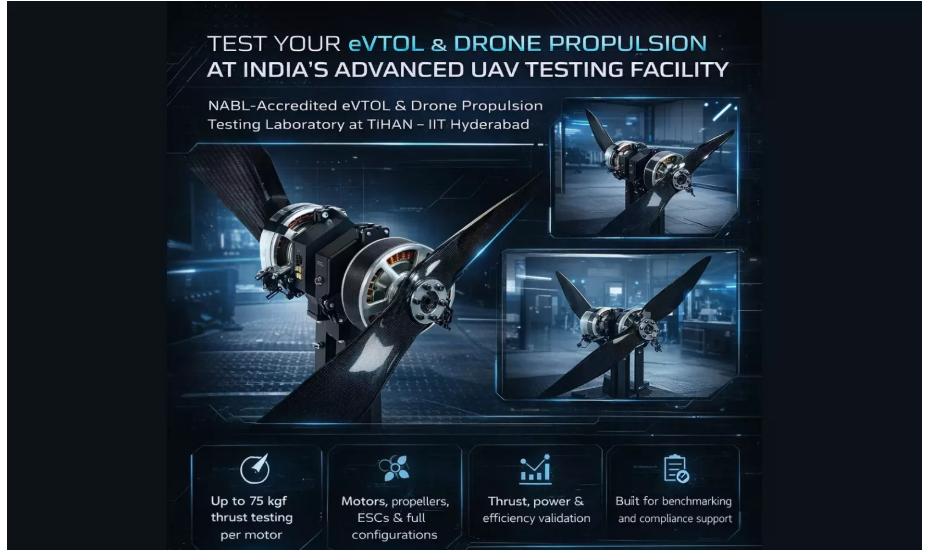
IIT-Hyderabad has operationalised an eVTOL (electric Vertical Take-Off and Landing) and Drone Propulsion Testing Laboratory, accredited by the National Accreditation Board for Testing and Calibration Laboratories (NABL) under ISO/IEC 17025 standards.
Introduction
Many drone start-ups previously had to test propulsion systems informally or send them abroad for validation. With the launch of this accredited lab at IIT-Hyderabad, developers can now conduct certified propulsion testing within the city.
The lab is being set up under the Technology Innovation Hub on Autonomous Navigation (TiHAN) Foundation at IIT-Hyderabad.
Key Features of the Lab
1. NABL Accreditation
- Accredited under ISO/IEC 17025 standards.
- Ensures calibrated and traceable testing environment.
- Data generated can be used for benchmarking, research documentation, and regulatory compliance.
2. Testing Capabilities
- Supports single, coaxial, and staggered propulsion configurations.
- Thrust capacity range: 0.1 to 70 kilogram-force.
- Infrastructure supports up to 75 kilogram-force per motor.
- Suitable for small drones and heavier payload platforms.
3. Measured Parameters
NABL-accredited measurements include:
- Thrust
- DC current
- DC voltage
- Power
- Thrust efficiency
- RPM
- Temperature
4. Motor Testing
- Tests Brushless DC (BLDC) motors.
- Controllers rated from 29 kV to 3000 kV.
- Includes propeller assemblies used in UAVs.
Significance
For Drone Start-ups
- Access to reliable propulsion validation within India.
- Reduced dependency on foreign testing facilities.
- Faster transition from prototype to deployment.
For Industry & Defence
- Supports UAV original equipment manufacturers (OEMs).
- Assists advanced air mobility ventures.
- Useful for defence-linked research units and academic teams.
For Emerging Applications
Drone usage is expanding in:
- Logistics
- Surveillance
- Agriculture
- Urban mobility
With increasing applications, propulsion reliability has become a central concern.
Conclusion
The launch of the NABL-accredited drone propulsion lab at IIT-Hyderabad marks a significant step in strengthening India’s drone innovation ecosystem. By enabling certified propulsion testing within the country, the facility removes a major barrier for start-ups and manufacturers, accelerating research, regulatory compliance, and deployment in the rapidly expanding drone sector.
CARE MCQ
Q. The drone propulsion testing laboratory at IIT-Hyderabad has been established under which of the following foundations?
- National Supercomputing Mission
- Technology Innovation Hub on Autonomous Navigation (TiHAN) Foundation
- Atal Innovation Mission
- Digital India Corporation
Answer: B
- Technology Innovation Hub on Autonomous Navigation (TiHAN) Foundation: Correct
The report explicitly says the lab is being set up under IIT-H’s Technology Innovation Hub on Autonomous Navigation (TiHAN) Foundation—hence this option is correct.
Additional information:
- The facility is NABL-accredited and the accreditation aligns with ISO/IEC 17025, which means testing happens in a calibrated and traceable environment (important for regulatory acceptance and credible performance data).
- It supports propulsion testing for single, coaxial, and staggered configurations.
- Thrust testing range: 0.1 to 70 kilogram-force, and the infrastructure supports up to 75 kilogram-force per motor, covering small drones to heavier payload platforms.
- NABL-accredited measurements include thrust, DC current, DC voltage, power, thrust efficiency (at nominal speed), along with RPM and temperature.
- The lab can test BLDC motors with controllers rated from 29 kV to 3000 kV, along with propeller assemblies used in UAVs.
- Practical value: manufacturers/start-ups can use the generated data for benchmarking, research documentation, and regulatory processes, reducing the need to send systems abroad for validation.
- Option (c) Atal Innovation Mission: Incorrect
AIM promotes innovation via Atal Tinkering Labs and Atal Incubation Centres