Table of Contents
Relevance: GS Paper II – Judiciary | Governance | Constitutional Provisions
For Prelims:
Article 124, Supreme Court (Number of Judges) Act 1956, Collegium System, sanctioned strength, judicial vacancies
For Mains:
judicial reforms, pendency of cases, access to justice, judicial infrastructure, constitutional governance, judicial efficiency
Why in News?
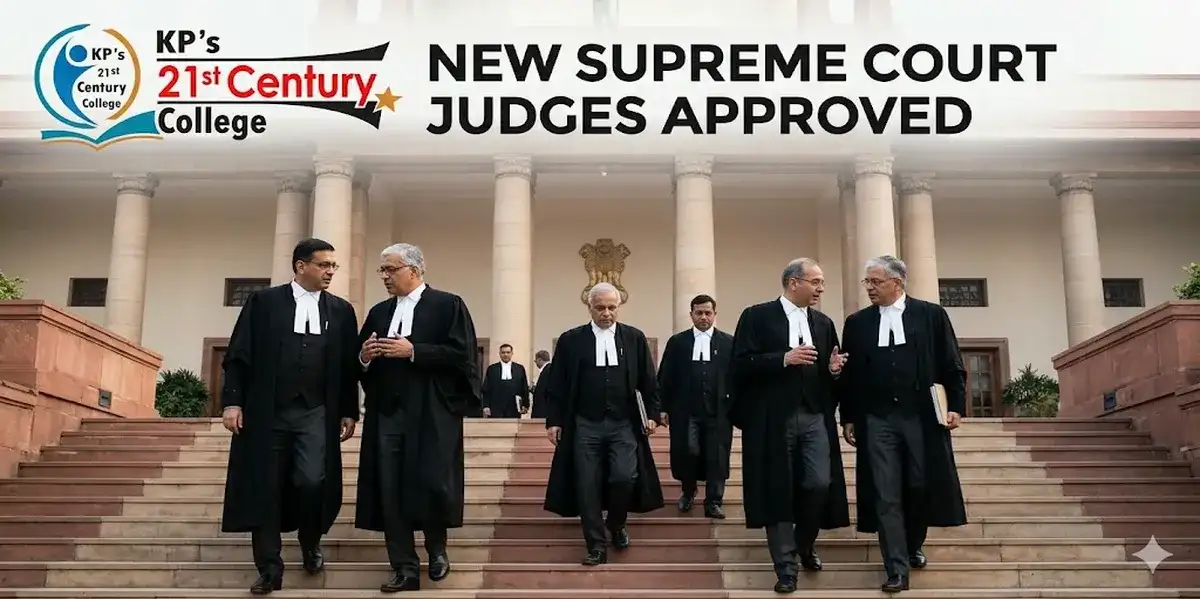
- The Union Cabinet approved a proposal to increase the sanctioned strength of judges in the Supreme Court of India from 34 to 38.
- The government will introduce a Bill to amend the Supreme Court (Number of Judges) Act, 1956 in the next Parliament session.
- The move comes amid rising pendency of cases in the Supreme Court, which currently exceeds 92,000 cases.
Constitutional Basis for Supreme Court Strength
Article 124(1)
- Article 124 establishes the Supreme Court of India.
- It states that the Supreme Court shall consist of:
– The Chief Justice of India (CJI)
– Such number of other judges as Parliament may prescribe by law. - Thus, Parliament has the exclusive authority to increase the number of Supreme Court judges.
What is the Supreme Court (Number of Judges) Act, 1956?
- The Supreme Court (Number of Judges) Act, 1956 regulates the sanctioned strength of Supreme Court judges.
- The Act was enacted under Article 124(1) of the Constitution.
- It has been amended multiple times to increase the number of judges in response to growing litigation and judicial workload.
Recent Cabinet Decision
- The Union Cabinet approved increasing the number of judges from 34 to 38, including the Chief Justice of India.
- The proposed amendment seeks to strengthen judicial capacity and reduce case backlog.
- The decision also considers upcoming retirements and existing vacancies in the Supreme Court.
Evolution of Supreme Court Strength
Year | Strength (Excluding CJI) | Total Strength |
1950 | 7 | 8 |
1956 | 10 | 11 |
1960 | 13 | 14 |
1977 | 17 | 18 |
1986 | 25 | 26 |
2008 | 30 | 31 |
2019 | 33 | 34 |
2026 (Proposed) | 37 | 38 |
Why the Number of Judges is Being Increased
Rising Case Pendency
- The Supreme Court currently has more than 92,000 pending cases.
- Pendency has increased significantly after the pandemic period.
- Increased use of e-filing and digital accessibility has also increased case inflow.
Judicial Vacancies
- Existing vacancies due to retirements have increased pressure on sitting judges.
- More retirements are expected in 2026, including:
– Justice J.K. Maheshwari
– Justice Pankaj Mithal
– Justice Sanjay Karol
Expanding Scope of Litigation
- The Supreme Court handles constitutional matters, public interest litigations, election disputes, and appeals from across the country.
- Increasing socio-economic complexity has led to a rise in litigation.
Significance of Increasing Judicial Strength
- Faster Disposal of Cases: More judges can reduce pendency and improve case disposal rates.
- Better Access to Justice: Timely hearings improve citizens’ access to justice.
- Reduced Burden on Existing Judges: Existing judges currently face extremely heavy workloads.
- Strengthening Constitutional Governance Constitutional benches can function more efficiently with greater judicial strength.
Challenges Beyond Increasing Judges
- Infrastructure Constraints: Merely increasing judges without improving court infrastructure may not solve delays fully.
- Procedural Delays: Frequent adjournments and lengthy procedures contribute significantly to pendency.
- Vacancy Delays: Delays in appointments continue despite sanctioned posts being increased.
- Limited Use of Technology in Lower Judiciary: Pendency originates largely in subordinate courts, requiring systemic reform
Conclusion
The decision to increase the strength of the Supreme Court reflects the growing complexity and volume of litigation in India. While expanding judicial capacity is an important step toward reducing pendency, meaningful judicial reform also requires improvements in infrastructure, procedural efficiency, and timely appointments. A stronger and more efficient judiciary remains essential for protecting constitutional rights and ensuring effective delivery of justice.
CARE MCQ
Q. With reference to the Supreme Court of India, consider the following statements:
- Parliament has the power to increase the number of Supreme Court judges.
- The Supreme Court (Number of Judges) Act, 1956 was enacted under Article 124 of the Constitution.
- The President independently appoints Supreme Court judges without judicial consultation.
Which of the statements given above is/are correct?
(a) 1 and 2 only
(b) 2 and 3 only
(c) 1 only
(d) 1, 2 and 3
Ans: (a)
Explanation:
Statement 1 is correct: Article 124 of the Constitution empowers Parliament to regulate and increase the strength of judges in the Supreme Court through legislation.
Statement 2 is correct: The Supreme Court (Number of Judges) Act, 1956 was enacted under the provisions of Article 124 to determine the sanctioned strength of Supreme Court judges.
Statement 3 is incorrect: Although judges are formally appointed by the President, the appointment process involves judicial consultation through the Collegium System, and the President does not act independently in this matter.
Q.Consider the following statements:
- The Chief Justice of India (CJI) is not required to be a part of a Constitution Bench.
- The largest Constitution Bench in the history of the Supreme Court of India was in the A.K Gopalan case, 1950.
- Supreme Court has an exclusive jurisdiction over disputes related to the election of the President.
How many of the statements given above are correct?
a) Only one
b) Only two
c) Only three
d) None
Answer: (b)
Explanation:
Statement A is correct: The Chief Justice of India (CJI) is not required to be a part of a Constitution Bench. The CJI is the Master of the Roster and has the sole discretion to decide which cases will be heard by a Constitution Bench. The Constitution Benches have decided many of India’s most important Supreme Court cases, including: Kesavananda Bharati v. State of Kerala and A. K. Gopalan v. State of Madras.
Statement B is incorrect: The largest Constitution Bench in the history of the Supreme Court of India was the 13-judge bench in the Kesavananda Bharati v. State of Kerala case(1973).
Statement C is correct: According to Article 71 of the Constitution, all doubts and disputes arising out of or in connection with the election of a President or Vice-President shall be inquired into and decided by the Supreme Court.
Q.Regarding the removal of a judge of the Supreme Court or a High Court in India, which of the following statements is correct?
a) The resolution for removal must be passed by a simple majority of the total membership of each House of Parliament.
b) The President can issue the removal order based on a recommendation from the Chief Justice of India after an internal inquiry.
c) An address passed by each House of Parliament, supported by a majority of the total membership of that House and by a majority of not less than two-thirds of the members of that House present and voting, is required.
d) The grounds for removal are ‘violation of the Constitution’ or ‘gross misconduct’, as determined by the Supreme Court collegium.
Answer: (c)
Explanation:
Article 124(4) of the Indian Constitution specifies the procedure for the removal of a Supreme Court judge, which also applies to High Court judges (Article 217). A judge can be removed by an order of the President only after an address by Parliament has been presented to him in the same session for such removal. This address must be supported by a special majority in each House of Parliament, meaning a majority of the total membership of that House AND a majority of not less than two-thirds of the members of that House present and voting. The grounds for removal are ‘proved misbehaviour’ or ‘incapacity’. The Judges Inquiry Act, 1968, regulates the procedure for the investigation and presentation of an address for the removal of a judge.
Q.Consider the following statements regarding the tenure and conditions of service for various constitutional functionaries in India:
- The Comptroller and Auditor General of India holds office for a term of six years or until he attains the age of 65 years, whichever is earlier.
- The Chief Election Commissioner and other Election Commissioners hold office for a fixed term of six years or until they attain the age of 65 years, whichever is earlier, and all can be removed only through a process similar to the removal of a Supreme Court Judge.
- The Attorney General of India holds office during the pleasure of the President and his remuneration is fixed by the Parliament.
- A Governor can be removed from office by the President on the grounds of proven misbehavior or incapacity, following an impeachment process by the State Legislature.
How many of the statements given above are correct?
a) Only one
b) Only two
c) Only three
d) None
Answer: (a)
Explanation:
Statement 1 is correct: The Comptroller and Auditor General (CAG) of India is appointed for a term of six years or until he attains the age of 65 years, whichever is earlier. This is provided by the CAG’s (Duties, Powers and Conditions of Service) Act, 1971, which is enacted under Article 148(3) of the Constitution.
Statement 2 is incorrect: While the Chief Election Commissioner (CEC) and other Election Commissioners (ECs) do hold office for a fixed term of six years or until they attain the age of 65 years, whichever is earlier, the removal process is different for the CEC and ECs. The Chief Election Commissioner can be removed from office in the same manner and on the same grounds as a Judge of the Supreme Court. However, other Election Commissioners cannot be removed from office except on the recommendation of the Chief Election Commissioner. The statement incorrectly claims that “all can be removed only through a process similar to the removal of a Supreme Court Judge.”
Statement 3 is incorrect: The Attorney General of India (AG) holds office during the pleasure of the President, as stipulated in Article 76(4) of the Constitution. However, his remuneration is determined by the President, not by the Parliament. Article 76(4) states that the Attorney General shall receive such remuneration as the President may determine.
Statement 4 is incorrect: A Governor holds office during the pleasure of the President (Article 156(1)). There are no specific grounds mentioned in the Constitution for the removal of a Governor, nor is there an impeachment process by the State Legislature for their removal. The President can remove a Governor at any time without assigning any reason or following any specific procedure like impeachment.
FAQs
Q1. Which Article deals with the composition of the Supreme Court?
Ans: Article 124 of the Constitution.
Q2. What is the current proposed strength of the Supreme Court?
Ans: 38 judges including the Chief Justice of India.
Q3. Why is the number of judges being increased?
Ans: To reduce pendency and improve judicial efficiency.
Q4. Who recommends names for Supreme Court appointments?
Ans: The Supreme Court Collegium recommends names.
Q5. Why is judicial pendency a major issue?
Ans: It delays justice delivery and increases burden on litigants and courts.