Table of Contents
Relevance: GS Paper II – International Relations | International Institutions | GS Paper III – Environment | Security
For Prelims:
Ecocide, Rome Statute, ICC, ENMOD Convention, IUCN, war crimes, environmental destruction, Council of Europe Convention
For Mains:
environmental security, international humanitarian law, climate justice, environmental governance, armed conflict and ecology, global environmental accountability.
Why in News?
- Lebanon accused Israel of committing “ecocide” during the 2023–24 conflict by allegedly causing massive environmental destruction.
- Iran also alleged ecocide after Israeli strikes on fuel depots reportedly caused toxic “black rain” and severe pollution.
- Several countries and environmental organizations are now demanding formal recognition of ecocide as an international crime under the Rome Statute.
- The Council of Europe adopted a convention in 2025 criminalizing severe environmental destruction.
What is Ecocide?
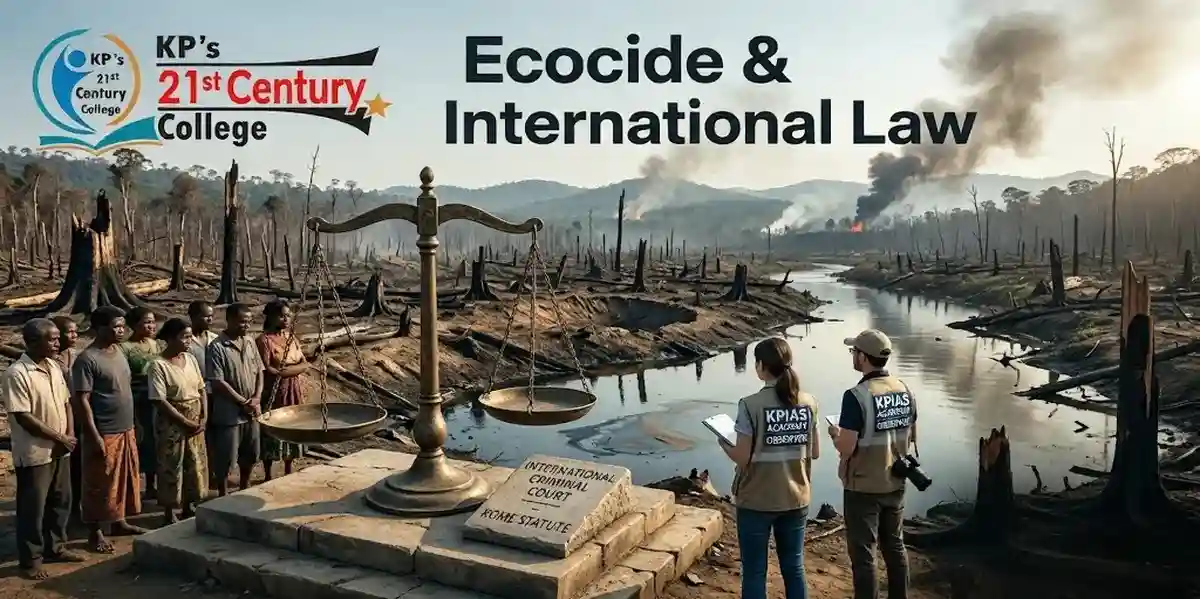
- Ecocide refers to large-scale destruction or severe damage to ecosystems and the environment caused by human activities.
- It involves actions that result in widespread, long-term, or irreversible environmental harm.
- The concept treats nature and ecosystems as entities deserving independent legal protection, not merely as resources for human use.
- Ecocide can occur during war, industrial disasters, mining, deforestation, oil spills, or large-scale pollution.
Origin and Evolution of the Concept
- The term “ecocide” was coined in 1970 by biologist Arthur W. Galston.
- It emerged during criticism of the environmental destruction caused during the Vietnam War.
- The use of Agent Orange and chemical defoliants devastated forests, biodiversity, and agricultural lands.
- Over time, environmental movements expanded the concept beyond warfare to include peacetime environmental destruction.
Environmental Damage During Wars
Modern wars increasingly damage ecosystems directly and indirectly:
- Destruction of forests and biodiversity hotspots
- Oil spills and toxic contamination of rivers and oceans
- Air pollution from burning fuel depots and industrial facilities
- Soil degradation and radioactive contamination
- Damage to agricultural systems and food security
- Long-term public health consequences due to toxic exposure
Current Position under International Law
- International law currently provides only limited protection against environmental destruction during armed conflict.
- Most existing laws are anthropocentric, meaning they focus primarily on harm to humans rather than harm to ecosystems themselves.
- Environmental destruction is usually addressed only when linked to humanitarian suffering or war crimes.
Rome Statute and Environmental Damage
The Rome Statute is the founding treaty of the International Criminal Court (ICC).
Existing Provision
- Article 8 of the Rome Statute recognizes environmental destruction as a war crime only under very strict conditions.
For prosecution, the attack must:
- Be intentional
- Cause widespread, long-term, and severe environmental damage
- Be clearly excessive compared to anticipated military advantage
Why Existing Laws are Inadequate
- Very High Legal Threshold: Proving “widespread, long-term, and severe” damage simultaneously is extremely difficult.
- Applicable Mainly During War: Current ICC provisions apply largely to wartime situations, not peacetime environmental destruction.
- Human-Centric Approach: Existing frameworks focus more on civilian harm than ecological harm itself.
- Weak Enforcement: Many international environmental treaties lack criminal liability mechanisms.
- Jurisdictional Limitations: Several countries involved in conflicts are not parties to the ICC, limiting prosecution.
Countries Recognising Ecocide
Several countries have incorporated ecocide-related provisions into domestic laws:
- Vietnam
- Russia
- Ukraine
- France
- Belgium
- Chile
These laws vary in scope but generally criminalize severe environmental destruction.
Council of Europe Convention 2025
The Council of Europe is a major European intergovernmental organization established in 1949 to promote human rights, democracy, and the rule of law across Europe. It is separate from the European Union (EU).
In 2025, the Council of Europe remained in focus mainly due to developments related to:
European Convention on Human Rights (ECHR)
- Several European countries demanded reinterpretation of migration-related rulings of the European Court of Human Rights.
- Debate emerged on balancing national sovereignty with human rights obligations.
Convention for Ukraine Claims Commission (2025)
- In December 2025, under the Council of Europe framework, many countries adopted a convention to establish an International Claims Commission for Ukraine.
- Objective: provide compensation mechanisms for damages caused during the Russia-Ukraine war.
Cybercrime and Digital Governance Conventions
- The Council of Europe continued expanding global cooperation through conventions such as the Budapest Convention on Cybercrime.
Key Facts
- Headquarters: Strasbourg, France
- Members: 46 countries
- Major achievement: European Convention on Human Rights
- Judicial body: European Court of Human Rights
Difference Between Council of Europe and European Union
Council of Europe | European Union |
Human rights organization | Economic and political union |
46 members | 27 members |
Includes non-EU countries | Only EU members |
Runs ECHR | Runs EU institutions |
Environmental Modification Convention (ENMOD)
The Environmental Modification Convention prohibits hostile environmental modification techniques.
It bans deliberate manipulation of:
- Climate
- Atmosphere
- Hydrosphere
- Ecosystems
for military or hostile purposes.
Limitations
- Focuses only on deliberate environmental modification techniques
- Does not adequately address broader wartime environmental destruction
Role of International Organizations
International Union for Conservation of Nature (IUCN)
- International Union for Conservation of Nature is an international organization established in 1948 for the conservation of nature and sustainable use of natural resources.
- The headquarters of IUCN is located in Gland, Switzerland, and it operates through a global network of governments, NGOs, scientists, and environmental experts.
- IUCN is regarded as the world’s largest environmental knowledge network and plays a major role in global biodiversity conservation efforts.
- The organization provides scientific data, technical expertise, and policy recommendations to countries and international institutions on environmental protection and sustainable development.
- One of the most important contributions of IUCN is the publication of the IUCN Red List of Threatened Species, which assesses the extinction risk faced by plant and animal species across the world.
- The IUCN Red List classifies species into categories such as Extinct, Critically Endangered, Endangered, Vulnerable, Near Threatened, and Least Concern based on scientific assessment.
- IUCN also develops guidelines for the management and classification of protected areas, including national parks, wildlife sanctuaries, and biosphere reserves.
- The organization works extensively on issues such as climate change, ecosystem restoration, wildlife conservation, forest protection, and marine biodiversity preservation.
- IUCN organizes the World Conservation Congress, which serves as an important global platform for discussions on environmental governance and conservation policies.
- India is an active member of IUCN, and many Indian species such as the Bengal Tiger, Asiatic Lion, Great Indian Bustard, and Gangetic Dolphin are assessed under the IUCN Red List.
- The assessments and reports released by IUCN are widely used by governments, researchers, and international organizations for framing conservation laws and environmental policies.
Challenges in Recognising Ecocide Internationally
- Political Resistance: Many powerful countries fear legal exposure for military or industrial activities.
- Difficulty in Attribution: Determining responsibility during war is often politically and legally complex.
- Definitional Ambiguity: There is no universally accepted legal definition of ecocide.
- Sovereignty Concerns: States worry that international environmental criminal law may interfere with national sovereignty.
- ICC Membership Issues: Non-signatory states cannot easily be subjected to ICC jurisdiction.
Significance of Recognising Ecocide
Environmental Accountability: Creates legal responsibility for large-scale ecological destruction.
Deterrence: Discourages states and corporations from causing irreversible environmental damage.
Climate Justice: Protects vulnerable communities dependent on ecosystems for survival.
Way Forward
- Develop a universally accepted legal definition of ecocide.
- Strengthen international environmental criminal law mechanisms.
- Expand liability beyond wartime destruction to peacetime ecological disasters.
- Improve international cooperation for environmental monitoring and evidence collection.
- Integrate environmental protection into humanitarian and security frameworks.
Conclusion
The growing demand to recognize ecocide reflects the evolving understanding that environmental destruction threatens not only ecosystems but also global peace, public health, and human survival. While current international law provides limited protection, recent initiatives by international organizations and regional institutions indicate a shift toward stronger ecological accountability. Recognizing ecocide under international law could become a major step toward integrating environmental justice with global governance and humanitarian principles.
CARE MCQ
Q. With reference to the concept of “Ecocide”, consider the following statements:
- The Rome Statute currently recognizes ecocide as a separate international crime.
- The term “ecocide” first gained prominence in the context of environmental destruction during the Vietnam War.
- The Environmental Modification Convention prohibits hostile use of environmental modification techniques.
Which of the statements given above is/are correct?
(a) 2 and 3 only
(b) 1 and 2 only
(c) 1 and 3 only
(d) 1, 2 and 3
Ans: (a)
Explanation:
Statement 1 is incorrect: The Rome Statute of the International Criminal Court (ICC) does not currently recognize ecocide as an independent international crime. Discussions and campaigns are ongoing to include it alongside genocide, war crimes, crimes against humanity, and aggression.
Statement 2 is correct: The term ecocide became widely associated with the large-scale environmental destruction caused during the Vietnam War, particularly due to the use of chemical defoliants such as Agent Orange.
Statement 3 is correct: The Environmental Modification Convention (ENMOD), 1977 prohibits the hostile use of environmental modification techniques having widespread, long-lasting, or severe effects.
Q.Consider the following statements regarding the crimes under the Rome Statute of the International Criminal Court (ICC):
Statement 1: The Rome Statute, in defining the crime of genocide, specifically enumerates national, ethnical, racial, and religious groups as protected categories, thereby explicitly excluding ‘political groups’ from its scope.
Statement 2: The International Criminal Court’s jurisdiction over the crime of aggression is restricted to acts committed by persons in a position effectively to exercise control over or to direct the political or military action of a State.
Which one of the following is correct in respect of the above statements?
- Both Statement 1 and Statement 2 are correct and Statement 2 is the correct explanation for Statement 1
- Both Statement 1 and Statement 2 are correct and Statement 2 is not the correct explanation for Statement 1
- Statement 1 is correct but Statement 2 is incorrect
- Statement 1 is incorrect but Statement 2 is correct
Ans: (b)
Explanation:
Statement 1 is correct: Article 6 of the Rome Statute defines genocide by specifying ‘national, ethnical, racial or religious group’ as protected categories, consistent with the 1948 Genocide Convention. It does not include ‘political groups’, which has been a point of debate but is the established legal definition within the Statute.
Statement 2 is also correct: Article 8 bis of the Rome Statute, concerning the crime of aggression, specifies that it can only be committed by a person in a position effectively to exercise control over or to direct the political or military action of a State. This reflects the leadership nature of this crime. Both statements are factually correct details about different crimes defined by the Rome Statute.
However, Statement 2, which describes the specific perpetrator requirement for the crime of aggression, does not explain why ‘political groups’ are excluded from the definition of genocide in Statement 1. They are distinct, albeit related, legal provisions within the Rome Statute.
Q. Which one of the following principles best describes the relationship between the International Criminal Court and national jurisdictions, as established by the Rome Statute?
(a) The ICC exercises universal jurisdiction over all crimes irrespective of nationality or location
(b) The ICC operates on the principle of complementarity, intervening only when national courts are unwilling or unable to prosecute
(c) National courts must automatically defer all relevant cases to the ICC
(d) The ICC and national courts simultaneously prosecute the same crimes under concurrent jurisdiction
Ans: (b)
Explanation:
The Rome Statute is based on the principle of complementarity, meaning the ICC acts as a court of last resort. It intervenes only when national judicial systems are unwilling or genuinely unable to investigate or prosecute serious international crimes.
FAQs
Q1. What is ecocide?
Ans: Ecocide refers to large-scale destruction or severe damage to the environment and ecosystems.
Q2. Is ecocide recognized by the ICC?
Ans: No. The Rome Statute does not currently recognize ecocide as a separate crime.
Q3. What is the Rome Statute?
Ans: It is the founding treaty of the International Criminal Court (ICC).
Q4. What is the ENMOD Convention?
Ans: It is an international treaty prohibiting hostile environmental modification techniques.
Q5. Why is ecocide important for UPSC?
Ans: It connects international law, environment, warfare, climate justice, and global governance—important for GS II and GS III.