Table of Contents
Relevance: GS Paper III (Agriculture, Fertilizer Subsidy, Soil Health) | TGPSC/APPSC (Agricultural Policies and Rural Economy)
For Prelims:
Urea, Neem-Coated Urea, N:P:K Ratio, Nutrient Use Efficiency (NUE), Soil Health Card, e-Panta, Fertilizer Control Order (FCO), Essential Commodities Act
For Mains:
Fertilizer subsidy reforms, balanced fertilization, groundwater depletion, sustainable agriculture, nutrient imbalance
Why in News?
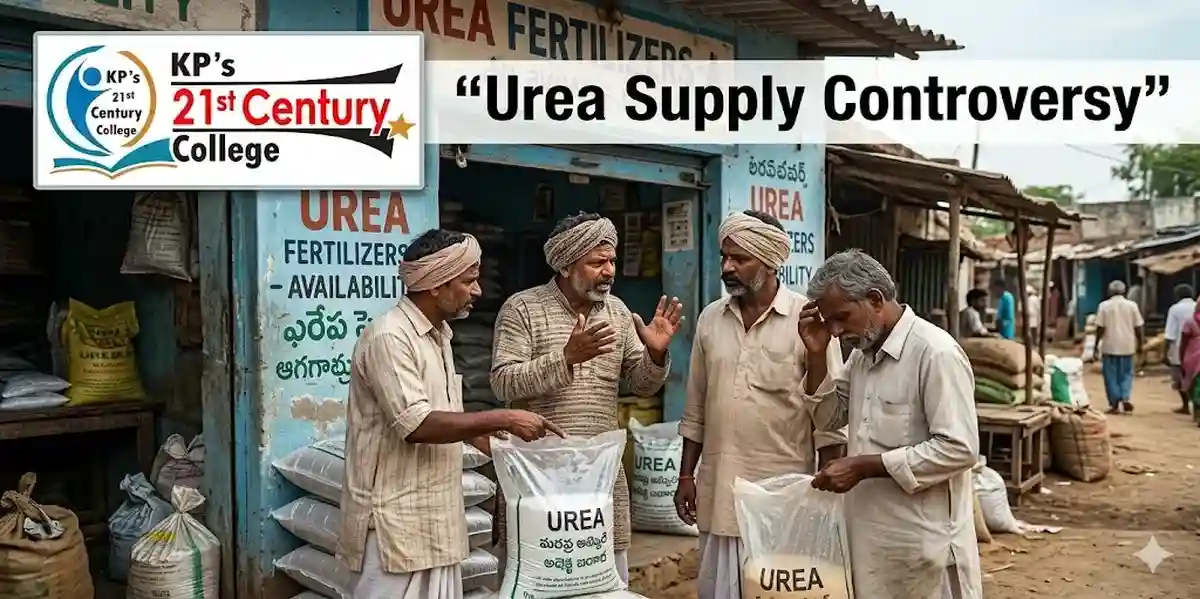
Harish Rao criticised the Telangana government for allegedly imposing an unofficial restriction on urea sales, stating that farmers cultivating sugarcane, vegetables, and orchards were facing shortages despite availability of fertilizer stocks with dealers and cooperative societies.
Urea and India’s Fertilizer Consumption Pattern
Urea is the most widely used nitrogenous fertilizer in India and contains nearly 46% nitrogen, making it one of the highest nitrogen-content solid fertilizers used in agriculture.
India’s fertilizer usage pattern remains heavily tilted toward urea because:
- Urea receives high subsidy support from the government.
- It is significantly cheaper than phosphatic and potassic fertilizers.
- Farmers often associate higher nitrogen application with improved crop yields.
The scientifically recommended nutrient application ratio is generally:
N:P = 4:2:1
However, actual usage in many regions is dominated by nitrogen application, creating severe nutrient imbalance in soils.
Telangana’s Monitoring System for Fertilizer Distribution
- Telangana uses the Aadhaar-enabled Fertilizer Distribution System (AeFDS), where fertilizers are sold through PoS machines with Aadhaar authentication, ensuring only genuine farmers receive subsidized inputs.
- The system is integrated with the Integrated Fertilizer Management System (iFMS) of the Central Government for real-time tracking of fertilizer production, allocation, movement, and sales.
- Entire supply chain is digitally monitored from manufacturer → wholesaler → retailer → farmer, reducing diversion, hoarding, and black marketing.
- Fertilizer allocation is based on crop-wise and season-wise demand estimation, ensuring adequate supply during peak agricultural seasons.
- Telangana has introduced mobile/app-based fertilizer booking systems, allowing farmers to book fertilizers in advance and improving last-mile delivery efficiency.
- Multi-level monitoring is ensured through mandal, district, and state-level control mechanisms, enabling quick response to shortages and complaints.
- Every transaction is digitally recorded, promoting transparency, accountability, and adherence to MRP, with strict action against irregularities.
- The system supports Direct Benefit Transfer (DBT) in fertilizers, ensuring subsidies reach intended beneficiaries.
- Overall, it enhances efficient resource utilization, reduces leakages, and strengthens agricultural productivity and governance.
Environmental and Agricultural Effects of Excessive Urea Use
- Soil Quality Decline: Excess nitrogen application reduces soil microbial activity and depletes micronutrients such as zinc, iron, and boron.
- Groundwater Contamination: Unused nitrogen often leaches into groundwater as nitrates, creating health and environmental risks.
- Low Nutrient Efficiency
Only about 30–40% of applied nitrogen is effectively absorbed by crops, while the remaining portion is lost through:
- Leaching
- Surface runoff
- Volatilization
Water-Intensive Crops and Rising Resource Stress
- Water-intensive crops such as rice, sugarcane, and wheat require large quantities of water, often exceeding local ecological capacity, especially in semi-arid regions.
- In India, cultivation of these crops in water-stressed regions like Punjab, Haryana, and parts of Telangana and Maharashtra has led to excessive dependence on groundwater.
- Over-extraction of groundwater has resulted in falling water tables, aquifer depletion, and increased energy use for irrigation.
- The dominance of these crops is driven by Minimum Support Price (MSP), assured procurement, and input subsidies (power, irrigation, fertilizers), creating a policy-induced distortion.
- Inefficient irrigation methods, particularly flood irrigation, lead to significant water wastage and low water-use efficiency.
- Rising water stress contributes to soil degradation, salinization, and reduced long-term agricultural sustainability.
- Climate change further aggravates the issue through erratic rainfall, higher temperatures, and increased evapotranspiration, intensifying water demand.
- The imbalance in cropping patterns discourages the cultivation of less water-intensive and climate-resilient crops like millets, pulses, and oilseeds.
- Solutions include crop diversification, promotion of micro-irrigation (drip and sprinkler systems), rational pricing of water and electricity, and awareness among farmers.
- Addressing this challenge is crucial for ensuring water security, sustainable agriculture, and long-term food security in India.
Way Forward
States should promote balanced fertilization through awareness campaigns and scientific extension services.
Greater emphasis is required on:
- Precision agriculture
- Drip fertigation
- Organic nutrient integration
- Soil testing-based fertilizer application
Policy reforms must balance sustainability goals with timely availability of fertilizers to farmers.
Conclusion
The debate surrounding urea regulation in Telangana reflects the larger national challenge of balancing agricultural productivity with environmental sustainability. Long-term solutions require scientific nutrient management, efficient distribution systems, groundwater conservation, and farmer awareness rather than excessive dependence on nitrogen fertilizers alone.
CARE MCQ
Q. Consider the following statements regarding urea in India:
- Urea contains about 46% nitrogen.
- Neem coating of urea was introduced to improve nutrient efficiency.
- The Fertilizer Control Order, 1985 operates under the Essential Commodities Act, 1955.
Which of the statements given above are correct?
(a) 1 and 2 only
(b) 2 and 3 only
(c) 1 and 3 only
(d) 1, 2 and 3
Ans: (d)
Explanation:
Statement 1 is correct: Urea is the most widely used nitrogenous fertiliser in India and contains approximately 46% nitrogen, making it highly concentrated and cost-effective.
Statement 2 is correct: The Government introduced Neem-Coated Urea (NCU) to reduce nitrogen losses, improve nutrient-use efficiency, prevent excessive diversion for industrial use, and enhance soil health. Neem coating slows the release of nitrogen into the soil.
Statement 3 is correct: The Fertilizer Control Order (FCO), 1985 was issued under the provisions of the Essential Commodities Act, 1955 to regulate the manufacture, sale, quality, distribution, and pricing of fertilisers in India.
Q.Which of the following is NOT a direct environmental consequence primarily associated with the widespread use of urea as an agricultural fertilizer?
a) Eutrophication of aquatic ecosystems
b) Emission of nitrous oxide (N₂O) into the atmosphere
c) Ammonia volatilization contributing to atmospheric pollution
d) Significant increase in soil salinity
Ans: (d)
Explanation:
Widespread use of urea as an agricultural fertilizer is associated with several environmental impacts. It can lead to eutrophication of water bodies due to nitrogen runoff, the emission of nitrous oxide (N₂O), a potent greenhouse gas, from nitrification and denitrification processes, and ammonia volatilization, which contributes to air pollution. However, urea application generally contributes to soil acidification rather than a significant increase in soil salinity. Soil salinization is more commonly linked to factors like irrigation with saline water, poor drainage, or the use of certain other types of fertilizers.
Q.Consider the following statements regarding the uses of urea in agriculture:
Statement 1: For effective foliar application in most agricultural crops, the biuret content in urea fertilizer should ideally not exceed 0.25% to prevent potential phytotoxicity.
Statement 2: The primary mechanism by which Neem-Coated Urea (NCU) reduces nitrogen loss in agricultural soils is by physically encapsulating the urea prills, thereby slowing down the dissolution rate and making it less susceptible to immediate ammonia volatilization.
Which one of the following is correct in respect of the above statements?
a) Both Statement 1 and Statement 2 are correct and Statement 2 is the correct explanation for Statement 1
b) Both Statement 1 and Statement 2 are correct and Statement 2 is not the correct explanation for Statement 1
c) Statement 1 is correct but Statement 2 is incorrect
d) Statement 1 is incorrect but Statement 2 is correct
Ans: (C)
Explanation: Statement 1 is correct. Biuret is a chemical impurity produced during the manufacture of urea. At high concentrations (typically above 0.25% to 0.5%, depending on the crop and application method), biuret can be phytotoxic, causing leaf tip burn, chlorosis, and reduced yield, especially when applied as a foliar spray.
Statement 2 is incorrect. While the coating does provide some physical barrier, the primary mechanism of Neem-Coated Urea (NCU) in reducing nitrogen loss is through the active compounds in neem oil (e.g., azadirachtin). These compounds act as nitrification inhibitors and urease inhibitors. By inhibiting the urease enzyme, NCU slows down the hydrolysis of urea to ammonia, thereby reducing ammonia volatilization. By inhibiting nitrifying bacteria, it slows down the conversion of ammonium to nitrate, which is prone to leaching. The statement incorrectly emphasizes physical encapsulation and dissolution rate as the primary mechanism over the biochemical inhibition
TGPSC CARE MAINS:
Q.Discuss the environmental and agricultural consequences of excessive urea consumption in India. Suggest measures for promoting balanced fertilizer use. [ 250 Words]
FAQs
Q. Why is urea heavily used in Indian agriculture?
Ans: Because it is highly subsidised and contains high nitrogen content.
Q. What is the ideal N:P:K ratio in agriculture?
Ans:Approximately 4:2:1.
Q. Why was Neem-Coated Urea introduced?
Ans: To reduce diversion and improve nitrogen-use efficiency.
Q. What is e-Panta?
Ans: A digital crop monitoring and agricultural input management system used for tracking cultivation and fertilizer allocation.