Table of Contents
Relevance: GS Paper III (Skill Development, Employment, Manufacturing) | GS Paper II (India–Japan Relations) | APPSC (Human Resource Development)
For Prelims:
APSSDC, Specified Skilled Worker (SSW), Engineer/Specialist in Humanities/International Services (EHI), Kaizen, ITI, Aichi Prefecture
For Mains:
International labour mobility, skill development, India–Japan partnership, demographic transition, manufacturing workforce
Why in News?
The Andhra Pradesh State Skill Development Corporation signed a Letter of Intent with Japan’s Fourth Valley Concierge Corporation (FVCC) to facilitate overseas employment opportunities for Andhra Pradesh youth, particularly in Japan’s automobile manufacturing sector under the Specified Skilled Worker (SSW) and EHI visa categories.
FVCC Partnership Framework
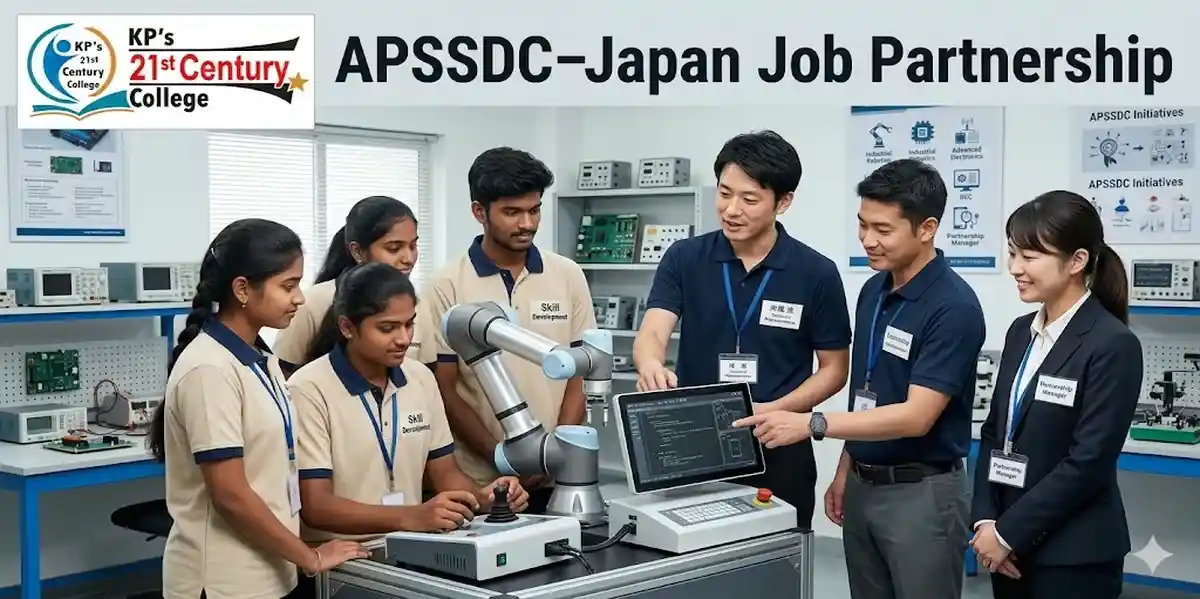
The partnership has been launched under APSSDC’s Skill International Programme to create structured overseas employment pathways for technically trained youth.
Under the arrangement:
- APSSDC will identify, mobilise, and train candidates through its institutional network.
- FVCC will facilitate recruitment, placement, documentation, onboarding, and employer coordination in Japan.
- Dedicated nodal officers will coordinate implementation and monitoring.
The initiative particularly targets ITI and polytechnic students trained in technical trades relevant to industrial manufacturing.
Japan’s Labour Crisis and Skilled Worker Demand
Japan faces severe labour shortages due to:
- Ageing population
- Declining birth rate
- Shrinking working-age population
This demographic transition has created demand for foreign skilled workers in manufacturing, healthcare, construction, and industrial services.
Japan’s automobile manufacturing ecosystem is among the sectors facing acute shortage of shop-floor technical workers.
This explains the increasing recruitment of foreign workers under regulated skill migration frameworks.
Land Titling Systems in India: Conceptual Shift
India traditionally follows a presumptive land titling system, where ownership is
Specified Skilled Worker (SSW) Visa System
Japan introduced the Specified Skilled Worker (SSW) system in 2019 to address labour shortages in selected sectors.
- SSW permits foreign workers in sectors facing manpower shortage.
- Manufacturing and industrial machinery sectors are included.
- Workers must pass skill proficiency and Japanese language tests.
- Unlike earlier trainee programmes, SSW allows limited job mobility within the same sector.
The programme is distinct from Japan’s older Technical Intern Training Programme (TITP), which was more restrictive in labour mobility.
Automobile Sector Linkages and Industrial Geography
The collaboration mainly targets Japan’s automobile and auto-component manufacturing sector.
Key geographical linkage:
- Aichi Prefecture is Japan’s major automobile manufacturing region.
- Toyota Motor Corporation has its headquarters in Toyota City within Aichi Prefecture.
The targeted jobs are technical shop-floor roles such as:
- CNC machine operators
- Welders
- Fitters
- Fabrication workers
- Assembly technicians
- Maintenance personnel
This reflects a sector-specific labour mobility model, unlike Gulf migration which is largely construction-oriented.
Skill Ecosystem and Technical Training in Andhra Pradesh
Andhra Pradesh possesses a growing network of:
- Industrial Training Institutes (ITIs)
- Polytechnics
- Skill development centres
The programme aligns ITI trades with Japanese industrial requirements.
Training modules include:
- Japanese language instruction
- Factory safety communication
- Precision manufacturing standards
- Kaizen practices
Kaizen is an important Japanese industrial concept emphasising continuous efficiency improvement and workplace discipline.
India–Japan Strategic and Economic Linkages
India and Japan maintain a Special Strategic and Global Partnership involving:
- Industrial cooperation
- Infrastructure development
- Skill partnerships
- Supply chain diversification
Japan has previously supported India through:
- Delhi–Mumbai Industrial Corridor (DMIC)
- Mumbai–Ahmedabad High-Speed Rail Project
- Japanese Industrial Townships
The APSSDC initiative reflects growing cooperation in human resource mobility and manufacturing integration.
Way Forward
- Technical education in Andhra Pradesh should increasingly align with international industrial standards.
- Language training and certification systems must be strengthened for overseas employability.
- India can expand bilateral skill mobility partnerships with ageing economies facing workforce shortages.
- Robust safeguards are needed to ensure fair recruitment practices and worker protection abroad.
Conclusion
The APSSDC–Japan partnership represents an important shift from low-skilled overseas migration toward structured global workforce integration in advanced manufacturing sectors. By linking technical education with international labour demand, Andhra Pradesh is positioning itself as a skilled manpower hub in the evolving global industrial economy.
CARE MCQ
Q. Consider the following statements regarding Japan’s Specified Skilled Worker (SSW) system:
- It was introduced to address labour shortages in selected sectors.
- Workers under the SSW system are completely prohibited from changing employers.
- Manufacturing sector jobs are covered under the SSW framework.
Which of the statements given above are correct?
(a) 1 and 2 only
(b) 1 and 3 only
(c) 2 and 3 only
(d) 1, 2 and 3
Ans: (b)
Explanation:
Statement 1 is correct: Japan introduced the Specified Skilled Worker (SSW) visa system in 2019 to address acute labour shortages in sectors facing workforce constraints.
Statement 2 is incorrect: Workers under the SSW framework are not completely prohibited from changing employers. They may change employers within the same eligible sector, subject to immigration and contractual conditions.
Statement 3 is correct: The manufacturing sector is one of the sectors covered under the SSW system, along with industries such as nursing care, construction, agriculture, and food services.
Q.Consider the following statements regarding the APSSDC–Japan FVCC partnership:
- The collaboration primarily targets managerial roles in Japan’s automobile companies.
- The partnership focuses on shop-floor technical roles such as machinists, welders, and industrial workers.
Which of the statements given above is/are correct?
(a) 1 only
(b) 2 only
(c) Both 1 and 2
(d) Neither 1 nor 2
Ans: (b)
Explanation:
Statement 1 is incorrect: The APSSDC–Japan FVCC partnership is not primarily aimed at managerial or white-collar positions. Instead, it focuses on addressing labour shortages in Japan’s industrial and manufacturing sectors through skilled technical manpower.
Statement 2 is correct: The programme mainly targets shop-floor and factory-level technical jobs such as machinists, welders, fitters, assembly-line operators, and other manufacturing-related occupations under Japan’s skilled worker framework. These sectors face significant labour shortages due to Japan’s ageing population and shrinking workforce.
The initiative aims to create structured employment pathways for Andhra Pradesh youth under Japan’s Specified Skilled Worker (SSW) and related visa categories.
Q.With reference to automobile sector employment in Japan, consider the following statements:
- Aichi Prefecture is one of Japan’s major automobile manufacturing regions.
- Toyota City is associated with large automobile production clusters.
Which of the statements given above is/are correct?
(a) 1 only
(b) 2 only
(c) Both 1 and 2
(d) Neither 1 nor 2
Ans: (c)
Explanation:
Statement 1 is correct: Aichi Prefecture is one of Japan’s most important industrial regions and serves as a major hub of the country’s automobile manufacturing industry. It hosts numerous automobile assembly plants, component manufacturers, and engineering facilities.
Statement 2 is correct: Toyota City developed around the operations of Toyota Motor Corporation and is globally recognized as a prominent automobile production cluster with extensive supplier networks and manufacturing infrastructure.
APPSC CARE MAINS:
Q.Discuss the significance of international skill mobility partnerships in addressing employment generation and demographic challenges with reference to the Andhra Pradesh–Japan collaboration. [250 WORDS]
FAQs
Q. What is APSSDC?
Ans: Andhra Pradesh State Skill Development Corporation is the State’s nodal agency for skill development and workforce training.
Q. What is Japan’s SSW visa system?
Ans: It is a visa framework introduced in 2019 to recruit foreign skilled workers in sectors facing labour shortages.
Q. Why is Japan recruiting foreign workers?
Ans: Due to ageing population and shrinking workforce.
Q. Which sector is the main focus of the APSSDC–Japan partnership?
Ans: Automobile and auto-component manufacturing sector.