Table of Contents
Relevance: GS Paper III – Infrastructure | Transport | Energy | Environment | Sustainable Urban Development
For Prelims:
APSRTC, Electric Bus, Gross Cost Contract (GCC), FAME India Scheme, CNG Bus, Lithium-ion Battery, LFP Battery, Depot Charging, Fast Charging, Stree Shakti Scheme
For Mains:
Public Transport Electrification, Sustainable Mobility, Green Transport, State Transport Undertakings, Urban Air Pollution, EV Policy, Energy Transition, Cost-efficient Public Transport
Why in News?
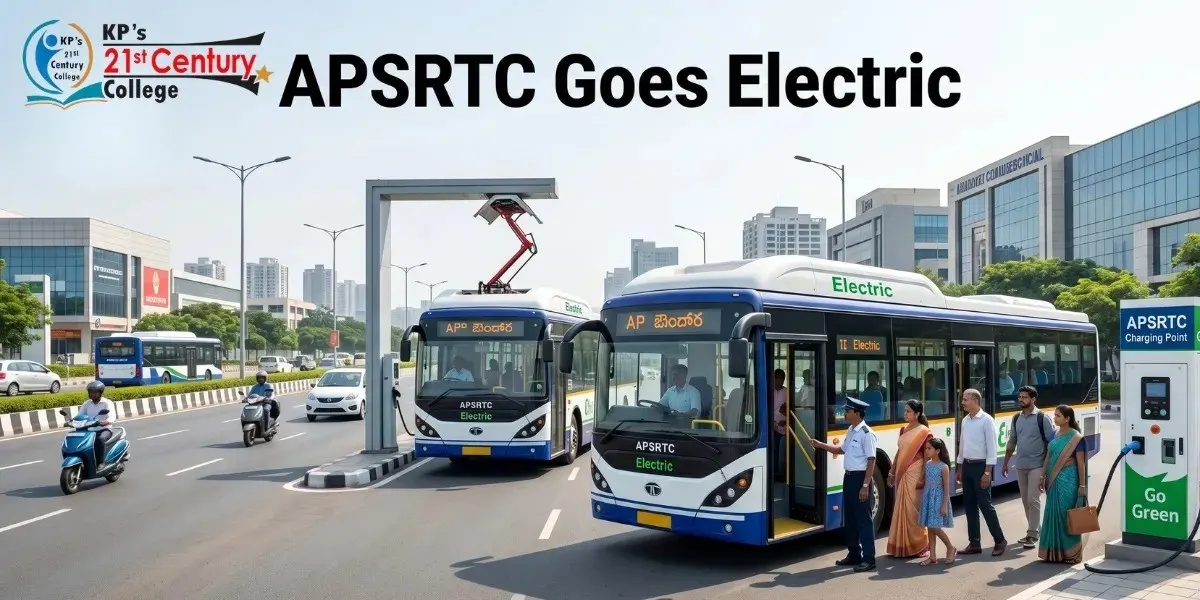
- The Andhra Pradesh government has prepared a roadmap to transform the Andhra Pradesh State Road Transport Corporation (APSRTC) into a modern electric mobility-driven public transport system.
- The plan focuses on the gradual replacement of ageing diesel buses with electric buses and the deployment of cleaner fleets to reduce operational costs, improve environmental performance, and make public transport financially sustainable.
- The government has approved the procurement of 5,746 electric buses and 500 CNG buses over the next five years, along with additional buses under the Stree Shakti scheme.
- This marks a major shift in Andhra Pradesh’s public transport policy toward sustainable and green mobility.
Background of APSRTC Fleet Modernisation
- State Road Transport Corporations across India have traditionally depended on diesel buses due to lower upfront costs and the availability of fuelling infrastructure.
- However, diesel buses involve high fuel expenditure, frequent maintenance costs, and significant environmental pollution through emissions of particulate matter, nitrogen oxides, and carbon dioxide.
- Rising fuel prices and increasing urban pollution have made diesel-based transport economically and environmentally difficult to sustain.
- APSRTC has therefore initiated a structured transition toward electric mobility to improve long-term financial efficiency and reduce dependence on conventional fuels.
- The move also aligns with India’s broader national goal of clean mobility and reduced transport-sector emissions.
Present Status of APSRTC Bus Fleet
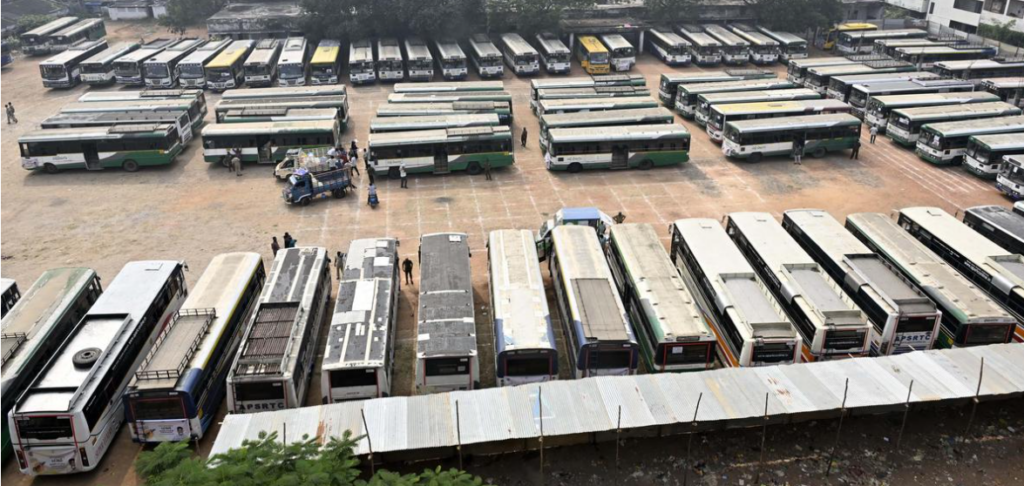
At present, APSRTC operates a total fleet of 10,951 buses.
Out of these:
- 8,199 are RTC-owned buses
• 2,752 are hired buses - Officials state that 2,630 buses, including 1,941 RTC-owned buses and 689 hired buses, will continue in operation because they will not complete either 15 years of service or their agreement period by 2030.
- This means these diesel buses must continue until the end of their approved lifespan.
- The remaining 8,321 buses are identified for gradual conversion into electric vehicles.
- This forms the core of the State’s electric mobility roadmap.
Government Roadmap for Electric Fleet Transition
The government has approved:
- Procurement of 5,746 electric buses
• Procurement of 500 CNG buses
• Proposal for 1,445 additional buses under the Stree Shakti scheme
• Procurement of 903 diesel buses for immediate operational needs - The diesel buses are being procured because large-scale deployment of EVs requires time for charging infrastructure, depot readiness, and route planning.
- Officials estimate that APSRTC requires financial assistance of ₹382 crore for the first year alone to meet the capital expenditure for diesel-to-electric bus conversion.
- This shows that the transition is planned as a phased and realistic reform rather than an immediate replacement.
Electric Buses in Public Transport
- Electric buses use battery-powered electric motors instead of internal combustion engines.
- Unlike diesel buses, they do not produce tailpipe emissions and therefore help reduce air pollution significantly.
- Most electric buses in India use Lithium-ion batteries, especially Lithium Iron Phosphate (LFP) chemistry because of better thermal stability and longer battery life.
- The typical operating range of an electric bus is around 150 to 300 kilometres per charge depending on battery capacity and route conditions.
- Electric buses are nearly 3 to 4 times more energy efficient than diesel buses because electric motors convert nearly 85–90% of input energy into motion.
- They also reduce operating costs by nearly 30–40% per kilometre over the long term.
- Charging systems generally include:
- Depot-based slow charging (6–8 hours)
Opportunity or fast charging (1–2 hours or less)
- Depot-based slow charging (6–8 hours)
- This makes them highly suitable for structured public transport operations.
Gross Cost Contract (GCC) Model
Most State Transport Undertakings in India deploy electric buses through the Gross Cost Contract (GCC) model.
Under this system:
- Private operators own and maintain the buses
• The government or transport corporation pays per kilometre of service - This model reduces the upfront capital burden on the government while ensuring professional maintenance and fleet management.
- It allows public transport corporations to expand electric fleets without bearing the full cost of vehicle ownership.
- The GCC model is widely used under national EV programmes and helps improve financial sustainability.
Diesel vs CNG vs Electric Buses
Aspect / Fact | Diesel Buses | CNG Buses | Electric Buses |
Main Fuel | High-speed diesel derived from petroleum | Compressed Natural Gas mainly consisting of Methane (CH₄) | Electricity stored in batteries |
Pollution Level | Highest pollution among all three | Lower pollution than diesel | Zero tailpipe emission |
Major Emissions | PM2.5, PM10, NOx, SOx, CO₂ | Lower PM and NOx, but CO₂ emissions and methane leakage concern | No direct PM, NOx, or CO₂ emission during operation |
Greenhouse Gas Concern | Major contributor to global warming | Methane leakage is serious because methane is more potent than CO₂ in the short term | Depends on electricity source; cleaner if powered by renewables |
Initial Cost | Lowest procurement cost | Moderate procurement cost | Highest procurement cost |
Long-Term Cost | Highest fuel and maintenance cost | Lower than diesel | Lowest operating and maintenance cost over time |
Noise Pollution | High engine noise | Moderate noise | Very low and much quieter |
Infrastructure Requirement | Existing fuel stations already available | Requires CNG stations and gas supply network | Requires charging stations and battery support system |
Environmental Status | Least sustainable option | Considered a transition or bridge fuel | Long-term sustainable transport solution |
Special Concern | High urban air pollution and fuel import burden | Methane leakage reduces climate benefits | Battery disposal and recycling challenge (lithium, cobalt, nickel) |
Government Policy Focus | Gradually being reduced | Used as an intermediate cleaner option | Strongly promoted under FAME India and PM e-Bus Sewa |
Strategic Benefit | High dependence on imported crude oil | Cleaner than diesel but still fossil-fuel based | Improves energy security and supports Net Zero 2070 target |
Policy Support for Electric Mobility
Electric bus adoption is supported by several national and state policies.
FAME India Scheme Phase II
- The Faster Adoption and Manufacturing of Hybrid and Electric Vehicles (FAME) Scheme promotes electric mobility, especially in public transport.
- It provides financial support for electric buses and charging infrastructure.
NITI Aayog E-Mobility Vision
- NITI Aayog promotes large-scale electrification of transport to reduce fuel imports and improve air quality.
Paris Agreement Commitments
- Transport is a major source of carbon emissions.
- Electric mobility supports India’s climate commitments under the Paris Agreement by reducing fossil fuel dependence.
Andhra Pradesh Mobility Goals
- APSRTC’s electric transition aligns with the State’s focus on green transport, urban sustainability, and efficient public service delivery.
Significance for Andhra Pradesh
- The transition to electric buses will reduce APSRTC’s long-term fuel expenditure and improve operational sustainability.
- It will reduce urban pollution and improve air quality, especially in major transport corridors.
- Electric buses also improve passenger comfort through reduced noise and smoother travel.
- The policy supports cleaner cities and strengthens Andhra Pradesh’s environmental commitments.
- The inclusion of additional buses under the Stree Shakti scheme also connects women-focused welfare with sustainable public transport expansion.
- This makes the reform both economically and socially significant.
Challenges in EV Transition
- The biggest challenge is the high initial capital cost of electric buses and charging infrastructure.
- Battery replacement and maintenance remain expensive.
- Charging stations require land, grid capacity, and technical planning.
- Long-distance and rural routes may face operational limitations due to charging range.
- Training of drivers, technicians, and depot staff is necessary.
- Financial sustainability depends on proper route planning and efficient contract management.
- The transition must also ensure that public transport services are not disrupted during fleet replacement.
Way Forward
- Charging infrastructure must be developed simultaneously with bus procurement.
- Depot modernisation and route-based planning should be prioritised.
- Use of renewable energy for charging can further improve sustainability.
- The GCC model should be strengthened with transparent contracts and performance monitoring.
- Financial assistance from the Centre and multilateral institutions should be leveraged.
- Battery recycling systems must be developed for long-term environmental safety.
- A balanced transition using diesel, CNG, and EVs during the intermediate phase will ensure operational continuity.
Conclusion
APSRTC’s roadmap for electric fleet transition represents a major structural reform in public transport.
The shift from diesel dependence toward electric mobility reflects both economic necessity and environmental responsibility.
With phased implementation, policy support, and infrastructure readiness, Andhra Pradesh can build a modern, cost-efficient, and sustainable transport system.
Electric buses are not merely a technology change—they represent the future of public mobility and urban governance.
CARE MCQ
Q. With reference to electric buses in public transport, consider the following statements:
- Electric buses generally have higher energy efficiency than diesel buses.
- Under the Gross Cost Contract model, the State Transport Corporation owns and maintains the buses directly.
- FAME India Scheme supports electrification of public transport systems.
Which of the statements given above are correct?
A) 1 and 3 only
B) 2 and 3 only
C) 1 and 2 only
D) 1, 2 and 3
Ans: (a)
Explanation
Statement 1 is correct because electric motors convert nearly 85–90% of input energy into motion, making them far more efficient than diesel engines.
Statement 2 is incorrect because under the Gross Cost Contract model, private operators own and maintain the buses while the government pays per kilometre of service.
Statement 3 is correct because FAME India Scheme Phase II specifically supports electric public transport including electric buses.
Therefore, the correct answer is A.
Q. Consider the following statements regarding urban air pollution in India:
- Vehicular emissions are among the major contributors to particulate pollution in large metropolitan cities.
- Secondary pollutants such as ground-level ozone can form due to chemical reactions involving nitrogen oxides and volatile organic compounds in the presence of sunlight.
- PM2.5 particles are larger and less harmful than PM10 particles because they settle faster in the atmosphere.
Which of the statements given above are correct?
(a) 1 and 2 only
(b) 2 and 3 only
(c) 1 and 3 only
(d) 1, 2 and 3
Ans: (a)
Explanation:
Statement 1 is correct: In major Indian cities, vehicular emissions are one of the leading contributors to urban air pollution, especially PM2.5, nitrogen oxides (NOx), carbon monoxide, and hydrocarbons. Rapid urbanization, traffic congestion, and the growing number of private vehicles significantly worsen air quality. Diesel vehicles are particularly important sources of fine particulate matter.
Statement 2 is correct: Ground-level ozone is a secondary pollutant, meaning it is not emitted directly but forms in the atmosphere through chemical reactions. When nitrogen oxides (NOx) and volatile organic compounds (VOCs) react in the presence of sunlight, ozone is produced near the surface. This is harmful to human health and crops, unlike stratospheric ozone which is beneficial.
Statement 3 is incorrect: This statement is incorrect because PM2.5 particles are smaller and more dangerous than PM10, not larger. Their very small size allows them to penetrate deep into the lungs and even enter the bloodstream, causing serious cardiovascular and respiratory diseases. PM10 is comparatively larger and less penetrating. Therefore, PM2.5 is more harmful, not less.
Q. Consider the following statements regarding Electric Vehicle (EV) policy in India:
- The FAME scheme was launched to promote faster adoption and manufacturing of electric and hybrid vehicles in India.
- Lithium-ion batteries used in EVs depend significantly on critical minerals such as lithium, cobalt, and nickel.
- Under India’s EV policy, registration tax and GST on all EVs are completely removed by constitutional mandate.
Which of the statements given above are correct?
(a) 1 and 2 only
(b) 2 and 3 only
(c) 1 and 3 only
(d) 1, 2 and 3
Ans: (a)
Explanation:
Statement 1 is correct: The FAME Scheme (Faster Adoption and Manufacturing of Electric Vehicles) was launched by the Government of India to encourage the use of electric and hybrid vehicles. It provides demand incentives, supports charging infrastructure, and promotes domestic manufacturing as part of India’s clean mobility transition. FAME-II further expanded this support, especially for public and shared transport.
Statement 2 is correct: Most EV batteries are based on lithium-ion technology, which depends heavily on critical minerals such as lithium, cobalt, nickel, and graphite. These minerals are strategically important because supply concentration in a few countries creates economic and geopolitical risks for energy transition goals.
Statement 3 is incorrect: There is no constitutional provision mandating complete removal of registration tax or GST on all EVs. While the government has reduced GST on EVs to 5% and some states provide registration tax exemptions or subsidies, these are policy measures, not constitutional obligations. Therefore, the statement is incorrect.
APPSC Mains Question
Q. Discuss the significance of electric bus adoption in State Road Transport Corporations with special reference to APSRTC’s roadmap for fleet electrification.
How can public transport electrification contribute to sustainable urban development in Andhra Pradesh?
(250 Words)
FAQs
Q1. Why is APSRTC shifting to electric buses?
To reduce fuel costs, improve environmental performance, modernise transport services, and make public transport financially sustainable.
Q2. What is the GCC model?
It is a system where private operators own and maintain buses while the government pays based on distance operated.
Q3. Why are LFP batteries commonly used in electric buses?
Because they offer better thermal safety, longer life, and reliable performance for heavy public transport use.
Q4. Why are CNG buses also being procured?
Because CNG acts as a cleaner transitional fuel while full-scale EV deployment takes time.
Q5. Which national scheme supports electric buses in India?
The FAME India Scheme Phase II supports electric public transport and charging infrastructure development.