APPSC Daily Current Affairs - 31st December 2025
Source: Deccan Chronicle
Relevance:
GS Paper III: Science & Technology – Space Technology, Indigenous technology development
Role of ISRO in strategic and commercial space sector
Important Key Concepts for Prelims and Mains:
For Prelims:
- ISRO, Small Satellite Launch Vehicle (SSLV), SS3 (SSLV Third Stage), Satish Dhawan Space Centre (SDSC), Vikram Sarabhai Space Centre (VSSC)
For Mains:
- Indigenous launch vehicle development, Solid rocket motor technology, Private sector participation in space, Launch-on-demand capability
Why in News?
- Indian Space Research Organisation (ISRO) successfully conducted a static ground test of an improved version of the third stage (SS3) of the Small Satellite Launch Vehicle (SSLV) at the Satish Dhawan Space Centre, Sriharikota.
- The test marks a key milestone in enhancing payload capacity, reliability, and industrial readiness of SSLV.
Location: Satish Dhawan Space Centre (SDSC), Sriharikota, Andhra Pradesh

About Small Satellite Launch Vehicle (SSLV)
- A three-stage, all-solid launch vehicle developed by ISRO.
- Designed to:
- Launch small satellites (up to ~500 kg) into Low Earth Orbit (LEO).
- Enable launch-on-demand with quick turnaround time.
- Be amenable to industrial production, supporting private sector participation.
- Intended to complement PSLV for the growing small-satellite market.
Key Technical Details of the SS3 Static Test
Third Stage (SS3) Characteristics
- Delivers velocity of up to 4 km/s to the launch vehicle.
- Employs:
- Monolithic composite motor case
- Free-standing nozzle divergent, reducing inert mass.
Major Improvements Validated
- Carbon-epoxy motor case:
- High-strength, filament-wound structure.
- Significantly reduced stage mass.
- Improved payload performance by ~90 kg.
- Improved igniter and nozzle system:
- Enhanced efficiency and robustness.
- Fault-tolerant electro-mechanical nozzle control system:
- Low-power control electronics.
- Higher reliability during flight.
Manufacturing & Indigenous Capability
- Motor case realised at:
- Vikram Sarabhai Space Centre (VSSC) – Composites Entity.
- Solid motor casting and testing:
- Satish Dhawan Space Centre (SDSC).
- Test duration: 108 seconds.
- Outcome:
- All parameters matched predictions.
- Improved SS3 motor qualified for induction into flight missions.
Infrastructure Expansion for Solid Motors (2025)
- Solid Motor production facilities commissioned (July 2025) at Sriharikota to augment capacity.
- Second production line for Ammonium Perchlorate commissioned (September 2025) at Alwaye:
- Doubled production of the key oxidiser for solid propellants.
- Indigenous 10-tonne vertical mixer commissioned at SDSC:
- World’s largest solid propellant mixing equipment.
- SMPST facilities at SDSC:
- Successfully realised and tested solid motor for the first orbital launch vehicle developed by an Indian space start-up.
Significance
- Technological Self-Reliance:
Strengthens indigenous capability in solid rocket propulsion and advanced composites. - Commercial Space Readiness:
Enhances SSLV’s competitiveness in the global small-satellite launch market. - Private Sector Enablement:
Industrial-friendly design supports ISRO–industry collaboration under the Indian Space Policy. - Strategic Capability:
Reliable solid motor technology is critical for both civilian and strategic launch systems. - Launch-on-Demand Vision:
Reduced turnaround time aligns with responsive space launch requirements.
Conclusion
The successful static test of the improved SSLV third stage (SS3) marks a major step in ISRO’s efforts to modernise India’s small satellite launch capability. By combining advanced materials, indigenous manufacturing, and expanded infrastructure, ISRO is strengthening India’s position as a reliable, self-reliant, and competitive space-faring nation.
CARE MCQ
Q. With reference to the Small Satellite Launch Vehicle (SSLV), consider the following statements:
- SSLV is a three-stage all-solid launch vehicle designed for launch-on-demand missions.
- The third stage of SSLV delivers approximately 4 km/s velocity to the launch vehicle.
- The improved SS3 motor uses a carbon-epoxy motor case to enhance payload capacity.
Which of the statements given above are correct?
A. 1 and 2 only
B. 2 and 3 only
C. 1 and 3 only
D. 1, 2 and 3
Answer: D
Explanation
- Statement 1 is correct.
The Small Satellite Launch Vehicle (SSLV) is a three-stage, all-solid launch vehicle developed by ISRO. It is specifically designed to support launch-on-demand missions with a quick turnaround time and is suitable for industrial production, catering to the growing small-satellite market. - Statement 2 is correct.
The third stage (SS3) of SSLV provides a velocity of up to about 4 km/s to the launch vehicle. This high velocity contribution is critical for inserting small satellites into their intended Low Earth Orbits. - Statement 3 is correct.
The improved version of the SS3 motor uses a carbon-epoxy composite motor case, which significantly reduces the inert mass of the stage. This weight reduction has resulted in an increase of about 90 kg in payload capacity, thereby enhancing the overall performance of SSLV.
Source: The Hindu
Relevance:
GS Paper I – Indian Culture, Art & Architecture (Maritime Heritage)
GS Paper III – Indigenous Technology, Knowledge Systems
Important Key Concepts for Prelims and Mains:
For Prelims:
- INSV Kaundinya, Stitched Ship, Ajanta Caves, Tankai Method, Coir Rope, Indigenous Shipbuilding, Maritime Heritage, Indian Ocean Trade Routes
For Mains:
- Maritime Civilisation, Indigenous Knowledge Systems (IKS), Cultural Diplomacy, Archaeology–Technology Interface, Soft Power Projection, Heritage Revival
Why in News?
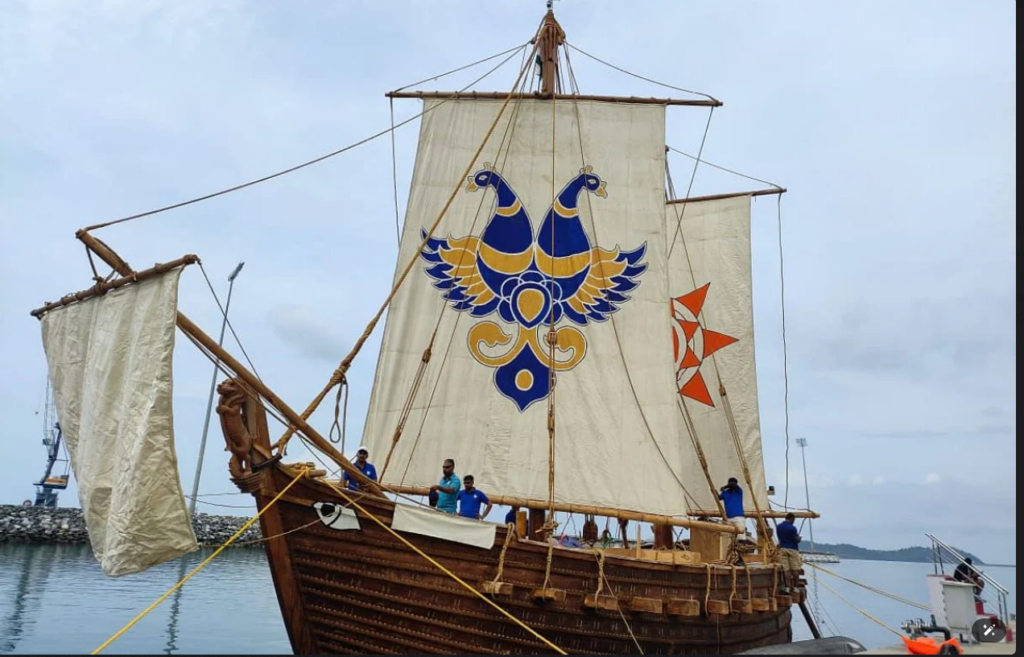
The Indian Navy’s stitched sailing vessel INSV Kaundinya has commenced its maiden overseas voyage from Porbandar (Gujarat) to Muscat (Oman), symbolically retracing ancient Indian Ocean maritime routes that once connected India with West Asia, Africa, and Southeast Asia.
Background: India’s Stitched Ship Tradition
India possesses one of the world’s oldest seafaring traditions. Long before the advent of modern navigation and metal-hulled ships, Indian mariners built stitched vessels using wooden planks bound together with coconut coir ropes and sealed with natural resins.
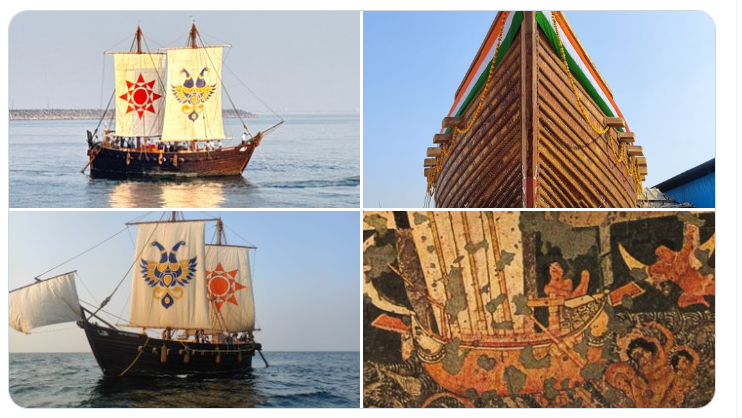
- Such vessels are referenced in literary sources, archaeological findings, and visual depictions, notably the 5th century CE Ajanta Cave paintings.
- These ships enabled sustained trade, migration, and cultural exchange across the Indian Ocean world.
INSV Kaundinya: Design and Construction
INSV Kaundinya is a faithful recreation of an ancient Indian sailing vessel, built using historically authentic techniques.
- Inspired by a ship depicted in the Ajanta murals (5th century CE)
- Constructed under a tripartite collaboration:
- Ministry of Culture
- Indian Navy
- Hodi Innovations
Traditional Craftsmanship
- Built using the Tankai method, where:
- Hull is stitched first
- Ribs are added later
- No metal or engines are used
- Wooden planks stitched with coir rope, sealed with natural resin, cotton, and oils
- Crafted by traditional artisans from Kerala, led by master shipwright Babu Sankaran
Technical Details
- Length: ~19.6 metres
- Width: ~6.5 metres
- Draft: ~3.33 metres
- Crew: ~15 trained sailors
- Powered entirely by wind and sail
Symbolism and Cultural Significance
INSV Kaundinya is not merely a vessel but a floating symbol of India’s maritime civilisation.
- Sail motifs: Gandabherunda and Sun – symbols of power and continuity
- Bow sculpture: Simha Yali – guardian figure signifying strength and protection
- Deck element: Harappan-style stone anchor, evoking early seafaring traditions
- Named after Kaundinya, the ancient Indian mariner associated with early voyages to Southeast Asia
Strategic and Civilisational Importance
Reviving Ancient Maritime Highways
- The Porbandar–Muscat route was historically a vital corridor for:
- Spice and textile trade
- Cultural and religious exchange
- Knowledge transmission
Soft Power and Cultural Diplomacy
- Demonstrates India’s civilisational depth and continuity
- Reinforces India’s identity as a historic maritime power, not merely a modern naval state
- Complements initiatives such as:
- Indian Ocean outreach
- Cultural diplomacy with Gulf and ASEAN regions
Challenges Highlighted
- Absence of original blueprints required reliance on artistic and archaeological interpretation
- Need to reconcile ancient design with modern safety and stability standards
- Limited public awareness of India’s indigenous maritime technologies
Way Forward
- Integrate such projects into heritage education and maritime museums
- Promote stitched ship voyages as part of cultural tourism and diplomacy
- Encourage interdisciplinary collaboration between:
- Archaeologists
- Naval architects
- Traditional artisans
- Use INSV Kaundinya as a model for reviving other indigenous technological traditions
Conclusion
INSV Kaundinya stands as a living testament to India’s ancient maritime ingenuity. By successfully recreating and sailing a stitched vessel across historic ocean routes, India has reaffirmed its civilisational engagement with the seas. The initiative bridges archaeology, indigenous knowledge, and modern naval expertise, strengthening India’s cultural soft power while restoring pride in its maritime past.
UPSC PYQ
Q. With reference to the Indian Ocean Rim Association for Regional Cooperation (IOR-ARC), consider the following statements: (2015)
- It was established very recently in response to incidents of piracy and accidents of oil spills.
- It is an alliance meant for maritime security only.
Which of the statements given above is/are correct?
- 1 only
- 2 only
- Both 1 and 2
- Neither 1 nor 2
Answer: D
CARE MCQ
Q. INSV Kaundinya, recently in the news for reviving India’s ancient maritime heritage, is distinctive because it:
- Uses a hybrid engine–sail propulsion system and welded metal hull
- Is powered solely by sails and constructed using the indigenous Tankai method
- Employs nuclear propulsion with a steel-reinforced hull
- Is operated by an unmanned autonomous navigation system
Answer: B
Explanation:
INSV Kaundinya is a traditional sailing vessel that relies entirely on wind propulsion. It is built using the Tankai method, an ancient Indian shipbuilding technique in which the hull is stitched first and ribs are added later, completely avoiding the use of metal.
Additional Information:
- The vessel is about 19.6 metres long and 6.5 metres wide, with a draft of 3.33 metres.
- It is operated by a crew of around 15 trained sailors.
- The project aims to recreate ancient Indian maritime practices and highlight India’s seafaring heritage in the Indian Ocean region.
Source: The Hindu
Relevance:
Facts for Prelims, GS Paper I – Medieval Indian History – Bhakti Movement, Indian Culture – Literature, Music, Dance, Theatre, Regional cultural traditions of Northeast India
Important Key Concepts for Prelims and Mains:
For Prelims:
- Batadrava Than / Borduwa, Mahapurush Srimanta Sankardeva Abhirbhav Kshetra, Srimanta Sankardeva, Neo-Vaishnavism, Ekasarana Nama Dharma, Namghar, Satra, Ankiya Naat, Bhaona, Sattriya Dance, Borgeet, Gayan-Bayan
For Mains:
- Bhakti movement in Northeast India, Cultural federalism, Religion as a tool of social integration, Preservation of living heritage, State role in cultural conservation
Why in News?
- Amit Shah inaugurated the ₹227-crore redeveloped Batadrava Than, the birthplace of Srimanta Sankardeva, in Assam’s Nagaon district.
- The project has been designed not merely as a tourism site, but as a cultural-spiritual complex reflecting the life, philosophy, and artistic legacy of Mahapurush Sankardeva and Assam’s Vaishnavite traditions.

About the Redevelopment Project
- Official Name: Mahapurush Srimanta Sankardeva Abhirbhav Kshetra
- Project Cost: ₹227 crore
- First Proposed: Assam State Budget 2021–22
Objectives
- Preserve Sankardeva’s religious, cultural, and artistic legacy
- Strengthen Assam’s Namghar–Satra ecosystem
- Promote heritage-based spiritual tourism
- Showcase Assam’s broader cultural traditions
Highlights of the Inauguration
- Presence of:
- Assam CM Himanta Biswa Sarma
- Union Ministers Sarbananda Sonowal and Pabitra Margherita
- Assam Cultural Minister Bimal Bora
- The Home Minister received a traditional Sattriya welcome through Gayan-Bayan (ritual singing and drumming).
- Visited the central sanctum housing the Guru Asana, the sacred seat of Sankardeva.
Who was Srimanta Sankardeva?
About
- Period: 15th–16th century (1449–1568)
- Region: Assam
- Role: Bhakti saint, philosopher, social reformer, poet, playwright, musician, dancer
- Holds a foundational position in Assam’s history, society, culture, and religious life
- His work initiated a new phase of Assamese literature and culture
- A major figure of the Indian Bhakti movement, especially in Eastern India

Early Life and Background
- Born: October 1449
- Family: Siromani Bhuyans (landed gentry)
- Undertook a transformative pilgrimage across North India in 1481
- Composed his first Borgeet at Badarikashrama (Badrinath)
- Faced opposition from:
- Orthodox religious groups
- Local rulers
- Shifted locations frequently due to persecution
- Died: 1568
Philosophical & Religious Contributions
Neo-Vaishnavism in Assam
- Founder and propagator of Eka-Sarana-Nama-Dharma (Mahapurushiya Dharma)
Core Principles
- Worship of a single deity – Vishnu as Krishna
- Essence lies in sarana (exclusive refuge) in one God
- Rejected:
- Idol worship
- Elaborate rituals
- Caste hierarchy
Forms of Bhakti Emphasised
Out of Navadha Bhakti, stressed only:
- Śravaṇa – Listening to God’s name and stories
- Kīrtana – Congregational chanting and singing
Social Vision
- Advocated universal brotherhood
- Unified Assam’s heterogeneous society (tribes, castes, languages) under Neo-Vaishnavism
Institutional Contributions
Namghars
- Community prayer halls
- Centres of:
- Congregational worship
- Social equality
- Moral discipline
- Open to all castes and communities
Satras
- Vaishnavite monasteries
- Centres for:
- Religious instruction
- Arts (music, dance, theatre)


Literary Contributions
- Translated 8 of the 12 books of the Bhagavata Purana into Brajavali
- Adi Dasama (Krishna’s childhood) – most popular section
Major Works
| Work | Description |
| Kirtana-Ghosha | Magnum opus; congregational devotional songs; one of Assam’s four sacred texts |
| Gunamala | Condensed Bhagavata Purana; composed in one night |
| Nimi Nava Siddhi Samvada | Doctrinal treatise |
| Bhakti Pradipa | Denounces worship of deities other than Krishna |
| Bhatimas | Innovative poetic form for praising God or Guru |
| HariScandra-Upakhyana | Early narrative work |
| Rukmini Harana Kavya | Early devotional kavya |
Contributions to Art & Culture
Ankiya Naats
- One-act plays with no divisions
- Written in Brajavali
- Blend:
- Religious philosophy
- Indigenous entertainment
- Classical Sanskrit drama
Bhaona
- Theatrical performance of Ankiya Naats
- Performed in Namghars
Sattriya Dance
- Originated in Satras
- Recognised as a classical dance form of India
- Governed by rules of rhythm, expression, and singing
Borgeets
- Devotional songs based on ragas and talas
- Around 240 composed
- Still actively sung today
Comparative Perspective & Culture
| Aspect | Shaivism | Vaishnavism | Neo-Vaishnavism (Ekasarana) |
| Supreme Deity | Shiva | Vishnu / avatars | Krishna alone |
| Region | South India, Kashmir | Pan-India | Assam & Northeast |
| Practice | Yoga, tantra | Temple worship | Naam-kirtan, no idols |
| Philosophy | Jnana / Tantra | Bhakti & surrender | Exclusive devotion, egalitarian |
| Key Figures | Adi Shankara | Ramanuja, Chaitanya | Sankardeva, Madhavdeva |
| Culture | Shaiva temples | Bhakti poetry | Namghars, Satras, Sattriya |
Legacy
- Namghars and Satras remain living institutions
- Sattriya, Bhaona, Borgeets, Kirtana-Ghosha continue as core elements of Assamese identity
- Sankardeva’s legacy sustains:
- Literature
- Music
- Dance
- Theatre
- Social harmony
Conclusion
The ₹227-crore redevelopment of Batadrava Than, combined with the enduring spiritual, cultural, and social legacy of Srimanta Sankardeva, reinforces Assam’s place in India’s Bhakti tradition. The initiative highlights how living cultural institutions, when supported by the State, can strengthen identity, inclusivity, and heritage-based development
UPSC PYQ
Q. With reference to the famous Sattriya dance, consider the following statements: (2014)
- Sattriya is a combination of music, dance and drama.
- It is a centuries-old living tradition of Vaishnavites of Assam.
- It is based on classical Ragas and Talas of devotional songs composed by Tulsidas, Kabir and Mirabai.
Which of the statements given above is/are correct?
- 1 only
- 1 and 2 only
- 2 and 3 only
- 1, 2 and 3
Ans: B