Boost Your APPSC Group-1 Preparation - New Batch & Test Series 2026
Relevance: APPSC Group I Paper IV: Economy and Development of Andhra Pradesh
Prelims
Andhra Pradesh State Handbook of Youth Opportunity, YouthPOWER score, Future of India Foundation, GITAM Deemed to be University, labour force participation, regular salaried employment
Mains
Graduate unemployment, women’s workforce participation, education–employment gap, industry-linked skilling, district-level planning, employment quality, labour productivity, inclusive growth
Why in News?
The Andhra Pradesh State Handbook of Youth Opportunity has ranked Visakhapatnam first among the State’s 26 districts, with a YouthPOWER score of 55.The handbook was released at GITAM Deemed to be University in Visakhapatnam by MP M. Sribharat. The event was organised by the Future of India Foundation.
About the Andhra Pradesh State Handbook of Youth Opportunity
The handbook assesses the opportunities available to young people across all 26 districts of Andhra Pradesh.
The assessment covers five parameters:
- Participation
- Opportunity
- Work
- Education
- Readiness or skilling
Its findings are based on nearly 180 indicators drawn from 27 government databases. The district-level approach helps identify differences in education, employment, skills and economic opportunities within the State.
Andhra Pradesh’s Youth Employment Profile
- Andhra Pradesh performs relatively well in school education, while a large proportion of young people pursue higher education compared with many other States.
- However, the handbook identifies a gap between educational progress and employment outcomes. The State has struggled to convert its educational advantages into secure and well-paid employment, particularly for graduates.
Major Employment Indicators
| Indicator | Andhra Pradesh’s position |
| Youth unemployment rate | 16.2% |
| Youth labour force participation rate | 46.4% |
| Youth neither employed, studying nor undergoing training | 28.4% |
| Labour force participation among young women | 29.7% |
The figures indicate that participation in education has not automatically resulted in adequate employment opportunities.
The handbook identifies two areas requiring urgent attention:
- Creating suitable employment for graduates
- Increasing women’s participation in the workforce
Positive Developments in Andhra Pradesh
The handbook also records important improvements in the State.
Improvement in Nutrition
Child and adult nutrition indicators improved in Andhra Pradesh even as they worsened in the median State during the same period.
Shift in Employment Structure
Over the previous eight years, young workers gradually moved away from agriculture towards:
- Services
- Trade
- Hospitality
- Construction
This reflects a change in the sectoral distribution of youth employment.
Financial and Digital Access
- Access to banking and digital connectivity among young women expanded faster in Andhra Pradesh than in any other State surveyed.
- However, improvements in education, nutrition and digital access were not matched by corresponding improvements in the quality and security of employment.
Why Did Visakhapatnam Rank First?
- Visakhapatnam recorded the highest YouthPOWER score of 55 because of its relatively strong performance in employment, productivity and education.
High Share of Salaried Employment
- Around 60% of workers in Visakhapatnam hold regular salaried jobs. This is nearly three times the 21% recorded in a typical district.
- The district’s labour market therefore has a stronger orientation towards formal employment.
Higher Labour Productivity
Value added per worker, which indicates the productivity of local enterprises, is approximately:
- ₹1.79 lakh in Visakhapatnam
- ₹1.42 lakh in a typical district
This suggests that enterprises in Visakhapatnam generate greater economic value per worker than those in the median district.
Better Educational Participation among Young Women
- Only 15% of young women aged 15–21 years in Visakhapatnam were outside education. The corresponding figure for a typical district was 33%.
Stronger Mathematics Learning Outcomes
- Around 41% of Class 9 students in Visakhapatnam met grade-level standards in mathematics, compared with 35% in a typical district.
- In the handbook, a “typical district” means the median district value for the respective indicator.
Comparative Position of Visakhapatnam
| Indicator | Visakhapatnam | Typical district |
| Workers in regular salaried employment | 60% | 21% |
| Value added per worker | ₹1.79 lakh | ₹1.42 lakh |
| Young women aged 15–21 outside education | 15% | 33% |
| Class 9 students meeting mathematics standards | 41% | 35% |
These indicators explain Visakhapatnam’s leading position in the State-level ranking.
Conclusion
The YouthPOWER rankings show that Visakhapatnam has developed comparatively strong educational and formal employment outcomes. However, Andhra Pradesh continues to face a wider gap between educational achievement and secure employment, particularly among graduates and young women. Closer coordination among educational institutions, skilling agencies, industries and elected representatives is necessary to convert the State’s human capital into productive and inclusive employment.
CARE MCQ
Q. Consider the following statements regarding the Andhra Pradesh State Handbook of Youth Opportunity:
- It assesses all 26 districts of Andhra Pradesh.
- It evaluates districts across participation, opportunity, work, education and readiness.
- Visakhapatnam recorded the highest YouthPOWER score in the State.
- More than half of Visakhapatnam’s workers hold regular salaried jobs.
Which of the statements given above are correct?
(a) 1 and 2 only
(b) 1, 2 and 3 only
(c) 2, 3 and 4 only
(d) 1, 2, 3 and 4
Answer: (d) 1, 2, 3 and 4
Statement-wise Explanation
- Statement 1 is correct: The handbook assesses all 26 districts of Andhra Pradesh.
- Statement 2 is correct: Its five parameters are participation, opportunity, work, education and readiness or skilling.
- Statement 3 is correct: Visakhapatnam ranked first with a YouthPOWER score of 55.
- Statement 4 is correct: Around 60% of workers in Visakhapatnam hold regular salaried jobs.
FAQs
1. What is the Andhra Pradesh State Handbook of Youth Opportunity?
It is a district-level assessment of youth participation, opportunity, work, education and readiness in Andhra Pradesh.
2. Which district topped the YouthPOWER rankings?
Visakhapatnam topped the rankings with a score of 55.
3. What is Andhra Pradesh’s youth unemployment rate?
The handbook places the State’s youth unemployment rate at 16.2%.
4. What are the two urgent concerns identified by the handbook?
They are graduate employment and low workforce participation among young women.
5. Why did Visakhapatnam perform well?
It recorded higher salaried employment, greater labour productivity and better educational outcomes.
6. What does a “typical district” mean in the handbook?
It refers to the median district value for the relevant indicator.
Relevance: UPSC GS Paper II: Government Policies and Citizen Participation
Prelims
Swachh Bharat Mission, SBM-G, SBM-U, Swachhata Hi Seva, ODF Plus, GOBARdhan, Cleanliness Target Units, SafaiMitra, FACES, Swachhata App
Mains
Jan Bhagidari, behavioural change, circular economy, source segregation, sanitation-worker welfare, resource recovery, community ownership, Whole-of-Government approach
Why in News?
Swachhata Hi Seva 2026 is being conducted from September 17 to October 2, 2026, under the theme “Swachhata Mein Sahbhag; Swachh Bharat, Viksit Bharat.”The campaign emphasises collective ownership of cleanliness, youth participation, sanitation-worker welfare, waste-management responsibilities and public awareness of the Solid Waste Management Rules, 2026.
What is the Swachh Bharat Mission?
- The Swachh Bharat Mission (SBM) was launched on October 2, 2014 as a nationwide sanitation movement.
- Its logo represents the spectacles of Mahatma Gandhi, reflecting his emphasis on cleanliness. The logo helped create a common identity for the national cleanliness campaign.
The Mission has two components:
| Component | Area of focus |
| Swachh Bharat Mission-Grameen | Rural sanitation, toilet access and usage, solid waste management and liquid waste management |
| Swachh Bharat Mission-Urban | Urban sanitation, public spaces, waste management and sanitation infrastructure |
The Mission initially focused on access to toilets and the elimination of open defecation. It has since expanded into a wider movement covering:
- Waste collection and segregation
- Solid and liquid waste management
- Visual cleanliness
- Behavioural change
- Sanitation-worker welfare
- Citizen participation
Progress under Swachh Bharat Mission
Rural Sanitation
Rural India was declared Open Defecation Free in 2019.
As of September 17, 2026:
| Indicator | Achievement |
| ODF Plus villages | More than 5.69 lakh |
| ODF Plus Model villages | More than 5.25 lakh |
| Villages with solid-waste management | More than 5.38 lakh |
| Villages with liquid-waste management | More than 5.65 lakh |
| Individual household toilets constructed | 12.22 crore |
| Operational GOBARdhan plants | 1,314 in 585 districts |
| Household-level biogas plants | 98,273 |
Urban Sanitation
| Indicator | Achievement |
| Wards with complete door-to-door waste collection | 95,478 |
| Wards with complete source segregation | 83,963 |
| Waste-to-compost plants | 3,254 |
| Waste-to-energy plants | 60 |
| Sewage treatment plants | 1,112 |
| Faecal sludge treatment plants | 1,131 |
| Public sanitation facilities | 68,339 |
The public sanitation facilities include:
- 37,766 public toilets
- 25,512 community toilets
- 5,061 urinals
These achievements show the Mission’s transition from toilet construction to comprehensive and sustainable sanitation systems.
What is an ODF Plus Village?
- An ODF Plus village sustains its open-defecation-free status while managing solid and liquid waste and maintaining visual cleanliness.
ODF Plus villages are classified into three progressive stages:
| Stage | Requirement |
| Aspiring | Manages either solid waste or liquid waste |
| Rising | Manages both solid and liquid waste |
| Model | Manages both waste streams, maintains visual cleanliness and displays ODF Plus messages |
The classification encourages villages to move gradually from basic sanitation to complete waste management and visible cleanliness.
What is Swachhata Hi Seva?
- Swachhata Hi Seva (SHS) is an annual public-participation campaign conducted since 2017.
- It is organised before Swachh Bharat Diwas, observed on October 2. It provides a dedicated period for citizens, institutions and governments to undertake collective cleanliness activities.
- The campaign is based on Jan Bhagidari, which means public participation in governance and community development.
| Important Related Terms
|
Swachhata Hi Seva 2026
SHS 2026 follows both a Whole-of-Government and a Whole-of-Society approach.
Whole-of-Government Approach
- Different ministries, departments, State governments, local bodies and public institutions coordinate their sanitation activities.
Whole-of-Society Approach
- Citizens, students, youth organisations, NGOs, sanitation workers, educational institutions and community groups participate collectively.
- The campaign also creates awareness about the Solid Waste Management Rules, 2026, particularly the responsibilities of citizens, institutions and waste generators.
Five Activity Pillars of SHS 2026
1. Transformation of Cleanliness Target Units and Public Places
Cleanliness Target Units (CTUs) are neglected garbage points and difficult-to-clean locations requiring special intervention.
The campaign seeks to transform these areas through:
- Waste removal
- Beautification
- Mapping of cleaned locations
- Long-term maintenance
- Prevention of renewed dumping
The campaign covers:
- Markets
- Schools
- Hospitals
- Transport hubs
- Parks
- Water bodies
- Public and community toilets
Citizens can report garbage and sanitation-related grievances through the Swachhata App. Identified sites can subsequently be mapped on the SHS 2026 portal.
FACES Assessment
Public and community toilets will be assessed through FACES parameters:
- F – Functional
- A – Accessible
- C – Clean
- E – Eco-friendly
- S – Safe
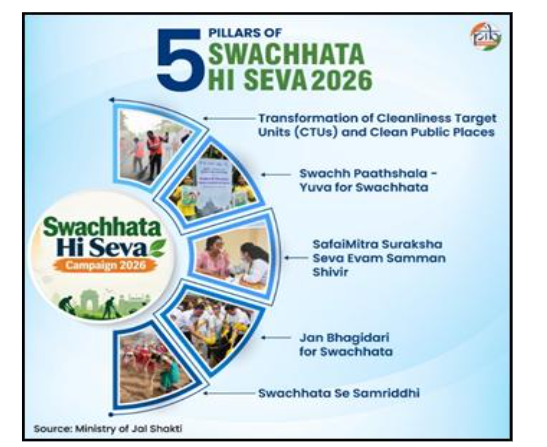
2. Swachh Paathshala—Yuva for Swachhata
- Students and young people have been given a dedicated role in the campaign.
- Students from Classes 6 to 12 will participate in Swachhata Gyan Yatras to sanitation and waste-management facilities.
Schools are encouraged to organise discussions on:
- Waste management
- Water conservation
- Personal hygiene
- Handwashing
- Menstrual hygiene
- Safe drinking water
The objective is to build sanitation awareness at an early age and create long-term behavioural change.
3. SafaiMitra Suraksha, Seva Evam Samman Shivirs
Special camps will be organised for sanitation workers and their families.
They will provide:
- Health services
- Safety equipment
- Welfare-scheme linkages
- Recognition of sanitation workers
- Support for workers’ families
The pillar recognises that sustainable sanitation depends upon the health, dignity and safety of sanitation workers.
4. Jan Bhagidari for Swachhata
Citizens and institutions are encouraged to take responsibility for everyday cleanliness.
Major activities include:
- Awareness about the Solid Waste Management Rules, 2026
- Demonstrations of four-way waste segregation
- Promotion of home composting
- Campaigns against littering
- Campaigns against single-use plastics
- Swachhata rallies and human chains
- Public cleanliness pledges
- Collection of reusable household items
Swachh Parv, Harit Parv
Festivals occurring during the campaign period are encouraged to follow:
- Plastic-free practices
- Eco-friendly decorations
- Proper waste segregation
- Post-festival cleaning
- Environmentally responsible celebrations
5. Swachhata Se Samriddhi
This pillar connects cleanliness with economic value, resource recovery and the circular economy.
It promotes the principles of:
- Reduce
- Reuse
- Recycle
Important activities include:
- Kabaad Se Jugaad: Creating useful products from discarded materials.
- Kabaad Se Kala: Producing art from waste materials.
The initiative shows that waste can become a resource when it is properly segregated, reused and recycled.
Special Activities
Ek Din, Ek Ghanta, Ek Saath
- On October 1, 2026, simultaneous cleanliness activities will be organised across the country.
- Citizens, institutions, youth groups and NGOs are encouraged to participate together for one hour.
Special Meetings on October 2
On Swachh Bharat Diwas:
- Special Gram Sabhas will discuss SHS activities and the Solid Waste Management Rules, 2026.
- Urban local bodies will conduct Special Council Meetings.
These meetings seek to convert campaign activities into continuing local action.
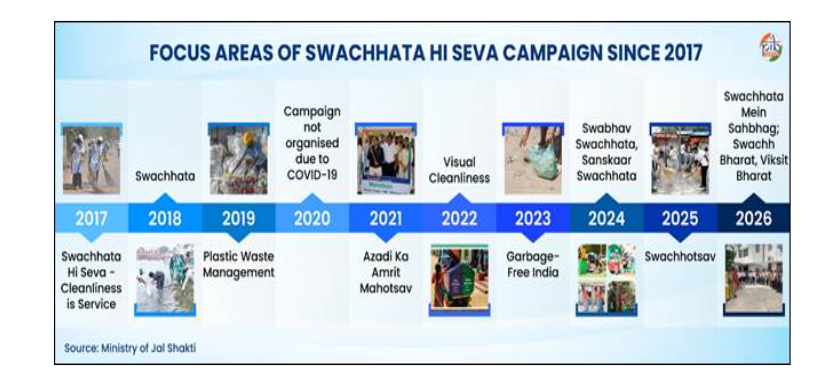
Evolution of Swachhata Hi Seva
The campaign has gradually expanded from voluntary cleaning to sustainable waste management and behavioural change.
| Year | Main focus |
| 2017 | Beginning of the people-led cleanliness movement and large-scale shramdaan |
| 2018 | Strengthening Jan Bhagidari and declaring sanitation as everyone’s responsibility |
| 2019 | Plastic-waste collection, segregation and reduction of single-use plastics |
| 2020 | Campaign not conducted because of the COVID-19 pandemic |
| 2021 | Sustaining ODF status, ODF Plus activities and liquid-waste management |
| 2022 | Visual cleanliness, waste segregation and the 4R principle |
| 2023 | “Garbage-Free India,” public-space transformation and SafaiMitra welfare |
| 2024 | “Swabhav Swachhata, Sanskaar Swachhata”—cleanliness as a habit and value |
| 2025 | “Swachhotsav”—clean and environmentally responsible community celebrations |
| 2026 | “Swachhata Mein Sahbhag”—collective ownership and sustained participation |
Major Milestones in the Campaign’s Evolution
SHS 2017: Beginning of a People-Led Movement
The first campaign was launched on September 15, 2017. It promoted voluntary participation and the Swachhata pledge.
At that time:
- 4.82 crore toilets had been constructed since 2014.
- 2.38 lakh villages had become ODF.
- Toilet coverage had increased from 42% in 2014 to 64% in 2017.
- 2.46 crore children participated in a national painting competition.
SHS 2019: Focus on Plastic Waste
The campaign promoted alternatives such as cloth and jute bags and organised plastic-waste collection and segregation.
During this period:
- Six States discouraged or banned single-use plastic.
- Similar action was taken by 171 districts.
SHS 2021: Comprehensive Cleanliness
The campaign focused on sustaining ODF achievements and accelerating ODF Plus activities.
Important actions included:
- More than 60 lakh participants
- Over 1.5 lakh shramdaan activities
- More than 43,000 Gram Sabha resolutions against single-use plastic
- Construction of household and community soak pits for liquid-waste management
SHS 2022: Visual Cleanliness
The campaign promoted the 4R principle:
- Refuse
- Reduce
- Reuse
- Recycle
More than 9.81 crore people participated in sanitation-related shramdaan.
SHS 2023: Garbage-Free India
The campaign recorded large-scale action to clean:
- Beaches
- Riverbanks and waterfronts
- Legacy waste sites
- Tourist destinations
- Public spaces
- Water bodies
- Garbage-vulnerable sites
It also organised SafaiMitra welfare camps and brought youth into the campaign through the Indian Swachhata League 2.0.
SHS 2024: Cleanliness as Behaviour
The theme “Swabhav Swachhata, Sanskaar Swachhata” connected cleanliness with habits and social values.
The campaign transformed neglected residential areas, roadsides and markets. It also promoted:
- Swachh Bharat Cultural Fests
- Swachh Food Streets
- Waste-to-Art activities
- Tree plantation
- SafaiMitra welfare
SHS 2025: Swachhotsav
The campaign brought sanitation practices into community celebrations.
Its five pillars covered:
- Transformation of CTUs
- Clean public spaces
- SafaiMitra welfare
- Clean and green festivities
- Advocacy for Swachhata
The campaign cleaned 15.75 lakh CTUs and 5.89 lakh public spaces. It also promoted eco-friendly pandals, post-festival cleanliness and Swachhata Rangolis.
Significance of SHS 2026
Behavioural Change
The campaign seeks to make cleanliness a regular habit rather than an occasional activity.
Citizen Ownership
Jan Bhagidari makes citizens active partners in sanitation instead of treating cleanliness as the government’s responsibility alone.
Youth Participation
School-based activities can create a generation that understands waste segregation, hygiene and environmental responsibility.
Dignity of Sanitation Workers
Health camps, safety equipment and welfare linkages recognise the essential role of SafaiMitras.
Circular Economy
Reuse, recycling, composting and waste-to-art activities reduce waste while recovering economic and social value.
Sustainable Public Spaces
The transformation and continued maintenance of CTUs can prevent cleaned areas from returning to their earlier condition.
Local Institutional Participation
Gram Sabhas and urban local bodies can convert national campaign goals into village- and city-level action.
Viksit Bharat
Clean surroundings, efficient waste management, healthy communities and responsible citizenship support the wider objective of a developed India.
Challenges
Sustaining Behavioural Change
Public participation may decline after the campaign period ends.
Source Segregation
Waste processing becomes difficult when households and institutions fail to separate waste correctly.
Maintenance of Transformed Sites
Cleanliness Target Units may again become dumping points without regular monitoring.
Sanitation-Worker Safety
Workers require continuous access to protective equipment, health services and welfare benefits.
Infrastructure Management
Waste-treatment plants, toilets, drainage systems and sanitation facilities require regular operation and maintenance.
Uneven Local Capacity
Local bodies differ in financial resources, technical skills and waste-processing infrastructure.
Moving Beyond Symbolic Participation
Short cleanliness drives must be followed by systematic collection, processing, recycling and safe disposal.
Way Forward
Make Swachhata a Year-Round Activity
Local bodies and communities should continue cleanliness activities beyond the annual campaign period.
Strengthen Source Segregation
Households and institutions should be trained in four-way segregation and proper waste disposal.
Ensure Long-Term CTU Maintenance
Every transformed location should have a responsible institution, monitoring system and maintenance plan.
Protect SafaiMitras
Health check-ups, safety equipment, welfare linkages and dignity at work should become permanent features of sanitation governance.
Deepen Youth Engagement
Swachhata Gyan Yatras and school discussions should be integrated with continuing sanitation education.
Promote Circularity
Home composting, reuse, recycling, Kabaad Se Jugaad and Kabaad Se Kala should be expanded.
Use Digital Monitoring
The Swachhata App and SHS portal should be used to identify problems, monitor their resolution and map transformed locations.
Strengthen Local Review
Gram Sabhas and urban council meetings should periodically review waste management, public toilets and cleanliness infrastructure.
Maintain Whole-of-Society Participation
Government departments, schools, citizen groups, NGOs and businesses must share responsibility for sustained sanitation.
Conclusion
Swachhata Hi Seva 2026 represents the transition of Swachh Bharat from infrastructure creation to community ownership and sustained behavioural change. Its focus on youth, sanitation workers, source segregation, public spaces and resource recovery gives sanitation a wider social and environmental meaning. The long-term success of the campaign will depend on whether cleanliness continues beyond the campaign period and becomes an everyday civic responsibility.
CARE MCQ
Q. Consider the following statements regarding Swachhata Hi Seva 2026:
- Its theme emphasises collective participation in cleanliness.
- It creates awareness about the Solid Waste Management Rules, 2026.
- FACES parameters are used to assess public and community toilets.
- It is implemented only through rural local bodies.
Which of the statements given above are correct?
(a) 1 and 2 only
(b) 1, 2 and 3 only
(c) 2, 3 and 4 only
(d) 1, 2, 3 and 4
Answer: (b) 1, 2 and 3 only
Explanation:
- Statement 1 is correct: Its theme is “Swachhata Mein Sahbhag; Swachh Bharat, Viksit Bharat.”
- Statement 2 is correct: The campaign promotes awareness of stakeholder responsibilities under the Solid Waste Management Rules, 2026.
- Statement 3 is correct: FACES stands for Functional, Accessible, Clean, Eco-friendly and Safe.
- Statement 4 is incorrect: Rural and urban local bodies, government institutions, citizens and other organisations participate in the campaign.
FAQs
1. What is Swachhata Hi Seva?
It is an annual campaign that mobilises citizens and institutions for collective cleanliness action.
2. When is SHS 2026 being conducted?
It is being conducted from September 17 to October 2, 2026.
3. What is the theme of SHS 2026?
The theme is “Swachhata Mein Sahbhag; Swachh Bharat, Viksit Bharat.”
4. What are Cleanliness Target Units?
They are neglected garbage points and difficult-to-clean locations selected for transformation and maintenance.
5. What is Swachhata Se Samriddhi?
It connects cleanliness with resource recovery, recycling, creativity and the circular economy.
6. What are FACES parameters?
They assess whether public sanitation facilities are Functional, Accessible, Clean, Eco-friendly and Safe.
Relevance: GS Paper II – Constitution, Fundamental Rights, Directive Principles and Government Policies; GS Paper I – Indian Society and Women’s Empowerment.
Prelims: Uniform Civil Code, Article 44, Article 25, Article 29, Directive Principles of State Policy, personal laws, Presidential assent, Hindu Marriage Act, Hindu Succession Act and Shariat Act.
Mains: Gender justice, constitutional morality, religious freedom, cultural diversity, tribal customary laws, equality within communities and personal-law reform.
Why in News?
Union Home Minister Amit Shah has indicated that the Uniform Civil Code (UCC) would be implemented in all 21 NDA-ruled States by 2029.Uttarakhand has had a UCC in force since January 2025. UCC Bills passed by the legislatures of Assam, Gujarat and Madhya Pradesh are awaiting Presidential assent.
What is a Uniform Civil Code?
- A Uniform Civil Code means a common set of secular personal laws applicable to all citizens, irrespective of religion, caste or tribe.
- It would govern family-related matters such as marriage, divorce, maintenance, custody, adoption, inheritance and succession of property.
- India already has uniform criminal laws and common civil laws covering taxation, contracts and negotiable instruments. However, marriage, divorce and inheritance continue to be governed mainly by community-specific personal laws based on religious doctrines and customary practices.
How are Personal Matters Governed Today?
| Community | Existing legal framework |
| Hindus | Hindu Marriage Act, 1955 and Hindu Succession Act, 1956 |
| Jains, Buddhists and Sikhs | Generally covered by Hindu personal laws |
| Sikhs | Marriages can also be registered under the Anand Marriage framework |
| Muslims | Muslim Personal Law (Shariat) Application Act, 1937 |
| Christians and Parsis | Governed by their respective personal laws |
| Tribal communities | Many follow customary family laws protected through constitutional exceptions |
Thus, citizens belonging to different communities may be governed by different legal rules in similar family matters.
Constitutional Position of UCC
Article 44
- Article 44 states:“The State shall endeavour to secure for the citizens a Uniform Civil Code throughout the territory of India.”
- It is placed in Part IV of the Constitution, which contains the Directive Principles of State Policy.
The important features of Article 44 are:
- It places a responsibility on the State to work towards a UCC.
- It is a constitutional objective rather than an immediately enforceable right.
- Being a Directive Principle, it cannot be directly enforced by courts.
- Its implementation requires legislation by the appropriate legislature.
Fundamental Rights Connected with UCC
- Article 25: Guarantees freedom of conscience and the right to practise a religion of one’s choice.
- Article 29: Protects the right of any section of citizens to conserve its distinct culture.
- Right to equality: Requires the State to prevent discrimination and secure equal civil rights.
The constitutional question is how to harmonise Article 44 with religious freedom, cultural protection and gender equality.
Constituent Assembly Debate
- The Constitution-makers were divided over the inclusion of UCC.
- Some members wanted it to be made a Fundamental Right because they believed that common civil laws would establish legal uniformity and secure equal rights for women.
- Several Muslim members opposed this proposal because they feared that a compulsory UCC could violate the freedom of religion guaranteed under Part III of the Constitution.
- As a compromise, UCC was placed in the non-justiciable Directive Principles of State Policy rather than in the enforceable Fundamental Rights.
Arguments in Favour and Against UCC
Arguments in Favour
- Gender justice: It can provide women equal rights in marriage, divorce, maintenance and inheritance.
- Secular civil system: The same secular rules would govern all citizens in personal matters, irrespective of religion.
- Equal citizenship: Civil rights would be determined by citizenship rather than religious identity.
- Legal uniformity: A common code may reduce differences and confusion arising from multiple personal laws.
- Women’s empowerment: Discriminatory provisions found in different personal laws can be removed.
Arguments Against
- Religious freedom: Common personal laws may conflict with religious practices protected under Article 25.
- Cultural protection: Community traditions and cultural practices may receive protection under Article 29.
- Loss of diversity: A single code may weaken India’s religious and cultural pluralism.
- Tribal customs: A common framework may conflict with constitutionally protected customary practices.
- Uniformity is not equality: A uniform law may still be unjust unless its provisions are fair, inclusive and gender-sensitive.
Issue of Tribal Exemptions
The State-level UCC measures referred to in the article have exempted tribal populations from their ambit.
The main reasons are:
- Constitutional safeguards protecting tribal culture
- Recognition of customary family laws
- The belief that several tribal customs already provide adequate rights to women
However, such exemptions create an equality concern. If tribal groups are exempted to protect their customs while the code is made compulsory for religious minorities, the distinction may appear discriminatory.
Any exemption should therefore be based on clear and constitutionally valid principles.
Why is Gender Justice Central to UCC?
The principal purpose of personal-law reform is to provide women equal rights in:
- Marriage and divorce
- Maintenance and custody
- Adoption
- Succession and inheritance
- Religious freedom under Article 25 is subject to constitutional morality and other Fundamental Rights, including equality.
- In the Section 6A of the Citizenship Act, 1955 case decided in 2024, the Supreme Court held that practices such as casteism and gender discrimination, which conflict with the constitutional spirit, cannot claim protection under Article 29.
- Therefore, removing discriminatory provisions from personal laws may be viewed as upholding women’s equality rather than violating religious or cultural rights.
Landmark Supreme Court Judgments
| Judgment | Key observation |
| Mohd. Ahmed Khan v. Shah Bano Begum, 1985 | The Supreme Court upheld a divorced Muslim woman’s right to maintenance under Section 125 of the Code of Criminal Procedure. It noted the continued non-implementation of Article 44 and emphasised the need for common civil principles. |
| Sarla Mudgal v. Union of India, 1995 | The Court held that a Hindu husband cannot convert to Islam merely to enter a second marriage without legally dissolving the existing marriage. It warned against the misuse of personal laws. |
| Daniel Latifi v. Union of India, 2001 | The Court upheld the Muslim Women (Protection of Rights on Divorce) Act, 1986, while ensuring reasonable and fair provision for a divorced Muslim woman beyond the Iddat period. |
| John Vallamattom v. Union of India, 2003 | The Supreme Court invalidated Section 118 of the Indian Succession Act, 1925 as discriminatory under Article 14 and connected common civil standards with equal citizenship. |
| Shayara Bano v. Union of India, 2017 | The Court invalidated Talaq-e-Biddat, or instant triple talaq. It demonstrated that personal-law practices can be tested against constitutional principles. |
| Jose Paulo Coutinho v. Maria Luiza Valentina Pereira, 2019 | The Supreme Court referred to Goa as an example where common civil rules broadly operate across religious communities while preserving certain limited rights. |
Challenges
- Balancing constitutional rights: The State must reconcile equality and dignity with religious freedom and cultural protection.
- Minority apprehensions: Some minority communities, particularly Muslims, fear interference with their personal laws.
- Tribal customary practices: Constitutionally protected traditions complicate the application of a single framework.
- Unequal exemptions: Exempting some communities while applying UCC to others may raise discrimination concerns.
- Absence of consensus: A code introduced without broad consultation may face social and legal resistance.
- Diversity within communities: Customs may vary within the same religious or social community.
- Gender-just drafting: A uniform law will promote justice only if its provisions are themselves fair and non-discriminatory.
- Risk of politicisation: Political debate may overshadow the objective of reforming unequal family laws.
Way Forward
- Prioritise gender justice: The central objective must be equal rights for women in marriage, divorce, maintenance and inheritance.
- Uphold constitutional morality: Religious and cultural practices should be respected, but practices violating equality and dignity require reform.
- Build broad consensus: Women’s organisations, religious groups, tribal representatives, legal experts and civil society should participate in consultations.
- Consider a voluntary UCC: Dr. B.R. Ambedkar suggested that UCC could initially apply to citizens who formally choose to be governed by it.
- Reform discriminatory personal laws: Unequal provisions can be amended without immediately replacing every personal-law system.
- Adopt gradual implementation: Reform can begin with clearly discriminatory rules concerning custody, adoption, maintenance, succession and inheritance.
- Clarify tribal exemptions: Any exemption should have a transparent constitutional basis and should not create arbitrary differences.
- Protect individual choice: Personal-law reform should recognise individuals as rights-bearing citizens rather than treating communities as the only legal units.
Conclusion
The UCC debate is not simply about replacing different personal laws with one common statute. It involves balancing women’s equality, individual dignity and constitutional morality with religious freedom, cultural rights and tribal traditions. A gradual and consultative reform process can protect individual rights without treating cultural uniformity as the final objective.
CARE MCQ
Q. Consider the following statements regarding the Uniform Civil Code:
- Article 44 directs the State to endeavour to secure a UCC throughout India.
- Article 44 forms part of the Fundamental Rights.
- Article 25 protects freedom of religion.
- The Law Commission’s 2018 Consultation Paper supported reforming discriminatory personal laws.
Which of the statements given above are correct?
(a) 1 and 2 only
(b) 1, 3 and 4 only
(c) 2, 3 and 4 only
(d) 1, 2, 3 and 4
Answer: (b) 1, 3 and 4 only
Statement-wise Explanation
- Statement 1 is correct: Article 44 contains the constitutional objective of securing a UCC.
- Statement 2 is incorrect: Article 44 is a Directive Principle and is non-justiciable.
- Statement 3 is correct: Article 25 guarantees freedom of conscience and religion.
- Statement 4 is correct: The Law Commission favoured reform within personal laws to ensure gender justice.
FAQs
1. What is a Uniform Civil Code?
It is a common set of secular laws governing personal matters such as marriage, divorce and inheritance.
2. Which constitutional provision deals with UCC?
Article 44 under the Directive Principles of State Policy deals with UCC.
3. Why is UCC associated with gender justice?
It seeks to ensure equal civil rights for women across religious communities.
4. Why do some groups oppose UCC?
They fear that it may interfere with religious freedom, cultural identity and customary practices.
5. What voluntary approach did Dr. B.R. Ambedkar suggest?
He proposed that UCC could initially apply to citizens who willingly choose it.
6. What did the Law Commission recommend in 2018?
It recommended reforming discriminatory personal laws and promoting equality within communities.