Why in News?
Swachhata Hi Seva 2026 is being conducted from September 17 to October 2, 2026, under the theme “Swachhata Mein Sahbhag; Swachh Bharat, Viksit Bharat.”The campaign emphasises collective ownership of cleanliness, youth participation, sanitation-worker welfare, waste-management responsibilities and public awareness of the Solid Waste Management Rules, 2026.
What is the Swachh Bharat Mission?
- The Swachh Bharat Mission (SBM) was launched on October 2, 2014 as a nationwide sanitation movement.
- Its logo represents the spectacles of Mahatma Gandhi, reflecting his emphasis on cleanliness. The logo helped create a common identity for the national cleanliness campaign.
The Mission has two components:
| Component | Area of focus |
| Swachh Bharat Mission-Grameen | Rural sanitation, toilet access and usage, solid waste management and liquid waste management |
| Swachh Bharat Mission-Urban | Urban sanitation, public spaces, waste management and sanitation infrastructure |
The Mission initially focused on access to toilets and the elimination of open defecation. It has since expanded into a wider movement covering:
- Waste collection and segregation
- Solid and liquid waste management
- Visual cleanliness
- Behavioural change
- Sanitation-worker welfare
- Citizen participation
Progress under Swachh Bharat Mission
Rural Sanitation
Rural India was declared Open Defecation Free in 2019.
As of September 17, 2026:
| Indicator | Achievement |
| ODF Plus villages | More than 5.69 lakh |
| ODF Plus Model villages | More than 5.25 lakh |
| Villages with solid-waste management | More than 5.38 lakh |
| Villages with liquid-waste management | More than 5.65 lakh |
| Individual household toilets constructed | 12.22 crore |
| Operational GOBARdhan plants | 1,314 in 585 districts |
| Household-level biogas plants | 98,273 |
Urban Sanitation
| Indicator | Achievement |
| Wards with complete door-to-door waste collection | 95,478 |
| Wards with complete source segregation | 83,963 |
| Waste-to-compost plants | 3,254 |
| Waste-to-energy plants | 60 |
| Sewage treatment plants | 1,112 |
| Faecal sludge treatment plants | 1,131 |
| Public sanitation facilities | 68,339 |
The public sanitation facilities include:
- 37,766 public toilets
- 25,512 community toilets
- 5,061 urinals
These achievements show the Mission’s transition from toilet construction to comprehensive and sustainable sanitation systems.
What is an ODF Plus Village?
- An ODF Plus village sustains its open-defecation-free status while managing solid and liquid waste and maintaining visual cleanliness.
ODF Plus villages are classified into three progressive stages:
| Stage | Requirement |
| Aspiring | Manages either solid waste or liquid waste |
| Rising | Manages both solid and liquid waste |
| Model | Manages both waste streams, maintains visual cleanliness and displays ODF Plus messages |
The classification encourages villages to move gradually from basic sanitation to complete waste management and visible cleanliness.
What is Swachhata Hi Seva?
- Swachhata Hi Seva (SHS) is an annual public-participation campaign conducted since 2017.
- It is organised before Swachh Bharat Diwas, observed on October 2. It provides a dedicated period for citizens, institutions and governments to undertake collective cleanliness activities.
- The campaign is based on Jan Bhagidari, which means public participation in governance and community development.
| Important Related Terms
|
Swachhata Hi Seva 2026
SHS 2026 follows both a Whole-of-Government and a Whole-of-Society approach.
Whole-of-Government Approach
- Different ministries, departments, State governments, local bodies and public institutions coordinate their sanitation activities.
Whole-of-Society Approach
- Citizens, students, youth organisations, NGOs, sanitation workers, educational institutions and community groups participate collectively.
- The campaign also creates awareness about the Solid Waste Management Rules, 2026, particularly the responsibilities of citizens, institutions and waste generators.
Five Activity Pillars of SHS 2026
1. Transformation of Cleanliness Target Units and Public Places
Cleanliness Target Units (CTUs) are neglected garbage points and difficult-to-clean locations requiring special intervention.
The campaign seeks to transform these areas through:
- Waste removal
- Beautification
- Mapping of cleaned locations
- Long-term maintenance
- Prevention of renewed dumping
The campaign covers:
- Markets
- Schools
- Hospitals
- Transport hubs
- Parks
- Water bodies
- Public and community toilets
Citizens can report garbage and sanitation-related grievances through the Swachhata App. Identified sites can subsequently be mapped on the SHS 2026 portal.
FACES Assessment
Public and community toilets will be assessed through FACES parameters:
- F – Functional
- A – Accessible
- C – Clean
- E – Eco-friendly
- S – Safe
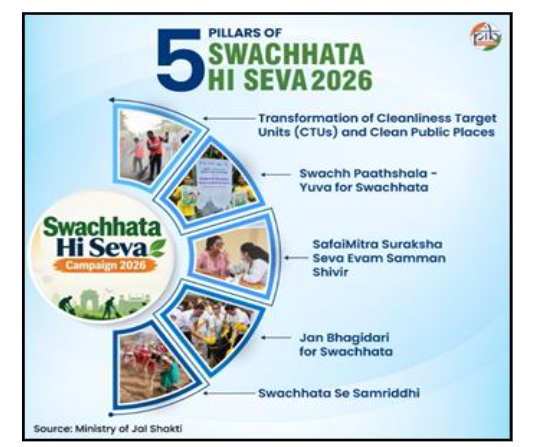
2. Swachh Paathshala—Yuva for Swachhata
- Students and young people have been given a dedicated role in the campaign.
- Students from Classes 6 to 12 will participate in Swachhata Gyan Yatras to sanitation and waste-management facilities.
Schools are encouraged to organise discussions on:
- Waste management
- Water conservation
- Personal hygiene
- Handwashing
- Menstrual hygiene
- Safe drinking water
The objective is to build sanitation awareness at an early age and create long-term behavioural change.
3. SafaiMitra Suraksha, Seva Evam Samman Shivirs
Special camps will be organised for sanitation workers and their families.
They will provide:
- Health services
- Safety equipment
- Welfare-scheme linkages
- Recognition of sanitation workers
- Support for workers’ families
The pillar recognises that sustainable sanitation depends upon the health, dignity and safety of sanitation workers.
4. Jan Bhagidari for Swachhata
Citizens and institutions are encouraged to take responsibility for everyday cleanliness.
Major activities include:
- Awareness about the Solid Waste Management Rules, 2026
- Demonstrations of four-way waste segregation
- Promotion of home composting
- Campaigns against littering
- Campaigns against single-use plastics
- Swachhata rallies and human chains
- Public cleanliness pledges
- Collection of reusable household items
Swachh Parv, Harit Parv
Festivals occurring during the campaign period are encouraged to follow:
- Plastic-free practices
- Eco-friendly decorations
- Proper waste segregation
- Post-festival cleaning
- Environmentally responsible celebrations
5. Swachhata Se Samriddhi
This pillar connects cleanliness with economic value, resource recovery and the circular economy.
It promotes the principles of:
- Reduce
- Reuse
- Recycle
Important activities include:
- Kabaad Se Jugaad: Creating useful products from discarded materials.
- Kabaad Se Kala: Producing art from waste materials.
The initiative shows that waste can become a resource when it is properly segregated, reused and recycled.
Special Activities
Ek Din, Ek Ghanta, Ek Saath
- On October 1, 2026, simultaneous cleanliness activities will be organised across the country.
- Citizens, institutions, youth groups and NGOs are encouraged to participate together for one hour.
Special Meetings on October 2
On Swachh Bharat Diwas:
- Special Gram Sabhas will discuss SHS activities and the Solid Waste Management Rules, 2026.
- Urban local bodies will conduct Special Council Meetings.
These meetings seek to convert campaign activities into continuing local action.
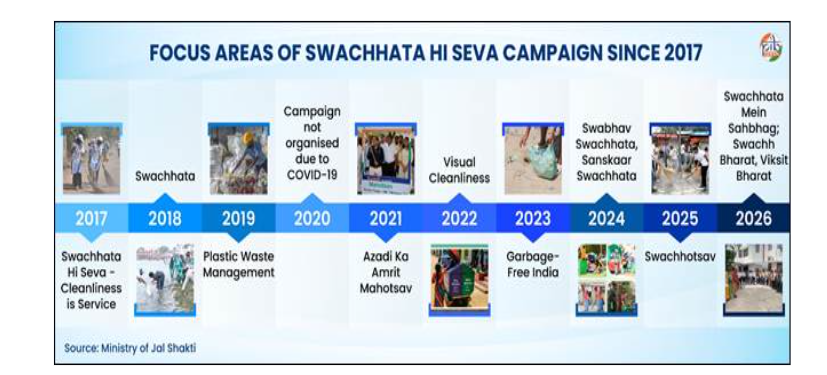
Evolution of Swachhata Hi Seva
The campaign has gradually expanded from voluntary cleaning to sustainable waste management and behavioural change.
| Year | Main focus |
| 2017 | Beginning of the people-led cleanliness movement and large-scale shramdaan |
| 2018 | Strengthening Jan Bhagidari and declaring sanitation as everyone’s responsibility |
| 2019 | Plastic-waste collection, segregation and reduction of single-use plastics |
| 2020 | Campaign not conducted because of the COVID-19 pandemic |
| 2021 | Sustaining ODF status, ODF Plus activities and liquid-waste management |
| 2022 | Visual cleanliness, waste segregation and the 4R principle |
| 2023 | “Garbage-Free India,” public-space transformation and SafaiMitra welfare |
| 2024 | “Swabhav Swachhata, Sanskaar Swachhata”—cleanliness as a habit and value |
| 2025 | “Swachhotsav”—clean and environmentally responsible community celebrations |
| 2026 | “Swachhata Mein Sahbhag”—collective ownership and sustained participation |
Major Milestones in the Campaign’s Evolution
SHS 2017: Beginning of a People-Led Movement
The first campaign was launched on September 15, 2017. It promoted voluntary participation and the Swachhata pledge.
At that time:
- 4.82 crore toilets had been constructed since 2014.
- 2.38 lakh villages had become ODF.
- Toilet coverage had increased from 42% in 2014 to 64% in 2017.
- 2.46 crore children participated in a national painting competition.
SHS 2019: Focus on Plastic Waste
The campaign promoted alternatives such as cloth and jute bags and organised plastic-waste collection and segregation.
During this period:
- Six States discouraged or banned single-use plastic.
- Similar action was taken by 171 districts.
SHS 2021: Comprehensive Cleanliness
The campaign focused on sustaining ODF achievements and accelerating ODF Plus activities.
Important actions included:
- More than 60 lakh participants
- Over 1.5 lakh shramdaan activities
- More than 43,000 Gram Sabha resolutions against single-use plastic
- Construction of household and community soak pits for liquid-waste management
SHS 2022: Visual Cleanliness
The campaign promoted the 4R principle:
- Refuse
- Reduce
- Reuse
- Recycle
More than 9.81 crore people participated in sanitation-related shramdaan.
SHS 2023: Garbage-Free India
The campaign recorded large-scale action to clean:
- Beaches
- Riverbanks and waterfronts
- Legacy waste sites
- Tourist destinations
- Public spaces
- Water bodies
- Garbage-vulnerable sites
It also organised SafaiMitra welfare camps and brought youth into the campaign through the Indian Swachhata League 2.0.
SHS 2024: Cleanliness as Behaviour
The theme “Swabhav Swachhata, Sanskaar Swachhata” connected cleanliness with habits and social values.
The campaign transformed neglected residential areas, roadsides and markets. It also promoted:
- Swachh Bharat Cultural Fests
- Swachh Food Streets
- Waste-to-Art activities
- Tree plantation
- SafaiMitra welfare
SHS 2025: Swachhotsav
The campaign brought sanitation practices into community celebrations.
Its five pillars covered:
- Transformation of CTUs
- Clean public spaces
- SafaiMitra welfare
- Clean and green festivities
- Advocacy for Swachhata
The campaign cleaned 15.75 lakh CTUs and 5.89 lakh public spaces. It also promoted eco-friendly pandals, post-festival cleanliness and Swachhata Rangolis.
Significance of SHS 2026
Behavioural Change
The campaign seeks to make cleanliness a regular habit rather than an occasional activity.
Citizen Ownership
Jan Bhagidari makes citizens active partners in sanitation instead of treating cleanliness as the government’s responsibility alone.
Youth Participation
School-based activities can create a generation that understands waste segregation, hygiene and environmental responsibility.
Dignity of Sanitation Workers
Health camps, safety equipment and welfare linkages recognise the essential role of SafaiMitras.
Circular Economy
Reuse, recycling, composting and waste-to-art activities reduce waste while recovering economic and social value.
Sustainable Public Spaces
The transformation and continued maintenance of CTUs can prevent cleaned areas from returning to their earlier condition.
Local Institutional Participation
Gram Sabhas and urban local bodies can convert national campaign goals into village- and city-level action.
Viksit Bharat
Clean surroundings, efficient waste management, healthy communities and responsible citizenship support the wider objective of a developed India.
Challenges
Sustaining Behavioural Change
Public participation may decline after the campaign period ends.
Source Segregation
Waste processing becomes difficult when households and institutions fail to separate waste correctly.
Maintenance of Transformed Sites
Cleanliness Target Units may again become dumping points without regular monitoring.
Sanitation-Worker Safety
Workers require continuous access to protective equipment, health services and welfare benefits.
Infrastructure Management
Waste-treatment plants, toilets, drainage systems and sanitation facilities require regular operation and maintenance.
Uneven Local Capacity
Local bodies differ in financial resources, technical skills and waste-processing infrastructure.
Moving Beyond Symbolic Participation
Short cleanliness drives must be followed by systematic collection, processing, recycling and safe disposal.
Way Forward
Make Swachhata a Year-Round Activity
Local bodies and communities should continue cleanliness activities beyond the annual campaign period.
Strengthen Source Segregation
Households and institutions should be trained in four-way segregation and proper waste disposal.
Ensure Long-Term CTU Maintenance
Every transformed location should have a responsible institution, monitoring system and maintenance plan.
Protect SafaiMitras
Health check-ups, safety equipment, welfare linkages and dignity at work should become permanent features of sanitation governance.
Deepen Youth Engagement
Swachhata Gyan Yatras and school discussions should be integrated with continuing sanitation education.
Promote Circularity
Home composting, reuse, recycling, Kabaad Se Jugaad and Kabaad Se Kala should be expanded.
Use Digital Monitoring
The Swachhata App and SHS portal should be used to identify problems, monitor their resolution and map transformed locations.
Strengthen Local Review
Gram Sabhas and urban council meetings should periodically review waste management, public toilets and cleanliness infrastructure.
Maintain Whole-of-Society Participation
Government departments, schools, citizen groups, NGOs and businesses must share responsibility for sustained sanitation.
Conclusion
Swachhata Hi Seva 2026 represents the transition of Swachh Bharat from infrastructure creation to community ownership and sustained behavioural change. Its focus on youth, sanitation workers, source segregation, public spaces and resource recovery gives sanitation a wider social and environmental meaning. The long-term success of the campaign will depend on whether cleanliness continues beyond the campaign period and becomes an everyday civic responsibility.