

Boost Your APPSC Group-1 Preparation - New Batch & Test Series 2026
Relevance: APPSC – Andhra Pradesh Economy, Energy Infrastructure, Environment, Industrial Development, Regional Current Affairs
Prelims:
- Windergy India 2026 | NREDCAP | Solar Energy | Wind Energy | Pumped Storage Hydro | Battery Energy Storage System | Green Hydrogen | Electrolyser | Compressed Biogas
Mains:
- Renewable Energy Transition | Investment Mobilisation | Green Employment | Grid Stability | Energy Storage | Green Industrialisation | Energy Resilience
Why in News?
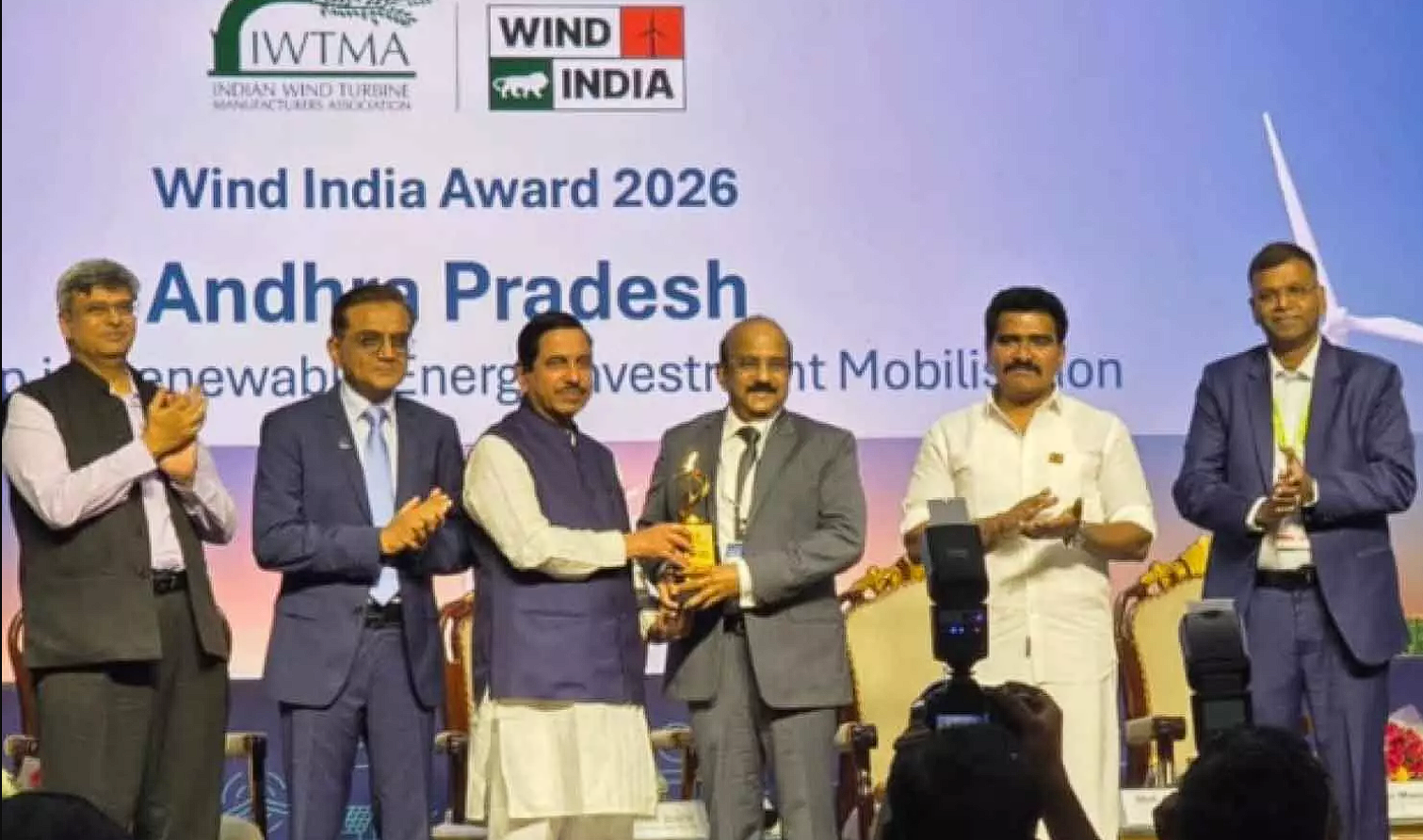
Andhra Pradesh received the Leadership State in Renewable Energy Investment Mobilisation Award for attracting large investments in clean energy.
Since June 2024, the State has sanctioned 97 clean-energy projects worth nearly ₹4 lakh crore, with the potential to generate approximately 4.71 lakh jobs.
About the Award
- The award was presented at the 8th International Trade Fair and Conference—Windergy India 2026.
- Venue: Chennai Trade Centre
- Date: 8 October 2026
- Union Minister for New and Renewable Energy Pralhad Joshi presented the award.
- M. Kamalakar Babu, Vice-Chairman and Managing Director of NREDCAP, received it on behalf of Andhra Pradesh.
NREDCAP stands for the New and Renewable Energy Development Corporation of Andhra Pradesh.
Renewable Energy Investments in Andhra Pradesh
The State has sanctioned projects across different segments of the clean-energy ecosystem.
| Sector | Sanctioned capacity |
| Solar energy | 26.45 GW |
| Wind energy | 5.86 GW |
| Pumped-storage hydroelectricity | 19.95 GW |
| Battery Energy Storage Systems | 12.6 MWh |
| Green hydrogen and derivatives | 2.20 MMTPA |
| Electrolyser manufacturing | 2 GW |
| Compressed biogas | 11,521 tonnes per day |
Important Units
- GW: Gigawatt
- MWh: Megawatt-hour
- MMTPA: Million Metric Tonnes Per Annum
What are the Major Project Areas?
Solar and Wind Energy
The sanctioned solar and wind projects will expand Andhra Pradesh’s renewable electricity-generation capacity.
Pumped-storage Hydroelectricity
Pumped-storage projects store electricity by pumping water to an upper reservoir during periods of surplus power. Water is released to generate electricity when demand rises.
The sanctioned 19.95 GW capacity is intended to support round-the-clock grid stability.
Battery Energy Storage
Battery systems can store surplus renewable electricity and supply it during periods of low solar or wind generation.
Green Hydrogen
The State has approved 2.20 MMTPA of green hydrogen and derivative-production capacity.
Green hydrogen is produced by using renewable electricity to split water through electrolysis.
Electrolyser Manufacturing
The approved 2 GW electrolyser-manufacturing capacity can support domestic production of equipment required for green-hydrogen generation.
Compressed Biogas
Compressed biogas projects with a combined capacity of 11,521 tonnes per day have been sanctioned. Such units convert biodegradable material into usable gaseous fuel.
Expected Outcomes
- Mobilisation of nearly ₹4 lakh crore in clean-energy investment
- Potential creation of 4.71 lakh jobs
- Expansion of renewable-energy generation
- Improved grid stability through pumped storage and batteries
- Development of a green-hydrogen manufacturing ecosystem
- Growth of clean-energy industries and associated supply chains
About Windergy India 2026
- Edition: Eighth
- Duration: 7–9 October 2026
- Venue: Chennai Trade Centre
- Theme: “Wind—Powering India’s Energy Resilience”
- It was jointly organised by:
- Ministry of New and Renewable Energy;
- Ministry of Power; and
- Indian Wind Turbine Manufacturers Association.
Conclusion
The award recognises Andhra Pradesh’s efforts to attract investments across solar, wind, energy storage, green hydrogen and compressed biogas. Effective and timely implementation of the sanctioned projects can strengthen grid reliability, promote green industrialisation and generate large-scale employment in the State.
CARE MCQ
Q. Consider the following statements regarding Andhra Pradesh’s renewable-energy investment drive:
- Andhra Pradesh received the Leadership State in Renewable Energy Investment Mobilisation Award.
- The State has sanctioned 19.95 GW of pumped-storage hydroelectric projects.
- Windergy India 2026 was held under the theme “Wind—Powering India’s Energy Resilience”.
- The award was received by the Andhra Pradesh Pollution Control Board.
Which of the statements given above are correct?
(a) 1 and 2 only
(b) 1, 2 and 3 only
(c) 2, 3 and 4 only
(d) 1, 2, 3 and 4
Answer: (b)
Explanation
- Statement 1 is correct: Andhra Pradesh received the award for attracting major renewable-energy investments.
- Statement 2 is correct: The sanctioned projects include 19.95 GW of pumped-storage hydroelectric capacity.
- Statement 3 is correct: Windergy India 2026 carried the theme “Wind—Powering India’s Energy Resilience”.
- Statement 4 is incorrect: The award was received by the Vice-Chairman and Managing Director of NREDCAP, not the State Pollution Control Board.
FAQs
Q. Which renewable-energy award did Andhra Pradesh receive?
The Leadership State in Renewable Energy Investment Mobilisation Award.
Q. How many clean-energy projects have been sanctioned since June 2024?
A total of 97 projects.
Q. What is their approximate investment value?
Nearly ₹4 lakh crore.
Q. How many jobs may the projects generate?
Approximately 4.71 lakh jobs.
Q. Where was Windergy India 2026 held?
It was held at the Chennai Trade Centre.
Relevance: UPSC GS Paper III: Science and Technology, Indigenisation of Technology, Manufacturing and Defence Technology
- Prelims: Additive Manufacturing | 3D Printing | CAD | STL File | Slicing | NSAM | NSAM 2.0 | MeitY | NAMS | ESTIC 2026 | Atal Tinkering Labs | Design for Additive Manufacturing | Industry 5.0
- Mains: Digital Manufacturing | Technological Self-reliance | Distributed Manufacturing | Mass Customisation | Import Substitution | Industry–Academia Collaboration | Intellectual Property | Strategic Manufacturing | Sustainable Production | Viksit Bharat 2047
Why in News?
- India’s National Strategy for Additive Manufacturing, introduced in 2022, is progressing towards its proposed NSAM 2.0 phase.
- Under the strategy, more than 1.54 lakh people have been trained, 56 start-ups supported and 65 India-specific technologies developed.
- The next phase will focus on commercialisation, intellectual property, digital integration, affordable machines and materials, defence applications and additive-manufacturing electronics.
What is Additive Manufacturing?
Additive Manufacturing (AM) is a digital production process in which a three-dimensional object is created by adding material layer by layer according to a digital design.
It is commonly known as 3D printing.
Unlike conventional manufacturing, which often removes material from a larger block, additive manufacturing builds only the required shape.
It combines:
- computing;
- electronics;
- design software;
- artificial intelligence;
- automation; and
- material science.
More than 40 additive-manufacturing processes are currently available or under research and development.
How Does Additive Manufacturing Work?
Virtual Design
The object is first created as a digital model using:
- Computer-Aided Design;
- a three-dimensional scanner; or
- AI-based tools that can generate models from photographs.
STL File
The digital model is generally converted into an STL or Standard Tessellation Language file.
An STL file represents the surface of a three-dimensional object through a collection of triangular surfaces.
Slicing
Slicing software divides the digital model into hundreds or thousands of thin horizontal layers.
It generates instructions for the machine about:
- the shape of each layer;
- material deposition;
- movement of the printing head; and
- printing sequence.
Printing
The additive-manufacturing machine reads the sliced file and deposits or fuses material layer by layer.
Final Object
The layers are joined to form a complete three-dimensional object. The printed component may undergo finishing, heat treatment, polishing or other post-processing before commercial use.
Which Materials are Used?
Thermoplastics
Common thermoplastics include:
- Acrylonitrile Butadiene Styrene;
- polycarbonate;
- Polylactic Acid; and
- Polyvinyl Alcohol.
Water-soluble PVA is often used for temporary support structures that can later be dissolved.
Metals
Additive manufacturing can use:
- stainless steel;
- titanium;
- aluminium;
- gold;
- silver; and
- other metal alloys.
Metal printing is important for aerospace, defence, medical implants and high-performance engineering.
Ceramics
Materials include:
- zirconia;
- alumina;
- tricalcium phosphate; and
- glass-based materials.
Biomaterials
- Biomaterials such as silicon, calcium phosphate and zinc can be used for bone-support structures.
- Researchers are also studying bio-inks containing living cells to produce tissues, blood-vessel structures and organ-like models. Most complex organ-printing applications remain at the research stage.
Composites and Semiconductor-grade Materials
Advanced composites and specialised materials are being developed for electronics, photonics, energy storage and strategic applications.
Additive and Conventional Manufacturing
| Basis | Additive manufacturing | Conventional subtractive manufacturing |
| Method | Adds material layer by layer | Removes material from a larger block |
| Design input | Controlled by a digital model | Uses machining tools and physical processes |
| Material waste | Generally lower | Can produce considerable waste |
| Complex shapes | Easier to manufacture | May require several processes and components |
| Customisation | Suitable for customised products | Expensive for small customised batches |
| Tooling | Limited specialised tooling | Often requires moulds, dies and cutting tools |
| Production suitability | Prototypes and specialised production | Large-scale standardised manufacturing |
What is the Global Opportunity?
- The global additive-manufacturing machines market is projected to reach USD 149 billion by 2035.
- The additive-manufacturing electronics supply chain is expected to grow from approximately USD 18 billion to USD 112 billion.
- India has opportunities to manufacture AM platforms using:
- polymers;
- metals;
- composites;
- ceramics; and
- semiconductor-grade materials.
What are its Major Applications in India?
Space and Aerospace
Additive manufacturing enables the production of:
- lightweight components;
- complex engine parts;
- components with fewer joints;
- rapidly developed prototypes; and
- customised space hardware.
In May 2024, IIT Madras-incubated Agnikul Cosmos launched Agnibaan SOrTeD, which featured a single-piece, additively manufactured semi-cryogenic rocket engine.
Defence
The technology can support:
- rapid production of spare parts;
- repair and maintenance in remote areas;
- field-level manufacturing;
- construction of military structures; and
- reduced dependence on long supply chains.
The Indian Army inaugurated its first additively manufactured two-storey dwelling unit at Ahmedabad, built in 12 weeks. The technology has also been applied to precast defence structures in areas such as Ladakh.
NSAM is supporting workshop-level facilities for Maintenance, Repair and Overhaul across the three Armed Forces.
Healthcare
AM enables products customised according to a patient’s anatomy.
Applications include:
- implants;
- prosthetics;
- surgical guides;
- dental products;
- bone grafts; and
- anatomical models.
MeitY-supported start-up OsteoForge is working on natural silk-based implants. The Technology Development Board is supporting customised bone grafts made from indigenous bioceramic materials.
Electronics
India’s AM centres have demonstrated printed:
- batteries;
- antennas;
- varistors;
- capacitors; and
- other electronic components.
The Indian Institute of Science has demonstrated photonic integrated-circuit blocks using additive-manufacturing technology.
NSAM is also developing concrete-based supercapacitors for solar-energy storage.
Construction
Three-dimensional construction printing can:
- reduce construction time;
- minimise material waste;
- lower logistics requirements;
- improve design flexibility; and
- enable faster housing development.
The Kelvin 6K Pro on-site construction printer demonstrated the capacity to construct a 2,500 sq ft house in less than 30 days using low-carbon geopolymer material.
Early applications indicate the potential for:
- nearly 30% lower material and logistics costs; and
- up to 90% lower emissions compared with conventional cement-based construction.
These outcomes will depend on materials, energy sources, design and project conditions.
What is the National Strategy for Additive Manufacturing?
The Ministry of Electronics and Information Technology released the National Strategy for Additive Manufacturing in February 2022.
It is aligned with:
- Make in India;
- Atmanirbhar Bharat;
- Digital India; and
- Viksit Bharat 2047.
The strategy promotes cooperation among:
- Union and State governments;
- industries;
- start-ups;
- universities; and
- research institutions.
What are the Targets of NSAM?
The strategy aims to:
- capture 5% of the global AM market;
- add nearly USD 1 billion to India’s GDP;
- develop 50 India-specific AM technologies;
- nurture 100 new start-ups;
- develop 500 new products;
- train one lakh skilled workers; and
- build AM capabilities across 10 existing and emerging manufacturing sectors.
Seven specialised Development and Deployment Centres have been established for:
- research and development;
- skilling;
- technology demonstration; and
- industry access to AM facilities.
What Progress has been Achieved?
More than four years after the launch of NSAM:
- more than 1,54,000 individuals have been trained;
- 56 AM start-ups have received support; and
- 65 India-specific technologies have been developed.
These technologies cover:
- materials;
- machines;
- Design for Additive Manufacturing;
- processes; and
- printed products.
- Applications have emerged in aerospace, healthcare, electronics, energy, food processing and photonics.
What is NSAM 2.0?
NSAM 2.0 is being conceptualised to move India’s AM ecosystem from research and prototypes towards large-scale commercialisation.
Proposed Priorities
- Accelerate generation of intellectual property rights
- Digitally integrate the AM ecosystem
- Commercialise globally competitive technologies
- Reduce the cost of machines and materials through clusters
- Strengthen the AM-electronics value chain
- Expand the start-up base
- Support defence applications
- Promote SDG-oriented pilot programmes
- Develop international standards
- Encourage joint research and technology partnerships
What are the Supporting Platforms?
National Additive Manufacturing Symposium
The National Additive Manufacturing Symposium brings together:
- policymakers;
- scientists;
- industries;
- start-ups;
- academia; and
- government institutions.
The second edition was organised by MeitY on 13 March 2026 in New Delhi.
It focused on:
- NSAM 2.0;
- defence adoption;
- industry requirements;
- MeitY-supported research centres;
- inter-ministerial coordination; and
- ecosystem partnerships.
ESTIC 2026
The second Emerging Science, Technology and Innovation Conclave is scheduled for 27–29 October 2026 at Bharat Mandapam, New Delhi.
- Organiser: Council of Scientific and Industrial Research
- Theme: “Creative Minds, Catalyzing Science, Empowering Technologies”
- It will cover 12 thematic areas, including additive manufacturing and other emerging technologies.
Atal Tinkering Labs
Atal Tinkering Labs expose students from Classes VI–XII to:
- 3D printing;
- robotics;
- Internet of Things; and
- Do-it-Yourself innovation.
Each laboratory receives a grant of ₹20 lakh for an innovation workspace of around 1,200–1,500 sq ft.
What is the Significance of Additive Manufacturing?
Technological Self-reliance
Domestic development of machines, software and materials can reduce import dependence.
Faster Innovation
Digital designs can be quickly converted into prototypes and tested without expensive tooling.
Strategic Security
Local production of critical components can strengthen defence, space and medical supply chains.
Mass Customisation
AM can produce personalised medical devices and specialised industrial components in small quantities.
Resource Efficiency
Layer-wise production can reduce material waste compared with conventional machining.
Distributed Manufacturing
Digital designs can be transmitted and manufactured near the point of use, reducing transport and inventory requirements.
Start-up and Employment Generation
AM creates opportunities in:
- design;
- software;
- material science;
- machine manufacturing;
- maintenance;
- healthcare; and
- advanced engineering.
Industry 5.0
The technology supports flexible, intelligent and human-centred manufacturing through automation, digital production and customisation.
What are the Major Challenges?
High Cost
Industrial AM machines, metal powders, specialised materials and post-processing equipment remain expensive.
Import Dependence
India continues to depend on imported machines, advanced materials and critical components.
Standardisation and Certification
Defence, aerospace and medical products require strict standards for safety, quality and reliability.
Skill Gap
India needs trained professionals in design, material science, machine operation, simulation and post-processing.
Quality Consistency
Maintaining identical strength, density and surface finish across multiple production batches can be difficult.
Limited Commercial Scale
Many Indian AM applications remain at the prototype or demonstration stage.
Intellectual Property and Cybersecurity
Since production depends on digital files, theft or manipulation of designs can compromise commercial interests and product safety.
Environmental Concerns
Although AM can reduce material waste, its overall sustainability depends on:
- energy consumption;
- material source;
- recyclability;
- emissions from printing; and
- post-processing requirements.
Way Forward
- Develop indigenous AM machines, materials and design software.
- Establish common standards and certification laboratories.
- Promote affordable shared facilities for MSMEs and start-ups.
- Expand Design for Additive Manufacturing training.
- Connect research institutions with manufacturing clusters.
- Provide financial support for commercialisation and market testing.
- Strengthen cybersecurity and intellectual-property protection for digital designs.
- Promote low-energy machines and recyclable materials.
- Use government procurement to support certified indigenous products.
- Build international partnerships while protecting strategic technologies.
Conclusion
Additive manufacturing can transform India’s production system from conventional mass manufacturing towards flexible, digital and customised production. NSAM has created a foundation through skilling, start-up support and indigenous technology development. NSAM 2.0 must now focus on affordability, certification, commercialisation and domestic supply chains. A strong AM ecosystem can advance Atmanirbhar Bharat, Industry 5.0 and Viksit Bharat 2047.
CARE MCQ
Q.Consider the following statements regarding Additive Manufacturing:
- It generally produces an object by depositing or fusing material layer by layer.
- An STL file represents a three-dimensional model through triangular surfaces.
- India’s National Strategy for Additive Manufacturing is implemented by the Ministry of Heavy Industries.
- Additive manufacturing can be used with metals, polymers, ceramics and biomaterials.
Which of the statements given above are correct?
(a) 1 and 2 only
(b) 1, 2 and 4 only
(c) 2, 3 and 4 only
(d) 1, 2, 3 and 4
Answer: (b) 1, 2 and 4 only
Explanation
- Statement 1 is correct: AM creates objects by successively depositing, curing or fusing layers of material.
- Statement 2 is correct: The STL format represents the surface of a three-dimensional object as interconnected triangular surfaces.
- Statement 3 is incorrect: The Ministry of Electronics and Information Technology released and anchors the National Strategy for Additive Manufacturing.
- Statement 4 is correct: AM can use polymers, metals, ceramics, composites and biomaterials.
FAQs
Q. What is additive manufacturing?
It is a digital manufacturing process that builds three-dimensional objects layer by layer.
Q. When was NSAM launched?
The National Strategy for Additive Manufacturing was launched in February 2022.
Q.Which ministry anchors NSAM?
It is anchored by the Ministry of Electronics and Information Technology.
Q. What is an STL file?
It is a digital file that represents a three-dimensional surface through triangular elements.
Q. What is the main objective of NSAM 2.0?
It aims to accelerate commercialisation, affordability, intellectual-property creation and global competitiveness in additive manufacturing.
Relevance: UPSC GS Paper II: International Relations; India–U.S. Relations, Indian Diaspora and Immigration Policy
Prelims:
- PERM | H-1B Visa | Green Card | Priority Date | EB-2 | EB-3 | Prevailing Wage | Form ETA-9089 | Form I-140 | USCIS | U.S. Department of Labor
Mains:
- Skilled Migration | Labour Protectionism | Indian IT Industry | Mobility of Professionals | Immigration Backlog | Global Talent Competition | Services Trade | Brain Circulation | India–U.S. Relations
Why in News?
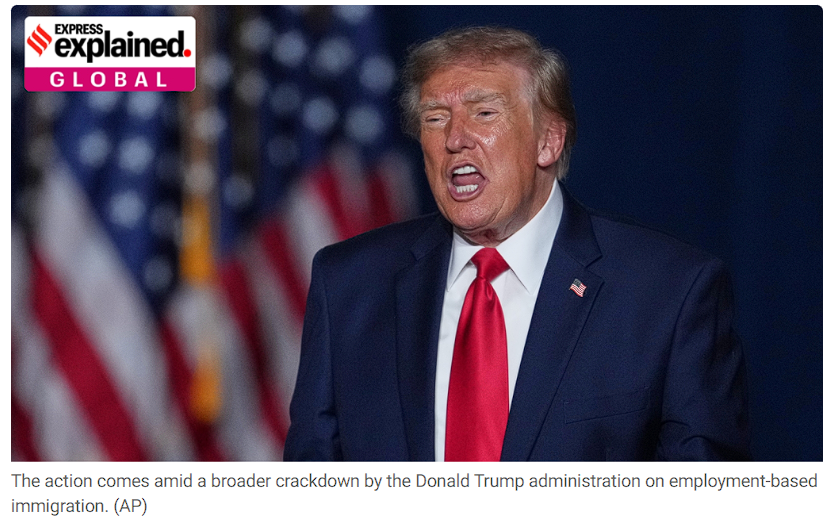
- The U.S. administration has suspended several major technology and IT outsourcing companies from the Permanent Labor Certification Programme, commonly called PERM.
- The affected companies include Cognizant, Infosys, Tata Consultancy Services, Wipro, HCL Technologies and Capgemini, besides Microsoft and Adobe.
- The U.S. administration has cited alleged fraudulent filings, wage undercutting and displacement of American workers.
The allegations remain subject to investigation and due process.
What is the PERM Programme?
PERM refers to the electronic system through which U.S. employers generally obtain permanent labour certification before sponsoring a foreign employee for an employment-based Green Card.
It is:
- an employer-driven process;
- administered by the U.S. Department of Labor;
- generally required before filing an employment-based immigrant petition; and
- intended to protect the employment opportunities, wages and working conditions of U.S. workers.
The Department of Labor must certify that:
- there are no sufficient, willing, qualified and available U.S. workers for the position; and
- employing a foreign worker will not adversely affect similarly employed American workers.
How Does the PERM Process Work?
Identification of a Permanent Job
- The employer identifies a permanent, full-time position that may be offered to a foreign worker.
Prevailing Wage Determination
- The employer obtains the prescribed wage level for the occupation and location. This prevents employers from hiring foreign workers at artificially low wages.
Recruitment of American Workers
- The employer conducts prescribed recruitment to determine whether qualified U.S. workers are available.
PERM Application
- The employer submits Form ETA-9089 to the Department of Labor.
Labour Certification
- If the requirements are satisfied, the Department certifies the application.
Immigrant Petition
- The employer files Form I-140, the Immigrant Petition for Alien Worker, with the U.S. Citizenship and Immigration Services.
Green Card Stage
- The employee can apply for permanent residence when an immigrant visa number becomes available.
The date on which the Department of Labor receives the PERM application generally becomes the worker’s priority date, or position in the Green Card queue. The certified application is normally valid for 180 days for submission with Form I-140.
PERM, H-1B and Green Card: Key Differences
| Basis | H-1B | PERM | Green Card |
| Nature | Temporary work status | Labour certification process | Permanent resident status |
| Purpose | Employment in a speciality occupation | Tests the availability of suitable U.S. workers | Permits permanent residence and employment |
| Filed by | Employer | Employer | Employer-sponsored process followed by employee application |
| Main authority | USCIS, with a labour condition application to DOL | U.S. Department of Labor | USCIS/Department of State |
| Duration | Generally, up to six years, subject to exceptions | A procedural stage | Permanent residency |
| Does it itself grant permanent residence? | No | No | Yes |
Thus, PERM is neither a visa nor a Green Card. It is generally an important preliminary stage in the employer-sponsored Green Card process.
Which Companies are Affected?
The reported suspension covers:
- Cognizant
- Infosys
- Tata Consultancy Services
- Wipro
- HCL Technologies
- Capgemini
- Microsoft
- Adobe
The action particularly affects companies that depend significantly on foreign technology professionals and employer-sponsored immigration.
Why has the U.S. Taken this Action?
Alleged Recruitment Fraud
- Authorities allege that some employers did not conduct genuine recruitment to determine whether qualified American workers were available.
Wage-related Concerns
- The administration has raised concerns that foreign workers may be employed at lower wages, weakening the bargaining position of U.S. workers.
Alleged Job Displacement
- The administration argues that excessive dependence on foreign employees can reduce employment opportunities for American citizens.
“America First” Policy
The measure forms part of a broader emphasis on:
- domestic employment;
- strict scrutiny of employment visas;
- enforcement against misrepresentation; and
- reduction of dependence on foreign labour.
According to the U.S. administration, the affected companies have collectively received more than 230,000 H-1B approvals and over 100,000 permanent labour certifications since 2009. These are administration claims forming part of its justification for the action.
How Will the Suspension Affect Indian Professionals?
Delay in Green Card Sponsorship
Affected employers cannot proceed normally with PERM filings while the suspension remains in force.
Employees whose process has not reached the PERM stage may therefore be unable to:
- begin labour certification;
- secure a priority date; or
- proceed to the I-140 stage.
Loss of Priority Date Advantage
The priority date determines a worker’s place in the employment-based immigrant visa queue. A delay in PERM filing means a later place in an already lengthy queue.
Greater Uncertainty for H-1B Workers
H-1B status is normally limited to six years. Certain workers can extend it beyond six years when:
- a labour certification or I-140 petition has been pending for at least 365 days; or
- an approved I-140 exists but a Green Card number is unavailable.
Therefore, inability to begin the PERM process can create difficulties for workers approaching the six-year limit. Eligible workers with approved petitions and unavailable visa numbers may receive extensions of up to three years at a time.
Reduced Employment Mobility
An employee may become more dependent on the sponsoring employer because changing jobs can complicate or restart parts of the immigration process.
Family and Career Uncertainty
Long delays can affect:
- job changes;
- home ownership;
- children’s education;
- spousal employment; and
- long-term settlement decisions.
Why are Indian Applicants Particularly Affected?
Indian nationals constitute a large share of H-1B beneficiaries and employment-based Green Card applicants.
Per-country Limits
U.S. immigration law limits the proportion of family-sponsored and employment-based immigrant visas that may be issued to nationals of any single country.
Because demand from India greatly exceeds the available supply, Indian applicants face long waiting periods.
Visa Backlog
In the September 2026 Visa Bulletin, India’s EB-2 category became unavailable for final action after the annual limit was exhausted.
With the start of the new U.S. financial year, the October 2026 Visa Bulletin listed:
- EB-2 India final-action date: 1 November 2013
- EB-3 India final-action date: 1 January 2014
Only applicants with priority dates earlier than the relevant cut-off date can generally receive final approval.
What are EB-2 and EB-3?
- EB-2: Professionals holding advanced degrees and persons with exceptional ability.
- EB-3: Skilled workers, professionals and certain other workers.
Implications for Indian IT Companies
Talent-deployment Difficulties
Companies may find it harder to place experienced Indian employees permanently at client locations in the U.S.
Higher Compliance Costs
Firms may have to strengthen:
- recruitment documentation;
- prevailing-wage compliance;
- internal audits; and
- immigration-related legal review.
Greater Local Hiring
The suspension could push companies to recruit more U.S. workers and expand local training programmes.
Change in Business Models
Indian IT companies may rely more on:
- offshore service delivery;
- automation;
- remote project management;
- local partnerships; and
- distributed global delivery centres.
Employee Retention Problems
Professionals seeking permanent residency may move to unaffected employers or other countries offering clearer immigration pathways.
Wider Implications for India
India–U.S. Services Trade
Restrictions on professional mobility may become a friction point in bilateral economic relations, particularly in the IT and digital-services sectors.
Reverse Migration
Some affected workers may return to India, contributing skills, capital and international experience to India’s technology ecosystem.
Diversification of Talent Destinations
Indian professionals and companies may increasingly consider:
- Canada;
- Europe;
- Australia;
- the United Kingdom; and
- emerging technology centres in Asia.
Opportunity for Domestic Innovation
Uncertainty in U.S. immigration can encourage experienced Indian professionals to establish or join:
- domestic technology companies;
- research institutions;
- start-ups; and
- Global Capability Centres in India.
Major Concerns
- Blanket suspension may affect workers who were not involved in any wrongdoing.
- Prolonged uncertainty can disrupt families and legitimate business operations.
- Restricting skilled migration may create talent shortages in the U.S. technology sector.
- Protectionist policies can weaken innovation and global competitiveness.
- Genuine labour protection must be balanced with procedural fairness and the contribution of skilled immigrants.
- Frequent immigration-policy changes may affect confidence in the India–U.S. technology partnership.
Way Forward
For Affected Companies
- Conduct independent immigration-compliance audits.
- Maintain transparent recruitment records.
- Strictly follow prevailing-wage requirements.
- Cooperate with investigations and seek timely legal review.
- Develop a balanced workforce of local and international professionals.
For Indian Professionals
- Maintain valid immigration status and documentation.
- Seek qualified legal advice instead of relying on informal information.
- Explore sponsorship through compliant employers where legally permitted.
- Develop skills in high-demand and specialised technology areas.
- Diversify long-term career and migration options.
For India
- Raise professional-mobility issues through India–U.S. economic and diplomatic dialogues.
- Strengthen domestic opportunities in advanced technology and research.
- Encourage the return and reintegration of highly skilled professionals.
- Expand technology partnerships with multiple countries.
- Move the IT sector towards high-value consulting, innovation and intellectual-property creation.
For the United States
- Ensure transparent investigations and due process.
- Penalise proven violations without unnecessarily affecting compliant workers.
- Reduce employment-based Green Card backlogs.
- Balance labour protection with the need to attract globally competitive talent.
Conclusion
The PERM suspension reflects a wider shift towards stricter employment-based immigration enforcement in the United States. While protecting domestic workers and preventing fraud are legitimate objectives, broad restrictions can create uncertainty for lawful migrants and technology companies. India must combine diplomatic engagement with diversification of markets, domestic innovation and greater creation of high-value employment opportunities.
CARE MCQ
Q. Consider the following statements regarding the U.S. PERM programme:
- A PERM application is generally filed by the employer on behalf of a foreign worker.
- An approved PERM application directly grants permanent residency to the worker.
- The PERM process seeks to ensure that hiring a foreign worker does not adversely affect similarly employed U.S. workers.
- The filing date of a PERM application generally becomes the worker’s priority date.
Which of the statements given above are correct?
(a) 1 and 2 only
(b) 1, 3 and 4 only
(c) 2, 3 and 4 only
(d) 1, 2, 3 and 4
Answer: (b)
Explanation
- Statement 1 is correct: The U.S. employer, not the foreign employee, generally files the PERM application.
- Statement 2 is incorrect: PERM is only a labour certification stage. It does not directly grant a Green Card.
- Statement 3 is correct: The Department of Labor examines whether qualified U.S. workers are available and whether foreign hiring would harm their wages or working conditions.
- Statement 4 is correct: The date on which the Department of Labor receives the application generally becomes the employee’s priority date.
FAQs
Q. What is PERM?
It is the U.S. permanent labour certification process used by employers sponsoring foreign workers for Green Cards.
Q. Is PERM the same as an H-1B visa?
No, H-1B is temporary work status, while PERM is generally a step towards employer-sponsored permanent residency.
Q. What is a priority date?
It is the date that determines an applicant’s place in the employment-based Green Card queue.
Q. Why are Indian applicants heavily affected?
High demand and per-country limits have created long Green Card backlogs for Indians.
Q. Does suspension cancel every approved Green Card petition?
No. The impact depends on the stage of each case and the precise scope of the suspension.