Table of Contents
Relevance: APPSC Group 1 Mains paper II – Governance, Education, Human Resource Development, Welfare Schemes,
For Prelims:
- Andhra Model of Education, 100% Enrolment, One Class-One Teacher, GFLN, Clicker Technology, Chromebooks, Star-Rating System, Smart Kitchens, LEAP App
For Mains:
- Public Education Reform, Learning Outcomes, School Dropouts, Digital Classrooms, Foundational Literacy, Gender Sensitivity, Value-Based Education, Educational Equity
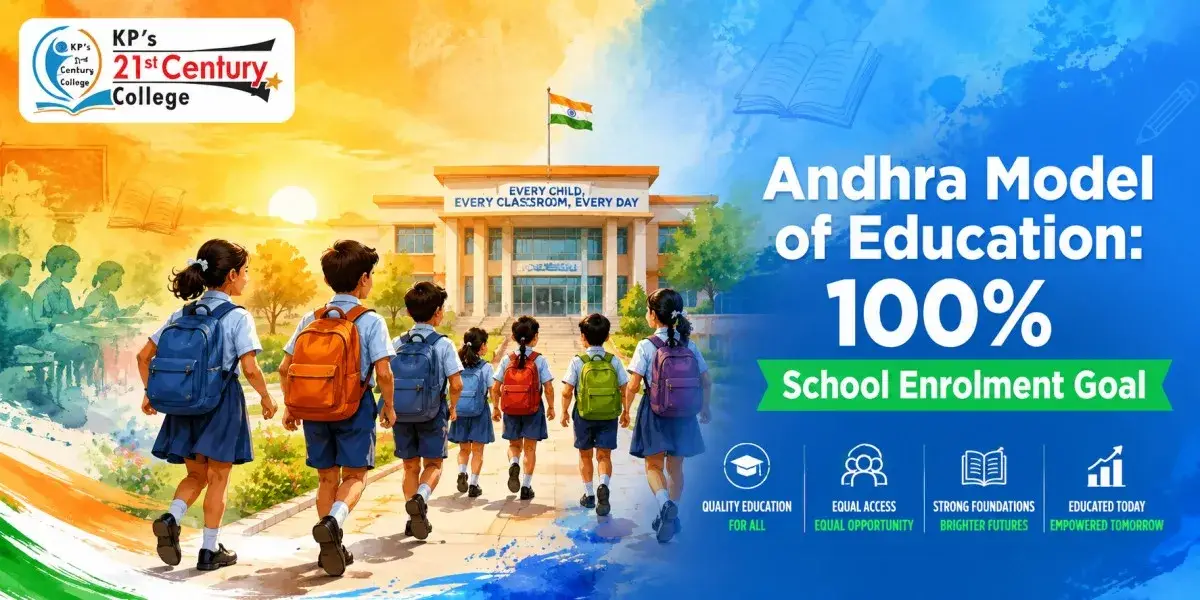
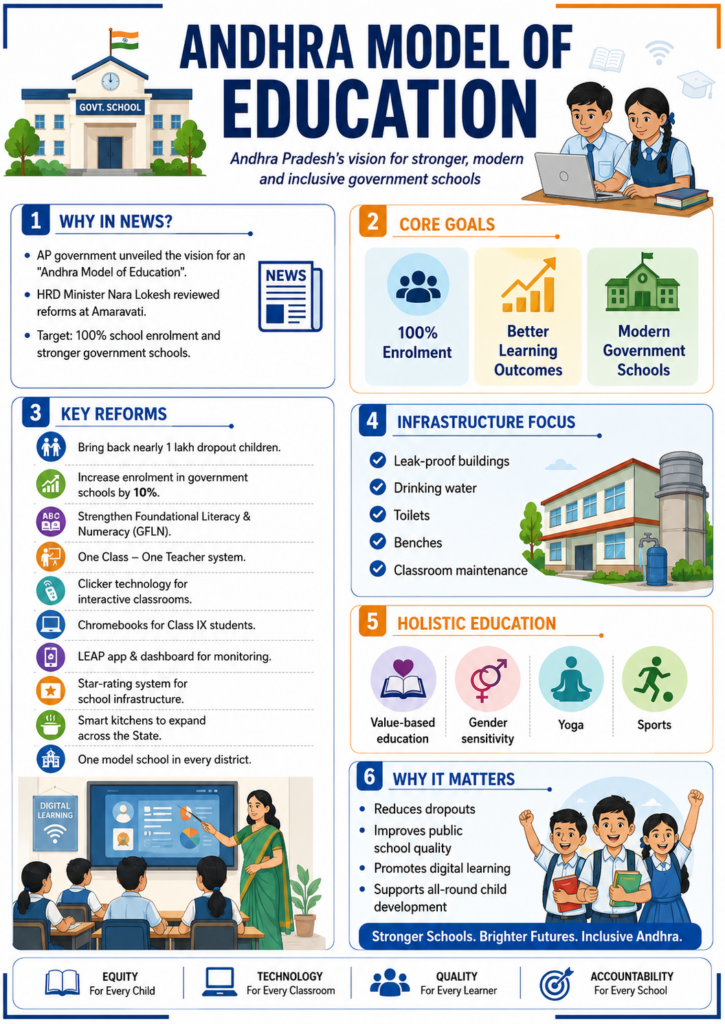
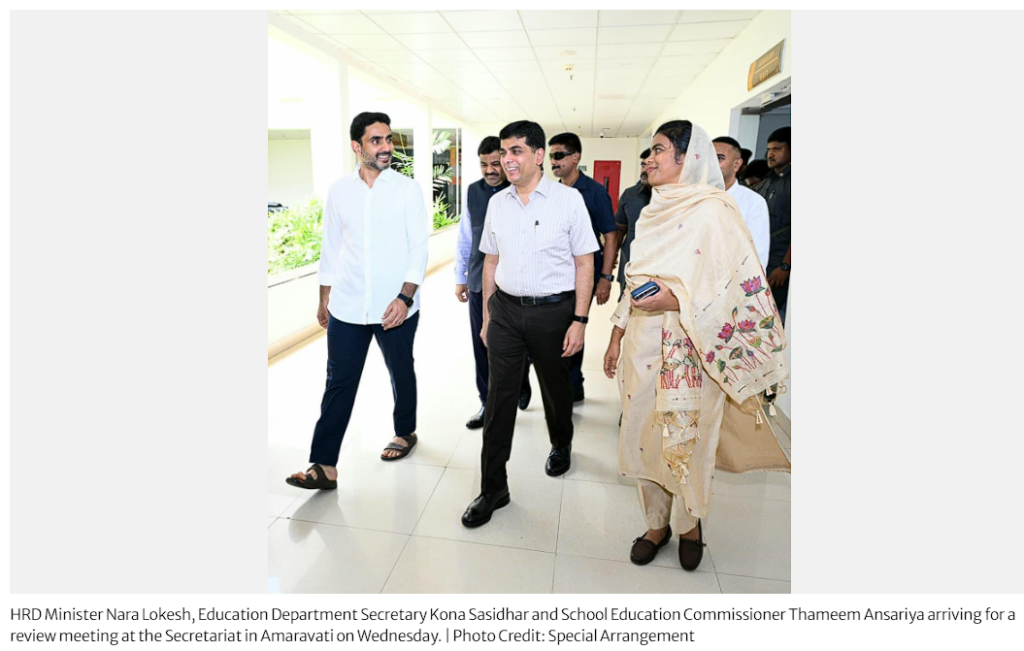
The Andhra Pradesh government has announced its vision to develop an “Andhra Model of Education” as a role model for the country. HRD Minister Nara Lokesh reviewed education reforms with District Education Officers and other officials at the Secretariat in Amaravati.
The government has set a target of 100% school enrolment and aims to strengthen government schools through better infrastructure, digital tools, teacher training and improved learning outcomes.
What is the Andhra Model of Education?
The Andhra Model of Education is a proposed school education reform model focused on making government schools strong, modern, inclusive and student-friendly.
It aims to ensure that government schools compete with private institutions in terms of teaching quality, infrastructure, technology and learning outcomes.
The model focuses on three major goals:
- 100% enrolment of children
- Improvement of learning outcomes
- Modernisation of government schools
Key Features
1. Goal of 100% School Enrolment
- The State government expressed concern over nearly one lakh school dropouts. Officials were directed to identify children who were never enrolled or who had left school and bring them back into the education system.
- The government also aims to increase enrolment in government schools by at least 10%.
2. Focus on Learning Outcomes
- The government will strengthen the Guaranteed Foundational Literacy and Numeracy Programme. This is important because even a small learning gap can affect lakhs of students.
- Foundational literacy means the ability to read and understand basic text. Foundational numeracy means the ability to do basic calculations.
3. Digital Learning Measures
The government plans to introduce:
- Clicker technology for interactive classroom learning
- Chromebooks for Class IX students
- LEAP app and dashboard system for better monitoring and transparency
These measures aim to make classroom teaching more student-centred and technology-driven.
4. One Class-One Teacher System
- The government is implementing the One Class-One Teacher system. This can improve classroom responsibility and help teachers understand the learning level of students better.
5. School Infrastructure Reform
A star-rating system has been introduced for government school infrastructure. Schools will be assessed on basic facilities such as:
- Leak-proof buildings
- Drinking water
- Toilets
- Benches
- Proper classroom maintenance
This will help improve accountability and infrastructure quality.
6. Smart Kitchens
- Smart kitchens, already introduced in Kadapa schools, will be expanded across Andhra Pradesh within two years. This can improve hygiene and efficiency in school meal preparation.
7. Model Schools in Every District
- The Minister cited the example of Nidamarru school in Mangalagiri, which is being developed as an international school. The government has urged officials to develop at least one model school in every district.
8. Holistic Education
The government also wants schools to give importance to:
- Value-based education
- Gender sensitivity
- Yoga
- Sports
This reflects a shift from only marks-based education to all-round development.
Significance
Educational Significance
- The reforms can improve access, enrolment and learning quality in government schools. Focus on foundational literacy and numeracy will help students build strong basic skills.
Social Significance
- The 100% enrolment goal is important for children from poor families, migrant households and vulnerable communities. It can reduce child labour and prevent children from being pushed into agricultural or informal work.
Governance Significance
- The LEAP app, dashboard monitoring and star-rating system can improve transparency and accountability in school administration.
Technological Significance
- Clicker technology and Chromebooks can help modernise classroom learning. They can also reduce the gap between government and private schools.
Challenges
- Bringing back nearly one lakh dropouts may require strong field-level tracking.
- Digital learning may face problems such as lack of internet, device maintenance and teacher training.
- Infrastructure reforms need continuous funding and monitoring.
- Learning outcomes cannot improve only through technology; teacher quality and classroom methods are equally important.
- Migrant children and poor families may need additional social support to continue education.
Way Forward
- Conduct regular surveys to identify out-of-school children.
- Strengthen bridge courses for dropouts and first-generation learners.
- Provide proper training to teachers in digital tools and modern teaching methods.
- Ensure internet, electricity and device maintenance in all schools.
- Link education reforms with nutrition, health and social welfare schemes.
- Develop model schools in every district without neglecting ordinary rural schools.
Conclusion
The Andhra Model of Education aims to make government schools more inclusive, modern and outcome-oriented. Its focus on 100% enrolment, digital learning, foundational literacy, infrastructure improvement and value-based education can strengthen public education in Andhra Pradesh. Effective implementation, teacher support and continuous monitoring will decide its long-term success.
CARE MCQ
Q. With reference to the Andhra Model of Education, consider the following statements:
- It aims to achieve 100% school enrolment in Andhra Pradesh.
- The State government plans to introduce Chromebooks for Class IX students.
- Smart kitchens introduced in Kadapa schools will be expanded across the State.
Which of the above statements are correct?
A. 1 and 2 only
B. 2 and 3 only
C. 1 and 3 only
D. 1, 2 and 3
Answer: D
Explanation:
- Statement 1 is correct: The government has set a goal of achieving 100% school enrolment.
- Statement 2 is correct: Chromebooks are proposed for Class IX students to improve classroom learning.
- Statement 3 is correct: Smart kitchens, already introduced in Kadapa, will be expanded across the State.
Additional Information: The reforms aim to improve enrolment, reduce dropouts, strengthen learning outcomes and modernise government schools.
Q. With reference to the school education reforms in Andhra Pradesh, consider the following pairs:
| Reform | Purpose |
| 1. Star-rating system | Assessment of school infrastructure |
| 2. GFLN programme | Foundational literacy and numeracy |
| 3. LEAP app | Monitoring and transparency |
How many of the above pairs are correctly matched?
A. Only one
B. Only two
C. All the three
D. None
Answer: C
Explanation:
- Pair 1 is correctly matched: The star-rating system assesses facilities such as buildings, toilets, drinking water and classrooms.
- Pair 2 is correctly matched: GFLN focuses on Foundational Literacy and Numeracy.
- Pair 3 is correctly matched: The LEAP app and dashboard aim to improve monitoring and transparency.
Additional Information: These reforms combine infrastructure development, learning improvement and technology-based governance.
FAQs
1. What is the Andhra Model of Education?
It is a proposed education reform model of Andhra Pradesh focused on 100% enrolment, better learning outcomes, digital classrooms and improved school infrastructure.
2. What is the main goal of the model?
The main goal is to achieve 100% school enrolment and improve the quality of government school education.
3. What is clicker technology?
Clicker technology allows students to answer classroom questions digitally, helping teachers check learning levels quickly.
4. Why are smart kitchens important?
Smart kitchens improve hygiene, quality and efficiency in preparing school meals, which can support better attendance and student health.