Why in News?
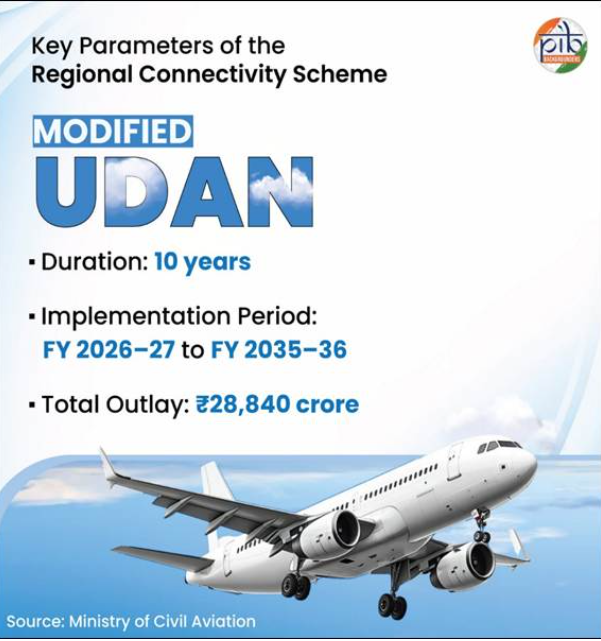
The Government recently launched the Modified UDAN Scheme to deepen regional connectivity and build on the achievements of the original UDAN programme. Modified UDAN will operate from FY 2026–27 to FY 2035–36 with an outlay of ₹28,840 crore, focusing on airport infrastructure, operational support, airline viability and specialised connectivity in remote regions.
What is UDAN Scheme?
- UDAN stands for Ude Desh ka Aam Nagrik. It is a Regional Connectivity Scheme launched to make air travel affordable and accessible for common citizens.
- The scheme aims to connect small and medium cities with bigger cities through air services. It focuses on bringing unserved and underserved airports into the national aviation network.
- Under UDAN, the airfare for a one-hour journey by fixed-wing aircraft or around 500 km air travel was fixed at about ₹2,500. This made regional air travel cheaper and more accessible for ordinary passengers.
How UDAN Started
- UDAN was launched in October 2016 under the National Civil Aviation Policy, 2016.
- The basic idea was to fulfil the common citizen’s dream of air travel and extend aviation beyond metro cities. The first UDAN flight was operated on the Shimla–Delhi route in April 2017.
- The scheme became an important policy instrument to democratise air travel and integrate smaller towns into India’s aviation map.
How UDAN Works
UDAN follows a market-driven bidding model.
Airline companies bid for regional air routes. The airline that asks for the lowest subsidy is generally awarded the route.
To make the service affordable and viable:
- fares are capped for selected seats
- airlines receive Viability Gap Funding
- airport charges and operational costs are reduced
- States provide support through concessions
- limited route exclusivity is provided
Under the fare-linked arrangement, airlines are required to reserve a specified number of seats for affordable travel on UDAN routes.
What Changed After UDAN?
Before UDAN, India’s aviation growth was largely concentrated in a few big metro cities. Smaller towns and medium cities did not receive equal benefits.
| Before UDAN | After UDAN |
| Air connectivity was concentrated mainly in big metro cities. | Connectivity began shifting towards small and medium cities. |
| Small towns had limited access to regular flights. | More regional routes were opened. |
| Passengers depended on long road or rail journeys. | Travel time reduced significantly on many regional routes. |
| Aviation benefits were unevenly distributed. | Air travel became more inclusive and citizen-oriented. |
| Regional economic activity was restricted by poor connectivity. | Tourism, local trade, healthcare access and mobility improved. |
The provided classroom material also notes that after UDAN, air traffic became more regionally distributed, airline operating costs reduced due to support mechanisms, and passenger numbers from smaller cities increased.

Key Achievements of UDAN
UDAN has expanded India’s regional aviation network in a major way.
Key achievements include:
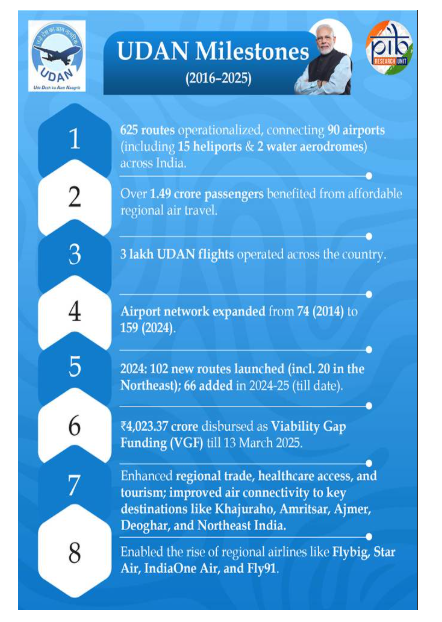
- 679 routes operationalised.
- 95 airports, heliports and water aerodromes connected.
- More than 1.68 crore passengers benefited.
- India’s operational airports increased from 74 in 2014 to 165 by July 2026.
- India has emerged as the third-largest domestic aviation market globally.
The scheme has improved connectivity to remote, hilly and island regions such as Tezpur, Pasighat, Diu, Pithoragarh and Rourkela.
UDAN has also supported:
- tourism
- local economic activity
- healthcare access
- emergency services
- faster movement of people and goods
Passenger-friendly initiatives such as UDAN Yatri Cafés, Flybrary and free Wi-Fi services have improved the travel experience.
Need for Modified UDAN
The original UDAN scheme achieved major success, but it also faced sustainability challenges.
1. Route Viability Issue
Many regional routes had low passenger demand in the initial years. Some routes struggled to remain commercially viable after the subsidy period ended.
2. Short Subsidy Period
The earlier subsidy period was often not sufficient for airlines to build stable passenger markets in smaller cities.
3. Disused Routes and Airports
Some routes and revived airports became inactive due to low demand, high operating costs and weak commercial viability.
4. Difficult Terrain
Remote, hilly and island regions need specialised aircraft, helicopters and helipads rather than conventional airport infrastructure alone.
Therefore, Modified UDAN was introduced to strengthen long-term sustainability, airport infrastructure and airline viability.
Key Features of Modified UDAN
Modified UDAN is a revamped version of the UDAN scheme, aimed at improving connectivity to Tier-2 and Tier-3 cities and difficult regions.
| Feature | Details |
| Implementation period | FY 2026–27 to FY 2035–36 |
| Total outlay | ₹28,840 crore |
| Main focus | Infrastructure, operational support and airline viability |
| Special focus | Remote and geographically difficult regions |
| Approach | Affordable air travel with long-term operational sustainability |
The scheme supports helicopters, helipads and specialised aircraft to improve last-mile connectivity.
Components of Modified UDAN
1. Development of Aerodromes
The scheme proposes the development of 100 airports from existing unserved airstrips. This will help connect smaller towns and remote regions with the national transport network.
2. Operation and Maintenance Support
Small airports, heliports and water aerodromes often face high recurring costs and low revenue. Modified UDAN provides O&M support to help them continue operations during the initial years.
3. Development of Modern Helipads
The scheme proposes 200 modern helipads in priority regions where airports may not be feasible. This is especially important for hilly, remote and difficult areas.
4. Viability Gap Funding
Regional air routes often need support because passenger demand is initially low. Viability Gap Funding helps airlines operate such routes until they become commercially sustainable.
5. Atmanirbhar Aviation Capacity
The scheme proposes the use of HAL Dhruv helicopters and HAL Dornier aircraft. This supports indigenous aviation capacity and improves operations in remote terrain.
Funding Mechanism and Institutional Support
- UDAN uses an innovative RCS levy mechanism. A small fee is levied on selected domestic flights to fund regional connectivity.
- This helps create financial support from within the aviation sector itself.
- Government participation also improves coordination among airlines, airports and State governments. Non-monetary concessions reduce the operational cost for airline operators and make regional routes more viable.
Significance of UDAN and Modified UDAN
1. Democratisation of Air Travel
UDAN makes air travel accessible to ordinary citizens and smaller towns.
2. Regional Development
The scheme connects smaller cities with larger markets, improving trade, mobility and services.
3. Tourism Promotion
Air connectivity to remote, hilly and island destinations supports tourism and local employment.
4. Healthcare and Emergency Services
Helipads and regional air services improve access to emergency care and administrative support.
5. Last-Mile Connectivity
Modified UDAN strengthens connectivity in difficult regions where ordinary airports may not be practical.
6. Employment Generation
The scheme creates jobs in aviation, airport services, tourism, logistics and allied sectors.
7. Atmanirbhar Bharat
Use of indigenous aircraft and helicopters strengthens domestic aviation manufacturing and operational capability.
Challenges
1. Commercial Sustainability
Many regional routes may not become profitable immediately after subsidy support ends.
2. Low Passenger Demand
Smaller towns may initially have limited passenger traffic.
3. High Operating Costs
Regional routes and small airports often face high fuel, maintenance and operational costs.
4. Infrastructure Gaps
Some areas need better airports, road links, terminal facilities and passenger services.
5. Aircraft Availability
Regional aviation requires suitable small aircraft and helicopters.
6. Balanced Planning
Air connectivity must be linked with tourism, business, healthcare and cargo demand to become sustainable.
Way Forward
India should make UDAN routes commercially viable by integrating them with tourism circuits, healthcare networks, business travel, cargo services and regional economic planning. Regional airports should be connected with road, rail and bus networks. Modified UDAN should ensure timely airport development, efficient use of VGF, modern helipad construction, passenger facilities and indigenous aviation capacity.
Conclusion
UDAN has transformed India’s aviation sector by shifting air connectivity from a metro-centric model to a more inclusive regional network. Modified UDAN marks the next phase by focusing on infrastructure, helipads, operational support, airline viability and indigenous aviation capacity. If implemented effectively, it can make India’s aviation network more inclusive, resilient and economically sustainable.