
Relevance: APPSC Group I: Emerging technologies, wildlife monitoring and Andhra Pradesh current affairs
For Prelims:
- Quadruped robotic dog, LiDAR, thermal imaging, geo-tagged alerts
For Mains:
- AI-enabled surveillance, human–wildlife interaction, difficult-terrain monitoring, technology-assisted patrolling
Why in News?
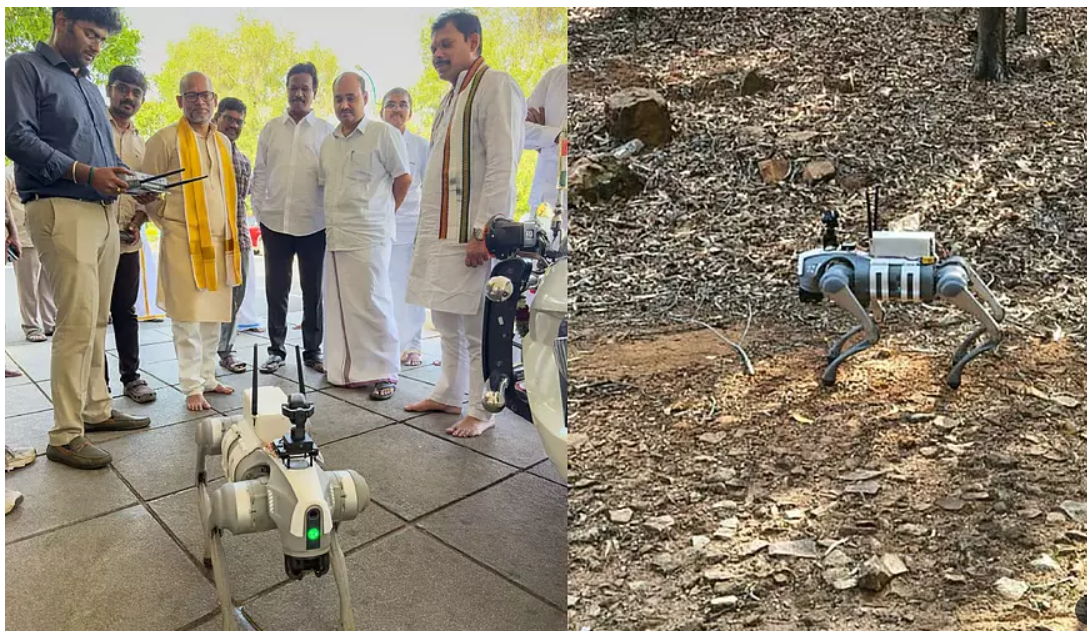
The Tirumala Tirupati Devasthanams (TTD) is evaluating a quadruped robotic dog for monitoring wildlife in the Tirumala forests and improving the safety of devotees using the Alipiri–Tirumala footpath.Officials reviewed its performance and suitability for surveillance in forest areas and terrain where regular human patrolling is difficult.
Purpose of the Initiative
The proposed system aims to:
- Detect wildlife movement near pilgrim routes
- Identify the location of animals
- Improve surveillance during poor visibility
- Alert devotees before animals approach
- Support forest, vigilance and security teams
- Reduce the immediate exposure of personnel to risky situations
Forest stretches adjoining the Alipiri footpath are being considered priority areas for its use.
Technical Features
The robotic dog is equipped with:
- Optical cameras
- Thermal-imaging cameras
- A 360-degree LiDAR system
- Multiple environmental and movement sensors
- Artificial-intelligence capabilities
- Live communication systems
- Sound and light systems
What is LiDAR?
LiDAR uses light-based sensing to map surroundings and detect objects and terrain. The 360-degree system allows the robot to observe its environment in all directions while moving.
Role of Thermal Imaging
Thermal cameras detect heat signatures. They can assist surveillance during:
- Darkness
- Fog
- Other low-visibility conditions
AI-Based Classification
The artificial-intelligence system can distinguish among:
- Large wild animals
- Humans
- Vehicles
- Domestic animals
Such classification can help surveillance teams determine the nature of a detected movement before beginning a field response.
Working Mechanism
When the robotic dog detects wildlife, it can:
- Collect visual and thermal information.
- Identify the category of the detected object.
- Record the geographical location.
- Generate a geo-tagged alert.
- Transmit live video and thermal feeds.
- Send the information to the control room and patrolling teams.
Officials can assess the situation remotely and decide how forest, vigilance or security personnel should respond.
Proposed Areas of Use
Footpath Surveillance
The robot may patrol areas adjoining the Alipiri–Tirumala walking route and detect leopards or other wild animals before they enter pilgrim zones.
Difficult Terrain
Its quadruped design may allow movement through locations where fixed equipment or regular human patrols face difficulty.
Reported Wildlife Locations
Unlike a stationary system, it can be shifted to a site after officials receive information about animal activity.
Patrol Planning
Its sensors may gather data relating to:
- Terrain conditions
- Animal movement
- Frequently used routes
- Vulnerable locations
This information can guide patrol deployment and the placement of other surveillance equipment.
Sound and Light Deterrence
Officials are examining whether the robot’s sound and light systems can discourage animals from moving towards pilgrim areas.
The objective is to:
- Maintain distance between people and wildlife
- Reduce direct encounters
- Limit the need for immediate human intervention
Its suitability for this role will form part of the evaluation process.
Robotic Dog and Fixed Camera Traps
| Robotic Dog | Fixed Camera Trap |
| Mobile surveillance platform | Installed at one location |
| Can be moved to reported activity zones | Covers a predetermined area |
| Provides live visual and thermal feeds | Records activity within its field of view |
| Collects terrain and movement information | Mainly monitors passing animals |
| Supports remote assessment | Requires placement at likely movement routes |
The robotic system is intended to complement fixed surveillance rather than replace it.
Conclusion
The proposed robotic dog offers a mobile and AI-enabled addition to Tirumala’s wildlife-monitoring network. Its usefulness will depend on reliable detection, communication and movement under real forest conditions, supported by existing surveillance systems and trained response teams.
CARE MCQ
1. Consider the following statements regarding the robotic dog evaluated by TTD:
- It is equipped with optical and thermal-imaging cameras.
- Its AI system can distinguish large animals from humans and vehicles.
- It is intended to repla ce all existing camera traps and foot patrols.
Which of the statements given above are correct?
(a) 1 only
(b) 1 and 2 only
(c) 2 and 3 only
(d) 1, 2 and 3
Answer: (b) 1 and 2 only
Explanation
- Statement 1 is correct: The robotic dog carries optical cameras for regular visual monitoring and thermal cameras for detecting heat signatures during darkness, fog and other low-visibility conditions.
- Statement 2 is correct: Its AI system can classify large animals, humans, vehicles and domestic animals. This helps officials understand what has been detected before sending personnel.
- Statement 3 is incorrect: TTD has clearly stated that the robot will only supplement existing camera traps, foot patrols and forest-surveillance systems. It will not replace them.
FAQs
1. Where may the robotic dog be deployed?
It is being considered mainly for forests adjoining the Alipiri–Tirumala footpath.
2. What can its AI system identify?
It can classify large animals, humans, vehicles and domestic animals.
3. Can it operate in darkness?
Its thermal-imaging cameras can collect heat-based information during darkness and low visibility.
4. What is a geo-tagged alert?
It is a warning containing the geographical location of detected wildlife.
5. Will it replace forest patrols?
No. It is intended to supplement existing patrols, camera traps and surveillance systems.
6. Has TTD approved permanent deployment?
No. Officials are still evaluating its performance and operational suitability.
Relevance: GS Paper III: Space technology, indigenisation and scientific achievements
For Prelims:
- Re-entry, kinetic energy, heat flux, ablative TPS, carbon phenolic, PICA
For Mains:
- Human spaceflight safety, thermal engineering, technological reliability, indigenous re-entry capability
Why in News?
The Gaganyaan crew module will use an ablative thermal protection system to protect its structure and astronauts from temperatures reaching approximately 1,800°C during atmospheric re-entry.
What Is the Gaganyaan Programme?
Gaganyaan is India’s indigenous human-spaceflight programme. It seeks to demonstrate the country’s ability to send astronauts into a 400-km Low Earth Orbit and return them safely to Earth.
The programme has three major flight components:
1. Human-Rated LVM3
The Human-Rated Launch Vehicle Mark-3 (HLVM3) is a modified version of ISRO’s LVM3 rocket. Its systems have been redesigned and tested to meet higher reliability and human-safety requirements.
It is:
- approximately 53 metres tall;
- about 640 tonnes in mass;
- a three-stage launch vehicle; and
- capable of carrying around 10 tonnes to Low Earth Orbit.
2. Orbital Module
The Orbital Module consists of:
- Crew Module: The pressurised and habitable section that accommodates the astronauts.
- Service Module: The unpressurised section containing propulsion, power, thermal-control, avionics and deployment systems.
3. Crew Escape System
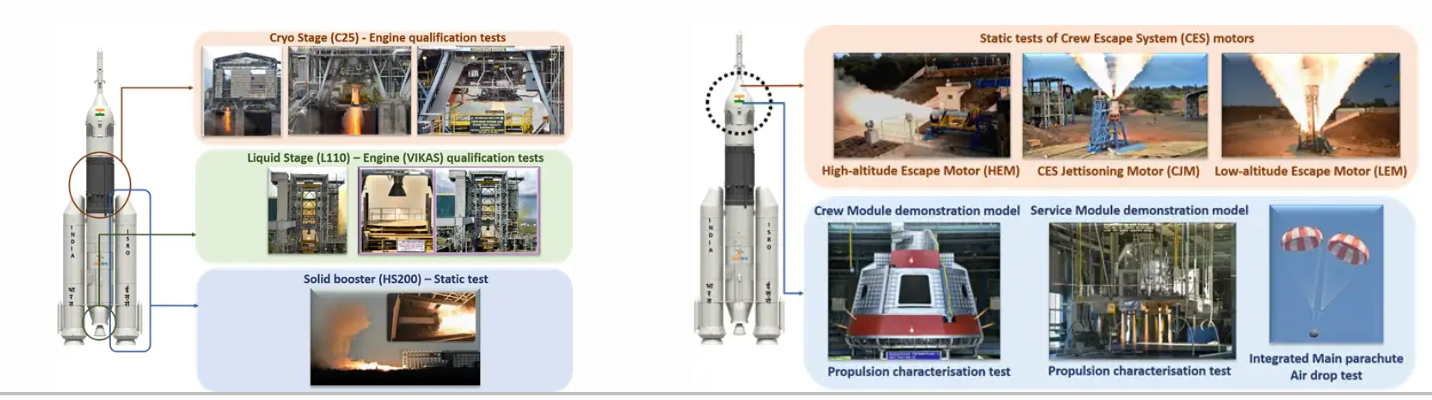
The Crew Escape System uses quick-acting solid motors to pull the Crew Module away from the launch vehicle during an emergency at the launch pad or during ascent. It protects astronauts before orbital injection and is different from the thermal shield used during re-entry. (ISRO)
Why Is Atmospheric Re-entry Dangerous?
A spacecraft in Low Earth Orbit travels at nearly 7,500–8,000 metres per second. It cannot simply stop before entering the atmosphere. Instead, the atmosphere must reduce its speed.
During re-entry:
- the spacecraft strongly compresses the air ahead of it;
- the compressed gas becomes extremely hot;
- a high-temperature shock layer forms around the vehicle; and
- heat is transferred to the spacecraft through radiation and convection.
Thus, re-entry heating is caused mainly by the compression and heating of atmospheric gases, not merely by ordinary friction.
More than 99% of the module’s kinetic energy is eventually dissipated into the surrounding atmosphere. However, even the small share transferred towards the spacecraft can damage or melt an unprotected structure.
Additional Operational Difficulties
- Re-entry cannot normally be aborted once it begins.
- Velocity, temperature and deceleration change rapidly.
- Communication may be temporarily disturbed by ionised gases.
- Astronauts have very limited time to correct failures manually.
- The module must maintain the correct orientation.
- The TPS, parachutes and recovery systems must operate in a fixed sequence.
What Is a Thermal Protection System?
A Thermal Protection System is the combination of heat-resistant materials, coatings and structural arrangements used to protect a spacecraft from extreme temperatures.
The Gaganyaan Crew Module has a double-walled construction:
- a pressurised metallic inner structure; and
- an unpressurised external structure carrying the TPS.
The TPS is approximately 30–35 mm thick in critical regions. Its thickness and material distribution may differ across the surface because the entire module does not receive the same heat load.
Its main functions are to:
- prevent excessive heat from entering the cabin;
- preserve the module’s structural strength;
- protect avionics and life-support equipment;
- withstand aerodynamic forces during re-entry; and
- keep conditions survivable for the astronauts.
Why Is the Crew Module Blunt-Shaped?
A blunt body produces a strong shock wave that remains at some distance from the spacecraft’s surface. This shock-wave stand-off distance reduces the direct transfer of extreme heat to the module.
A blunt shape also creates high aerodynamic drag. This allows the atmosphere to slow the spacecraft before the parachutes are deployed.
Therefore, the capsule’s shape performs two connected functions:
- managing aerodynamic heating; and
- producing controlled deceleration.
How Does an Ablative Heat Shield Work?
An ablative shield protects the spacecraft by deliberately sacrificing its outer material.
Stage 1: Heat Absorption
The shield absorbs a large quantity of incoming thermal energy. Its low thermal conductivity slows the movement of heat towards the spacecraft’s internal structure.
Stage 2: Chemical Decomposition
At high temperatures, the material undergoes pyrolysis, meaning heat-driven chemical decomposition. This process consumes part of the incoming energy.
Stage 3: Formation of Char
A carbon-rich char layer forms on the surface. This layer acts as additional insulation and reduces heat transfer to the structure beneath it.
Stage 4: Outgassing
The decomposing material releases gases. These gases flow outward through the char and form a relatively cooler layer near the surface, reducing the effect of the hot external flow.
Stage 5: Surface Recession
The heated outer material gradually burns, erodes or peels away. This carries absorbed heat away from the spacecraft.
Thus, the shield manages heat through:
- insulation;
- chemical decomposition;
- charring;
- outgassing; and
- controlled material loss.
Major Types of Thermal Protection Systems
| Type | Method of heat management | Major characteristic |
| Ablative TPS | Decomposes and sacrifices surface material | Highly reliable; generally single-use |
| Radiative TPS | Releases absorbed heat as electromagnetic radiation | Suitable for reusable vehicles if the surface remains intact |
| Heat-sink TPS | Stores heat by increasing the material’s temperature | Usually uses materials with high heat capacity |
| Insulating TPS | Restricts heat flow through low-conductivity materials | Protects the internal structure from external heating |
A spacecraft may use more than one thermal-protection method because different areas experience different heating conditions.
Why Has Gaganyaan Selected an Ablative TPS?
The ablative system is suitable for Gaganyaan because:
- the Crew Module is designed primarily for one atmospheric re-entry;
- ablative materials can withstand very high and fluctuating heat loads;
- they provide protection even when external conditions vary from predictions;
- their functioning does not require active pumps or cooling machinery;
- ISRO already has experience with ablative re-entry materials; and
- they avoid the complicated inspection and refurbishment required by reusable shields.
Its main disadvantage is that the protective material is consumed. The shield must therefore be replaced rather than reused.
Materials Used in Ablative Protection
Common ablative materials include:
- carbon phenolic; and
- silica phenolic.
India’s Space Capsule Recovery Experiment used carbon-phenolic material in the nose-cap region, which experienced high heat flux.
Phenolic resin decomposes under heating, while the reinforcing carbon or silica structure helps form an insulating char. The material, thickness and bonding method must be selected according to the expected local temperature, heat flux and pressure.
Gaganyaan’s Re-entry and Recovery Sequence
The thermal shield is one part of a wider system for safe return.
1. De-orbiting
The spacecraft performs a controlled manoeuvre to leave orbit and enter the atmosphere along a planned trajectory.
2. Separation
The Crew Module separates from the Service Module because only the Crew Module is designed to return safely through the atmosphere.
3. Atmospheric Entry
The module enters the denser atmosphere at very high speed. Its heat shield faces the direction of maximum heating.
4. Aerodynamic Deceleration
Atmospheric drag reduces the module’s velocity. The ablative shield protects it during this high-temperature phase.
5. Parachute Deployment
Once the speed and altitude fall sufficiently, the parachute system operates in sequence. It includes:
- apex-cover separation parachutes;
- drogue parachutes;
- pilot parachutes; and
- main parachutes.
Gaganyaan uses ten parachutes belonging to four types. They gradually reduce the module’s velocity to permit safe sea landing. (ISRO)
6. Splashdown and Uprighting
The Crew Module lands in the sea. The Crew Module Uprighting System ensures that the capsule remains in the correct position after splashdown.
7. Recovery
Pre-designated recovery teams locate the capsule, reach it by sea or air and safely extract the astronauts.
Major Indian Technology Demonstrations
Space Capsule Recovery Experiment, 2007
SRE-1 demonstrated India’s ability to:
- return a spacecraft from orbit;
- manage atmospheric re-entry;
- use thermal-protection materials;
- operate navigation and guidance systems;
- conduct parachute-assisted descent; and
- recover a capsule from the sea.
LVM3-X/CARE Mission, 2014
The Crew Module Atmospheric Re-entry Experiment (CARE) demonstrated:
- re-entry of a full-scale Crew Module;
- blunt-body re-entry aerodynamics;
- aerothermal performance;
- thermal-protection technology;
- apex-cover separation;
- clustered parachute deployment; and
- recovery operations.
CARE supplied important data for improving the Gaganyaan Crew Module. (ISRO)
Pad Abort Test, 2018
The test demonstrated that the Crew Escape System could rapidly move the Crew Module away from the launch vehicle during an emergency at the launch pad.
TV-D1 Mission
The first Test Vehicle demonstration validated:
- the in-flight Crew Escape System;
- module-separation mechanisms;
- Crew Module characteristics;
- parachute-based deceleration; and
- recovery after splashdown.
Integrated Air Drop Tests
The Integrated Air Drop Tests evaluated the complete parachute-based deceleration sequence under representative conditions. The second test successfully deployed all ten parachutes in the planned order.
Significance for India
Human-Spaceflight Capability
Successful re-entry will demonstrate that India can independently launch astronauts, support them in orbit and return them safely.
Technological Self-reliance
The programme promotes indigenous capability in advanced materials, human-rated launch systems, avionics, life support, guidance and recovery.
Wider Scientific Applications
Research in heat-resistant materials can support launch vehicles, hypersonic systems, defence applications, aviation and high-temperature industries.
Foundation for Future Missions
Experience from Gaganyaan will contribute to India’s plans for the Bharatiya Antariksh Station, long-duration human spaceflight and future crewed exploration. BAS is planned as a five-module station, with the first module, BAS-01, approved for development and launch. (
Major Challenges
- Predicting heating under changing atmospheric conditions
- Preventing cracks, gaps and separation of TPS tiles or panels
- Achieving consistent material quality across the heat shield
- Maintaining the correct re-entry angle and module orientation
- Protecting interfaces around doors, windows and sensors
- Ensuring reliable operation after prolonged exposure to space
- Integrating the TPS with parachutes and recovery systems
- Meeting very high human-rating and mission-reliability standards
Way Forward
- Conduct successive uncrewed missions under realistic re-entry conditions.
- Test systems under both normal and off-nominal situations.
- Use temperature, pressure and strain sensors to obtain actual flight data.
- Strengthen non-destructive inspection of the completed heat shield.
- Improve computational models using data from CARE and uncrewed missions.
- Maintain redundancy in navigation, avionics and parachute systems.
- Conduct repeated recovery exercises with the Indian Navy and other agencies.
- Develop reusable thermal-protection technologies for future space vehicles.
Conclusion
Gaganyaan’s ablative thermal shield is the spacecraft’s primary defence during atmospheric re-entry. It protects the Crew Module through insulation, chemical decomposition, charring, outgassing and controlled surface loss. However, astronaut safety depends on the combined performance of the module’s shape, guidance system, TPS, parachutes, uprighting mechanism and recovery network. Successful validation of this integrated system will mark a major step in India’s transition from robotic space exploration to independent human spaceflight.

UPSC PYQ
Q. With reference to India’s satellite launch vehicles, consider the following statements:
- PSLVs launch satellites useful for Earth-resource monitoring, whereas GSLVs are designed mainly to launch communication satellites.
- Satellites launched by PSLV appear to remain permanently fixed at the same position in the sky when viewed from a particular location on Earth.
- GSLV Mk III is a four-stage launch vehicle in which the first and third stages use solid rocket motors, while the second and fourth stages use liquid rocket engines.
Which of the statements given above is/are correct?
(a) 1 only
(b) 2 and 3
(c) 1 and 2
(d) 3 only
Answer: (a) 1 only
Explanation
Statement 1 is correct:
The Polar Satellite Launch Vehicle (PSLV) is primarily used to place Earth-observation and remote-sensing satellites into polar and Sun-synchronous orbits. The Geosynchronous Satellite Launch Vehicle (GSLV) is mainly designed to carry heavier communication satellites towards geosynchronous or geostationary orbits.
Statement 2 is incorrect:
A satellite appears fixed over the same location on Earth only when it is placed in a geostationary orbit. PSLV generally launches satellites into polar, Sun-synchronous or other low-Earth orbits. Therefore, they do not normally remain fixed at one position in the sky.
Statement 3 is incorrect:
GSLV Mk III, now called LVM3, is a three-stage launch vehicle, not a four-stage vehicle:
CARE MCQ
Q. With reference to the Gaganyaan Crew Module, consider the following statements:
- Its Thermal Protection System forms part of its unpressurised external structure.
- Its Service Module is intended to accompany the Crew Module through atmospheric re-entry and splashdown.
- Its ablative shield protects it partly through chemical decomposition and outgassing.
Which of the statements given above are correct?
A. 1 only
B. 1 and 3 only
C. 2 and 3 only
D. 1, 2 and 3
Answer: B. 1 and 3 only
Explanation
- Statement 1 is correct: The Crew Module has a pressurised inner structure and an unpressurised external structure carrying the TPS.
- Statement 2 is incorrect: The Service Module provides propulsion, power and other support in orbit but separates before the Crew Module completes atmospheric re-entry.
- Statement 3 is correct: Ablative material absorbs heat, decomposes, forms char and releases gases that reduce heat transfer.
FAQs
1. Does ordinary friction alone produce re-entry heat?
No. The principal cause is the rapid compression and heating of atmospheric gases ahead of the high-speed spacecraft.
2. What is ablation?
Ablation is the controlled consumption of a heat-shield material through decomposition, charring, erosion and outgassing to remove heat.
3. Is Gaganyaan’s heat shield reusable?
It is primarily a single-use ablative system because part of its material is consumed during re-entry.
4. What is the difference between TPS and the Crew Escape System?
The TPS protects the module from re-entry heat. The Crew Escape System pulls the module away from the rocket during a launch or ascent emergency.
5. Why are parachutes not deployed immediately during re-entry?
At orbital speeds, the aerodynamic force would destroy them. Atmospheric drag must first reduce the module’s velocity to a safe deployment range.
6. What is the role of CARE in Gaganyaan?
CARE demonstrated full-scale Crew Module re-entry, aerothermal performance, thermal protection, parachute deployment and recovery.
Relevance: UPSC GS Paper III—Security challenges, defence technology, indigenisation and achievements in science and technology
For Prelims:
- Atmanirbhar Bharat, Defence Acquisition Council, AoN, DAP 2020, DPM 2025, Positive Indigenisation Lists, iDEX, ADITI, TDF, SRIJAN-DEEP, Defence Industrial Corridors, Defence Exim Portal
For Mains:
- Defence indigenisation, strategic autonomy, military modernisation, defence exports, public-private partnership, innovation ecosystem, resilient supply chains
Why in News?
As India marks its 80th Independence Day, the country’s defence sector has recorded significant growth in budgetary support, indigenous production, exports, research and private-sector participation. These developments reflect India’s transition from import dependence towards a more self-reliant and technologically capable defence ecosystem.
Transformation of India’s Defence Sector
India’s defence policy increasingly links national security with domestic industrial capability. Under Atmanirbhar Bharat, the government has focused on:
- modernising the armed forces;
- encouraging indigenous design and production;
- expanding private-sector participation;
- supporting start-ups and MSMEs;
- reducing dependence on imported equipment;
- promoting defence exports; and
- developing critical and emerging technologies.
The objective is not complete economic isolation but the creation of domestic capacity in strategically important systems.
Defence Investment and Military Modernisation
Growth in Defence Budget
India’s defence budget increased from ₹2.53 lakh crore in 2013–14 to ₹7.85 lakh crore in 2026–27, representing approximately 3.1-fold growth.
Growth in Capital Expenditure
Capital expenditure increased from ₹94,587.95 crore in 2014–15 to ₹2.19 lakh crore in 2026–27, registering approximately 2.3-fold growth.
Capital expenditure supports the purchase and development of:
- aircraft and helicopters;
- missiles and air-defence systems;
- warships and submarines;
- communication and surveillance equipment;
- artillery and armoured platforms; and
- supporting military infrastructure.
Defence Production and Exports
Record Indigenous Production
India’s defence production reached a record ₹1.78 lakh crore in 2025–26.
| Producing segment | Share in total production |
| Public-sector entities | 76% |
| Private-sector companies | 24% |
The public sector remains the principal producer, while private companies are acquiring a larger role in components, platforms, innovation and exports.
Expansion of Defence Exports
Defence exports increased from ₹686 crore in 2013–14 to ₹38,424 crore in 2025–26. This represents approximately 56-fold growth over 12 years.
Indian defence products now reach more than 80 countries.
| Exporting segment | Exports in 2025–26 | Share |
| Defence Public Sector Undertakings | ₹21,071 crore | 54.84% |
| Private sector | ₹17,353 crore | 45.16% |
National Targets for 2029
The government aims to achieve:
- ₹3 lakh crore in annual defence production; and
- ₹50,000 crore in annual defence exports.
Research, Innovation and Testing Infrastructure
Defence Research and Development
Defence R&D allocation increased from ₹13,716.14 crore in 2014–15 to ₹29,100.25 crore in 2026–27, an increase of more than 112%.
Since 2022–23, 25% of the defence R&D budget has been opened to:
- private industry;
- start-ups;
- MSMEs; and
- academic institutions.
This seeks to widen the country’s defence-technology base beyond government laboratories.
Defence Testing Portal
Testing facilities across 24 DRDO laboratories have been made accessible through the Defence Testing Portal.
The portal enables domestic manufacturers and start-ups to:
- identify specialised testing facilities;
- request paid access;
- validate products and components; and
- reduce the need to create expensive testing infrastructure independently.
Defence Acquisition Reforms
Defence Acquisition Council
- The Defence Acquisition Council (DAC) is the apex body responsible for major capital-acquisition decisions of the Ministry of Defence.
- It grants Acceptance of Necessity (AoN), which formally recognises the armed forces’ requirement and allows the procurement process to proceed.
- The DAC has granted AoN for more than ₹6 lakh crore of systems designed by DRDO and intended to be manufactured by Indian industry.
Major approved indigenous acquisitions include:
- 97 Tejas Mk-1A fighter aircraft: approximately ₹62,000 crore
- 156 LCH Prachand helicopters: approximately ₹62,700 crore
Evolution of the Procurement Framework
Defence Procurement Procedure, 2016
DPP 2016:
- streamlined defence procurement;
- promoted Make in India; and
- created the foundation for later indigenisation reforms.
Defence Acquisition Procedure, 2020
DAP 2020:
- gives priority to indigenous procurement;
- encourages Indian design and development;
- increases opportunities for domestic companies; and
- supports greater indigenous content in defence equipment.
Defence Procurement Manual, 2025
DPM 2025 governs revenue procurement required for the operation and maintenance of the armed forces.
It streamlined approximately ₹1 lakh crore of procurement by:
- accelerating approvals;
- relaxing penalties for indigenous projects; and
- providing greater assurance of long-term orders.
Draft Defence Acquisition Procedure, 2026
The draft DAP 2026 proposes:
- simpler acquisition categories;
- stronger support for indigenous design and development; and
- indigenous-content requirements of up to 60%.
Innovation-Support Schemes
Innovations for Defence Excellence
iDEX connects the armed forces with start-ups, MSMEs and independent innovators.
- Approved outlay: ₹498.78 crore
- Start-ups, MSMEs and innovators engaged: 676
- Design and development contracts by March 2026: 551
It provides a pathway for innovative solutions to move from military problem statements to prototype development and possible procurement.
ADITI Scheme
The Acing Development of Innovative Technologies with iDEX (ADITI) scheme supports the development of strategically important and advanced defence technologies.
- Outlay: ₹750 crore
- Implementation period: 2023–24 to 2025–26
- Implementing framework: Defence Innovation Organisation
Technology Development Fund
The Technology Development Fund (TDF) supports Indian industries in developing critical defence technologies.
- Maximum grant: ₹50 crore
- Projects under implementation by June 2026: 80
- Value of projects: ₹334 crore
- Additional corpus for deep and emerging technologies: ₹500 crore
Technology Transfer and Industry Participation
DRDO is connecting public research with commercial manufacturing through its Development-cum-Production Partner framework.
Progress recorded by March 2026 included:
- technologies transferred to 134 partner companies;
- 2,180 technology-transfer agreements signed; and
- more than 2,780 intellectual property rights opened for industry use.
Technology transfer enables companies to manufacture tested defence systems without independently developing every technology from the beginning.
Indigenisation and Domestic Manufacturing
Positive Indigenisation Lists
Positive Indigenisation Lists identify defence items that must be procured from domestic sources within prescribed timelines.
By May 2026:
- 10 lists had been notified;
- five were issued by the Department of Military Affairs;
- five were issued by the Department of Defence Production; and
- the lists covered 5,521 items.
They create predictable demand for Indian manufacturers while progressively restricting imports of listed items.
SRIJAN-DEEP Platform
The SRIJAN Defence Equipment Empowerment Platform (DEEP) is a digital repository supporting indigenous defence sourcing.
As of May 2026, it contained:
- more than 41,000 vendors; and
- approximately 2.7 lakh products.
It helps connect defence requirements with domestic suppliers and strengthens local supply chains.
Defence Industrial Corridors
Uttar Pradesh Defence Industrial Corridor
By April 2026, it had recorded:
- investment commitments of ₹42,057 crore; and
- grounded investments of ₹4,409 crore.
The BrahMos Integration and Testing Facility in Lucknow has also commenced missile manufacturing.
Tamil Nadu Defence Industrial Corridor
It had attracted:
- proposed investment of ₹32,699 crore; and
- realised investment of ₹6,446 crore.
The two corridors seek to create manufacturing clusters, common infrastructure, skilled employment and stronger linkages among large firms, MSMEs and research institutions.
Ease of Doing Business and Defence Trade
Industrial Licensing
The validity of industrial licences was extended:
- from seven years, extendable by three years;
- to 15 years, extendable by three years, providing a maximum of 18 years.
Licences under the Arms Act can now receive lifetime validity.
Defence Exim Portal
The revamped Defence Exim Portal provides:
- end-to-end digital processing;
- automated company verification;
- simplified registration;
- real-time application tracking; and
- secure payment integration.
It is intended to make defence exports and imports more transparent and efficient.
Foreign Direct Investment
The defence-sector FDI limit permits:
- up to 74% through the automatic route; and
- up to 100% through the government route.
By March 2026, the sector had attracted FDI inflows of ₹6,670.59 crore.
Higher FDI limits are intended to bring capital, specialised technology, manufacturing capability and integration with global supply chains. However, strategically sensitive investments remain subject to government scrutiny.
Operational Self-Reliance in 2025–26
Ammunition Indigenisation
The Indian Army achieved approximately 91% self-sufficiency in ammunition by indigenising 159 of the 175 ammunition variants in its inventory.
This improves operational preparedness by:
- reducing dependence on external suppliers;
- enabling faster replenishment;
- limiting vulnerability to international disruptions; and
- supporting domestic production capacity.
Missiles and Emerging Technologies
Strategic and Precision-strike Systems
India successfully tested:
- Agni-4 Intermediate-Range Ballistic Missile;
- Agni-5 long-range surface-to-surface ballistic missile;
- TARA glide weapon; and
- RudraM-II air-to-surface missile.
These tests validated indigenous capabilities in long-range deterrence and precision strikes against ground targets.
Air-defence Systems
DRDO advanced:
- Kusha Long-Range Air Defence Missile;
- Very Short-Range Air Defence System (VSHORADS); and
- an integrated air-defence system combining missile interceptors, short-range weapons and laser technologies.
A layered air-defence network uses different systems to intercept threats at different ranges and altitudes.
Hypersonic Technology
DRDO conducted a 12-minute ground test of an actively cooled scramjet combustor.
A scramjet engine:
- uses oxygen from the atmosphere instead of carrying an oxidiser;
- maintains supersonic airflow through the combustion chamber; and
- can support sustained flight at hypersonic speeds.
Active cooling protects the combustor from the extreme heat generated during high-speed operation.
Maritime Defence and Strike Capabilities
Indigenous Naval Platforms
The Indian Navy commissioned 12 warships and submarines, including:
- INS Surat;
- INS Nilgiri; and
- INS Vaghsheer.
INS Mahendragiri, a stealth frigate with more than 75% indigenous content, also entered service.
Other developments included:
- launch of SHACHI, the first of 11 Next Generation Offshore Patrol Vessels;
- commissioning of INS Dunagiri;
- commissioning of INS Sanshodhak; and
- commissioning of INS Agray.
The completion of the indigenous Sandhayak-class survey fleet improves hydrographic surveying, maritime-domain awareness and support for naval operations.
Naval and Ballistic Missile Capabilities
DRDO successfully tested:
- the Naval Anti-Ship Missile–Medium Range; and
- a multi-layered Ballistic Missile Defence capability.
These systems strengthen India’s capacity to address aerial, ballistic and maritime threats.
Significance of Defence Self-Reliance
1. Strategic Autonomy
Domestic production reduces dependence on foreign suppliers during wars, sanctions and global supply-chain disruptions.
2. Operational Preparedness
Local manufacturing permits faster maintenance, repair, ammunition replenishment and technological upgrades.
3. Economic Development
Defence production generates skilled employment and creates demand for metallurgy, electronics, aerospace, artificial intelligence and advanced materials.
4. Export Competitiveness
Growing exports improve India’s position as a reliable defence partner and support long-term strategic relationships.
5. Innovation Ecosystem
Schemes such as iDEX, ADITI and TDF connect the armed forces with start-ups, academia, MSMEs and private companies.
6. Resilient Supply Chains
Indigenisation lists, technology transfers and defence corridors help create domestic networks of component and subsystem manufacturers.
Conclusion
India’s defence transformation represents a shift from import-led acquisition towards indigenous design, development and manufacturing. Higher investment, acquisition reforms, innovation schemes, indigenisation lists and industrial corridors have expanded domestic capability. Sustained progress will depend on converting research into timely procurement, mastering critical technologies and ensuring consistent quality. A competitive and technologically advanced defence-industrial base will strengthen India’s military preparedness, strategic autonomy and role as a dependable security partner by 2047.
UPSC PYQ
Q. Who heads the Defence Acquisition Council?
(a) Defence Minister
(b) Defence Secretary
(c) Chief of the Integrated Defence Staff
(d) Director General (Acquisition)
Answer: (a) Defence Minister
Explanation
The Defence Acquisition Council (DAC) is the highest decision-making body in the Ministry of Defence for major capital acquisitions. It is chaired by the Union Defence Minister (Raksha Mantri).
Its principal functions include:
- granting Acceptance of Necessity (AoN) for capital-acquisition proposals;
- approving major defence procurement decisions;
- promoting timely acquisition of equipment; and
- supporting modernisation and operational preparedness of the Armed Forces.
CARE MCQ
Q. With reference to India’s defence procurement framework, consider the following statements:
- The Defence Acquisition Council grants Acceptance of Necessity for major capital acquisitions.
- The Defence Procurement Manual 2025 primarily deals with revenue procurement.
- Positive Indigenisation Lists require every listed item to be procured exclusively from Defence Public Sector Undertakings.
Which of the statements given above are correct?
A. 1 only
B. 1 and 2 only
C. 2 and 3 only
D. 1, 2 and 3
Answer: B. 1 and 2 only
Explanation
- Statement 1 is correct: The DAC is the apex procurement body and grants Acceptance of Necessity for major defence acquisitions.
- Statement 2 is correct: DPM 2025 streamlines revenue procurement required for the operation and maintenance of the armed forces.
- Statement 3 is incorrect: Positive Indigenisation Lists require procurement from domestic sources. They do not restrict procurement only to Defence Public Sector Undertakings; eligible private Indian companies may also participate.
FAQs
1. What is defence indigenisation?
It is the process of designing, developing, manufacturing and maintaining defence equipment within the country to reduce dependence on foreign suppliers.
2. What is Acceptance of Necessity?
Acceptance of Necessity is the DAC’s initial approval recognising that the armed forces require a particular capability. It allows the formal procurement process to begin.
3. What is a Positive Indigenisation List?
It identifies defence items that must be procured from Indian sources after prescribed deadlines instead of being imported.
4. How is iDEX different from the Technology Development Fund?
iDEX primarily connects defence problem statements with start-ups, MSMEs and innovators. TDF provides grants for developing critical defence technologies through domestic industry.
5. Does self-reliance prohibit foreign collaboration?
No. Self-reliance seeks domestic technological and manufacturing capability. It can include joint development, investment and technology partnerships that strengthen Indian capacity.
6. What is the purpose of defence industrial corridors?
They create specialised manufacturing clusters with infrastructure, skilled workers and supply-chain connections for defence production.