Why in News?
Recently, the Government highlighted India’s progress in strengthening its space sovereignty through reforms, private sector participation, start-up growth, satellite capabilities, launch systems, space applications and human spaceflight ambitions.
India’s space journey has moved from building basic capabilities to developing advanced and globally competitive space technologies. Reforms over the past decade have opened the sector to private enterprises, start-ups and global partnerships.
What is Space Sovereignty?
Space sovereignty means a country’s ability to independently develop, launch, operate and use space technologies for national development and strategic autonomy.
It includes:
- indigenous launch vehicles;
- satellite manufacturing and operations;
- space-based communication and navigation;
- Earth observation capability;
- human spaceflight;
- private sector innovation;
- independent policy and regulatory framework.
For India, space sovereignty is important because space technology supports agriculture, disaster management, communication, defence, navigation, climate monitoring, infrastructure planning and digital governance.
How is India’s Space Ecosystem Expanding?
India’s space sector has seen rapid expansion in recent years.
Key indicators:
- Registered space start-ups increased from 1 in 2014 to around 440 in 2026.
- India’s space economy is valued at USD 9 billion as of August 2026.
- It is projected to reach USD 40–45 billion in the next decade.
- Private investment rose from USD 100.5 million in 2021–22 to USD 618.5 million by March 2026.
- By mid-2026, 113 authorisations were granted to 52 Non-Government Entities, including 18 start-ups.
This reflects a shift from a largely government-led space programme to a broader national space ecosystem involving public agencies, private companies and start-ups.
What is the Earth Observation Public-Private Partnership?
The Earth Observation Public-Private Partnership (EO-PPP) is a public-private framework launched by IN-SPACe.
Its objective is to develop India’s first privately owned Earth observation satellite constellation. It combines government oversight with private industry participation and is backed by around ₹1,200 crore in private investment commitments.
Significance
- Encourages private investment in satellite systems.
- Improves Earth observation capabilities.
- Supports agriculture, disaster management, urban planning and climate monitoring.
- Reduces dependence on foreign satellite data.
What are the Major Space Sector Reforms?
1. Opening of Space Sector to Private Participation
India opened its space sector to private participation in 2020. This allowed industry and start-ups to participate in satellites, launch systems and space applications.
2. Indian Space Policy 2023
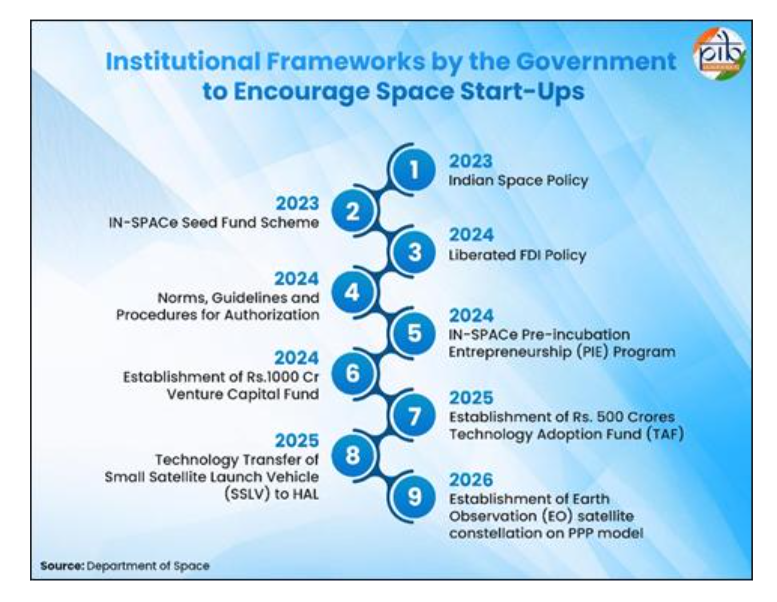
The Indian Space Policy 2023 expanded private participation across the space value chain. It defined the roles of NewSpace India Limited (NSIL) and Indian National Space Promotion and Authorisation Centre (IN-SPACe).
3. Role of NSIL
NSIL is the commercial arm of ISRO. It provides launch, satellite and space-based services and transfers ISRO technologies to Indian industry. Its revenue increased from ₹321.77 crore in FY 2021–22 to over ₹3,000 crore in FY 2024–25.
4. Role of IN-SPACe
IN-SPACe enables private space activities through a single-window mechanism. It facilitated technology transfers from ISRO to industry and start-ups.
5. Liberalised FDI Rules
In February 2024, FDI rules were liberalised for the space sector:
- Up to 74% FDI under automatic route for satellite manufacturing and operations.
- Up to 49% FDI for launch vehicles and spaceports.
- Up to 100% FDI for satellite and ground-segment components.
6. Norms, Guidelines and Procedures 2024
The NGP 2024 created transparent authorisation and compliance requirements. It improves regulatory predictability and ease of doing business.
7. Targeted Financing
Targeted financing is supporting the private space ecosystem through:
- IN-SPACe Seed Fund Scheme;
- ₹1,000 crore Venture Capital Fund;
- ₹500 crore Technology Adoption Fund;
- ₹75 crore Satellite Bus as a Service Scheme.
What are India’s Key Space Capabilities?
1. Indigenous Launch Vehicles
India has operationalised four indigenous launch vehicles:
- PSLV
- GSLV
- GSLV Mk III
- SSLV
These launch vehicles support Earth observation, communication, navigation, space science, exploration and commercial launches. During July 2023–June 2026, India completed 12 launch vehicle missions, carrying 11 national satellites and 9 satellites for international customers.
2. Expanding Launch Infrastructure
India is expanding launch infrastructure to meet national and commercial space demand.
Key developments:
- Sriharikota has two operational launch pads.
- A third launch pad is being established for next-generation launch vehicles.
- Kulasekarapattinam, Tamil Nadu is emerging as India’s second rocket launch site for SSLVs and private-sector launches.
3. Lunar Exploration
India’s lunar programme has achieved major milestones:
- Chandrayaan-1 (2008): Detected water molecules and hydroxyl on the lunar surface.
- Chandrayaan-2 (2019): Captured high-resolution lunar images from orbit.
- Chandrayaan-3 (2023): Made India the first country to soft-land near the Moon’s south pole and the fourth nation to soft-land on the Moon.
4. Mars, Sun and Deep Space Missions
India has expanded beyond lunar exploration:
- Mars Orbiter Mission: Inserted into Martian orbit on 24 September 2014 and operated for over eight years.
- AstroSat: India’s first dedicated astronomy mission.
- Aditya-L1: India’s first space-based solar mission, positioned near the Sun-Earth L1 point.
- XPoSat: Launched in January 2024 for X-ray polarisation astronomy.
- SPADEX: In January 2025, India became the fourth nation to demonstrate autonomous space docking and undocking.
5. NavIC
Navigation with Indian Constellation (NavIC) provides positioning, navigation and timing services across India and up to 1,500 km beyond India’s boundary. It strengthens navigation autonomy and supports civilian and strategic applications.
NavIC is being integrated into:
- power-grid synchronisation;
- real-time train tracking;
- Aadhaar geo-tagging;
- mobile chipsets.
What are India’s Future Space Missions?
1. Gaganyaan
The Gaganyaan human spaceflight programme was approved in January 2019. Its scope was expanded in September 2024 to a total outlay of ₹20,193 crore, covering eight total missions.
Objectives:
- launch a crew of 3 Indian astronauts;
- place them in a 400-km orbit;
- conduct a three-day mission;
- first uncrewed experimental mission targeted in Q4 of 2026;
- crewed mission targeted by 2027.
2. Bharatiya Antariksh Station
India is planning a five-module Bharatiya Antariksh Station (BAS).
Key targets:
- BAS-01 planned for launch by 2028;
- full operationalisation targeted by 2035;
- support for long-duration human spaceflight, microgravity research and advanced space operations.
3. Chandrayaan-4 and Chandrayaan-5/LUPEX
Future lunar missions include:
- Chandrayaan-4: To demonstrate lunar sample collection, ascent from lunar surface and sample return to Earth; planned timeline 2027.
- Chandrayaan-5/LUPEX: Joint ISRO-JAXA mission to study lunar volatiles near the Moon’s south polar region.
4. Venus Orbiter Mission
The Venus Orbiter Mission is targeted for launch in March 2028. It will study Venus’ geology, atmosphere and ionosphere and demonstrate aerobraking and thermal-management technologies.
What Advanced Technologies are Shaping India’s Space Future?
India is developing advanced technologies for next-generation space capabilities.
Key technologies include:
- 200-tonne thrust semi-cryogenic engine;
- semi-cryogenic booster stage for LVM3;
- booster recovery using Vertical Take-off and Vertical Landing technology;
- partially reusable Next Generation Launch Vehicle using LOX-Methane propulsion;
- winged orbital re-entry vehicle for the Reusable Launch Vehicle programme;
- air-breathing propulsion technology.
Significance
These technologies can:
- increase payload capacity;
- reduce launch costs;
- support reusable launch systems;
- improve India’s competitiveness in the global launch market;
- support long-term human spaceflight and deep-space missions.
What is the Significance of India’s Space Push?
1. Strengthens Strategic Autonomy
Indigenous launch vehicles, NavIC and satellite systems reduce dependence on foreign technologies.
2. Expands Space Economy
Start-ups, private investment and commercialisation through NSIL are expanding India’s space economy.
3. Supports National Development
Space applications support agriculture, weather forecasting, disaster management, communication, transport and governance.
4. Enhances Global Standing
Foreign satellite launches increased from 35 before 2014 to 399 as of January 2026, showing India’s growing role as a global launch service provider. India also has more than 300 space cooperation agreements across 61 countries and 5 multilateral organisations.
5. Promotes Innovation
Private participation, start-up growth and funding mechanisms encourage innovation across satellites, launch systems and applications.
6. Builds Human Spaceflight Capability
Gaganyaan, Axiom-4 experience, Bharatiya Antariksh Station and docking experiments are creating the foundation for sustained human presence in space.
What are the Key Challenges?
- High cost of advanced space missions.
- Need for stronger private-sector manufacturing capacity.
- Dependence on critical technologies and components.
- Requirement of robust space regulation and liability frameworks.
- Rising global competition in the launch market.
- Need for skilled human resources.
- Space debris and orbital traffic management concerns.
- Cybersecurity risks for satellite systems.
- Balancing commercial growth with national security.
Way Forward
- Strengthen domestic manufacturing of critical space components.
- Encourage start-ups through predictable regulation and funding.
- Expand public-private partnerships in satellites, launch vehicles and applications.
- Improve space situational awareness and debris management.
- Promote NavIC adoption in civilian and strategic sectors.
- Build stronger university-industry-ISRO research linkages.
- Ensure timely execution of Gaganyaan, BAS and lunar missions.
- Strengthen international cooperation while protecting strategic autonomy.
- Develop skilled manpower for space science, engineering and policy.
Conclusion
India’s space programme is entering a new phase. It is no longer limited to government-led missions but now includes private enterprises, start-ups, commercial services, international partnerships and human spaceflight ambitions.
India’s space sovereignty should be understood as a combination of self-reliance, strategic autonomy, innovation, private participation and global leadership. With reforms, indigenous capabilities and ambitious future missions, India is moving towards becoming a major global space power.