Table of Contents
Relevance: UPSC GS Paper II: Government Policies, Industrial Development, Employment Generation UPSC GS Paper III: Textile Sector, Manufacturing, Infrastructure, Exports, MSMEs
For Prelims:
- PM MITRA Parks | 5F Vision | Special Purpose Vehicle | Competitiveness Incentive Support | Textile Value Chain
For Mains:
- Integrated manufacturing | Textile exports | Employment generation | Industrial infrastructure | Economies of scale
Why in News?
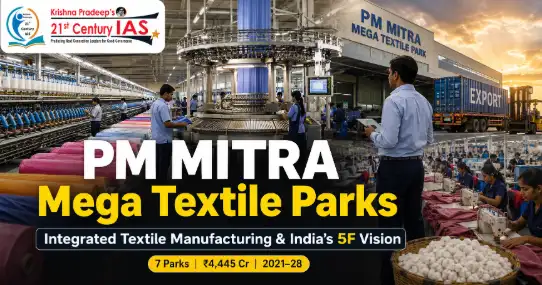
The Ministry of Textiles informed the Lok Sabha that the Government has approved 7 PM Mega Integrated Textile Region and Apparel Parks with a total scheme outlay of ₹4,445 crore for the period 2021-22 to 2027-28.
The Government stated that MoUs have been signed with all seven States, 100% land has been acquired or made available, environmental clearances have been received, and DPRs worth ₹13,537 crore have been finalised. Investment interest worth ₹68,590 crore has been received from PM MITRA States.
What is PM MITRA?
- PM MITRA stands for PM Mega Integrated Textile Region and Apparel.
- It is a scheme to create large-scale, integrated and modern textile industrial parks covering the complete textile value chain.
- The idea is to provide common infrastructure, plug-and-play facilities, logistics, worker support and industrial services in one location.
- The scheme aims to make India’s textile industry more competitive by reducing logistics cost, improving scale, attracting investment and generating employment.
Objectives of the Scheme
1. Integrated Textile Ecosystem
PM MITRA seeks to bring spinning, weaving, processing, dyeing, printing, garmenting and exports closer within a single industrial ecosystem.
2. Large-Scale Industrial Infrastructure
The parks will provide developed factory sites, roads, water, power, waste-water systems, Common Effluent Treatment Plants and testing facilities.
3. Employment Generation
Each PM MITRA Park is expected to generate around 3 lakh jobs, including 1 lakh direct and 2 lakh indirect employment opportunities.
4. Global Competitiveness
By creating economies of scale, the scheme aims to help Indian textile companies become global champions.
5. Investment Promotion
The parks are expected to attract large domestic and foreign investments in textile manufacturing and apparel exports.
Location of the Seven PM MITRA Parks
| State | Location | Park Type |
| Tamil Nadu | Virudhnagar | Greenfield |
| Telangana | Warangal | Brownfield |
| Gujarat | Navsari | Greenfield |
| Karnataka | Kalaburagi | Greenfield |
| Madhya Pradesh | Dhar | Greenfield |
| Uttar Pradesh | Lucknow | Greenfield |
| Maharashtra | Amravati | Brownfield |
| Greenfield: Government selects a new area and develops roads, power, water, factories, warehouses and textile-processing facilities from scratch.Brownfield: An area already has textile industries and infrastructure. The government expands and modernises it by adding better roads, common processing facilities, warehouses, etc. |
Current Progress of PM MITRA Parks
| State | Park Type | Land Available / Acquired | Investment Interest | State Expenditure Incurred |
| Madhya Pradesh | Greenfield | 2,158 acres | ₹19,846 crore | ₹94.06 crore |
| Tamil Nadu | Greenfield | 1,052 acres | ₹2,067.90 crore | ₹34.80 crore |
| Gujarat | Greenfield | 1,000 acres | ₹13,094 crore | ₹196.22 crore |
| Karnataka | Greenfield | 1,142 acres | ₹1,700 crore | ₹95.39 crore |
| Uttar Pradesh | Greenfield | 1,000 acres | ₹5,354 crore | ₹220.69 crore |
| Telangana | Brownfield | 1,020 acres | ₹3,800 crore | ₹123.93 crore |
| Maharashtra | Brownfield | 1,327 acres | ₹12,000 crore | ₹32.21 crore |
Overall Status
- MoUs signed with all States.
- Full land availability achieved for all seven sites.
- Environmental clearances received for all parks.
- Joint Venture Agreements signed for all 5 Greenfield sites.
- SPVs incorporated for all 5 Greenfield sites.
- DPRs worth ₹13,537 crore finalised for all seven States.
- Investment interests worth ₹68,590 crore received so far.
Infrastructure Components
PM MITRA Parks will contain both core infrastructure and support infrastructure.
Core Infrastructure
| Component | Purpose |
| Incubation Centre | Supports new firms, startups and design-led innovation |
| Plug-and-Play Facility | Allows units to start production faster |
| Developed Factory Sites | Reduces project setup time |
| Roads, Power and Water | Provides basic industrial infrastructure |
| Waste-Water System | Supports environmental compliance |
| Common Processing House | Enables shared processing facilities |
| Common Effluent Treatment Plant | Helps manage textile pollution |
| Design and Testing Centres | Improves product quality and competitiveness |
Support Infrastructure
| Component | Purpose |
| Workers’ Hostels and Housing | Supports labour welfare |
| Logistics Park | Reduces transport cost |
| Warehousing | Improves storage and supply chain efficiency |
| Medical Facilities | Provides health support for workers |
| Training and Skill Centres | Builds skilled manpower for textile units |
Land Use Pattern
PM MITRA Parks will follow a planned land-use model.
| Area Use | Share of Park Area |
| Manufacturing Activity | 50% |
| Utilities | 20% |
| Commercial Development | 10% |
This land-use pattern is intended to balance production, common services and commercial activities within the park.
Implementation Model
PM MITRA Parks will be developed through a Special Purpose Vehicle.
Key Features
- The SPV will be owned by the State Government and Government of India.
- It will operate in Public Private Partnership mode.
- The State Government will have majority ownership in the SPV.
- A Master Developer will be selected through objective criteria jointly developed by the Centre and State.
- The Master Developer will develop the industrial park and maintain it during the concession period.
The SPV will receive part of the lease rental from developed industrial sites. This revenue can be used for further expansion of the textile park, skill development and worker welfare.
Competitiveness Incentive Support
The Government of India will provide ₹300 crore for each PM MITRA Park to incentivise manufacturing units.
This support is called Competitiveness Incentive Support.
Main Features
- It is meant for newly established units in PM MITRA Parks.
- It will be paid up to 3% of turnover.
- It supports units during the early stage before they achieve viability.
- It helps reduce the initial business risk of textile manufacturing units.
This incentive can encourage firms to invest in large-scale textile manufacturing within the parks
5F Vision and Textile Value Chain
PM MITRA is inspired by the Prime Minister’s 5F Vision.
| 5F Component | Meaning |
| Farm | Cotton and other raw material production |
| Fibre | Conversion of raw material into fibre |
| Factory | Textile manufacturing and processing |
| Fashion | Apparel design and garmenting |
| Foreign | Export to international markets |
The Farm to Fibre to Factory to Fashion to Foreign approach links agriculture, manufacturing, design and exports into one integrated value chain.
Significance of PM MITRA Parks
1. Boost to Textile Manufacturing
Large integrated parks can reduce fragmentation in the textile sector and create modern industrial clusters.
2. Employment Generation
With each park expected to generate around 3 lakh jobs, the scheme can support labour-intensive manufacturing.
3. Export Competitiveness
Integrated infrastructure, testing centres, logistics parks and scale can help Indian textiles compete better in global markets.
4. Regional Industrial Development
The seven parks are spread across different States, promoting balanced regional growth.
5. Support to MSMEs
Plug-and-play infrastructure and common facilities can help smaller textile units reduce capital burden.
6. Environmental Management
Common Effluent Treatment Plants and waste-water systems can support cleaner textile processing.
7. Women’s Employment Potential
Textile and apparel sectors traditionally create significant employment opportunities for women, especially in garmenting and allied services.
Challenges
1. Timely Execution
Large industrial parks require quick completion of infrastructure, clearances and investor onboarding.
2. Land and Local Livelihood Concerns
Even when land is available, local communities must be included through fair compensation, jobs and welfare measures.
3. Environmental Compliance
Textile processing involves water use, dyes and effluents. Strong monitoring of CETPs is essential.
4. Global Competition
India faces competition from countries with large-scale textile exports and low production costs.
5. Skill Gap
Modern textile parks need trained workers in design, machinery, processing, logistics and quality control.
6. MSME Inclusion
The parks should not become only large-company zones; smaller units and local entrepreneurs must also benefit.
Way Forward
1. Complete Infrastructure on Time
Roads, power, water, CETPs, logistics and factory sites should be made operational quickly.
2. Strengthen Skill Development
Training centres should focus on modern textile machinery, apparel design, quality control, exports and digital production systems.
3. Promote MSME Linkages
Local MSMEs, weavers, garment units and service providers should be connected to the parks through vendor networks.
4. Ensure Environmental Safeguards
CETPs, water recycling and waste-management systems must be monitored through transparent compliance mechanisms.
5. Attract Anchor Investors
Large anchor units can bring supply chains, employment and export networks to each park.
6. Use Scheme Convergence
PM MITRA should be linked with logistics, skilling, MSME, export promotion and State industrial policies.
7. Build Global Branding
India should use the parks to promote itself as a reliable textile manufacturing and apparel export hub.
Conclusion
The PM MITRA Mega Textile Parks scheme is a major step towards transforming India’s textile sector from fragmented production to integrated, large-scale and globally competitive manufacturing. By combining core infrastructure, worker facilities, plug-and-play systems, SPV-based implementation and Competitiveness Incentive Support, the scheme can attract investment and generate employment. However, its success will depend on timely execution, environmental safeguards, MSME inclusion, skill development and export-oriented planning. If implemented effectively, PM MITRA can convert India’s traditional textile strength into a modern industrial and export advantage.
UPSC PYQ
Q. Which one of the following statements is correct about the PM-MITRA Scheme?
(CDS-I, 2026)
(A) Its goal is to develop at least one energy park in every State of India.
(B) It aims at developing integrated textile parks in India.
(C) Its goal is to open employment parks in every district of India.
(D) It aims at opening agro parks in India.
Answer: (B) It aims at developing integrated textile parks in India.
Explanation:
PM MITRA stands for PM Mega Integrated Textile Region and Apparel Parks. It is implemented by the Ministry of Textiles to develop integrated textile and apparel parks in India.
Q. PM MITRA Parks relate to which one of the following industries?
( NDA-I, 2026 )
(A) Automobile
(B) Shipbuilding
(C) Textile
(D) Pottery
Answer: (C) Textile
Explanation:
PM MITRA Parks are related to the textile and apparel industry. They aim to provide integrated infrastructure for different stages of textile production.
CARE MCQ
Q. Consider the following statements regarding PM MITRA Parks:
- PM MITRA stands for PM Mega Integrated Textile Region and Apparel.
- The scheme has approved seven textile parks across Greenfield and Brownfield sites.
- PM MITRA is inspired by the 5F vision: Farm to Fibre to Factory to Fashion to Foreign.
- The scheme is limited only to software parks and has no link with the textile sector.
Which of the statements given above are correct?
(a) 1, 2 and 3 only
(b) 1 and 4 only
(c) 2, 3 and 4 only
(d) 1, 2, 3 and 4
Answer: (a) 1, 2 and 3 only
Explanation
Statements 1, 2 and 3 are correct. PM MITRA relates to integrated textile parks and is based on the 5F textile value-chain vision.
Statement 4 is incorrect because PM MITRA is directly related to the textile and apparel sector, not software parks.
FAQs
1. What is PM MITRA?
PM MITRA stands for PM Mega Integrated Textile Region and Apparel.
2. How many PM MITRA Parks have been approved?
Seven PM MITRA Parks have been approved.
3. What is the total scheme outlay?
The scheme outlay is ₹4,445 crore for 2021-22 to 2027-28.
4. Where are the seven parks located?
They are located in Tamil Nadu, Telangana, Gujarat, Karnataka, Madhya Pradesh, Uttar Pradesh and Maharashtra.
5. Which Telangana location has been selected?
Warangal has been selected for the Telangana PM MITRA Park.
6. What is the 5F vision?
It means Farm to Fibre to Factory to Fashion to Foreign.
7. What is Competitiveness Incentive Support?
It is financial support of ₹300 crore per park to incentivise new manufacturing units, paid up to 3% of turnover.
8. How many jobs can each park generate?
Each park is expected to generate around 3 lakh jobs, including 1 lakh direct and 2 lakh indirect jobs.