
Why in News?
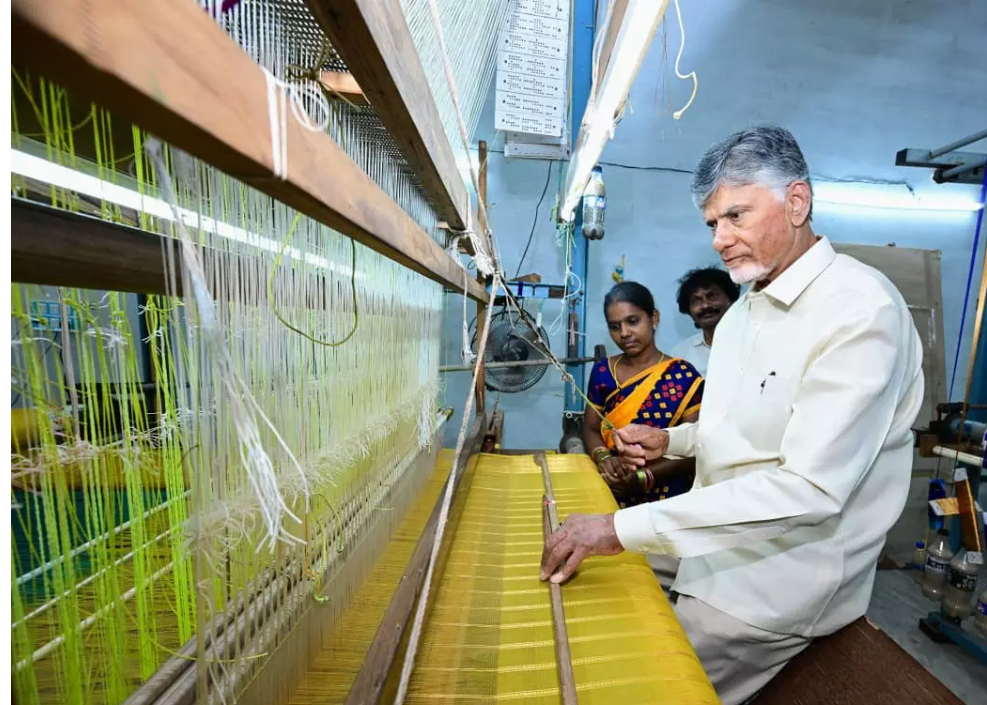
Andhra Pradesh launched the Netanna Sevalo scheme at Chirala in Bapatla district during the 12th National Handloom Day celebrations. Under the scheme, ₹179 crore was released to 71,536 eligible handloom families, with each family receiving ₹25,000 as financial assistance.
About Netanna Sevalo Scheme
Netanna Sevalo is a welfare scheme aimed at supporting handloom families in Andhra Pradesh through direct financial assistance.
| Feature | Details |
| Scheme | Netanna Sevalo |
| State | Andhra Pradesh |
| Launch Place | Chirala, Bapatla district |
| Total Assistance | ₹179 crore |
| Beneficiary Families | 71,536 |
| Assistance per Family | ₹25,000 |
The scheme is designed to provide immediate economic support to traditional weaving families and strengthen the livelihood base of the handloom sector.
Handloom Sector in Andhra Pradesh
- Handloom is a major part of Andhra Pradesh’s cultural and rural economy. The State has several well-known weaving centres such as Chirala, Venkatagiri, Dharmavaram, Uppada, Mangalagiri, Ponduru, Pedana, Srikalahasti and Narasapuram.
- About 1.27 lakh people depend on the handloom sector in the State. These weaving traditions represent both living cultural heritage and rural non-farm employment.
Major Support Measures for Weavers
1. Power Subsidy
| Category | Benefit | Coverage |
| Handloom families | Free power up to 200 units/month | 62,541 families |
| Powerloom units | Free power up to 500 units/month | 10,032 units |
This reduces the production cost for weaving households and small textile units.
2. Pension Support
Under NTR Pension Bharosa, 85,000 weavers receive ₹4,000 per month. The pension support costs around ₹35 crore per month and ₹420 crore annually.
3. Cooperative Credit Support
The State extended ₹79 crore in cash-credit support to 109 primary handloom cooperative societies. This can improve access to working capital and reduce dependence on informal credit.
4. Cluster Development
Approval was given for 10 handloom clusters under the Small Cluster Development Programme at a cost of ₹10 crore. Cluster-based development can improve common facilities, production quality, skill upgradation and collective marketing.
Infrastructure and Market Initiatives
Several initiatives are being taken to strengthen the handloom ecosystem.
- Handloom Marketing Assistance Programme: To improve market access for handloom products.
- Special facilities at Uppada: To support a major weaving centre.
- Handloom Park at Mangalagiri: To promote production, training and design support.
- Handloom and Handicrafts Museum at Shakhamuru, Amaravati: To preserve and promote craft heritage.
- Sustainable Textile Recycling Unit in Visakhapatnam: Proposed with an investment of ₹4,200 crore, linking textiles with circular economy.
Agreements with organisations, including Fabindia, are expected to improve promotion and marketing of handloom products.
BC Welfare and Social Justice Linkages
The handloom sector is closely connected with many traditional occupational communities. The State has also outlined wider welfare measures for Backward Classes and occupational groups.
Major Measures
- Draft BC Protection Act prepared.
- ₹505 crore assistance over two years to 1.34 lakh fishing families during the fishing-ban period.
- Mining leases proposed for Vaddera communities.
- Excise shop opportunities for toddy tappers.
- Additional ₹20,000 rooftop solar subsidy for eligible BC beneficiaries.
- Universal health insurance cover of ₹2.5 lakh proposed for every citizen.
These measures reflect a broader link between occupational welfare, social justice and livelihood security.
Chirala Textile Economy and Tourism Push
- Chirala has historically been a major textile centre and was known as “Mini Mumbai” because of its textile activity.
- The Suryalanka–Bapatla–Chirala coastal belt is proposed to be developed as a tourism destination. A ₹97-crore tourism corridor from Suryalanka to Chirala under the Swadesh Darshan scheme can link textiles, coastal tourism and local employment.
- The launch of the Bay of Bapatla website, handbook and the Bapatla LEAPS youth skill programme also points to a wider local development strategy.
Conclusion
The Netanna Sevalo scheme is an important intervention for Andhra Pradesh’s handloom families. It provides immediate financial support while being part of a larger framework of power subsidy, pension support, cooperative credit, cluster development, market assistance and tourism linkage. However, the future of the handloom sector cannot depend on welfare alone. Sustainable revival requires better market access, design innovation, digital promotion, cooperative strengthening and youth participation. Andhra Pradesh’s handloom economy can remain culturally vibrant and economically viable only when traditional weaving is converted into a dignified, competitive and future-ready livelihood.
Why in News?
Saudi Arabia, Türkiye and Pakistan signed the Makkah Joint Defence Agreement in August 2026. The agreement states that an armed attack on any one of the three countries will be treated as an attack on all three. This has drawn attention because it brings together Saudi financial power, Türkiye’s defence-industrial capability and Pakistan’s military strength.

What is the Makkah Joint Defence Agreement?
- The Makkah Joint Defence Agreement is a trilateral defence arrangement between Saudi Arabia, Türkiye and Pakistan.
- It builds upon the earlier Saudi-Pakistan Strategic Mutual Defence Agreement of 2025. With Türkiye joining the arrangement, the bilateral framework has expanded into a broader security grouping.
- The pact is being seen as a new form of collective defence arrangement in West Asia. However, it should not be equated with NATO because the full text and detailed operational obligations of the pact have not been made public.
Key Features of the Pact
1. Collective Defence Commitment
The pact declares that an armed attack on one member will be treated as an attack on all three.
2. Defence Cooperation
It aims to strengthen defence cooperation among the three countries.
3. Military Coordination
The agreement can encourage joint military exercises, training and operational coordination.
4. Intelligence Sharing
It may create formal channels for intelligence sharing, threat assessment and security coordination.
5. Strategic Deterrence
The pact seeks to create deterrence in a region affected by missile attacks, drones, proxy conflicts and maritime insecurity.
Why Saudi Arabia, Türkiye and Pakistan Need the Pact?
1. Saudi Arabia: Security and Defence Capacity
Saudi Arabia wants to reduce excessive dependence on the United States for security. Houthi attacks, Iranian missile and drone threats, Red Sea instability and risks around the Strait of Hormuz and Bab-el-Mandeb have exposed its security vulnerabilities.
The pact gives Saudi Arabia access to Pakistani military experience and Turkish defence technology, while helping it build domestic defence capacity.
2. Türkiye: Regional Influence and Defence Markets
Türkiye has a growing defence industry, especially in drones, aerospace and military technology. Through this pact, it can access Saudi capital, expand defence exports and strengthen its influence in West Asia.
3. Pakistan: Strategic Relevance and Leverage
Pakistan gains greater strategic importance in West Asia. It also strengthens defence, economic and energy ties with Saudi Arabia. The agreement increases Pakistan’s diplomatic weight in the Islamic world.
Strategic Capabilities and Benefits:
| Country / Grouping | What It Brings to the Pact | What It Seeks to Gain |
| Saudi Arabia | Strong financial resources, energy influence, strategic Gulf location and high defence-spending capacity | Stronger security deterrence, access to Pakistani military support, Turkish defence technology and better protection for Vision 2030 projects |
| Türkiye | Advanced defence industry, drone technology, aerospace capabilities and NATO-linked military experience | Saudi investment, larger defence export markets and greater geopolitical influence in West Asia |
| Pakistan | Nuclear capability, conventional military strength, large armed forces and long-standing defence links with Saudi Arabia | Greater importance in West Asian security, closer Saudi ties and stronger diplomatic leverage |
| Combined Strength | Saudi capital + Turkish defence technology + Pakistani military capability | Stronger collective defence, deeper military coordination and greater strategic autonomy |
Why the Pact Should Not Be Equated with NATO
The pact resembles NATO’s Article 5 in language because it says an attack on one member will be treated as an attack on all. However, it should not be treated as a NATO-style alliance.
Reasons
- The full text of the agreement has not been publicly released.
- Detailed operational obligations are unclear.
- It is not known whether the pact requires automatic military action.
- Mutual defence pacts depend not only on legal language but also on political will.
- The earlier Saudi-Pakistan defence pact did not automatically result in direct military action during regional attacks.
Therefore, the agreement is more significant as a strategic and defence-industrial partnership framework than as an automatic war-triggering alliance.
Historical Background: Earlier Pan-Islamic and Pan-Arab Defence Pacts
- The Makkah agreement is not the first attempt to build security cooperation among Muslim-majority or Arab states. Earlier arrangements show that such pacts often face challenges due to political divisions, weak coordination and changing regional alignments.
| Arrangement | Explanation |
| Treaty of Joint Defense and Economic Cooperation between Arab League States, 1950 | This was a Pan-Arab collective security arrangement with a mutual-defence clause. However, its effectiveness remained limited because Arab states often differed politically and lacked strong military coordination. |
| Baghdad Pact, 1955 / CENTO | It was formed by Iraq, Türkiye, Pakistan, Iran and the United Kingdom mainly to contain Soviet influence in West Asia. After Iraq withdrew following the 1958 coup, it became the Central Treaty Organization. It ended in 1979 after the Iranian Revolution. |
| Peninsula Shield Force, 1984 | Created by the Gulf Cooperation Council during the Iran-Iraq War, it aimed to protect the Arabian Peninsula through a joint military force. It was notably deployed in Bahrain in 2011. |
| Islamic Military Counter Terrorism Coalition, 2015 | A Saudi-led coalition of more than 40 countries focused on terrorism through military, financial, ideological and media cooperation. Critics have viewed it as having an anti-Iran orientation. |
Implications for India
1. Strengthening of Pakistan–Türkiye–Saudi Security Link
Saudi Arabia’s deeper defence partnership with Pakistan and Türkiye could strengthen a security network along India’s western flank. Since Pakistan and Türkiye have often taken positions against India on Kashmir at the UN and OIC, India must watch the diplomatic implications carefully.
2. Pakistan–Türkiye–China Axis
Both Pakistan and Türkiye have close strategic ties with China. Saudi Arabia’s closer security integration with them could indirectly strengthen a wider Pakistan–Türkiye–China alignment.
3. Impact on India–Saudi Relations
India and Saudi Arabia have built strong energy, trade, investment and strategic ties through the India–Saudi Strategic Partnership Council. However, if Saudi security dependence on Pakistan increases, Islamabad may try to gain diplomatic leverage on issues such as Kashmir.
4. Pakistan’s Military Modernisation
Saudi finance, Turkish defence technology and Pakistani military expertise could help Pakistan acquire advanced drones, fighters, air-defence systems and other military platforms. This may affect India’s conventional military calculations.
5. Western Indian Ocean Concerns
If trilateral defence cooperation expands into maritime security, it may increase the presence of these countries in the western Indian Ocean, where India seeks to remain a net security provider.
6. Conflict Threshold Ambiguity
The “attack on one is an attack on all” clause creates uncertainty over whether a future India–Pakistan crisis could draw political or military support from Saudi Arabia or Türkiye. Even if direct intervention is unlikely, it may give Pakistan a sense of strategic cover.
7. Counter-Terrorism Diplomacy
Stronger Saudi-Pakistan security ties could make India’s efforts to isolate Pakistan diplomatically on cross-border terrorism more difficult.
8. Nuclear Ambiguity
Pakistan’s nuclear capability gives the pact additional strategic weight. However, no formal Pakistani nuclear guarantee to Saudi Arabia has been publicly confirmed.
India’s Way Forward
1. Deepen Minilateral Partnerships
India should accelerate IMEC and I2U2 to strengthen economic and strategic ties with Saudi Arabia, UAE and other Gulf partners.
2. Strengthen Chabahar and INSTC
India should use Chabahar Port and the International North-South Transport Corridor to maintain access to Iran, Central Asia and Europe. This prevents India’s regional options from becoming dependent on the Pakistan–Türkiye axis.
3. Diversify Gulf Partnerships
India should expand defence, maritime, energy and technology cooperation with UAE, Oman and Qatar, ensuring that its West Asia policy does not depend only on one Gulf country.
4. Build Eastern Mediterranean Links
Strategic engagement with Greece, Cyprus, Armenia and Israel can give India additional diplomatic and defence options in the Eastern Mediterranean.
5. Maintain Defence Autonomy in the Gulf
India should deepen defence cooperation with Gulf countries without entering automatic mutual-defence commitments. This protects India’s strategic autonomy.
6. Strengthen Indigenous Defence Capabilities
Under Atmanirbhar Bharat, India must accelerate development of drones, counter-drone systems, AI-enabled warfare, electronic warfare, hypersonics and advanced air defence.
7. Strengthen Indian Ocean Security
India should use platforms such as the Indian Ocean Rim Association to promote maritime transparency and prevent bloc-based security politics in the Indian Ocean.
8. Fast-Track Defence Forces Vision 2047
India must build autonomy through capability by strengthening military, economic and technological power. West Asia should be treated as a strategic hub for energy security, trade, diaspora interests and maritime access.
Conclusion
The Makkah Joint Defence Agreement signals the emergence of a more multipolar and regionally driven security architecture in West Asia. It reflects Saudi Arabia’s search for security diversification, Türkiye’s ambition to expand regional influence and Pakistan’s effort to gain strategic relevance. For India, the pact is not an immediate military threat, but it creates diplomatic, defence and maritime challenges. India’s response should be based on strategic balancing: stronger Gulf partnerships, IMEC and I2U2, alternative connectivity through Chabahar and INSTC, enhanced Indian Ocean presence and faster defence indigenisation. The objective should be clear — protect India’s interests in West Asia while preserving strategic autonomy.
Why in News?
The e-Courts Mission Mode Project has been highlighted as a major digital governance reform that has transformed India’s judiciary from a paper-heavy system into a more accessible, transparent, trackable and technology-enabled justice delivery system. The project is now in Phase III, which focuses on paperless courts, digitisation, virtual hearings, interoperability and AI-based judicial support.
About e-Courts Mission Mode Project
The e-Courts Mission Mode Project was launched in 2007 to digitise court processes and make justice delivery faster, affordable and more transparent.
India’s judiciary traditionally depended heavily on paper records and physical court visits. This increased travel costs, delayed access to documents and made court processes difficult for litigants. The e-Courts Mission seeks to solve these problems by using digital platforms for filing, tracking, hearings, payments, record management and judicial administration.
Phases of e-Courts Mission
| Phase | Period | Major Focus |
| Phase I | 2011–2015 | Computerisation of over 14,000 courts and creation of basic network infrastructure |
| Phase II | 2015–2023 | Citizen-centric services such as NJDG, e-Filing, e-Sewa Kendras and expanded video conferencing |
| Phase III | 2023–2027 | Paperless courts, large-scale digitisation, virtual hearings, interoperability, AI, analytics and OCR |
Phase III aims to move the judiciary towards digital, paperless and intelligent courts.
Major Achievements under Phase III
| Component | Achievement |
| Fully functional e-Sewa Kendras | 1,806 established across court complexes |
| Infrastructure for paperless courts | 474 courts equipped |
| Virtual courts infrastructure | 538 courts equipped |
| e-Filing implementation | 4,519 courts |
| Video Conferencing facilities | 7,553 establishments, including courts, jails and hospitals |
| Solar facilities for ICT infrastructure | 1,626 court complexes |
| NSTEP facility | 6,895 courts |
| Court websites migrated to S3WAAS | 734 court sites |
| Additional hardware support | 18,380 courts |
| ICJS integration | Implemented by all High Courts |
| Training programmes | 2,372 trainings held |
National Judicial Data Grid
The National Judicial Data Grid was launched under Phase II. It is an online public dashboard that tracks court orders, judgments and case details in real time.
NJDG Tracks
- pending and disposed cases
- case categories
- stage of proceedings
- reasons for delay
- duration of delay
- data across Supreme Court, High Courts and District Courts
Significance
NJDG improves transparency, accountability, judicial planning and monitoring. By making pendency data public, it helps identify bottlenecks in the justice delivery system.
e-Filing and Digital Payments
Earlier, lawyers and citizens had to physically file complaints, replies, applications and other documents. The e-Filing system allows documents to be filed online from anywhere.
Key Services under e-Filing
- online filing of petitions and applications
- e-signing of documents
- online payment of court fees
- online submission of Vakalatnamas
- video recording of oaths
- dashboards for advocates and litigants
- ready-made templates for pleadings
- portfolio management for cases
Remote Hearings and Virtual Courts
Video conferencing has made court access easier for litigants, lawyers, witnesses, prisoners, police officials and experts.
Major Developments
- 7,553 establishments have video conferencing facilities.
- Over 4.18 crore remote hearings have been conducted.
- Livestreaming of court proceedings is operational in 11 High Courts.
- 31 Virtual Courts handle online adjudication of traffic challans.
- Virtual Courts have received 11.33 crore challans, amounting to ₹1,135.79 crore.
Nyaya Shruti, launched in 2024 under ICJS, enables accused persons, witnesses, police officials, prosecutors, experts and prisoners to appear or testify virtually.
Connecting Police, Courts, Prisons and Forensics
The e-Courts Mission is not limited to courts. It is also linking the wider criminal justice system.
Important Digital Justice Platforms
| Platform | Purpose |
| ICJS | Connects police, courts, prisons, forensics and prosecution |
| CCTNS | Digitises police processes from FIR to charge-sheet |
| ITSSO | Tracks investigation of sexual offences against women and children |
| e-Sakshya | Captures and manages digital evidence securely |
| e-Summons | Generates and transmits electronic summons |
| MedLEaPR | Handles medico-legal and postmortem reports digitally |
| e-Forensic | Supports digital forensic case handling |
| e-Prison | Manages prison and prisoner data |
| e-Prosecution | Links police and prosecution workflows |
| NAFIS | Enables fingerprint matching through a national biometric database |
This integration improves coordination among different pillars of the criminal justice system.
Seamless Tracking of Judicial Business
Digital platforms now allow lawyers, litigants and judges to track case-related information without repeated physical visits to courts.
Major Services
- case status tracking
- cause lists
- judicial updates
- SMS and email alerts
- multilingual e-Courts Services Portal
- mobile apps
The e-Courts Services App helps litigants and lawyers access case status, cause lists and court services. The JustIS App helps judges organise, monitor and manage judicial work digitally.
GPS-Tracked Summons through NSTEP
The National Service and Tracking of Electronic Processes enables bailiffs to serve summons and notices electronically.
Key Features of NSTEP
- centralised digital platform
- GPS-enabled web and mobile application
- real-time tracking of summons
- faster service across districts and States
- greater transparency in process delivery
NSTEP replaces slow paper-based summons delivery with a more accountable and trackable system.
Citizen Assistance through e-Sewa Kendras
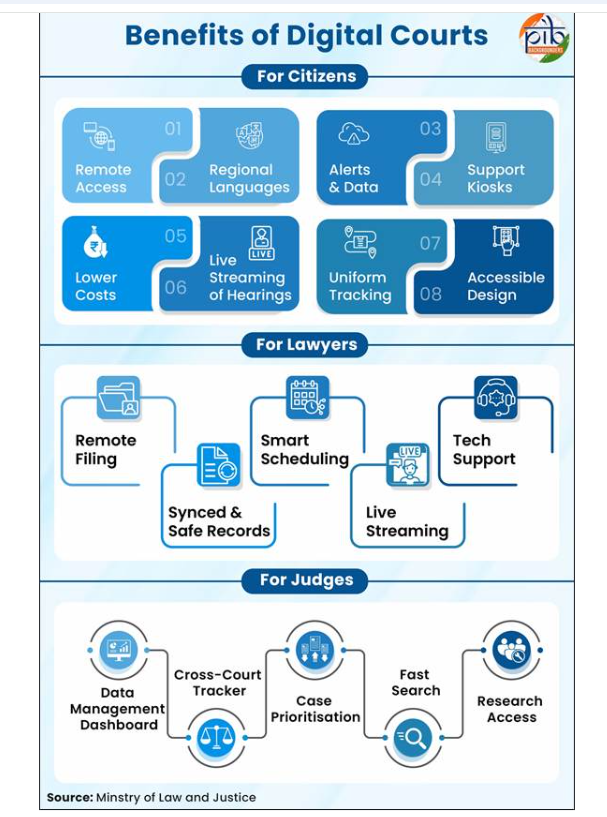
e-Sewa Kendras are citizen-friendly assistance centres located within court complexes. They help bridge the digital divide by assisting litigants who may not be comfortable using digital platforms on their own.
Services Provided
- case status and next hearing date
- certified copy applications
- e-filing assistance
- scanning and uploading documents
- e-signatures
- e-stamp purchase
- e-payments
- Aadhaar-based digital signatures
- downloading e-Courts mobile app
- joining video-conference hearings
- traffic challan disposal through Virtual Courts
- judgment and order copies through digital channels
- guidance on judges’ leave schedules
- free legal aid guidance
- eMulakat appointments for prison visits
Network of e-Sewa Kendras
As of 30 June 2026, there were:
- 49 e-Sewa Kendras across High Courts
- 2,535 e-Sewa Kendras across District Courts
AI-Assisted Judicial Processes
- Under Phase III, the e-Courts Mission is moving towards AI and Machine Learning-based judicial support.
- Out of the total ₹7,210 crore Phase III outlay, ₹53.57 crore has been earmarked for AI and Machine Learning applications in High Courts through 2027.
Major AI-Based Initiatives
| Initiative | Purpose |
| AI-assisted transcription | Transcribes oral arguments in Constitution Bench matters |
| LegRAA | Supports judges in legal research and document analysis |
| Digital Courts 2.1 | Provides single-window paperless court management |
| ASR-SHRUTI | Voice-to-text conversion |
| PANINI | Translation and dictation support for orders and judgments |
| eSCR translations | Translation of judgments into Indian languages |
| AI filing scrutiny tool | Identifies defects in e-filed petitions and extracts case metadata |
Through the eSCR portal, judgments are being translated into 18 Indian languages. Over 83,000 translations, including 36,344 in Hindi, had been completed by March 2025.
An AI tool developed with IIT Madras can automatically identify defects in e-filed petitions and extract case metadata. Prototype access has been provided to 200 Advocates-on-Record.
Significance of e-Courts Mission
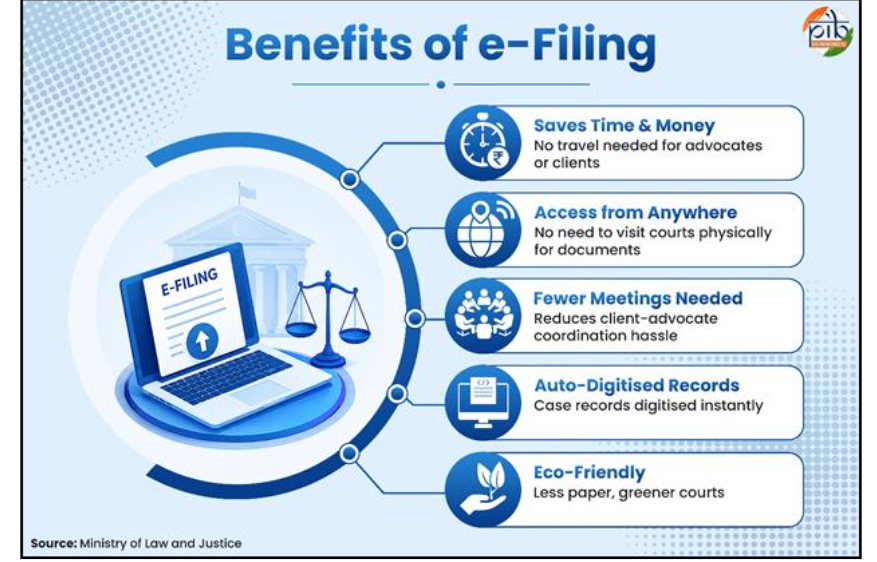
1. Access to Justice
Digital filing, remote hearings and e-Sewa Kendras reduce the need for physical court visits, saving time and cost.
2. Transparency
NJDG and case-tracking platforms make pendency, orders and case status visible to the public.
3. Speed and Efficiency
e-Filing, e-Summons, digital payments and video hearings reduce procedural delays.
4. Paperless Judiciary
Digitisation of records and paperless court platforms reduce dependence on physical files.
5. Criminal Justice Integration
ICJS improves coordination between police, courts, prisons, prosecution and forensic institutions.
6. Language Inclusion
Multilingual portals and translated judgments make the judicial system more accessible to citizens.
7. AI-Based Support
AI can assist in transcription, translation, legal research, filing scrutiny and case management.
Challenges
1. Digital Divide
Many litigants may lack digital literacy, internet access or devices.
2. Infrastructure Gaps
Reliable connectivity, hardware maintenance and power supply are essential for digital courts.
3. Cybersecurity Risks
Court records, evidence and judgments require strong data protection and cyber safeguards.
4. AI Accountability
AI tools must assist judges but cannot replace judicial reasoning or human discretion.
5. Language and Translation Accuracy
Judicial translations must be accurate because even small errors can affect legal understanding.
6. Training Needs
Judges, lawyers, clerks, police and litigants need regular training to use digital systems effectively.
Way Forward
1. Strengthen Digital Literacy
e-Sewa Kendras should be expanded and staff should be trained to assist first-time digital users.
2. Upgrade Court Infrastructure
Courts need reliable internet, hardware, power backup and cybersecurity systems.
3. Ensure Data Protection
Judicial data must be protected through encryption, secure access systems and audit trails.
4. Improve AI Governance
AI tools should remain assistive, transparent and accountable, with human oversight at every stage.
5. Expand Multilingual Access
Translation quality should be improved so that judgments and orders become accessible in regional languages.
6. Integrate Justice Institutions
ICJS should be strengthened to ensure smooth data flow among police, courts, prisons and forensic labs.
7. Monitor Outcomes
Digital reforms should be assessed based on reduced pendency, faster service delivery and improved citizen satisfaction.
Conclusion
The e-Courts Mission Mode Project has transformed India’s judiciary into a more digital, transparent and citizen-friendly system. By enabling e-Filing, remote hearings, NJDG, e-Sewa Kendras, NSTEP, ICJS integration and AI-assisted processes, it reduces dependence on physical court visits and improves access to judicial services. However, technology alone cannot solve judicial delays. Its success depends on infrastructure, cybersecurity, digital literacy, human oversight and institutional reform. As Phase III progresses through 2027, the e-Courts Mission can become a major step towards faster, affordable and inclusive justice delivery.