Why in News?
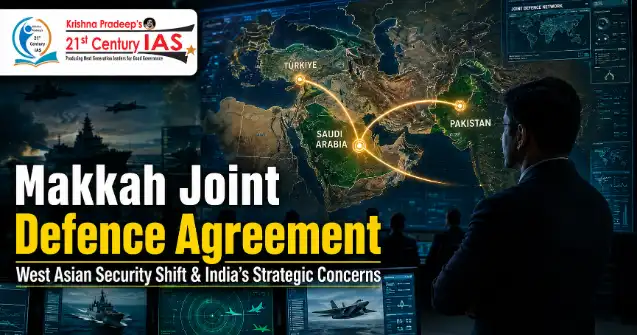
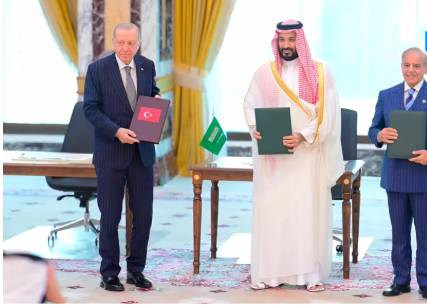
Saudi Arabia, Türkiye and Pakistan signed the Makkah Joint Defence Agreement in August 2026. The agreement states that an armed attack on any one of the three countries will be treated as an attack on all three. This has drawn attention because it brings together Saudi financial power, Türkiye’s defence-industrial capability and Pakistan’s military strength.
What is the Makkah Joint Defence Agreement?
- The Makkah Joint Defence Agreement is a trilateral defence arrangement between Saudi Arabia, Türkiye and Pakistan.
- It builds upon the earlier Saudi-Pakistan Strategic Mutual Defence Agreement of 2025. With Türkiye joining the arrangement, the bilateral framework has expanded into a broader security grouping.
- The pact is being seen as a new form of collective defence arrangement in West Asia. However, it should not be equated with NATO because the full text and detailed operational obligations of the pact have not been made public.
Key Features of the Pact
1. Collective Defence Commitment
The pact declares that an armed attack on one member will be treated as an attack on all three.
2. Defence Cooperation
It aims to strengthen defence cooperation among the three countries.
3. Military Coordination
The agreement can encourage joint military exercises, training and operational coordination.
4. Intelligence Sharing
It may create formal channels for intelligence sharing, threat assessment and security coordination.
5. Strategic Deterrence
The pact seeks to create deterrence in a region affected by missile attacks, drones, proxy conflicts and maritime insecurity.
Why Saudi Arabia, Türkiye and Pakistan Need the Pact?
1. Saudi Arabia: Security and Defence Capacity
Saudi Arabia wants to reduce excessive dependence on the United States for security. Houthi attacks, Iranian missile and drone threats, Red Sea instability and risks around the Strait of Hormuz and Bab-el-Mandeb have exposed its security vulnerabilities.
The pact gives Saudi Arabia access to Pakistani military experience and Turkish defence technology, while helping it build domestic defence capacity.
2. Türkiye: Regional Influence and Defence Markets
Türkiye has a growing defence industry, especially in drones, aerospace and military technology. Through this pact, it can access Saudi capital, expand defence exports and strengthen its influence in West Asia.
3. Pakistan: Strategic Relevance and Leverage
Pakistan gains greater strategic importance in West Asia. It also strengthens defence, economic and energy ties with Saudi Arabia. The agreement increases Pakistan’s diplomatic weight in the Islamic world.
Strategic Capabilities and Benefits:
| Country / Grouping | What It Brings to the Pact | What It Seeks to Gain |
| Saudi Arabia | Strong financial resources, energy influence, strategic Gulf location and high defence-spending capacity | Stronger security deterrence, access to Pakistani military support, Turkish defence technology and better protection for Vision 2030 projects |
| Türkiye | Advanced defence industry, drone technology, aerospace capabilities and NATO-linked military experience | Saudi investment, larger defence export markets and greater geopolitical influence in West Asia |
| Pakistan | Nuclear capability, conventional military strength, large armed forces and long-standing defence links with Saudi Arabia | Greater importance in West Asian security, closer Saudi ties and stronger diplomatic leverage |
| Combined Strength | Saudi capital + Turkish defence technology + Pakistani military capability | Stronger collective defence, deeper military coordination and greater strategic autonomy |
Why the Pact Should Not Be Equated with NATO
The pact resembles NATO’s Article 5 in language because it says an attack on one member will be treated as an attack on all. However, it should not be treated as a NATO-style alliance.
Reasons
- The full text of the agreement has not been publicly released.
- Detailed operational obligations are unclear.
- It is not known whether the pact requires automatic military action.
- Mutual defence pacts depend not only on legal language but also on political will.
- The earlier Saudi-Pakistan defence pact did not automatically result in direct military action during regional attacks.
Therefore, the agreement is more significant as a strategic and defence-industrial partnership framework than as an automatic war-triggering alliance.
Historical Background: Earlier Pan-Islamic and Pan-Arab Defence Pacts
- The Makkah agreement is not the first attempt to build security cooperation among Muslim-majority or Arab states. Earlier arrangements show that such pacts often face challenges due to political divisions, weak coordination and changing regional alignments.
| Arrangement | Explanation |
| Treaty of Joint Defense and Economic Cooperation between Arab League States, 1950 | This was a Pan-Arab collective security arrangement with a mutual-defence clause. However, its effectiveness remained limited because Arab states often differed politically and lacked strong military coordination. |
| Baghdad Pact, 1955 / CENTO | It was formed by Iraq, Türkiye, Pakistan, Iran and the United Kingdom mainly to contain Soviet influence in West Asia. After Iraq withdrew following the 1958 coup, it became the Central Treaty Organization. It ended in 1979 after the Iranian Revolution. |
| Peninsula Shield Force, 1984 | Created by the Gulf Cooperation Council during the Iran-Iraq War, it aimed to protect the Arabian Peninsula through a joint military force. It was notably deployed in Bahrain in 2011. |
| Islamic Military Counter Terrorism Coalition, 2015 | A Saudi-led coalition of more than 40 countries focused on terrorism through military, financial, ideological and media cooperation. Critics have viewed it as having an anti-Iran orientation. |
Implications for India
1. Strengthening of Pakistan–Türkiye–Saudi Security Link
Saudi Arabia’s deeper defence partnership with Pakistan and Türkiye could strengthen a security network along India’s western flank. Since Pakistan and Türkiye have often taken positions against India on Kashmir at the UN and OIC, India must watch the diplomatic implications carefully.
2. Pakistan–Türkiye–China Axis
Both Pakistan and Türkiye have close strategic ties with China. Saudi Arabia’s closer security integration with them could indirectly strengthen a wider Pakistan–Türkiye–China alignment.
3. Impact on India–Saudi Relations
India and Saudi Arabia have built strong energy, trade, investment and strategic ties through the India–Saudi Strategic Partnership Council. However, if Saudi security dependence on Pakistan increases, Islamabad may try to gain diplomatic leverage on issues such as Kashmir.
4. Pakistan’s Military Modernisation
Saudi finance, Turkish defence technology and Pakistani military expertise could help Pakistan acquire advanced drones, fighters, air-defence systems and other military platforms. This may affect India’s conventional military calculations.
5. Western Indian Ocean Concerns
If trilateral defence cooperation expands into maritime security, it may increase the presence of these countries in the western Indian Ocean, where India seeks to remain a net security provider.
6. Conflict Threshold Ambiguity
The “attack on one is an attack on all” clause creates uncertainty over whether a future India–Pakistan crisis could draw political or military support from Saudi Arabia or Türkiye. Even if direct intervention is unlikely, it may give Pakistan a sense of strategic cover.
7. Counter-Terrorism Diplomacy
Stronger Saudi-Pakistan security ties could make India’s efforts to isolate Pakistan diplomatically on cross-border terrorism more difficult.
8. Nuclear Ambiguity
Pakistan’s nuclear capability gives the pact additional strategic weight. However, no formal Pakistani nuclear guarantee to Saudi Arabia has been publicly confirmed.
India’s Way Forward
1. Deepen Minilateral Partnerships
India should accelerate IMEC and I2U2 to strengthen economic and strategic ties with Saudi Arabia, UAE and other Gulf partners.
2. Strengthen Chabahar and INSTC
India should use Chabahar Port and the International North-South Transport Corridor to maintain access to Iran, Central Asia and Europe. This prevents India’s regional options from becoming dependent on the Pakistan–Türkiye axis.
3. Diversify Gulf Partnerships
India should expand defence, maritime, energy and technology cooperation with UAE, Oman and Qatar, ensuring that its West Asia policy does not depend only on one Gulf country.
4. Build Eastern Mediterranean Links
Strategic engagement with Greece, Cyprus, Armenia and Israel can give India additional diplomatic and defence options in the Eastern Mediterranean.
5. Maintain Defence Autonomy in the Gulf
India should deepen defence cooperation with Gulf countries without entering automatic mutual-defence commitments. This protects India’s strategic autonomy.
6. Strengthen Indigenous Defence Capabilities
Under Atmanirbhar Bharat, India must accelerate development of drones, counter-drone systems, AI-enabled warfare, electronic warfare, hypersonics and advanced air defence.
7. Strengthen Indian Ocean Security
India should use platforms such as the Indian Ocean Rim Association to promote maritime transparency and prevent bloc-based security politics in the Indian Ocean.
8. Fast-Track Defence Forces Vision 2047
India must build autonomy through capability by strengthening military, economic and technological power. West Asia should be treated as a strategic hub for energy security, trade, diaspora interests and maritime access.
Conclusion
The Makkah Joint Defence Agreement signals the emergence of a more multipolar and regionally driven security architecture in West Asia. It reflects Saudi Arabia’s search for security diversification, Türkiye’s ambition to expand regional influence and Pakistan’s effort to gain strategic relevance. For India, the pact is not an immediate military threat, but it creates diplomatic, defence and maritime challenges. India’s response should be based on strategic balancing: stronger Gulf partnerships, IMEC and I2U2, alternative connectivity through Chabahar and INSTC, enhanced Indian Ocean presence and faster defence indigenisation. The objective should be clear — protect India’s interests in West Asia while preserving strategic autonomy.