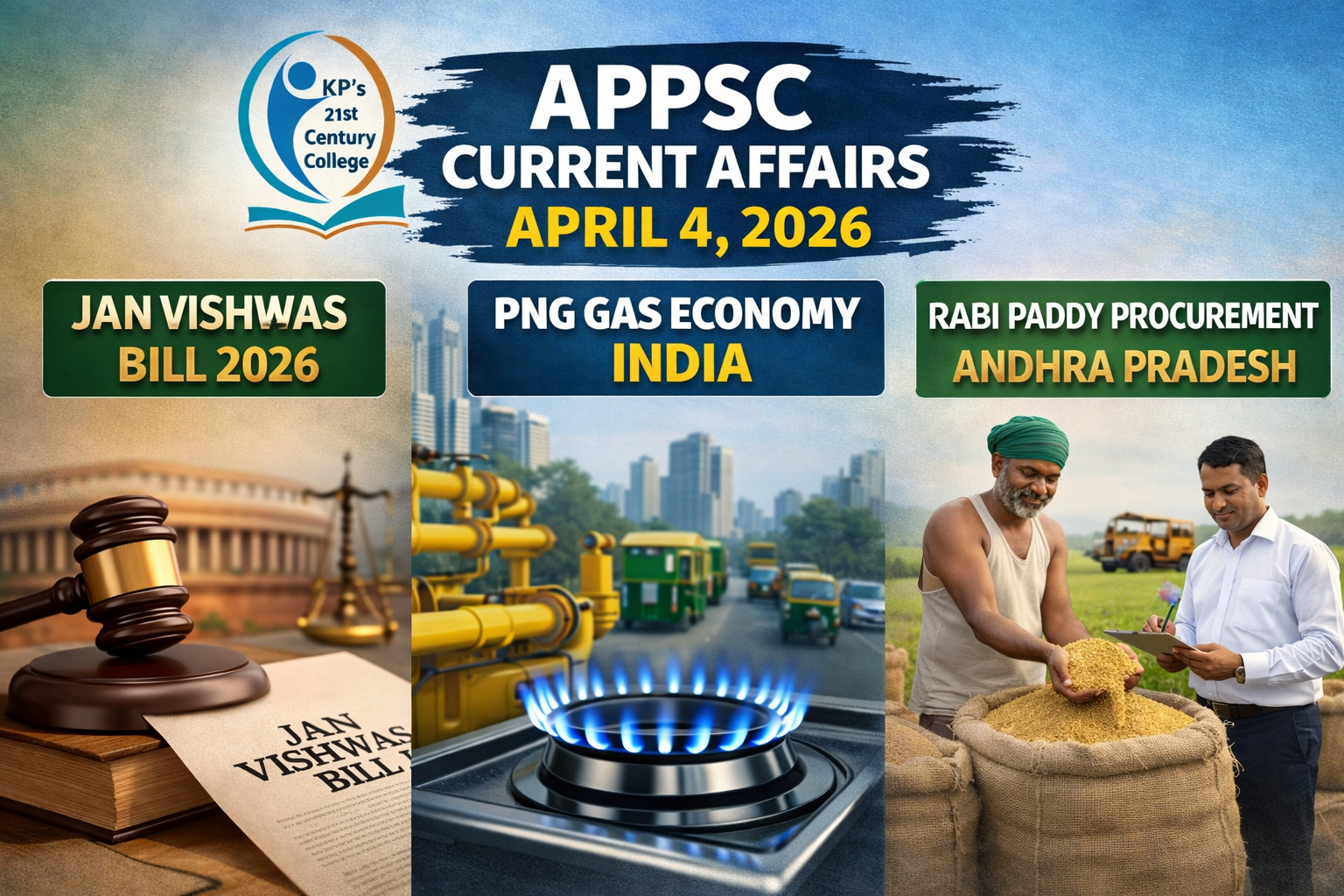
APPSC Current Affairs April 4th 2026
Relevance: GS Paper III – Agriculture (Food Procurement, Cropping Seasons, Agricultural Marketing)
For Prelims:
- Rabi Crop, Kharif Crop, Paddy Procurement, Minimum Support Price (MSP), Gunnysacks, Procurement Centres, Foodgrain Storage
For Mains:
- Agricultural Procurement System, Farmer Income Support, Food Security, Supply Chain Management in Agriculture, Public Distribution System (PDS)
Why in News?
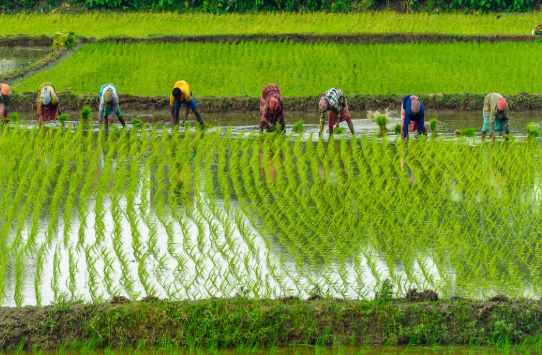
The Government of Andhra Pradesh has set a target to procure 23 lakh metric tonnes (MT) of paddy during the Rabi season starting from April 4, 2026.
The procurement will take place through 1,917 paddy procurement centres, and the government has assured that farmers will receive payment within 24 hours of procurement.
Background
• Paddy is one of the most important foodgrain crops in India and forms the staple diet for a large section of the population.
• State governments procure paddy from farmers at Minimum Support Price (MSP) through procurement centres to protect farmers from price fluctuations in the market.
• The procured paddy is milled into rice and supplied through the Public Distribution System (PDS) to ensure food security.
• Effective procurement operations are essential to support farmers and maintain stable foodgrain supplies.
Key Highlights of the Procurement Plan
• The government has fixed a procurement target of 23 lakh MT of paddy for the Rabi season.
• Procurement will be conducted through 1,917 procurement centres across the state.
• Farmers will receive payment within 24 hours after procurement of their produce.
• Around 5.4 crore gunnysacks have been arranged for packing and storing the procured paddy.
• Approximately 17,200 lorries will be deployed for transportation of paddy, and their movement will be monitored through GPS tracking.
• During the previous Kharif season, about 51 lakh MT of paddy was procured and payments worth ₹11,300 crore were made to around 7.8 lakh farmers.
Rabi and Kharif Cropping Seasons
Aspect | Rabi Crops | Kharif Crops |
Sowing Period | October–December | June–July |
Harvesting Period | March–April | September–October |
Climate Requirement | Cool and dry climate | Warm and wet climate |
Major Examples | Wheat, barley, mustard, gram | Rice, maize, cotton, soybean |
Dependence on Monsoon | Low | High |
Gunnysacks in Foodgrain Procurement
Aspect | Details |
Material | Traditionally made from jute fibre |
Purpose | Used for packing, storing, and transporting foodgrains |
Importance | Protects grains from moisture and damage |
Policy Link | Procurement agencies must ensure adequate supply during harvest seasons |
Environmental Benefit | Biodegradable and environmentally friendly compared to plastic packaging |
Significance
• Supports farmer income
- Timely procurement at MSP ensures that farmers receive a fair price for their produce.
• Prevents distress sales
- Farmers are protected from selling their produce at low market prices during harvest season.
• Strengthens food security
- Procured grains are used for welfare schemes and the Public Distribution System.
• Improves supply chain efficiency
- Use of GPS tracking for transportation enhances transparency and monitoring.
• Strengthens procurement infrastructure
- Establishment of procurement centres improves access for farmers.
Issues and Challenges
• Storage and transportation logistics can become difficult during peak harvest periods.
• Shortage of gunnysacks can disrupt procurement operations.
• Delays in transportation or milling may affect the overall supply chain.
• Weather conditions during harvesting can affect grain quality.
Way Forward
• Expand modern grain storage infrastructure such as silos and warehouses.
• Improve digital monitoring systems for procurement and payments.
• Strengthen transportation logistics and supply chains.
• Promote crop diversification to reduce excessive dependence on water-intensive crops like paddy.
Conclusion
The procurement of Rabi paddy in Andhra Pradesh reflects the crucial role of government procurement in supporting farmers and maintaining food security. Efficient procurement, adequate storage materials such as gunnysacks, and timely payments help ensure that agricultural markets function smoothly and farmer incomes remain stable.
CARE MCQ
Q. With reference to cropping seasons in India, consider the following statements:
- Rabi crops are generally sown during winter and harvested in spring.
- Kharif crops mainly depend on monsoon rainfall.
- Paddy is grown only as a Kharif crop in India.
Q. Consider the following statements regarding foodgrain procurement in India:
- The government procures foodgrains mainly at Minimum Support Price (MSP).
- Procured grains are distributed through the Public Distribution System.
- Gunnysacks are widely used for storing and transporting foodgrains.
Select the correct answer using the code below:
A. 1 and 2 only
B. 2 and 3 only
C. 1 and 3 only
D. 1, 2 and 3
Answer: D
Explanation
• Statement 1: Correct. Foodgrains are procured at MSP through government agencies.
• Statement 2: Correct. Procured grains are distributed through welfare schemes and the Public Distribution System.
• Statement 3: Correct. Gunnysacks made from jute are commonly used for storage and transportation of foodgrains.
MAINS QUESTION
Q. Government procurement of foodgrains plays a crucial role in ensuring food security and supporting farmer incomes in India. Discuss the challenges associated with procurement operations and suggest measures to improve their efficiency. (250 words)
Relevance: GS Paper II – Governance (Regulatory Reforms, Criminal Justice, Ease of Doing Business, Administrative Law)
For Prelims:
- Decriminalisation of Offences, Civil Penalty Framework, Adjudicating Authority, Appellate Mechanism, Consolidated Fund of India, Central Acts Rationalisation
For Mains:
- Trust-Based Governance, Proportionate Regulation, Regulatory Overcriminalisation, Administrative Adjudication, Compliance Burden Reduction, State–Citizen Interface, Procedural Fairness, Institutional Capacity
Why in News?
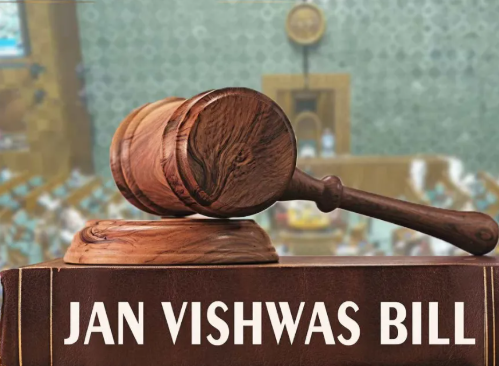
The Jan Vishwas (Amendment of Provisions) Bill, 2026 has been passed by Parliament as a major reform initiative aimed at decriminalising minor offences across multiple laws.
The Bill expands the scope of earlier reforms by covering a large number of legislations and provisions.
It seeks to reduce the compliance burden on individuals and businesses while improving the regulatory environment.
The reform is also seen as a step towards strengthening ease of doing business and promoting economic activity. At a broader level, it reflects a shift in governance philosophy towards trust-based regulation.
Background and Context
- India’s regulatory framework has traditionally relied heavily on criminal penalties, even for minor and procedural violations.
- This led to excessive criminalisation, increased litigation, and a compliance culture driven by fear rather than cooperation.
- Businesses and individuals often faced the risk of imprisonment for technical lapses, which discouraged economic activity and innovation.
- Over time, the need for rationalising such provisions became evident. The Jan Vishwas Bill builds upon earlier efforts to reform this system and seeks to align India’s regulatory practices with global standards.
Concept of the Reform
- The reform is based on the principle that penalties should be proportionate to the nature and intent of the offence.
- It recognises that minor and non-malicious violations should not be treated as criminal acts. Instead, such offences are addressed through civil penalties, warnings, and corrective mechanisms.
- This approach promotes voluntary compliance and reduces adversarial interaction between the State and citizens.
- It reflects a shift from a punitive regulatory model to a facilitative and trust-based governance framework.
Legislative Scope and Coverage
- The Bill covers nearly 80 Central Acts and rationalises more than 1,000 provisions, making it one of the most comprehensive compliance reforms in India.
- Its scope spans multiple sectors, including industry, trade, environment, public administration, and municipal governance.
- This wide coverage ensures that the reform has a systemic impact across the regulatory landscape. It also helps in creating greater uniformity and coherence in compliance requirements
Key Provisions of the Bill
- The Bill replaces imprisonment with monetary penalties for a large number of minor offences, thereby reducing reliance on criminal law. It removes obsolete and redundant provisions that no longer serve a regulatory purpose.
- It introduces a graded compliance mechanism, allowing warnings and improvement notices before penalties are imposed.
- Enforcement is shifted from criminal courts to administrative adjudication through designated officers and appellate authorities. It also provides for periodic revision of penalties to maintain their deterrence value.
Nature and Characteristics
- The reform is systemic in nature, as it cuts across multiple laws and sectors rather than focusing on a single domain.
- It is based on the principle of proportionate regulation and emphasises civil penalties over criminal sanctions.
- The framework is compliance-oriented, aiming to encourage voluntary adherence to rules.
- It also reflects a shift towards administrative enforcement mechanisms, reducing dependence on criminal courts.
Core Issues Involved
- A key issue addressed by the Bill is the problem of overcriminalisation in regulatory laws.
- The existing framework often treated minor procedural lapses as criminal offences, leading to inefficiency and misuse.
- Another issue is the high compliance burden faced by businesses, which affects economic growth.
- The Bill also raises questions about balancing regulatory effectiveness with ease of doing business.
- Additionally, it highlights the need for strong institutional capacity to implement reforms effectively.
Causes / Reasons
- The primary reason for the reform is the recognition that excessive criminalisation creates barriers to economic activity and discourages compliance.
- The growing emphasis on improving India’s ease of doing business ranking has also driven the need for regulatory simplification.
- The increasing burden on the criminal justice system further necessitated the removal of minor offences from its domain. Additionally, global best practices favour civil penalties over criminal sanctions for regulatory violations.
Implications
- The Bill is expected to reduce the compliance burden on businesses and individuals, thereby encouraging entrepreneurship and formalisation of the economy.
- It will improve the efficiency of the criminal justice system by reducing unnecessary cases. The shift towards administrative adjudication can lead to faster resolution of disputes.
- However, the reform also raises concerns about maintaining deterrence and ensuring effective enforcement in sensitive sectors.
Challenges / Criticisms
- Critics argue that excessive decriminalisation may dilute deterrence, particularly in areas related to public safety and environmental protection.
- There are concerns about the capacity and impartiality of adjudicating authorities, which will play a key role in enforcement.
- The possibility of arbitrary decision-making and lack of uniformity in implementation also poses challenges.
- Additionally, the shift from criminal penalties to civil fines may reduce accountability in certain cases.
Way Forward
The success of the reform depends on strengthening institutional capacity and ensuring transparency in administrative adjudication. Proper training of adjudicating authorities and establishment of robust appellate mechanisms are essential. Regular review of the impact of decriminalisation will help identify gaps and improve the framework. A balanced approach is required to ensure that ease of doing business does not compromise regulatory effectiveness and public interest.
Conclusion
The Jan Vishwas (Amendment of Provisions) Bill, 2026 represents a significant shift towards modern, trust-based governance in India. By reducing overcriminalisation and promoting proportionate regulation, it aims to create a more enabling regulatory environment. However, its long-term success will depend on effective implementation and maintaining a balance between facilitation and enforcement.
UPSC PYQ
Q. Discuss the role of administrative reforms in improving governance in India. (GS Paper II)
CARE MCQ
Q. With reference to the Jan Vishwas (Amendment of Provisions) Bill, 2026, consider the following statements:
- It replaces imprisonment for several minor offences with civil penalties.
- It shifts enforcement from criminal courts to administrative adjudication.
- It removes all forms of penalties for regulatory violations.
Which of the above statements are correct?
A. 1 and 2 only
B. 2 and 3 only
C. 1 and 3 only
D. 1, 2 and 3
Answer: A
Explanation:
Statement 1 is correct: The Bill decriminalises several minor and technical offences by replacing imprisonment with civil penalties such as monetary fines, thereby reducing the criminal burden on businesses and individuals.
Statement 2 is correct: The Bill provides for administrative adjudication through designated authorities, shifting enforcement from criminal courts to a faster and more efficient mechanism.
Statement 3 is incorrect: The Bill does not eliminate penalties; it only converts criminal penalties into civil/monetary penalties, ensuring that violations continue to attract consequences.
Therefore, only statements 1 and 2 are correct.
Q. With reference to the Jan Vishwas (Amendment of Provisions) Bill, 2026, consider the following statements:
- The Bill expands its scope significantly compared to the 2025 version by amending around 80 central laws.
- It introduces a mechanism of periodic increase in fines by 10% every three years.
- It completely abolishes criminal liability for all regulatory offences covered under the amended laws.
- It provides for warnings and advisories for initial contraventions in certain cases before imposing penalties.
Relevance: GS Paper III – Energy (Energy Security, Clean Energy Transition, Infrastructure, Urban Development)
For Prelims:
- Piped Natural Gas (PNG), City Gas Distribution (CGD), LNG Terminals, Methane (CH₄), City Gate Station (CGS), Trunk Pipeline
For Mains:
- Gas-Based Economy, Energy Transition, Urban Energy Infrastructure, Supply Chain Vulnerability, Clean Fuel Substitution, Energy Diversification, Chokepoints (Hormuz), Infrastructure Deficit
Why in News?
- The Ministry of Petroleum and Natural Gas has reviewed the expansion of PNG networks to accelerate India’s transition towards a gas-based economy. This comes amid global supply disruptions, especially at the Strait of Hormuz, which handles a major share of global energy trade.
- The situation has highlighted India’s dependence on imported LNG and vulnerability to external shocks.
- The government has prioritised gas allocation for households and essential services under the Essential Commodities Act.
- This has renewed focus on strengthening domestic gas infrastructure and expanding PNG access.
Background and Context
- India’s energy mix has traditionally relied on coal, oil, and LPG, with natural gas contributing a relatively small share. However, environmental concerns and urbanisation have increased the need for cleaner fuels.
- Global disruptions in gas supply chains have exposed India’s dependence on imported LNG, particularly from West Asia
- The limited domestic production and storage capacity further increase vulnerability. In this context, expanding PNG infrastructure through the City Gas Distribution network has become a strategic priority.
- The government aims to significantly increase PNG connections in the coming years.
Concept of PNG
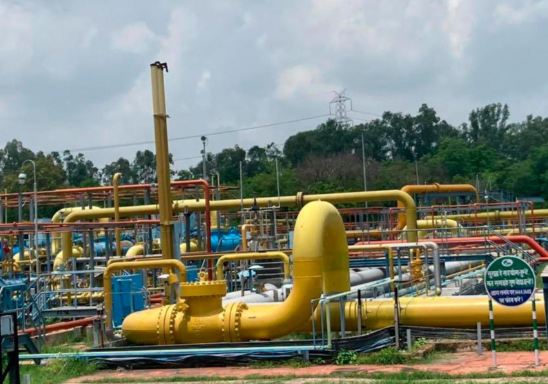
- Piped Natural Gas (PNG) is a system of delivering natural gas, primarily methane, directly to consumers through pipelines.
- Unlike LPG, which is stored and transported in cylinders, PNG is supplied continuously through an infrastructure network.
- It is a key component of the City Gas Distribution system and supports India’s vision of a gas-based economy.
- Methane has a lower carbon intensity compared to other fossil fuels, making PNG a relatively cleaner energy option. It represents a shift from portable fuel systems to network-based energy delivery.
Operational Mechanism
- Natural gas is sourced either from domestic fields or imported as Liquefied Natural Gas (LNG), which is regasified at coastal terminals. It is then transported through high-pressure trunk pipelines across regions.
- At the city level, City Gate Stations regulate pressure for safe distribution. The gas flows through a network of steel and polyethylene pipelines to reach residential and commercial areas.
- Last-mile connectivity ensures supply directly to households with metered billing. Integration with infrastructure planning platforms like PM Gati Shakti improves coordination.
Nature and Characteristics
- PNG ensures uninterrupted supply and eliminates the need for storage or refilling.
- It is safer compared to LPG as methane disperses quickly in case of leakage. The system is space-efficient and suitable for urban households.
- Meter-based billing improves transparency and consumption tracking. It also reduces logistics costs associated with cylinder transportation.
- Overall, PNG represents a modern, efficient, and cleaner energy delivery system.
IMP: LPG vs LNG vs CNG vs PNG
The distinction between different gas-based fuels is important for understanding India’s energy system.
- LPG (Liquefied Petroleum Gas) consists mainly of propane and butane and is stored as a liquid in pressurised cylinders. It is widely used for household cooking and is portable, but requires periodic refilling and logistics support.
- CNG (Compressed Natural Gas) is primarily methane compressed at high pressure and is used mainly as a transport fuel. It remains in gaseous form and is stored in cylinders fitted in vehicles, making it suitable for reducing vehicular emissions.
- PNG (Piped Natural Gas) is also methane-based but is supplied directly through pipelines to households and industries. It eliminates the need for storage and ensures continuous supply, making it an infrastructure-based fuel system.
- LNG (Liquefied Natural Gas) is natural gas cooled to around –160°C to convert it into liquid form for transportation. It is imported via ships, stored at terminals, and then regasified before being supplied through pipelines. LNG is not directly consumed by households but acts as a supply source for PNG, CNG, and industrial use.
- Thus, while LPG and CNG are end-use fuels in cylinder form, PNG is a pipeline-based delivery system, and LNG is primarily a transportation and storage form of natural gas.
Core Issues Involved
- A major issue is the gap between India’s gas-based economy targets and its existing infrastructure.
- The uneven distribution of pipeline networks limits PNG access in many regions. Dependence on imported LNG exposes the system to global price fluctuations and geopolitical risks. The affordability of gas remains a concern for consumers.
- Coordination among multiple agencies in infrastructure development is also a challenge.
Implications
- Energy Security
Expansion of PNG reduces dependence on LPG and imported fuels, enhancing energy diversification and resilience. - Environmental Impact
PNG, being cleaner than coal and oil, contributes to reduction in urban air pollution and greenhouse gas emissions. - Economic Impact
It reduces logistics costs, improves industrial efficiency, and supports long-term cost savings for consumers. - Urban Development
PNG infrastructure promotes modern urban planning and supports smart city initiatives.
Challenges / Criticisms :
- High Investment & Time Constraints: Expansion of pipeline infrastructure requires substantial capital investment and long gestation periods, particularly in rural and remote areas.
- Pricing Volatility: Domestic gas pricing remains linked to global markets, leading to fluctuations and affecting affordability for consumers.
- Limited Network Coverage: A significant portion of India still lies outside the pipeline network, restricting equitable access to cleaner fuel.
- Implementation & Behavioural Issues: Infrastructure projects face delays due to coordination challenges, while the shift from LPG to PNG also requires behavioural adaptation among users.
Way Forward
Expansion of City Gas Distribution networks must be accelerated to cover more regions. Domestic gas production should be increased and import sources diversified. Investment in pipeline infrastructure and last-mile connectivity is essential. Technological improvements in monitoring and safety should be adopted. Integration with urban planning initiatives will ensure efficient infrastructure development.
Conclusion
PNG is a key pillar of India’s transition towards a cleaner and more efficient energy system. It supports environmental goals, energy security, and urban development. However, its success depends on overcoming infrastructure and supply challenges. A coordinated approach combining policy, investment, and technology is essential for achieving a gas-based economy.
UPSC PYQ
Q. Discuss the role of natural gas in India’s energy transition. What are the challenges in increasing its share in the energy mix? (GS Paper III)
CARE MCQ
Q. With reference to LPG, LNG, CNG, and PNG, consider the following statements:
- LNG is produced by cooling natural gas to cryogenic temperatures, enabling its transport independent of pipeline infrastructure.
- PNG supply ensures lower transmission losses compared to LPG due to its direct pipeline delivery system.
- CNG and LNG differ primarily in their storage conditions, with CNG being compressed at high pressure while LNG is stored at very low temperatures.
- LPG is primarily composed of methane and is lighter than air, making it safer in case of leakage.
Which of the statements given above are correct?
A. 1, 2 and 3 only
B. 1 and 4 only
C. 2, 3 and 4 only
D. 1, 2, 3 and 4
Answer: A
Explanation:
Statement 1 is correct: LNG is formed by cooling natural gas to about -162°C, reducing its volume drastically, which enables long-distance transport via ships without pipelines.
Statement 2 is correct: PNG is supplied through pipelines directly to consumers, resulting in minimal handling and lower transmission losses compared to LPG, which requires cylinder-based distribution.
Statement 3 is correct: The key difference lies in storage—CNG is compressed gas stored at high pressure, whereas LNG is stored as a liquid at cryogenic temperatures, reflecting two distinct technological approaches.
Statement 4 is incorrect: LPG mainly consists of propane and butane, not methane. It is heavier than air, which makes leakage potentially more dangerous as it can accumulate near the ground.
Thus, statements 1, 2, and 3 are correct.
Q. With reference to Piped Natural Gas (PNG), consider the following statements:
- PNG is supplied through a city gas distribution network directly to households, industries, and commercial establishments.
- PNG eliminates the need for storage infrastructure at the consumer level, unlike LPG.
- PNG is stored and transported in liquid form within pipelines to reduce volume.
- PNG is considered safer than LPG because it is lighter than air and disperses quickly in case of leakage.