- Introduction to Defence Technology
- Organisation and Structure of the Indian Defence System
- Defence Innovation and Procurement
- Defence Research and Development Organisation (DRDO)
- Defence Research and Development Organisation (DRDO)
- Indian Missile system
- India’s Missile Defence System
- Aircrafts
- Naval Systems & Key Projects
- Modern Warfare Domains (Space, Cyber, and Biological)
- Strategic Deterrence and The Nuclear Triad
- Defence Technology Prelims Previous Year Questions
- Mains Previous Year Questions – Defence Technology
Aircraft Carriers
The ultimate symbol of a nation’s naval power is the aircraft carrier. While submarines hide and destroyers defend, an aircraft carrier is designed for massive “power projection.” It allows a country to send its fighter jets and military force thousands of kilometres away from its own shores, completely dominating the ocean.
What is an Aircraft Carrier?
An aircraft carrier is a massive warship that serves as a seagoing, floating airbase. It is equipped with a full-length flight deck capable of launching and landing fighter jets and helicopters in the middle of the ocean.
Because they are so large and valuable, aircraft carriers never travel alone. They are always surrounded by a protective fleet of destroyers, frigates, and submarines. This entire protective formation is called a Carrier Battle Group (CBG) or Carrier Strike Group.
How do Jets take off from a Ship?
Runways on land are several kilometres long, but a ship’s deck is very short. To launch heavy fighter jets from a short deck, navies use specific technologies. For UPSC, you must know the difference between the two main systems:
- STOBAR (Short Take-Off But Arrested Recovery): This is the system used by India. The front of the ship has an upward curve called a “ski-jump.” The fighter jet uses its own engine power to drive up the ramp, which throws it into the air. When landing, the jet catches a strong steel wire (arrestor wire) on the deck with a hook to stop quickly.
- CATOBAR (Catapult Assisted Take-Off But Arrested Recovery): Used primarily by the USA. Instead of a ski-jump, a powerful steam or electromagnetic catapult physically pushes and shoots the aircraft off a flat deck at extreme speeds.
INS Vikramaditya (The Russian Giant)
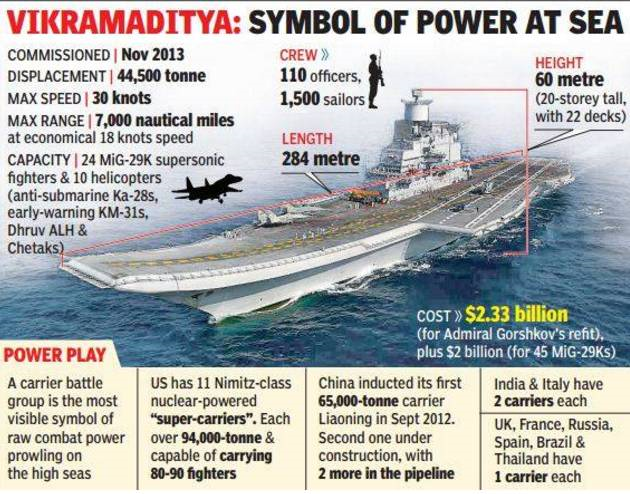
For many years, INS Vikramaditya has been the flagship (the most important ship) of the Indian Navy.
- Origin: It was originally built for the Soviet Navy under the name Admiral Gorshkov. India purchased it from Russia in 2004. After undergoing massive modifications and upgrades in Russia, it was commissioned into the Indian Navy in 2013.
- Features: It is a massive floating city, displacing about 44,500 tonnes. It operates on the STOBAR principle featuring a prominent ski-jump at its bow (front).
- The Air Wing: Its primary strike weapon is the Russian-made MiG-29K supersonic fighter jet. It also carries Kamov anti-submarine helicopters to protect the fleet from underwater threats.
INS Vikrant (The Pride of Indigenous Manufacturing)
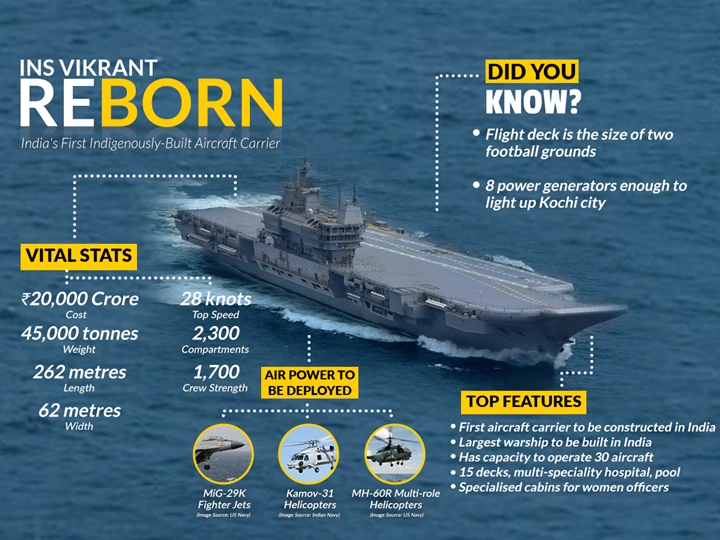
The commissioning of INS Vikrant (also known as IAC-1 or Indigenous Aircraft Carrier 1) was a historic milestone for India. With this ship, India joined an elite club of nations (including the US, UK, Russia, France, and China) capable of designing and building their own aircraft carriers.
- Design and Construction:
- It was designed by the Indian Navy’s Warship Design Bureau (WDB) and constructed entirely in India by Cochin Shipyard Limited (CSL) in Kerala.
- It was officially commissioned in September 2022.
- Atmanirbhar Bharat: A true symbol of self-reliance, the ship is built using special military-grade steel manufactured entirely in India by the Steel Authority of India Limited (SAIL). It features over 75% indigenous content.
- Size and Capacity: It displaces around 45,000 tonnes and is 262 metres long. It is so large that it contains over 2,300 compartments, designed for a crew of around 1,700 personnel.
- Aviation Capability:
- Like the Vikramaditya, it operates on the STOBAR mechanism.
- It is designed to carry a mix of around 30 aircraft.
- Currently, it operates the MiG-29K fighter jets, along with MH-60R Romeo multi-role helicopters and the indigenous Advanced Light Helicopter (ALH).
- In the future, it is expected to operate the French-made Rafale-M (Marine version) or the indigenous Twin Engine Deck Based Fighter (TEDBF) currently under development by DRDO.
INS VIRAAT
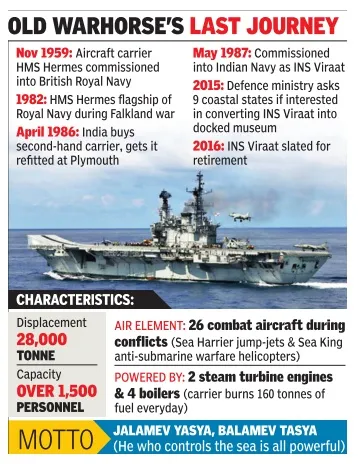
- INS Viraat was a Centaur-class aircraft carrier of the Indian Navy. INS Viraat was the flagship of the Indian Navy before INS Vikramaditya was commissioned in 2013.
- The ship was completed and commissioned in 1959 as the Royal Navy’s HMS Hermes, and decommissioned in 1984. It was sold to India in 1987.
- INS Viraat was commissioned into the Indian Navy on 12 May 1987, and served for almost 30 years.