

Table of Contents
Relevance: TGPSC Telangana Science and Technology
- Prelims: WiSig Networks | IIT Hyderabad | 32TR Massive MIMO | 5G Standalone | Open RAN | O-RAN Alliance | ULPI | n78 Mid-band | Spatial Layers | Altera Agilex FPGA | NM-ICPS | India Mobile Congress 2026
- Mains: Indigenous Telecommunications | Digital Sovereignty | Research Commercialisation | Public-funded Innovation | 5G Infrastructure | Technology Self-reliance | Academia–Industry Collaboration
Why in News?
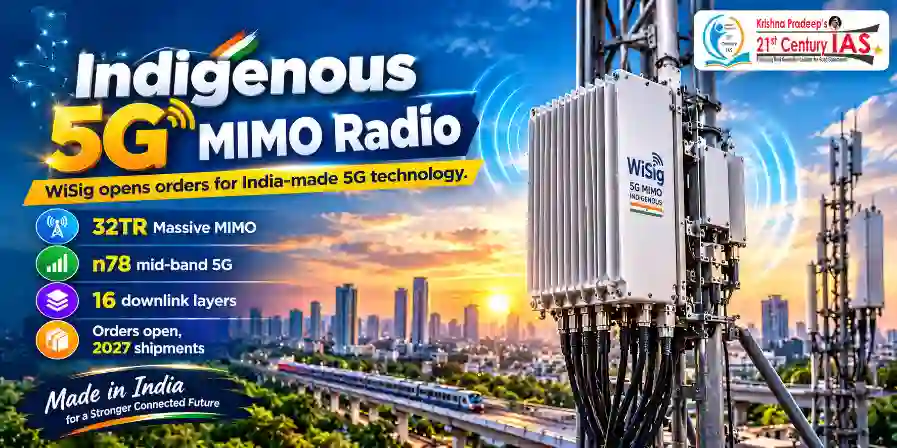
- WiSig Networks, an IIT Hyderabad-incubated company, has opened commercial orders for its indigenous 32TR Massive MIMO radio.
- The product was announced at India Mobile Congress 2026, with bulk shipments planned for 2027.
What is WiSig’s 5G Massive MIMO Radio?
It is a made-in-India 5G radio designed to:
- improve uplink performance;
- expand network coverage;
- enhance connectivity in weak-signal areas; and
- support mobile broadband and Fixed Wireless Access.
The radio was first unveiled at the Mobile World Congress in Barcelona in March 2026.
What is Massive MIMO?
MIMO means Multiple Input Multiple Output.
Massive MIMO uses many antennas to transmit and receive multiple data signals simultaneously. It helps a mobile network to:
- serve more users;
- improve data speed;
- increase network capacity;
- strengthen signal coverage; and
- use the available spectrum efficiently.
The term 32TR means that the radio has:
- 32 transmit channels; and
- 32 receive channels.
What are its Key Technical Features?
- Operates on the n78 mid-band 5G frequency
- Other frequency variants are under development
- Supports up to 16 spatial layers for downlink
- Supports up to eight spatial layers for uplink
- Uses Altera Agilex Field-Programmable Gate Arrays
- Complies with the O-RAN Alliance’s 7.2x standard
- Supports both Class A and Class B of Uplink Performance Improvement
What are Spatial Layers?
Spatial layers allow separate streams of data to be transmitted simultaneously through different antenna paths.
More spatial layers can improve:
- network capacity;
- data transmission speed; and
- service to multiple users.
What is Uplink Performance Improvement?
Uplink Performance Improvement (ULPI) improves the transmission of data from a user’s device to the mobile network.
Examples of uplink activities include:
- uploading files;
- making video calls;
- live streaming; and
- sending data to cloud services.
Class A
- Received signals are processed within the Radio Unit.
Class B
- Signal processing is performed in the network’s Distributed Unit.
WiSig’s support for both classes is intended to address limitations of earlier Open RAN radios, particularly in areas with weak coverage.
What is 5G Standalone?
A 5G Standalone network operates using an independent 5G core network rather than depending on the existing 4G core.
WiSig’s complete 5G Standalone solution has been tested for:
- Mobile Broadband: High-speed internet connectivity for mobile users.
- Fixed Wireless Access: Broadband connectivity to homes and businesses through wireless networks instead of physical cables.
What is Open RAN?
- Open Radio Access Network uses open and interoperable technical standards.
- It allows network operators to combine equipment and software supplied by different companies instead of depending completely on a single vendor.
- WiSig’s radio follows the O-RAN Alliance’s 7.2x standard.
Research and Institutional Support
- The radio was developed through research at IIT Hyderabad and WiSig Networks.
- The research focused on Massive MIMO and uplink-receiver algorithms.
- Funding support was provided by the IIITB COMET Foundation.
- The Foundation is supported through the Department of Science and Technology’s National Mission on Interdisciplinary Cyber-Physical Systems.
- The radio uses programmable Altera Agilex FPGAs.
WiSig demonstrated the radio and its complete 5G Standalone solution at Yashobhoomi, New Delhi, from 7–10 October 2026.
Conclusion
WiSig’s indigenous 32TR Massive MIMO radio demonstrates the commercialisation of research developed within India’s academic and start-up ecosystem. Its development can strengthen domestic capabilities in advanced telecommunications equipment, Open RAN technology and 5G network infrastructure.
CARE MCQ
Q. Consider the following statements regarding WiSig Networks’ Massive MIMO radio:
- It was developed by an IIT Hyderabad-incubated company.
- It has 32 transmit and 32 receive channels.
- It operates on the n78 mid-band frequency.
- It supports only non-standalone 5G networks dependent on a 4G core.
Which of the statements given above are correct?
(a) 1 and 2 only
(b) 1, 2 and 3 only
(c) 2, 3 and 4 only
(d) 1, 2, 3 and 4
Answer: (b) 1, 2 and 3 only
Explanation
- Statement 1 is correct: WiSig Networks is incubated at IIT Hyderabad.
- Statement 2 is correct: The radio contains 32 transmit and 32 receive channels.
- Statement 3 is correct: It operates on the n78 mid-band frequency.
- Statement 4 is incorrect: The radio is part of WiSig’s complete 5G Standalone solution, which uses an independent 5G core.
FAQs
Q. What does 32TR mean?
It means 32 transmit and 32 receive channels.
Q. What is Massive MIMO?
It is a technology that uses multiple antennas to improve network capacity, speed and coverage.
Q. Which frequency does WiSig’s radio support?
It supports the n78 mid-band frequency.
Q. When are bulk shipments expected?
Bulk shipments are planned for 2027.
Q. Which mission supported the research?
The research received support under the National Mission on Interdisciplinary Cyber-Physical Systems.