
Relevance: UPSC GS Paper II: Education, governance, welfare schemes and human resource development
Prelims
PM SHRI | Pradhan Mantri Schools for Rising India | NEP 2020 | Centrally Sponsored Scheme | Ministry of Education | KVS | NVS | NCERT | UDISE+ | Challenge Mode | School Quality Assessment Framework | DIKSHA | 5+3+3+4 Structure | KGBV | DIET | PM POSHAN
Mains
Human Capital Formation | Inclusive Education | Equity in Schooling | Learning Outcomes | Competency-based Education | Digital Pedagogy | Teacher Capacity Building | Green Schools | School Governance | Foundational Literacy and Numeracy
Why in News?
The Pradhan Mantri Schools for Rising India (PM SHRI) scheme has made major progress since its launch on 7 September 2022. As of July 2026, 13,092 schools have been selected across 36 States and Union Territories, covering around 90% of the target of more than 14,500 schools.The scheme is important because it seeks to develop selected existing schools as model institutions aligned with the vision of the National Education Policy 2020.
What is PM SHRI?
- PM SHRI stands for Pradhan Mantri Schools for Rising India.
- It is a Centrally Sponsored Scheme implemented by the Department of School Education and Literacy, Ministry of Education.
- The scheme aims to qualitatively strengthen existing schools and develop them as exemplar institutions. These schools are expected to demonstrate the effective implementation of NEP 2020 at the school level.
- PM SHRI schools are envisioned as safe, stimulating and welcoming learning spaces. They are supported by quality infrastructure, appropriate learning resources and diverse learning experiences.
Why was PM SHRI Needed?
- India has one of the largest school education systems in the world, with 14.71 lakh schools serving more than 24.69 crore students. Such a large system requires reforms that improve not only access, but also quality, equity and learning outcomes.
- The NEP 2020 provides the broader framework for transforming school education. PM SHRI translates this policy vision into institutional practice by upgrading selected schools into model schools.
- The scheme represents a shift from an infrastructure-centric model to a holistic school transformation model. It focuses on infrastructure, pedagogy, inclusion, sustainability, technology, teacher development and student well-being.
What are the Major Features of PM SHRI?
- NEP 2020 Alignment: PM SHRI schools showcase the key components of NEP 2020, including competency-based learning, flexibility, inclusion and holistic development.
- Exemplar School Model: These schools act as model institutions for neighbouring schools through mentoring, handholding, collaboration and clustering.
- Holistic Development: The scheme focuses not only on cognitive development, but also on creativity, leadership, socio-emotional skills, life skills and responsible citizenship.
- Inclusive Learning Environment: PM SHRI schools aim to provide equitable and joyful education to students from diverse backgrounds and varied learning abilities.
- Future-ready Skills: Students are exposed to 21st-century skills, digital learning, STEM-based education and links with local entrepreneurial ecosystems.
- Green School Orientation: The scheme promotes sustainable and environment-friendly school practices as part of school quality.
What is the Financial and Institutional Coverage?
- PM SHRI is being implemented over five years from 2022–23 to 2026–27.
- The total project cost is ₹27,360 crore, including a central share of ₹18,128 crore. The central share of approved Project Approval Board outlay increased from ₹2,520 crore in 2023–24 to ₹5,224 crore in 2026–27, showing an increase of around 107%.
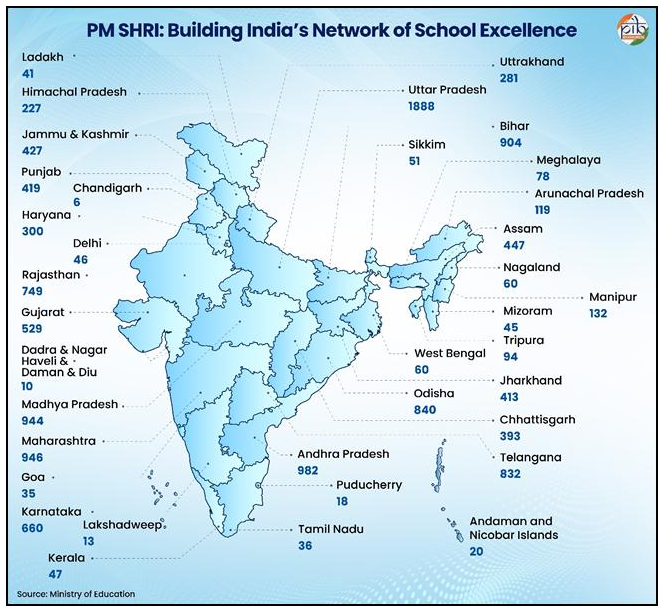
- As of July 2026, 13,092 schools have been selected. This is around 90% of the envisaged target. The scheme is expected to directly benefit more than 20 lakh students.
- The selected schools cover 725 districts and 8,340 blocks or urban local bodies. They include institutions under KVS, NVS and NCERT.
- Among the selected schools, 1,305 are primary schools, 3,102 upper primary schools, 3,141 secondary schools and 5,544 higher secondary schools. The network also includes 80 KGBVs, 913 KVS schools, 620 NVS schools and 4 NCERT schools.
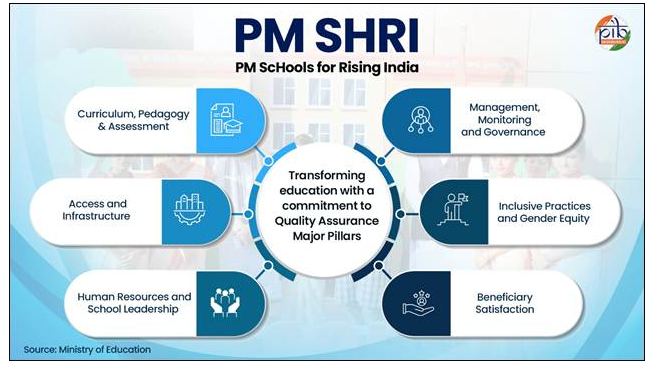
What are the Six Pillars of PM SHRI?
PM SHRI is based on six major pillars drawn from the vision of NEP 2020.
| Pillar | Focus Area |
| Curriculum, Pedagogy and Assessment | Competency-based, learner-centred and outcome-oriented education |
| Access and Infrastructure | Safe, inclusive, functional and barrier-free school infrastructure |
| Human Resources and School Leadership | Teacher capacity building and strong principal leadership |
| Management, Monitoring and Governance | Institutional planning, quality monitoring and accountability |
| Inclusive Practices and Gender Equity | Equal learning opportunities for all students |
| Beneficiary Satisfaction | Satisfaction of students, parents and community stakeholders |
These pillars show that PM SHRI focuses on the complete school ecosystem, not merely buildings or physical facilities.
How are PM SHRI Schools Selected?
PM SHRI schools are selected through Challenge Mode, where schools compete for support to become exemplar schools. The selection process has three stages.
- Stage 1: MoU with States and UTs: States and Union Territories sign an MoU with the Centre, committing to provide support for selected schools to achieve PM SHRI standards.
- Stage 2: Identification of Eligible Schools: Eligible schools are identified using prescribed minimum benchmarks and indicators available through UDISE+ data.
- Stage 3: Challenge Method: Eligible schools compete based on specified criteria. Their claims are verified through physical inspection by States, UTs, KVS or NVS authorities.
Final selection is done by an Expert Committee headed by the Secretary, School Education and Literacy, Ministry of Education.
Urban schools must score at least 70%, while rural schools must score at least 60% under the Challenge Method.
What are the Minimum Quality Benchmarks?
Schools must meet basic minimum standards before selection.
Important requirements include:
- Pucca building
- Barrier-free access
- Safety measures
- Separate toilets
- Drinking water
- Hand-washing facilities
- Electricity
- ID cards for teachers
- Library or sports facilities
- Enrolment above State average at elementary and senior secondary levels
The assessment also covers infrastructure, learning outcomes, pedagogy, PM POSHAN, vocational education, green initiatives and stakeholder commitment.
How does PM SHRI Transform School Education?
- Competency-based Learning: PM SHRI schools follow the National Curriculum Framework or State Curriculum Framework based on the 5+3+3+4 structure under NEP 2020.
- This promotes understanding, application, creativity and critical thinking instead of rote learning.
- Experiential Pedagogy: The scheme promotes bagless days, internships with local artisans, study of local arts and crafts, celebration of cultural events and preservation of indigenous knowledge.
- Such methods connect school learning with real life and local culture.
- Equity and Multilingualism: PM SHRI promotes mother tongue, local or regional language as the medium of teaching and learning, especially in early grades.
- According to UDISE+ 2025–26 data, PM SHRI schools have 6,102 Sanskrit teachers, 1,994 Urdu teachers and 9,152 regional language teachers.
- Technology-enabled Learning: The scheme supports ICT facilities, smart classrooms, internet connectivity, digital platforms and STEM-based programmes.
- Platforms such as DIKSHA provide digital resources and support interactive learning.
- Holistic Student Development: PM SHRI integrates academics with sports, arts, extracurricular activities and life-skills education.
- This helps develop leadership, creativity, socio-emotional competencies and adaptability.
- Teacher Capacity Building: PM SHRI supports professional development through DIETs.
- Financial assistance of up to ₹3 lakh per DIET is provided for capacity-building programmes, and up to ₹2,500 per teacher is provided for training subject teachers, principals, special educators, ICT teachers and master trainers.
- School Leadership Development: Principals are trained in educational leadership, school management and competency-based pedagogical planning.
- Teachers receive training in Holistic Progress Card, school safety, mental health, first-level counselling and ICT integration.
What is the Significance of PM SHRI?
- Operationalisation of NEP 2020: PM SHRI converts the broad vision of NEP 2020 into school-level practice.
- It brings competency-based learning, inclusion, digital education and holistic development into institutional practice.
- Human Capital Formation: By improving learning outcomes and future-ready skills, the scheme supports the development of capable and confident learners.
- This contributes to India’s long-term social and economic development.
- Equity in Education: PM SHRI promotes access for rural, underserved and diverse communities.
- Its focus on multilingual learning and inclusive practices helps reduce educational disparities.
- Systemic Reform through Mentorship: PM SHRI schools are expected to mentor neighbouring schools through collaboration and clustering.
- This can create a ripple effect beyond selected schools.
- Technology and Green Education: The scheme integrates digital pedagogy and sustainable practices.
- This aligns school education with future skill needs and environmental responsibility.
Way Forward?
- Outcome-based Monitoring: The scheme should track learning outcomes, classroom practices, inclusion and student well-being.
- Infrastructure improvement should be linked with measurable educational outcomes.
- Continuous Teacher Development: Training should be practical, regular and linked to classroom needs.
- DIETs must play a stronger role in mentoring teachers and school leaders.
- Local-language Digital Resources: Digital content should be available in mother tongue and regional languages.
- This will strengthen foundational literacy and inclusive learning.
- Institutionalised Mentorship: PM SHRI schools should have structured mechanisms to guide neighbouring schools.
- Cluster-based collaboration can spread good practices beyond selected schools.
- Community Participation: Parents, local bodies and school management committees should be involved in monitoring and school improvement.
- This can improve accountability and local ownership.
Conclusion
PM SHRI is an important reform for transforming Indian school education in line with NEP 2020. It moves beyond infrastructure to focus on learning outcomes, inclusion, digital pedagogy, teacher capacity and holistic development. If implemented effectively, PM SHRI schools can become models for wider education reform and help build an equitable, skilled and future-ready India.

CARE MCQ
Q. Consider the following statements regarding PM SHRI Schools:
- PM SHRI is a Centrally Sponsored Scheme launched in 2022.
- It aims to develop more than 14,500 existing schools as exemplar institutions.
- PM SHRI schools are selected through a three-stage Challenge Mode.
- The scheme is aligned with the National Education Policy 2020.
Which of the statements given above are correct?
(a) 1, 2 and 3 only
(b) 1 and 4 only
(c) 2, 3 and 4 only
(d) 1, 2, 3 and 4
Answer:
(d) 1, 2, 3 and 4
Explanation:
Statement 1 is correct: PM SHRI was launched on 7 September 2022 as a Centrally Sponsored Scheme.
Statement 2 is correct: It aims to strengthen more than 14,500 existing schools as exemplar institutions.
Statement 3 is correct: Schools are selected through a three-stage Challenge Mode.
Statement 4 is correct: PM SHRI is directly aligned with the vision of NEP 2020.
FAQs
1. What is PM SHRI?
PM SHRI stands for Pradhan Mantri Schools for Rising India, a scheme to develop model schools aligned with NEP 2020.
2. When was PM SHRI launched?
PM SHRI was launched on 7 September 2022.
3. What is the target under PM SHRI?
The scheme aims to strengthen more than 14,500 existing schools.
4. What is the total project cost of PM SHRI?
The total project cost is ₹27,360 crore, including a central share of ₹18,128 crore.
5. How are PM SHRI schools selected?
They are selected through a three-stage Challenge Mode based on quality benchmarks.
6. Why is PM SHRI important?
It helps implement NEP 2020 by creating model schools focused on quality, inclusion, digital learning and future-ready skills.
Relevance: UPSC GS Paper III: Climate change, disaster management, agriculture, water resources, sustainable development
Prelims
Gram Panchayat | Gram Sabha | 73rd Constitutional Amendment | Article 243G | Eleventh Schedule | PESA Act 1996 | GPDP | NAPCC | SAPCC | PMKSY | MGNREGA | National Mission for Sustainable Agriculture | Climate Smart Gram Panchayat Action Plan | Bela Gram Panchayat | Net-zero Panchayat
Mains
Climate Governance | Decentralised Planning | Local Climate Resilience | Community Participation | Natural Resource Management | Climate Adaptation | Climate Mitigation | Cooperative Federalism | Grassroots Democracy | Sustainable Rural Development
Why in News?
Climate change is increasingly affecting everyday life in rural India through agriculture, water availability, natural resources and rural livelihoods.This has brought attention to the need for panchayat-level climate planning, because climate risks differ across regions, villages and communities.Recent initiatives in States such as Uttar Pradesh and Karnataka have also highlighted the importance of involving Gram Panchayats in climate action.
Why Climate Planning Needs Localisation
- Climate change is not experienced uniformly across India. Its effects differ between urban and rural areas, and even from one village to another.
- In cities, climate risks are shaped by urbanisation, land-use change, infrastructure pressure and population density. In rural areas, climate risks are closely linked with agriculture, water availability, forests, common lands and natural-resource dependence.
- A drought-prone village may need groundwater recharge, water conservation and crop diversification. A flood-prone village may need drainage improvement, restoration of water bodies and protection of vulnerable infrastructure.
- Therefore, uniform national or State-level climate responses may not fully address the specific vulnerabilities of different local ecosystems. This makes decentralised and community-based climate planning important.
What is a Panchayat-Level Climate Action Plan?
- A panchayat-level climate action plan is a local framework through which a Gram Panchayat identifies climate risks in its area and integrates suitable responses into development planning.
- It does not treat climate action as a separate environmental activity. Instead, it links climate concerns with local development priorities such as agriculture, water, health, sanitation, livelihoods and natural-resource management.
Panchayat-level climate actions may include adaptation and mitigation measures.
| Type | Examples |
| Adaptation Measures | Crop diversification, climate-resilient agriculture, soil conservation, rainwater harvesting, groundwater recharge, restoration of local water bodies |
| Mitigation Measures | Afforestation, renewable energy, energy efficiency, improved waste management, reduction of fossil fuel dependence |
The plan can be integrated into the existing Gram Panchayat Development Plan (GPDP). This avoids creating a new bureaucracy and allows panchayats to use existing schemes and funds.
What are the Constitutional Foundations of Panchayat Climate Governance?
- The 73rd Constitutional Amendment gave constitutional status to panchayats and inserted Part IX into the Constitution.
- Article 243G empowers State legislatures to devolve powers and responsibilities to panchayats for preparing plans for economic development and social justice.
- The Eleventh Schedule is especially relevant to climate action because it includes subjects linked with rural resilience and natural resources.
Important subjects include:
- Agriculture
- Land improvement and soil conservation
- Minor irrigation
- Water management
- Watershed development
- Social and farm forestry
- Minor forest produce
- Drinking water
- Fuel and fodder
- Rural electrification
- Non-conventional energy
- Health and sanitation
- Maintenance of community assets
These subjects overlap with climate adaptation and mitigation. Hence, panchayat-level climate planning does not require an entirely new institutional mandate. It can build upon the existing constitutional role of local self-government.
How does PESA Strengthen Local Climate Governance?
- In Scheduled Areas, the Panchayats (Extension to Scheduled Areas) Act, 1996 provides an additional basis for local climate governance.
- PESA requires that panchayat laws in Scheduled Areas respect customary law, traditional practices and community management of resources.
- It gives the Gram Sabha an important role in protecting community resources and approving local development plans.
- This is important for climate action because many tribal and forest-dependent communities rely directly on land, forests, water bodies and minor forest produce. Their participation is essential for natural-resource management and climate resilience.
- Thus, PESA helps view panchayats not merely as implementing agencies, but as institutions of community-led resource governance.
How can Panchayats Complement National and State Climate Policies?
- India’s climate policy has largely followed a top-down framework.
- The National Action Plan on Climate Change (NAPCC) was launched in 2008. It included eight national missions covering solar energy, energy efficiency, sustainable habitat, water, sustainable agriculture, forests, Himalayan ecosystem and strategic knowledge for climate change.
- The State Action Plans on Climate Change (SAPCCs) were meant to translate national priorities into State-specific strategies.
- However, many climate-related actions are actually implemented at the local level. Water conservation, watershed development, irrigation, sustainable agriculture and natural-resource management often depend on rural institutions and local communities.
- Panchayats can complement national and State climate policies by making local development planning climate-responsive. They can use existing schemes such as MGNREGA, PMKSY and the National Mission for Sustainable Agriculture to implement climate-related activities.
- The idea is not to create a parallel climate bureaucracy, but to weave climate action into normal panchayat planning.
| What is the Example of Bela Gram Panchayat?
|
What are the Benefits of Panchayat-Level Climate Action?
- Context-specific Planning: Climate risks differ across villages, so local planning can identify the exact needs of each community.
- A drought-prone area can prioritise water conservation, while a flood-prone area can prioritise drainage and flood protection.
- Better Community Participation: Gram Sabha discussions can bring local knowledge into climate planning.
- This improves ownership and makes climate action more practical.
- Convergence with Existing Schemes: Climate action can be integrated with GPDP, MGNREGA, PMKSY and other schemes.
- This reduces the need for separate administrative structures.
- Protection of Vulnerable Groups: Climate impacts are often severe for farmers, landless labourers, women, tribal communities and natural-resource-dependent households.
- Panchayats can identify such groups more accurately.
- Strengthening Local Democracy: Panchayat-level climate planning deepens decentralisation.
- It converts climate action from a top-down policy issue into a community-level governance process.
Challenges
- Institutional Capacity Gap: Many Gram Panchayats lack technical capacity to assess climate risks, interpret climate data and design adaptation measures.
- They need regular support from district administrations, line departments, universities and specialised institutions.
- Lack of Localised Climate Data: Effective planning requires data on rainfall, temperature, groundwater, cropping patterns, natural resources and vulnerable households.
- Panchayats need simple and accessible data that can be combined with local knowledge.
- Finance Constraints: Climate action should not depend only on new funds, but existing funds are often fragmented across schemes.
- Better convergence of GPDP resources, panchayat funds, Central schemes, State schemes and CSR can support implementation.
- Weak Community Participation: Climate plans may become administrative documents if Gram Sabha participation is weak.
- Plans must emerge through local discussions and community priorities.
- Accountability Deficit: Without clear targets and indicators, it is difficult to know whether climate actions are reducing vulnerability.
- Periodic review and social audit can improve accountability.
- Implementation Gap: Panchayats may prepare plans but fail to implement them due to lack of functionaries, funds or technical guidance.
- This requires strengthening the “3Fs”: funds, functions and functionaries.
Way Forward
- Integrate Climate Action into GPDP: Panchayat-level climate planning should be included within the existing Gram Panchayat Development Plan.
- This avoids parallel structures and makes climate action part of routine local development.
- Strengthen Local Capacity: Panchayat members and officials should be trained in climate risk assessment, vulnerability mapping and adaptation planning.
- DIETs, Krishi Vigyan Kendras, universities and district-level institutions can support capacity building.
- Improve Local Data Systems: Panchayats should receive user-friendly data on rainfall, groundwater, agriculture, natural resources and vulnerable groups.
- Local observations and community knowledge should also be formally included.
- Ensure Scheme Convergence: Climate-related activities can be funded through convergence of MGNREGA, PMKSY, agriculture schemes, water schemes and panchayat funds.
- CSR and private finance may supplement public funds where appropriate.
- Empower Gram Sabhas: Gram Sabha discussions should guide climate priorities.
- This will make plans democratic, locally relevant and accountable.
- Create Monitoring Indicators: Each panchayat climate plan should have clear targets and indicators.
- Periodic reviews can help assess whether vulnerability is actually reducing.
Conclusion
Climate change is no longer only an environmental issue; it is also a governance challenge. Since rural community’s experience climate impacts through agriculture, water and natural resources, panchayats must become active institutions of local climate governance. Panchayat-level climate planning can complement national and State climate policies by making them locally relevant, participatory and accountable. Strengthening panchayats with funds, functions, functionaries, data and technical capacity is essential for building climate-resilient rural India.
CARE MCQ
Q. Consider the following statements regarding panchayat-level climate action in India:
- Article 243G enables State legislatures to devolve powers to panchayats for planning economic development and social justice.
- The Eleventh Schedule includes subjects such as agriculture, water management, social forestry and rural electrification.
- Panchayat-level climate action necessarily requires a completely new institutional structure outside GPDP.
- PESA strengthens the role of Gram Sabhas in protecting community resources in Scheduled Areas.
Which of the statements given above are correct?
(a) 1, 2 and 4 only
(b) 1 and 3 only
(c) 2, 3 and 4 only
(d) 1, 2, 3 and 4
Answer:
(a) 1, 2 and 4 only
Statement-wise Explanation:
Statement 1 is correct: Article 243G enables State legislatures to devolve powers and responsibilities to panchayats for economic development and social justice.
Statement 2 is correct: The Eleventh Schedule includes subjects such as agriculture, water management, social forestry, drinking water, rural electrification and community assets.
Statement 3 is incorrect: Panchayat-level climate action does not necessarily need a new structure. It can be integrated into the existing Gram Panchayat Development Plan.
Statement 4 is correct: PESA gives Gram Sabhas an important role in protecting community resources and approving local development plans in Scheduled Areas.
FAQs
1. What is panchayat-level climate action?
It means identifying local climate risks and including suitable adaptation and mitigation measures in Gram Panchayat planning.
2. Why are panchayats important in climate planning?
Panchayats understand local geography, livelihoods, water resources and community vulnerabilities better than distant institutions.
3. What is GPDP?
GPDP means Gram Panchayat Development Plan, through which panchayats prepare local development priorities.
4. What is the role of Article 243G?
Article 243G enables States to devolve powers to panchayats for local planning and implementation of development schemes.
5. What is an example of a climate-active panchayat?
Bela Gram Panchayat in Maharashtra became India’s first net-zero panchayat through tree plantation, solar panels and waste segregation.