Why in News?
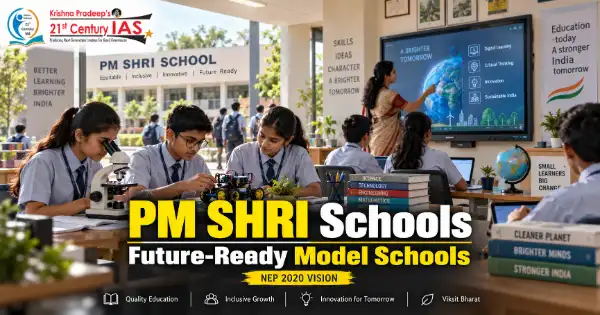
The Pradhan Mantri Schools for Rising India (PM SHRI) scheme has made major progress since its launch on 7 September 2022. As of July 2026, 13,092 schools have been selected across 36 States and Union Territories, covering around 90% of the target of more than 14,500 schools.The scheme is important because it seeks to develop selected existing schools as model institutions aligned with the vision of the National Education Policy 2020.
What is PM SHRI?
- PM SHRI stands for Pradhan Mantri Schools for Rising India.
- It is a Centrally Sponsored Scheme implemented by the Department of School Education and Literacy, Ministry of Education.
- The scheme aims to qualitatively strengthen existing schools and develop them as exemplar institutions. These schools are expected to demonstrate the effective implementation of NEP 2020 at the school level.
- PM SHRI schools are envisioned as safe, stimulating and welcoming learning spaces. They are supported by quality infrastructure, appropriate learning resources and diverse learning experiences.
Why was PM SHRI Needed?
- India has one of the largest school education systems in the world, with 14.71 lakh schools serving more than 24.69 crore students. Such a large system requires reforms that improve not only access, but also quality, equity and learning outcomes.
- The NEP 2020 provides the broader framework for transforming school education. PM SHRI translates this policy vision into institutional practice by upgrading selected schools into model schools.
- The scheme represents a shift from an infrastructure-centric model to a holistic school transformation model. It focuses on infrastructure, pedagogy, inclusion, sustainability, technology, teacher development and student well-being.
What are the Major Features of PM SHRI?
- NEP 2020 Alignment: PM SHRI schools showcase the key components of NEP 2020, including competency-based learning, flexibility, inclusion and holistic development.
- Exemplar School Model: These schools act as model institutions for neighbouring schools through mentoring, handholding, collaboration and clustering.
- Holistic Development: The scheme focuses not only on cognitive development, but also on creativity, leadership, socio-emotional skills, life skills and responsible citizenship.
- Inclusive Learning Environment: PM SHRI schools aim to provide equitable and joyful education to students from diverse backgrounds and varied learning abilities.
- Future-ready Skills: Students are exposed to 21st-century skills, digital learning, STEM-based education and links with local entrepreneurial ecosystems.
- Green School Orientation: The scheme promotes sustainable and environment-friendly school practices as part of school quality.
What is the Financial and Institutional Coverage?
- PM SHRI is being implemented over five years from 2022–23 to 2026–27.
- The total project cost is ₹27,360 crore, including a central share of ₹18,128 crore. The central share of approved Project Approval Board outlay increased from ₹2,520 crore in 2023–24 to ₹5,224 crore in 2026–27, showing an increase of around 107%.
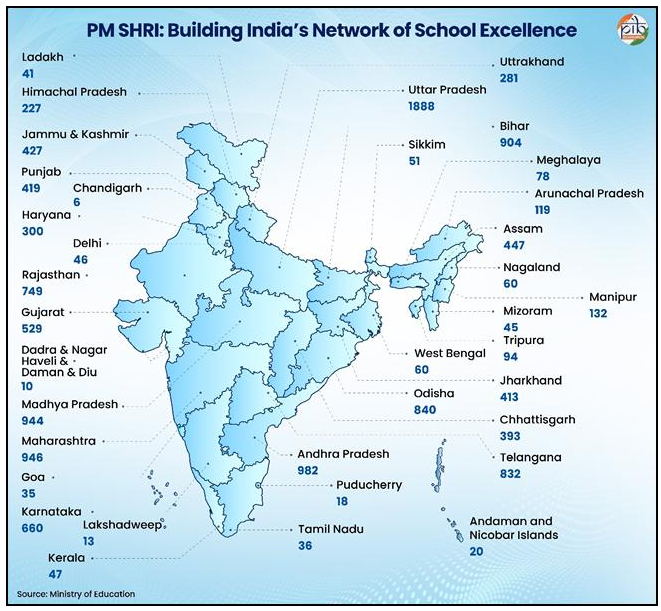
- As of July 2026, 13,092 schools have been selected. This is around 90% of the envisaged target. The scheme is expected to directly benefit more than 20 lakh students.
- The selected schools cover 725 districts and 8,340 blocks or urban local bodies. They include institutions under KVS, NVS and NCERT.
- Among the selected schools, 1,305 are primary schools, 3,102 upper primary schools, 3,141 secondary schools and 5,544 higher secondary schools. The network also includes 80 KGBVs, 913 KVS schools, 620 NVS schools and 4 NCERT schools.
What are the Six Pillars of PM SHRI?
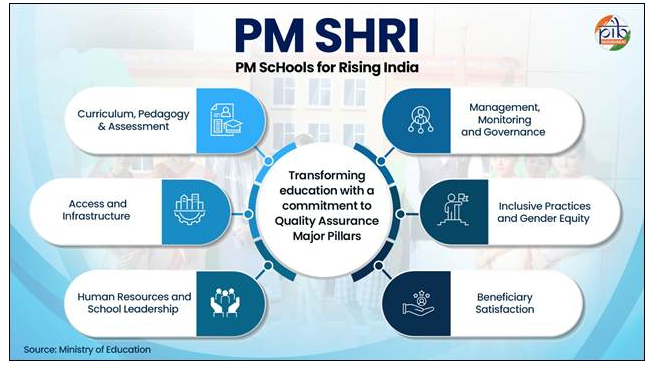
PM SHRI is based on six major pillars drawn from the vision of NEP 2020.
| Pillar | Focus Area |
| Curriculum, Pedagogy and Assessment | Competency-based, learner-centred and outcome-oriented education |
| Access and Infrastructure | Safe, inclusive, functional and barrier-free school infrastructure |
| Human Resources and School Leadership | Teacher capacity building and strong principal leadership |
| Management, Monitoring and Governance | Institutional planning, quality monitoring and accountability |
| Inclusive Practices and Gender Equity | Equal learning opportunities for all students |
| Beneficiary Satisfaction | Satisfaction of students, parents and community stakeholders |
These pillars show that PM SHRI focuses on the complete school ecosystem, not merely buildings or physical facilities.
How are PM SHRI Schools Selected?
PM SHRI schools are selected through Challenge Mode, where schools compete for support to become exemplar schools. The selection process has three stages.
- Stage 1: MoU with States and UTs: States and Union Territories sign an MoU with the Centre, committing to provide support for selected schools to achieve PM SHRI standards.
- Stage 2: Identification of Eligible Schools: Eligible schools are identified using prescribed minimum benchmarks and indicators available through UDISE+ data.
- Stage 3: Challenge Method: Eligible schools compete based on specified criteria. Their claims are verified through physical inspection by States, UTs, KVS or NVS authorities.
Final selection is done by an Expert Committee headed by the Secretary, School Education and Literacy, Ministry of Education.
Urban schools must score at least 70%, while rural schools must score at least 60% under the Challenge Method.
What are the Minimum Quality Benchmarks?
Schools must meet basic minimum standards before selection.
Important requirements include:
- Pucca building
- Barrier-free access
- Safety measures
- Separate toilets
- Drinking water
- Hand-washing facilities
- Electricity
- ID cards for teachers
- Library or sports facilities
- Enrolment above State average at elementary and senior secondary levels
The assessment also covers infrastructure, learning outcomes, pedagogy, PM POSHAN, vocational education, green initiatives and stakeholder commitment.
How does PM SHRI Transform School Education?
- Competency-based Learning: PM SHRI schools follow the National Curriculum Framework or State Curriculum Framework based on the 5+3+3+4 structure under NEP 2020.
- This promotes understanding, application, creativity and critical thinking instead of rote learning.
- Experiential Pedagogy: The scheme promotes bagless days, internships with local artisans, study of local arts and crafts, celebration of cultural events and preservation of indigenous knowledge.
- Such methods connect school learning with real life and local culture.
- Equity and Multilingualism: PM SHRI promotes mother tongue, local or regional language as the medium of teaching and learning, especially in early grades.
- According to UDISE+ 2025–26 data, PM SHRI schools have 6,102 Sanskrit teachers, 1,994 Urdu teachers and 9,152 regional language teachers.
- Technology-enabled Learning: The scheme supports ICT facilities, smart classrooms, internet connectivity, digital platforms and STEM-based programmes.
- Platforms such as DIKSHA provide digital resources and support interactive learning.
- Holistic Student Development: PM SHRI integrates academics with sports, arts, extracurricular activities and life-skills education.
- This helps develop leadership, creativity, socio-emotional competencies and adaptability.
- Teacher Capacity Building: PM SHRI supports professional development through DIETs.
- Financial assistance of up to ₹3 lakh per DIET is provided for capacity-building programmes, and up to ₹2,500 per teacher is provided for training subject teachers, principals, special educators, ICT teachers and master trainers.
- School Leadership Development: Principals are trained in educational leadership, school management and competency-based pedagogical planning.
- Teachers receive training in Holistic Progress Card, school safety, mental health, first-level counselling and ICT integration.
What is the Significance of PM SHRI?
- Operationalisation of NEP 2020: PM SHRI converts the broad vision of NEP 2020 into school-level practice.
- It brings competency-based learning, inclusion, digital education and holistic development into institutional practice.
- Human Capital Formation: By improving learning outcomes and future-ready skills, the scheme supports the development of capable and confident learners.
- This contributes to India’s long-term social and economic development.
- Equity in Education: PM SHRI promotes access for rural, underserved and diverse communities.
- Its focus on multilingual learning and inclusive practices helps reduce educational disparities.
- Systemic Reform through Mentorship: PM SHRI schools are expected to mentor neighbouring schools through collaboration and clustering.
- This can create a ripple effect beyond selected schools.
- Technology and Green Education: The scheme integrates digital pedagogy and sustainable practices.
- This aligns school education with future skill needs and environmental responsibility.
Way Forward?
- Outcome-based Monitoring: The scheme should track learning outcomes, classroom practices, inclusion and student well-being.
- Infrastructure improvement should be linked with measurable educational outcomes.
- Continuous Teacher Development: Training should be practical, regular and linked to classroom needs.
- DIETs must play a stronger role in mentoring teachers and school leaders.
- Local-language Digital Resources: Digital content should be available in mother tongue and regional languages.
- This will strengthen foundational literacy and inclusive learning.
- Institutionalised Mentorship: PM SHRI schools should have structured mechanisms to guide neighbouring schools.
- Cluster-based collaboration can spread good practices beyond selected schools.
- Community Participation: Parents, local bodies and school management committees should be involved in monitoring and school improvement.
- This can improve accountability and local ownership.
Conclusion
PM SHRI is an important reform for transforming Indian school education in line with NEP 2020. It moves beyond infrastructure to focus on learning outcomes, inclusion, digital pedagogy, teacher capacity and holistic development. If implemented effectively, PM SHRI schools can become models for wider education reform and help build an equitable, skilled and future-ready India.