


Menu

UPSC Current Affairs 5 October 2026 featuring the National Supercomputing Mission and Green Energy Corridor Phase-III.

Relevance: UPSC GS Paper III: Science and Technology; indigenisation of technology; information technology; infrastructure

Important Keywords for Prelims and Mains

Prelims: Supercomputer | High-Performance Computing | Parallel Processing | FLOPS | teraFLOPS | petaFLOPS | exaFLOPS | PARAM 8000 | PARAM Yuva | National Supercomputing Mission | C-DAC | IISc | DST | MeitY | PARAM Rudra | Rudra Server | PARAM Shavak | National Knowledge Network | HPC Shiksha Portal | ESTIC-2026

Mains: Technological self-reliance | Aatmanirbhar Bharat | Digital sovereignty | Indigenous innovation | Scientific infrastructure | Computational capacity | Research democratisation | Human-resource development | Sustainable development | Academia–industry collaboration

Why in News?

  • As of September 2026, India had deployed 40 supercomputers with a combined computing capacity of 68 petaFLOPS under the National Supercomputing Mission.
  • India is also preparing to host ESTIC-2026, which will cover supercomputing and other emerging technologies while promoting the vision of Viksit Bharat 2047.
What is a Supercomputer?

A supercomputer is a high-performance computing system designed to process large datasets and perform complex calculations at exceptionally high speeds.

  • Multiple processors: It combines several processors or computing nodes that work simultaneously.
  • Parallel processing: Multiple processors jointly work on a single complex calculation, reducing the time required to solve it.
  • High-speed connections: Computing nodes exchange data through high-speed interconnection networks.
  • Major uses: Supercomputers are used in weather forecasting, climate modelling, healthcare, space research, engineering, artificial intelligence and scientific simulations.

How is Computing Power Measured?

The performance of a supercomputer is measured in FLOPS—Floating Point Operations Per Second.

  • One teraFLOPS: One trillion calculations per second.
  • One petaFLOPS: One quadrillion calculations per second.
  • One exaFLOPS: One quintillion calculations per second.
  • The world’s fastest supercomputer in 2026 operates at approximately 2.19 exaFLOPS.

Why Does India Need Supercomputing Capabilities?

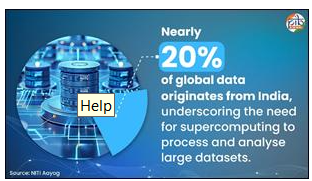
  • Growing data economy: India generates nearly 20% of the world’s data, creating demand for advanced computing infrastructure.
  • Complex scientific research: Climate, space, medicine and engineering require large-scale simulations that ordinary computers cannot perform efficiently.
  • Artificial intelligence: AI, machine learning and generative AI require high computing capacity to train and operate advanced models.
  • Disaster management: Supercomputers can support flood prediction, forest-fire modelling and extreme-weather forecasting.
  • Healthcare applications: They accelerate genomics research, disease tracking and drug discovery.
  • Agricultural planning: High-performance computing can support crop-yield estimation and climate-based agricultural decisions.
  • Technological sovereignty: Indigenous computing infrastructure reduces dependence on imported hardware and software.
  • Evidence-based governance: Fast data processing enables government agencies to make timely and informed decisions.

What is the National Supercomputing Mission?

The National Supercomputing Mission (NSM) was launched in April 2015 to establish a nationally distributed and technologically self-reliant supercomputing ecosystem.

Key Features

  • Financial outlay: Approximately ₹4,500 crore.
  • Jointly steered by:
    • Department of Science and Technology
    • Ministry of Electronics and Information Technology
  • Implementing institutions:
    • Centre for Development of Advanced Computing, Pune
    • Indian Institute of Science, Bengaluru
  • Target: Establish 50 supercomputers with a combined capacity exceeding 123 petaFLOPS across Indian academic and research institutions.
  • Objectives: Develop indigenous supercomputers, expand access to HPC, promote scientific research and create solutions for national and societal needs.

NSM’s Build Approach

The Mission follows a three-stage indigenous-development strategy:

  • Assembly: Assemble supercomputing systems within India.
  • Manufacturing: Increase domestic production of important hardware components.
  • Design and manufacturing: Develop complete indigenous capabilities in system design, hardware, software, networking and cooling.

How has India’s Supercomputing Programme Evolved?

PARAM 8000

  • PARAM 8000, developed by C-DAC, was unveiled in 1991.
  • It operated at a speed of one gigaflop.
  • It marked India’s entry into indigenous supercomputing and laid the foundation for the PARAM series.

PARAM Yuva

  • PARAM Yuva achieved a computing capacity of 54 teraFLOPS.
  • It supported applications such as weather forecasting and computational fluid dynamics.

Present Capacity under NSM

As of September 2026, India had commissioned:

  • 40 supercomputers with a combined capacity of 68 petaFLOPS;
  • 13 high-end systems with capacities above 1 petaFLOPS;
  • 12 mid-range systems with capacities between 500 teraFLOPS and 1 petaFLOPS; and
  • 15 systems with capacities below 500 teraFLOPS.

These systems were locally built and installed across academic and research institutions.

What are the National Applications of Supercomputing?

Genomics and Drug Discovery

  • The platform studies large molecular datasets to identify and test potential medicines.
  • During the COVID-19 pandemic, it was used to screen existing drugs and predict possible side effects, including heart-related risks.

Urban Environment Decision Support System

  • It combines detailed weather and air-pollution models.
  • It helps cities forecast heavy rainfall and pollution episodes and take preventive measures.

Flood Early-Warning System

  • It uses data analysis and predictive models to forecast floods up to two days in advance.
  • It is being applied in the Mahanadi River basin to protect communities and infrastructure.

Forest-Fire Spread Model

  • It combines satellite remote-sensing data with computational models to predict the spread of forest fires.
  • It has been tested in regions such as the Sikkim Himalayas.

Seismic Imaging Suite

  • It uses advanced algorithms to map underground structures.
  • It supports oil and gas exploration and performs at a level comparable with commercial seismic-imaging tools.

Materials Science and Computational Chemistry

  • It enables the simulation of atoms, molecules and alloys.
  • Researchers can study their properties and behaviour without depending entirely on physical experiments.

Support to Government Institutions

HPC applications developed under NSM support institutions such as:

  • India Meteorological Department
  • Central Water Commission
  • Central Pollution Control Board
  • Ministry of AYUSH

What Indigenous Technologies have been Developed under NSM?

Rudra Series of Servers

  • Rudra servers were designed and developed indigenously by C-DAC.
  • They provide processing power for complex simulations, calculations and AI workloads.
  • Their technology has been transferred to Indian Electronics Manufacturing Services partners for domestic production.

PARAM Rudra Supercomputers

  • PARAM Rudra systems use indigenous Rudra servers and an Indian system-software stack.
  • They support astronomy, material science, atomic physics and earth-science research.
  • By September 2026, approximately 6,000 Rudra servers had been deployed, while another 1,500 servers were under production.

High-Speed Interconnect Network

  • Indigenous networks operating at 100 Gbps and 200 Gbps have been developed and tested.
  • They enable faster communication and data transfer between computing nodes.

Indigenous Cooling Technology

  • India has developed and demonstrated indigenous cooling systems for high-performance computers.
  • These systems maintain operating temperatures and improve energy efficiency.

HPC System Software

  • A complete indigenous HPC software stack has been developed.
  • It supports the operation, integration and management of supercomputing systems.

PARAM Shavak

  • PARAM Shavak is a domestically designed and manufactured “supercomputing-in-a-box” system.
  • It serves the HPC and AI requirements of students and researchers in engineering colleges and universities.

How is NSM Building a Skilled Workforce?

As of September 2026, infrastructure created under NSM had:

  • supported more than 16,000 researchers;
  • included over 2,900 PhD scholars;
  • connected researchers from more than 400 institutions;
  • executed over 1.5 crore compute jobs; and
  • contributed to more than 1,990 research publications.

Capacity-Building Initiatives

  • HPC and Deep Learning Awareness Programmes: Introduce students, researchers and faculty to advanced computing.
  • Hackathons and Bootcamps: Provide practical experience in HPC, AI and generative AI.
  • Faculty Development Programmes: Train teachers in HPC, AI, machine learning and deep learning in collaboration with AICTE.
  • EduHPC Workshop: Offers annual training to faculty from institutions across India.
  • SWAYAM Course: The High-Performance Scientific Computing course under NPTEL provides a structured foundation in HPC.
  • HPC Shiksha Portal: Provides lectures, learning materials and access to computing resources.
  • NSM Users Forum: Enables users to resolve technical problems and share knowledge and good practices.

What is the Role of the National Knowledge Network?

The National Knowledge Network serves as the communication backbone of the National Supercomputing Mission.

  • It connects supercomputing facilities across academic and research institutions.
  • It allows researchers to access computing resources beyond their own institutions.
  • It supports collaborative research across geographical boundaries.
  • It enables the sharing of computing power, scientific knowledge and research capabilities.

What is ESTIC-2026?

  • Full name: Emerging Science, Technology and Innovation Conclave.
  • Edition: Second.
  • Dates: 27–29 October 2026.
  • Venue: Bharat Mandapam, New Delhi.
  • Theme: “Creative Minds, Catalyzing Science, Empowering Technologies.”
  • Organiser: Council of Scientific and Industrial Research.
  • It will cover 12 thematic areas, including supercomputing and other emerging technologies.
  • The conclave will promote scientific collaboration and support the vision of Viksit Bharat 2047.

What is the Significance of the National Supercomputing Mission?

  • Scientific self-reliance: Indigenous servers, software, networks and cooling systems reduce dependence on imported technology.
  • Democratisation of research: Distributed infrastructure gives universities and research institutions wider access to advanced computing.
  • Public-service delivery: HPC applications strengthen weather prediction, pollution monitoring and disaster preparedness.
  • Healthcare advancement: Genomics and computational platforms accelerate drug discovery and disease research.
  • Energy and resource security: Seismic imaging supports oil and gas exploration.
  • Human-capital development: Training initiatives build a workforce skilled in HPC, AI and deep learning.
  • Innovation ecosystem: The Mission promotes cooperation among government, academia, industry and research institutions.
  • Sustainable development: NSM contributes to 11 United Nations Sustainable Development Goals through applications in climate action, education, innovation and economic growth.
  • Digital sovereignty: Control over critical computing infrastructure strengthens national technological and strategic security.

Concerns

  • Capacity gap: India had achieved 68 petaFLOPS against the Mission’s target of more than 123 petaFLOPS by September 2026.
  • Rapid technological change: Supercomputing systems can become outdated quickly, requiring continuous research and upgrading.
  • Energy requirements: High-performance computing requires substantial power and efficient cooling systems.
  • Skilled workforce: Wider deployment must be supported by trained researchers, engineers and faculty members.
  • Institutional access: Research institutions must possess adequate connectivity and technical capacity to use HPC resources effectively.
  • Hardware and software capability: India must deepen domestic design and manufacturing across the complete computing value chain.
  • Research translation: Scientific computing should produce practical solutions for agriculture, health, climate, energy and governance.

Way Forward

  • Complete NSM targets: Accelerate the establishment of the remaining systems and achieve the planned capacity of over 123 petaFLOPS.
  • Develop advanced systems: Focus on faster, reliable and energy-efficient computing technologies.
  • Strengthen indigenisation: Expand domestic capabilities in processors, servers, interconnects, cooling and software.
  • Integrate AI and HPC: Combine supercomputing with AI to address complex problems in healthcare, agriculture and climate science.
  • Expand institutional access: Make computing facilities more accessible to universities, startups, researchers and industry.
  • Build human resources: Scale up courses, faculty training, hackathons and practical learning programmes.
  • Promote collaboration: Strengthen partnerships among government, academia, industry, startups and research organisations.
  • Prioritise societal applications: Direct computing resources towards disaster management, drug discovery, environmental protection and sustainable development.

Conclusion

The National Supercomputing Mission has transformed India from a user of imported computing systems into an emerging developer of indigenous supercomputing technologies. Its achievements in infrastructure, software, networking, applications and skill development strengthen India’s scientific and digital sovereignty. Completing the Mission’s capacity targets and integrating HPC with artificial intelligence can help convert advanced computing into practical solutions for national development. This will contribute to Aatmanirbhar Bharat and the wider vision of Viksit Bharat 2047.

CARE MCQ

Q. Consider the following statements regarding the National Supercomputing Mission:

  1. It is jointly steered by the Department of Science and Technology and the Ministry of Electronics and Information Technology.
  2. C-DAC, Pune, and the Indian Institute of Science, Bengaluru, are its implementing institutions.
  3. The Mission aims to establish 50 supercomputers with a cumulative capacity exceeding 123 petaFLOPS.
  4. The National Knowledge Network manufactures the Rudra series of indigenous servers.

Which of the statements given above are correct?

(a) 1 and 2 only
(b) 1, 2 and 3 only
(c) 2, 3 and 4 only
(d) 1, 2, 3 and 4

Answer: (b) 1, 2 and 3 only

Explanation

  • Statement 1 is correct: The Mission is jointly steered by the Department of Science and Technology and Ministry of Electronics and Information Technology.
  • Statement 2 is correct: C-DAC, Pune, and IISc, Bengaluru, implement the Mission.
  • Statement 3 is correct: NSM plans to establish 50 supercomputers with a cumulative capacity exceeding 123 petaFLOPS.
  • Statement 4 is incorrect: The National Knowledge Network connects supercomputing facilities through a high-speed network. The Rudra servers were designed and developed by C-DAC.

FAQs

Q. What is the National Supercomputing Mission?
It is a national initiative launched in 2015 to build indigenous HPC capacity and expand access to supercomputing.

Q. Which institutions implement NSM?
The Mission is implemented by C-DAC, Pune, and IISc, Bengaluru.

Q. What is PARAM Rudra?
It is an indigenous supercomputer built using domestically designed Rudra servers and an Indian software stack.

Q. What does petaFLOPS measure?
It measures computing performance equal to one quadrillion floating-point calculations per second.

Q. How does supercomputing support national development?
It enables advanced research and practical applications in weather, healthcare, agriculture, energy, disaster management and engineering.

Relevance: UPSC GS Paper III: Energy infrastructure, renewable energy, environment and climate change

Important Keywords for Prelims and Mains

Prelims: Green Energy Corridor | GEC Phase-III | MNRE | Intra-State Transmission System | Inter-State Transmission System | Battery Energy Storage System | Central Financial Assistance | State Transmission Utilities | TBCB | Cost Plus Basis | BOOM Model | Pumped Hydro Storage | Grid Curtailment


Mains: Renewable-energy integration | Grid modernisation | Transmission bottlenecks | Energy storage | Grid stability | Energy security | Decarbonisation | Just energy transition | Green employment | Sustainable growth

Why in News?

  • The Union Cabinet approved Green Energy Corridor Phase-III on 30 September 2026 to enable the evacuation of up to 135 GW of renewable energy across States and Union Territories.
  • The scheme has an outlay of ₹1,86,405 crore and includes a dedicated 50 GWh Battery Energy Storage System component.

What is the Green Energy Corridor?

The Green Energy Corridor is a transmission-infrastructure programme implemented by the Ministry of New and Renewable Energy.

It aims to:

  • transmit electricity from renewable-energy projects to demand centres;
  • strengthen intra-State and inter-State transmission networks;
  • reduce congestion and curtailment of renewable power;
  • improve grid stability; and
  • support the integration of large-scale solar and wind capacity.

The programme is being implemented through:

  • Intra-State Transmission System: Carries electricity within a State.
  • Inter-State Transmission System: Transfers electricity across State boundaries.

What are the Key Features of GEC Phase-III?

Renewable-Energy Evacuation

  • The scheme will strengthen the Intra-State Transmission System.
  • It will facilitate the evacuation of up to 135 GW of renewable energy.
  • Completion is targeted by FY 2032–33.

Financial Outlay

The total scheme outlay is ₹1,86,405 crore:

  • ₹1,36,378 crore: Development of intra-State transmission systems.
  • ₹50,000 crore: Installation of 50 GWh of Battery Energy Storage Systems.
  • ₹54,082 crore: Total Central Financial Support.

Battery Storage Component

For the first time under the Green Energy Corridor programme, a dedicated battery-storage component has been included.

  • The scheme provides for 50 GWh of BESS capacity.
  • The systems may be installed at renewable-energy developer or generator sites and other grid-important locations.
  • Storage will address intermittency, transmission congestion and peak-hour curtailment.
  • Stored electricity can be supplied during non-solar hours.

Consumer Benefit

Central Financial Assistance will help reduce intra-State transmission charges. Lower transmission costs can limit the final cost of renewable electricity for consumers.

How will GEC Phase-III be Implemented?

Greenfield Projects

  • New transmission projects will be implemented through Tariff-Based Competitive Bidding.
  • Transmission Service Providers will participate under the Build-Own-Operate-Maintain model.

Brownfield Projects

  • Upgradation and strengthening of existing transmission networks will be undertaken through the Cost Plus Basis.
  • Under this model, the approved project cost and a regulated return are recovered through tariffs.

Implementing Agencies

  • State Transmission Utilities will serve as the overall implementing agencies.
  • Transmission Service Providers will develop and operate competitively awarded projects.

What is the Status of GEC Phase-II?

Green Energy Corridor Phase-II is being implemented in seven States:

  • Gujarat
  • Himachal Pradesh
  • Karnataka
  • Kerala
  • Rajasthan
  • Tamil Nadu
  • Uttar Pradesh

Its targets include:

  • 7,863 circuit kilometres of transmission lines; and
  • 24,388 MVA of substation capacity.

Why Does India Need GEC Phase-III?

Transmission Bottlenecks

  • Renewable-energy capacity is being commissioned faster than the transmission network required to carry the electricity.
  • During FY 2025–26, approximately 6,900 GWh of clean electricity faced restrictions because of the mismatch between renewable generation and transmission infrastructure.

Growing Grid Curtailment

During April–June 2026:

  • Peak electricity demand reached a record 270 GW.
  • Grid operators curtailed approximately 8,133 GWh of solar electricity because of transmission constraints and grid-security requirements.

Intermittency of Renewable Energy

Solar and wind power are variable:

  • Solar generation falls after sunset.
  • Wind generation changes with weather conditions.
  • Electricity production may not coincide with peak demand.

Storage and grid strengthening are therefore necessary to balance electricity supply and demand.

Rapid Capacity Expansion

  • India plans to increase renewable-energy capacity from approximately 295 GW to 500 GW by 2030. It also aims to achieve 900 GW of installed non-fossil-fuel capacity by 2035.
  • Without corresponding transmission and storage capacity, a portion of this electricity may remain unused.

What is Renewable-Energy Curtailment?

Curtailment occurs when grid operators direct a power-generating unit to reduce or stop electricity generation, even when the plant is capable of producing power.

It may be required because of:

  • insufficient transmission capacity;
  • excessive generation during low-demand periods;
  • grid-security concerns;
  • lack of storage facilities; or
  • inability to balance variable generation.

Curtailment results in the loss of usable clean electricity and affects the financial viability of renewable-energy projects.

What is Energy Storage?

Energy storage refers to systems that store surplus electricity when generation is high and release it when demand increases or generation declines.

The process involves:

  1. converting electricity into a form that can be stored;
  2. retaining that energy for a required period; and
  3. converting it back into electricity when needed.

Energy storage helps address the mismatch between the time of renewable-energy generation and the time of electricity consumption.

What are the Major Types of Energy Storage?

Pumped Hydro Storage

  • Surplus electricity pumps water from a lower reservoir to a higher reservoir.
  • During peak demand, water is released downhill through turbines to produce electricity.
  • It is suitable for large-scale and long-duration storage where appropriate geography is available.

Battery Energy Storage Systems

  • BESS stores electricity in chemical form and releases it when required.
  • Lithium-ion batteries, particularly lithium iron phosphate batteries, are widely used for grid-scale storage.
  • Their major advantages include declining costs, high efficiency and long operational life.

Concentrating Solar-Thermal Storage

  • Mirrors focus sunlight on a receiver.
  • Materials such as molten salt absorb and store heat.
  • The stored heat later produces steam, which drives a turbine and generates electricity.

Compressed-Air Energy Storage

  • Surplus electricity compresses air and stores it in underground caverns or tanks.
  • When demand increases, the compressed air is released to operate turbines.

Flywheel Energy Storage

  • Electricity is stored as rotational energy in a rapidly spinning rotor.
  • Flywheels can release power almost instantly.
  • They are useful for grid stability and short-term fluctuations.

Gravity Energy Storage

  • Electricity is used to lift heavy weights to a higher elevation.
  • When electricity is required, the weights are lowered.

Their gravitational energy is converted back into electricity through generators

What is the Significance of GEC Phase-III?

Better Renewable-Energy Integration

The scheme will create transmission capacity to carry electricity from renewable-rich regions to demand centres.

Reduced Loss of Clean Electricity

A stronger grid and storage infrastructure will reduce the curtailment of solar and wind power.

Grid Stability

Battery systems can absorb excess electricity and release it when demand rises, thereby managing short-term fluctuations.

Support During Non-Solar Hours

Electricity stored during periods of high solar generation can be supplied in the evening or at night.

Lower Power Costs

Central assistance can reduce the transmission-cost burden and help keep electricity affordable for consumers.

Energy Security

Greater use of domestically generated renewable electricity can reduce dependence on imported fossil fuels.

Climate Benefits

The scheme will support the reduction of carbon emissions and promote ecologically sustainable growth.

Employment Generation

Transmission lines, substations and storage facilities can create direct and indirect employment in:

  • power-sector services;
  • equipment manufacturing;
  • construction; and
  • operations and maintenance.

Progress Towards National Targets

The project will support India’s targets of:

  • 500 GW renewable-energy capacity by 2030; and
  • 900 GW non-fossil-fuel capacity by 2035.

What Challenges Does the Renewable-Energy Sector Face?

Grid–Generation Mismatch

Transmission systems are not always completed at the same pace as renewable-energy projects, leading to stranded or curtailed generation.

Variability and Intermittency

Solar and wind generation depend on time and weather, making continuous electricity supply difficult without storage and flexible grid operations.

Transmission Congestion

Renewable-energy projects are often concentrated in resource-rich regions, while major electricity demand may be located elsewhere.

Peak-Demand Management

India must simultaneously meet record electricity demand and absorb variable renewable power without compromising grid security.

Storage Requirements

Large-scale renewable integration requires substantial energy-storage capacity to shift electricity from high-generation to high-demand periods.

Implementation Coordination

Successful implementation requires coordination among:

  • MNRE;
  • State governments;
  • State Transmission Utilities;
  • transmission providers;
  • renewable-energy developers; and
  • grid operators.

Financial Requirements

The programme requires investment of more than ₹1.86 lakh crore, along with timely project execution and effective use of Central assistance.

Way Forward

  • Synchronise infrastructure: Transmission lines and storage capacity should be commissioned alongside renewable-energy projects.
  • Accelerate grid expansion: Both intra-State and inter-State networks must expand in renewable-rich regions.
  • Adopt a storage mix: India should combine batteries, pumped hydro and other technologies according to duration and grid requirements.
  • Improve forecasting: Better solar, wind and demand forecasts can reduce balancing problems and curtailment.
  • Strengthen Centre–State coordination: Project approvals, financing and implementation should follow time-bound mechanisms.
  • Promote domestic manufacturing: Indigenous production of batteries, grid equipment and transmission components can improve energy security.
  • Ensure affordability: Competitive bidding and effective Central assistance should prevent transmission and storage costs from excessively increasing consumer tariffs.
  • Improve grid flexibility: Demand-response systems and flexible power generation should complement transmission and storage expansion.

Conclusion

India’s renewable-energy transition cannot depend on generation capacity alone. Electricity must also be transmitted, stored and delivered when consumers require it. By combining transmission expansion with 50 GWh of battery storage, GEC Phase-III addresses the critical gap between renewable-energy generation and grid readiness. Timely implementation can reduce clean-energy curtailment, strengthen energy security and support India’s transition towards a low-carbon economy.

CARE MCQ

Q. Consider the following statements regarding Green Energy Corridor Phase-III:

  1. It seeks to enable the evacuation of up to 135 GW of renewable energy.
  2. It includes a dedicated 50 GWh Battery Energy Storage System component.
  3. All greenfield intra-State transmission projects will be implemented through Tariff-Based Competitive Bidding.
  4. State Transmission Utilities will have no role in its implementation.

Which of the statements given above are correct?

(a) 1 and 2 only
(b) 1, 2 and 3 only
(c) 2, 3 and 4 only
(d) 1, 2, 3 and 4

Answer: (b) 1, 2 and 3 only

Explanation

  • Statement 1 is correct: GEC Phase-III will strengthen intra-State transmission networks to evacuate up to 135 GW of renewable energy.
  • Statement 2 is correct: The scheme includes a dedicated 50 GWh BESS component, with an allocation of ₹50,000 crore.
  • Statement 3 is correct: Greenfield intra-State transmission projects will be implemented through Tariff-Based Competitive Bidding.
  • Statement 4 is incorrect: State Transmission Utilities are the overall implementing agencies for the intra-State component.

FAQs

Q. What is the main objective of GEC Phase-III?
It aims to transmit up to 135 GW of renewable power through strengthened intra-State networks.

Q. What is the total outlay of GEC Phase-III?
The total outlay is ₹1,86,405 crore.

Q. How much battery-storage capacity is included?
The scheme provides for 50 GWh of Battery Energy Storage Systems.

Q. What is renewable-energy curtailment?
It is the forced reduction of available renewable generation to maintain grid stability or address transmission constraints.

Q. Why is energy storage important for solar and wind power?
It stores surplus electricity and supplies it when renewable generation is low or demand is high.

UPSC Current Affairs October 6th 2026
UPSC Current Affairs October 2nd 2026

Enroll Now for Unlimited UPSC Utsav

Start Date

20/09/2026

Timings

08 AM – 4 PM

    Courses

    Scroll to Top