Relevance: UPSC GS Paper II: Governance, Government policies, regulation of digital platforms, Centre-State coordination
For Prelims:
- Promotion and Regulation of Online Gaming Act, 2025, Promotion and Regulation of Online Gaming Rules, 2026, Online Gaming Authority of India, MeitY, Online Money Game, Online Social Game, E-sports, Section 19, Rule 9, Rule 10, Rule 12–19, Rule 20, Rule 21–22, User Safety Features, VPN, Proxy Server, Mirror Site, Mule Account, Telegram Fraud, CUTS International
For Mains:
- Blanket ban vs strong regulation, offshore gambling platforms, consumer protection, youth vulnerability, financial irregularities, money laundering, terror financing, cybercrime, digital enforcement challenges, harm-prevention safeguards, Centre-State coordination, regulatory sandbox
Why in News?
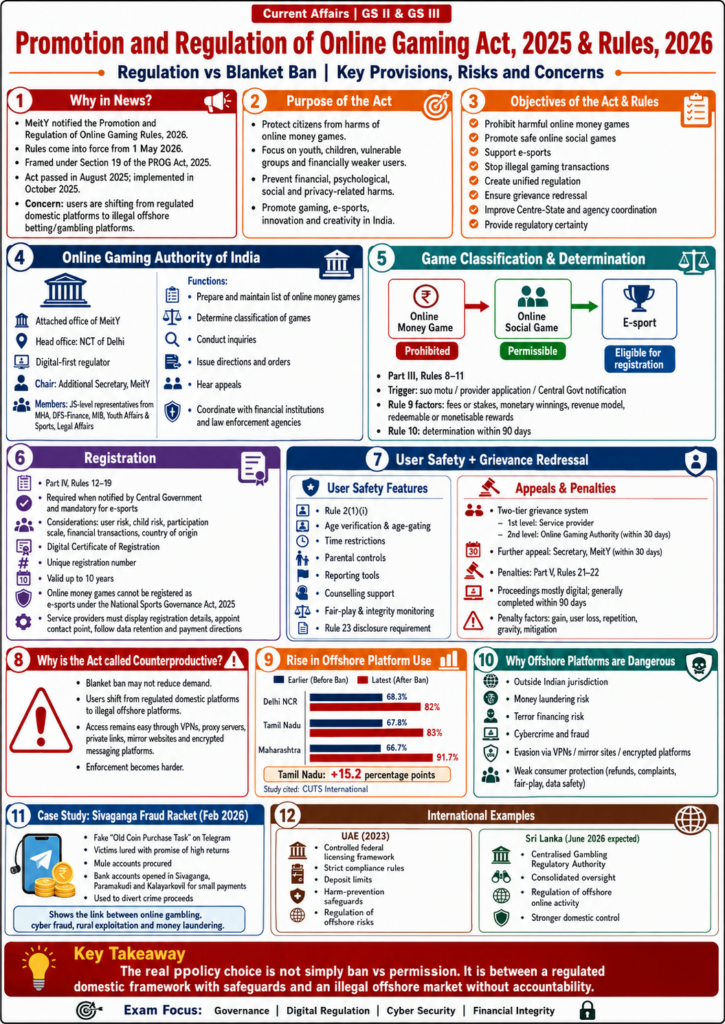
The Promotion and Regulation of Online Gaming Rules, 2026 were notified by the Ministry of Electronics and Information Technology, and are set to come into force from 1 May 2026.
The Rules have been framed under Section 19 of the Promotion and Regulation of Online Gaming Act, 2025. The Act was passed by Parliament in August 2025 and implemented in October 2025.
At the same time, concerns have been raised that the Act may be proving counterproductive. According to reports and surveys, many users have shifted from regulated domestic real-money gaming platforms to illegal offshore betting and gambling platforms after the ban.
Background of the PROG Act, 2025
The Promotion and Regulation of Online Gaming Act, 2025 was enacted to protect citizens from the harmful effects of online money games.
The Act aims to protect:
- Youth
- Children
- Vulnerable populations
- Financially weaker users
- Users exposed to addictive online games
The government’s objective is two-fold:
- First, to protect society from the financial, psychological, social and privacy-related harms caused by predatory online money gaming platforms.
- Second, to make India a global hub for gaming, innovation, e-sports and creativity.
Objectives of the Act and Rules
The Act and Rules aim to:
- Prohibit harmful online money games
- Promote safe online social games
- Support the growth of e-sports
- Protect users from addictive design and misleading promises of quick wealth
- Prevent banks and payment systems from facilitating illegal gaming transactions
- Provide regulatory certainty to the online gaming industry
- Create a unified regulatory authority
- Ensure grievance redressal and appellate mechanisms
- Strengthen coordination between the Centre, States, financial regulators and law enforcement agencies
Promotion and Regulation of Online Gaming Rules, 2026
The PROG Rules, 2026 are described as the operational architecture of the parent Act.
The Rules are organised into 6 Parts and 26 Rules.
They provide a legal and institutional framework for:
- Determining whether a game is an online money game
- Registering e-sports and notified online social games
- Establishing the Online Gaming Authority of India
- Ensuring user safety features
- Providing grievance redressal
- Imposing penalties
- Creating an appellate mechanism
| Online Gaming Authority of India
Institutional Structure
Composition The Authority will be chaired by the Additional Secretary, MeitY as an ex officio chairperson. It will include Joint Secretary-level representatives from:
Functions The Authority will:
|
Determination of an Online Game
Relevant Rules
The classification of online games is provided under Part III, Rules 8–11.
The Rules provide a determination test to decide whether a game is:
- An online money game, which is prohibited
- A permissible online social game
- An e-sport
When Determination is Triggered
Determination can be triggered in three situations:
- Suo motu action by the Authority
- Application by a service provider offering a game as an e-sport
- Notification by the Central Government requiring a category of online social games to be determined
Rule 9: Objective Factors
Under Rule 9, the Authority will examine factors such as:
- Whether users pay fees or stakes
- Whether there is an expectation of monetary winnings
- Revenue model of the platform
- Whether rewards or in-game assets can be redeemed
- Whether rewards can be monetised outside the game
Rule 10: Time Limit
The determination process should, as far as practicable, be completed within 90 days of a complete application or notice.
The result will be recorded in a determination order. This order will be specific to the particular game and the particular service provider.
Registration of Online Games
Relevant Rules
Registration is covered under Part IV, Rules 12–19.
Registration is required only where the Central Government notifies such requirement.
This may be done after considering:
- Risk to users
- Risk to children
- Scale of participation
- Financial transactions
- Country of origin of the game
Registration is also mandatory for every online game intended to be offered as an e-sport.
Certificate of Registration
After successful determination and registration, the Authority will issue a digital Certificate of Registration.
This certificate will have:
- A unique registration number
- Validity of up to 10 years
Important Restriction
An online money game cannot be recognised or registered as an e-sport under the National Sports Governance Act, 2025.
Obligations of Registered Service Providers
Registered service providers must:
- Prominently display determination or registration details
- Display the unique registration number
- Designate a point of contact
- Comply with data retention directions
- Follow directions related to payment facilitation
- Observe user safety and transparency requirements
User Safety Features
Rule 2(1)(i)
Rule 2(1)(i) introduces the concept of user safety features.
These are technical, procedural, operational, behavioural and system-related safeguards according to the risk profile of the game.
Major User Safety Features
The Rules mention:
- Age verification
- Age-gating
- Time restrictions
- Parental controls
- User reporting tools
- Counselling support
- Fair-play monitoring
- Integrity monitoring
- Internal grievance mechanisms
Under Rule 23, service providers must disclose user safety features and internal grievance redressal mechanisms while applying for determination or registration.
Grievance Redressal and Appellate Mechanism
The Rules provide a two-tier grievance redressal and appellate mechanism.
First Level: Service Provider
- Every online game service provider offering an online social game or e-sport must maintain a functional grievance redressal mechanism.
Second Level: Online Gaming Authority
- If the user is dissatisfied with the service provider’s decision, or if the complaint is not resolved, the user may approach the Online Gaming Authority of India within 30 days.
The Authority should try to dispose of the appeal within another 30 days.
Further Appeal
- A second appeal lies before the Appellate Authority, that is, the Secretary, MeitY.
- The Secretary, MeitY should dispose of appeals, as far as possible, within 30 days of receipt.
Penalties and Enforcement
Relevant Rules
- Penalties and enforcement are covered under Part V, Rules 21–22.
- Proceedings may be conducted in digital mode, unless physical presence is required.
- Proceedings should generally be completed within 90 days of receiving a complaint.
Factors for Penalty
Penalties must be proportionate. The Authority must consider:
- Gain from non-compliance
- Loss caused to users
- Repeated violations
- Gravity of the violation
- Mitigation efforts by the service provider
Why the Act is Being Called Counterproductive
The editorial argues that the implementation of the PROG Act is proving counterproductive because users are shifting from domestic regulated platforms to illegal offshore platforms.
A blanket ban may reduce visible domestic real-money gaming activity. But it may not reduce user demand. Instead, it may push users towards underground, illegal and more dangerous platforms.
This is a major concern because digital products are not physical goods. Users can access them through:
- VPNs
- Private links
- Proxy servers
- Mirror websites
- Encrypted messaging platforms
Therefore, enforcement becomes more difficult.
Rise in Offshore Platform Use
According to the editorial, early studies suggest that offshore online betting and gambling platforms have seen increased usage after the PROG Act.
A study by CUTS International reportedly found a significant rise in offshore participation after implementation of the Act.
Data on Offshore Platform Use
- Delhi NCR: increased from 68.3% to 82%
- Tamil Nadu: increased from 67.8% to 83%
- Maharashtra: increased from 66.7% to 91.7%
Tamil Nadu Example
In Tamil Nadu, 67.8% of users reported using offshore platforms before the ban, often along with domestic real-money gaming platforms.
After the ban, this increased to 83%.
This shows an increase of 15.2 percentage points.
Why Offshore Platforms are Dangerous
1. They Operate Outside Indian Jurisdiction
Offshore platforms are difficult to regulate because they are located outside India. Indian authorities cannot easily ensure compliance, consumer protection or grievance redressal.
2. They May Support Money Laundering
Illegal online betting networks can be used to transfer illegal money through hidden digital channels.
3. They May Create Terror Financing Risks
If funds are routed through suspicious or illegal channels, offshore platforms may create national security risks.
4. They Increase Cybercrime
Fraudsters may use fake betting apps, Telegram links, WhatsApp groups and investment traps to cheat users.
5. They Use Advanced Evasion Techniques
Illegal operators use:
- VPNs
- Proxy servers
- Encrypted platforms
- Mirror sites
- Private invitation links
When one domain is blocked, users are quickly shifted to another domain.
6. They Weaken Consumer Protection
Users on offshore platforms cannot easily access:
- Refund systems
- Complaint mechanisms
- Fair-play protection
- Data protection safeguards
- Responsible gaming tools
Case Study: Sivaganga Online Gambling and Fraud Racket
A recent inter-State online gambling and fraud racket came to light in Sivaganga, Tamil Nadu, in February 2026.
The fraud involved a fake “Old Coin Purchase Task” promoted on Telegram.
How the Fraud Worked
- Victims were promised high returns through fake old-coin bidding schemes.
- They were lured into investing money.
- The accused procured mule accounts.
- Villagers in Sivaganga, Paramakudi and Kalayarkovil were persuaded to open bank accounts in exchange for small payments.
- These accounts were then used to divert proceeds of crime.
Importance of the Case
This case shows that online gambling fraud is not limited to urban areas. It can also affect rural and semi-urban communities.
It also shows the link between online gambling, cyber fraud and financial crime.
International Examples
United Arab Emirates
The UAE had a long-standing prohibition on gambling. However, in 2023, it moved towards a tightly controlled federal licensing framework.
The framework includes:
- Strict compliance requirements
- Deposit limits
- Harm-prevention safeguards
- Regulation to address offshore risks
This shows that even countries with restrictive systems are exploring controlled regulation to manage offshore gambling risks.
Sri Lanka
Sri Lanka is moving towards establishing a centralised Gambling Regulatory Authority.
It is expected to become operational by June 2026.
The aim is to:
- Consolidate gambling oversight
- Bring offshore online activity under a clear domestic framework
- Improve regulatory control
Significance of the PROG Framework
The PROG Act and Rules are significant because they attempt to create a structured regulatory framework for a fast-growing digital sector.
1. Protection of Youth and Vulnerable Users
The Rules provide safeguards such as age verification, age-gating, parental controls and counselling support.
2. Regulatory Certainty
The Rules create a clear process to determine whether a game is prohibited or permissible.
3. Promotion of E-sports
The framework allows lawful e-sports to grow under a registration regime.
4. Consumer Protection
Grievance redressal and appellate mechanisms give users a formal route to raise complaints.
5. Financial System Protection
The Rules aim to prevent banks, payment systems and financial institutions from facilitating transactions linked to prohibited online money games.
6. Enforcement Coordination
The Authority can coordinate with law enforcement agencies, financial institutions and State governments.
7. Digital Governance
The Authority is designed as a digital-first regulator, which is important for a digital sector like online gaming.
Major Challenges
1. Blanket Ban May Push Users Underground
A ban may not eliminate demand. It may shift users from domestic regulated platforms to illegal offshore platforms.
2. Offshore Platforms are Difficult to Control
They operate outside India and can avoid domestic regulation.
3. Technology-Based Evasion
VPNs, proxy servers, private links and mirror websites make enforcement difficult.
4. Encrypted Platforms
WhatsApp and Telegram can be used to circulate betting links and fraud schemes.
5. Consumer Protection Gap
Users on illegal offshore platforms have limited access to grievance redressal and legal remedies.
6. Financial Crime Risks
Illegal platforms may be used for money laundering, mule accounts and suspicious cross-border transactions.
7. Centre-State Coordination
Gaming, betting, police action, financial regulation and cybercrime enforcement involve multiple authorities. Coordination is necessary.
8. Risk to Legitimate Gaming Industry
Over-regulation may affect genuine gaming innovation, online social games and e-sports.
9. Difficulty in Identifying Real Money Games
Some games may use rewards, tokens, in-game assets or indirect monetisation. Classification may become complex.
10. Protection of Children
Children are especially vulnerable to addictive design, online manipulation and misleading reward systems.
Way Forward
1. Move from Blanket Ban to Strong Regulation
India should consider whether a regulated domestic framework with safeguards may work better than a complete ban.
The real policy choice is not simply between allowing and banning. It is between:
- A regulated domestic system with accountability
or - An illegal offshore ecosystem without oversight
2. Strengthen Online Gaming Authority of India
The Authority must have technical experts, cybercrime experts, financial intelligence support and adequate staff.
3. Improve Centre-State Coordination
There should be coordination between:
- MeitY
- Ministry of Home Affairs
- RBI
- Banks
- Payment gateways
- State police
- Cybercrime units
- Financial Intelligence Unit
4. Stronger Action Against Offshore Platforms
India should strengthen domain blocking, payment blocking, transaction monitoring and international cooperation.
5. Regulate Payment Channels
Banks and payment systems must be prevented from facilitating transactions linked to prohibited online money games.
6. Use Technology for Enforcement
Artificial intelligence and data analytics can be used to detect suspicious gaming platforms, payment flows and repeated fraud patterns.
7. Public Awareness Campaigns
Users should be educated about:
- Fake betting links
- Telegram frauds
- Mule accounts
- Online money traps
- VPN-based illegal platforms
- Risks of offshore gambling
8. Introduce Harm-Prevention Measures
Possible safeguards include:
- Deposit limits
- Time limits
- Self-exclusion options
- Warning messages
- Counselling support
- Parental controls
- Age verification
9. Test Controlled Regulatory Sandbox
Policymakers may test a controlled regulatory model to understand user behaviour, platform risk and enforcement challenges.
10. Use Tax Revenue for Enforcement
If a regulated ecosystem is developed, tax revenue may be used for:
- Offshore monitoring
- Cybercrime enforcement
- Awareness campaigns
- Rehabilitation support
- Player protection systems
Conclusion
The Promotion and Regulation of Online Gaming Act, 2025 and the PROG Rules, 2026 are important steps towards regulating India’s online gaming sector. They aim to prohibit harmful online money games while promoting safe online social games and e-sports.
However, evidence of rising offshore platform use shows that a blanket ban alone may not solve the problem. It may push users towards illegal platforms that are beyond domestic oversight.
India needs a balanced and practical framework. Strong regulation, user safety, digital enforcement, financial monitoring and Centre-State coordination are necessary to protect citizens while supporting lawful gaming innovation.
UPSC PYQ
Q. Which of the following is/are the aim/aims of “Digital India” Plan of the Government of India? (2018)
- Formation of India’s own Internet companies like China did.
- Establish a policy framework to encourage overseas multinational corporations that collect Big Data to build their large data centres within our national geographical boundaries.
- Connect many of our villages to the Internet and bring Wi-Fi to many of our schools, public places and major tourist centres.
Select the correct answer using the code given below:
(a) 1 and 2 only
(b) 3 only
(c) 2 and 3 only
(d) 1, 2 and 3
Ans: (b)
CARE MCQ
Q. With reference to the Promotion and Regulation of Online Gaming Rules, 2026, consider the following statements:
- The Rules were framed under Section 19 of the Promotion and Regulation of Online Gaming Act, 2025.
- The Rules establish the Online Gaming Authority of India as an attached office of MeitY.
- The Rules allow online money games to be registered as e-sports.
Which of the statements given above is/are correct?
A. 1 and 2 only
B. 2 and 3 only
C. 1 and 3 only
D. 1, 2 and 3
Answer: A
Explanation:
Statement 1 is correct: Section 19 of the Act empowers the Central Government to make rules for carrying out the provisions of the Act.
Statement 2 is correct: The Online Gaming Authority of India is constituted as an attached office of MeitY.
Statement 3 is incorrect: Online money games cannot be recognised or registered as e-sports.
Additional Information:
The Rules aim to distinguish between prohibited online money games and permissible online social games or e-sports.
FAQs
1. What is the PROG Act, 2025?
It is a law enacted to regulate online gaming, prohibit harmful online money games and promote e-sports and online social games.
2. What are online money games?
Online money games involve payment of money or stakes with the expectation of monetary winnings.
3. Why are offshore gambling platforms dangerous?
They operate outside Indian regulation and may be used for fraud, money laundering, addiction and cybercrime.
4. What is the Online Gaming Authority of India?
It is the proposed regulatory authority under MeitY to classify games, register permissible games, handle grievances and support enforcement.
Relevance: UPSC: GS Paper III – Science and Technology, Artificial Intelligence, Digital Infrastructure and Inclusive Growth.
For Prelims:
- Neuro-Symbolic AI, Large Language Models, Neural Networks, Symbolic Reasoning, Knowledge Graphs, Ontology, NEP 2020, DIKSHA, Bhashini, PrahelikaAI, CREST Framework, C3AN Framework, PAL System.
For Mains:
- Explainable AI, AI in Education, Personalised Learning, Digital Divide, Rote Learning, Multilingual Education, Inclusive Growth, Teacher-AI Collaboration, Responsible AI, Data Privacy.
Why in News?
Technology experts and education researchers have highlighted Neuro-Symbolic Artificial Intelligence as a more suitable framework for Indian education than traditional generative AI models.It is gaining attention because it can provide logic-based, explainable, multilingual and affordable learning support. Unlike standard AI tools that often give direct answers, Neuro-Symbolic AI can help students understand the reasoning behind an answer.

What is Neuro-Symbolic AI?
- Neuro-Symbolic AI is a hybrid form of Artificial Intelligence.
- It combines two systems:
- Neural networks: They identify patterns from images, text, speech, handwriting and diagrams.
- Symbolic reasoning: It uses rules, logic, constraints, knowledge graphs and verified facts.
- In simple words:
- The neural part works like the “eyes and ears” of the system.
- The symbolic part works like the “logical brain” of the system.
- This helps AI give answers that are not only correct but also explainable.
Difference Between Standard AI and Neuro-Symbolic AI
- Standard Large Language Models work mainly through next-word prediction.
- They generate fluent answers based on patterns in large datasets.
- But they may not always understand rules of mathematics, science or logic.
- Neuro-Symbolic AI goes beyond prediction.
- It follows:
- Pattern recognition
- Logical reasoning
- Rule-based verification
- Curriculum-based factual checking
- Step-by-step explanation
- Therefore, it is more suitable for education, where understanding the process is as important as getting the answer.
Why Indian Education Needs Neuro-Symbolic AI
- Indian education still faces the problem of rote learning.
- Many students remember answers but struggle to explain concepts.
- Standard AI tools may increase shortcut-based learning.
- Neuro-Symbolic AI can help students move from memorisation to reasoning.
- It is especially useful in India because of:
- High pupil-teacher ratio
- Limited personalised teaching
- Rural digital divide
- Regional language diversity
- Need for affordable EdTech tools
- NEP 2020 focus on conceptual learning
Limitations of Traditional AI in Indian Classrooms
1. Infrastructure and Energy Mismatch
- Large AI models need strong internet, cloud infrastructure and high computing power.
- Such systems are difficult to use in rural and semi-urban schools.
- The content notes that only 47% of rural schools have functional computers, showing the seriousness of the digital divide.
2. High Cost
- Premium global AI models may be expensive at India’s scale.
- A global model request may cost around $0.09, while compact specialised models may cost around $0.0004 per request.
- For a country with nearly 1.4 million schools, this cost difference becomes very important.
3. Language Barrier
- Standard AI models are largely English-dominant.
- India has 22 constitutionally recognised languages and many dialects.
- Direct translation from English may distort meaning and reduce conceptual clarity.
4. Hallucination Problem
- AI hallucination means giving wrong information confidently.
- In education, this is dangerous because students may learn wrong facts, dates, formulas or explanations.
5. Black Box Problem
- Many AI systems cannot clearly explain how they reached an answer.
- This makes it difficult for teachers to identify the exact learning gap of a student.
Strategic Significance for Indian Education
1. Supports NEP 2020
Neuro-Symbolic AI supports the goals of National Education Policy 2020, such as:
- Conceptual understanding
- Critical thinking
- Experiential learning
- Multilingual education
- Reduced rote learning
- Technology-enabled learning
2. Reduces AI Hallucinations
- Neuro-Symbolic AI can use knowledge graphs based on verified curriculum content.
- Example: NCERT science chapters can be converted into structured knowledge maps.
- The symbolic layer checks whether the answer follows verified facts.
- If the system cannot verify the answer, it can safely say it does not know.
3. Enables Knowledge Tracing
- The system can track where a student is making mistakes.
- Example: In algebra, it can identify whether the student misunderstood signs, brackets or distributive property.
- This helps provide personalised feedback.
4. Supports Indian Languages
- Neuro-Symbolic AI can reason in Indian languages instead of merely translating English responses.
- It can combine neural translation with symbolic grammar rules.
- This can support initiatives like Bhashini.
5. Promotes Frugal Innovation
- These models are smaller and cheaper than large AI systems.
- They can be made offline-friendly.
- They can work on low-cost smartphones and tablets.
- This is useful for rural students with weak internet access.
Indigenous Case Studies
PrahelikaAI – IIT Kharagpur
- PrahelikaAI is being developed by IIT Kharagpur.
- It uses puzzles to improve reasoning and problem-solving.
- The model works on three major pillars:
- A large-scale puzzle dataset
- Translation of problems into Indian languages like Hindi and Bengali
- Neuro-symbolic algorithms and vision-language models
- It acts like a 24/7 digital tutor.
- It gives hints when students are stuck.
- It simplifies the problem first, then gives examples, and reveals the final answer only after repeated attempts.
- It also builds a personalised learning profile by tracking recurring mistakes.
CREST Framework
- The CREST framework uses knowledge graphs as factual guardrails.
- It helps verify AI-generated answers against trusted curriculum content.
- This makes AI more reliable for classrooms.
PAL System
- The Personal Adaptive Learner system uses neuro-symbolic guardrails.
- It converts static lessons into interactive learning.
- It asks questions at different difficulty levels without fabricating feedback.
C3AN Framework and Edge Deployment
- The C3AN framework supports lightweight, reliable and offline-friendly AI.
- It allows AI tools to run on low-end devices.
- This can help students in rural areas learn even without continuous internet.
Inclusive Growth Potential
- Neuro-Symbolic AI can support students who cannot access expensive private tutoring.
- It can help learners in government schools, rural areas and technical institutions.
- A student with a second-hand smartphone and weak internet can still access offline AI-based learning.
- It can support learning in mother tongue, such as Odia, Hindi, Bengali or other regional languages.
- It can also help teachers by showing:
- Which textbook section was used
- Which rule was applied
- Where the student made a mistake
- Which concept needs revision
Link with DIKSHA and Digital Public Infrastructure
- Neuro-Symbolic AI can be integrated with DIKSHA, India’s digital platform for school education.
- This can democratise access to personalised learning.
- India can also build a Bharat Ontology, an open-source curriculum knowledge graph.
- It can include:
- NCERT content
- State Board content
- Technical education content
- Regional language learning material
Significance
- Promotes reasoning-based learning.
- Helps reduce rote memorisation.
- Provides explainable answers.
- Reduces hallucination risks.
- Supports regional language education.
- Helps teachers identify learning gaps.
- Makes AI more affordable for Indian classrooms.
- Supports rural and low-resource learners.
- Aligns with NEP 2020 and SDG 4 on quality education.
- Encourages India’s indigenous educational technology development.
Challenges
- Building curriculum-based knowledge graphs is complex and time-consuming.
- India’s linguistic and dialect diversity needs localised datasets.
- Rural schools still face electricity, internet and device shortages.
- Teachers need training to use AI diagnostics.
- AI may increase teachers’ workload if not designed simply.
- Student data privacy must be protected.
- AI cannot fully understand emotional, family or socio-economic problems affecting a child.
- Risk of bias exists if knowledge graphs encode caste, gender, regional or language bias.
Way Forward
- Integrate Neuro-Symbolic AI with DIKSHA.
- Build open-source curriculum knowledge graphs under the IndiaAI Mission.
- Develop Indian language datasets and grammar-based AI tools.
- Make systems lightweight, offline-friendly and smartphone-compatible.
- Upgrade teacher training through NISHTHA 2.0.
- Use AI to support teachers, not replace them.
- Ensure strict compliance with the Digital Personal Data Protection Act, 2023.
- Conduct regular bias audits by independent educational bodies.
- Use AI for hints, explanation and diagnosis, not just answer generation.
- Focus on rural, government and regional-language schools.
Conclusion
Neuro-Symbolic AI can become an important tool for Indian education because it combines pattern recognition with logical reasoning. It can make AI more explainable, affordable, multilingual and reliable.
However, AI cannot replace teachers. Its real value lies in supporting teachers, identifying learning gaps and helping students understand concepts step by step. If implemented with proper infrastructure, teacher training, data protection and Indian-language support, Neuro-Symbolic AI can help India move from rote learning to true conceptual learning.
UPSC PYQ
Q. Which one of the following is the characteristic of Artificial Intelligence?
[CDS-I – 2025]
A. Replicates human decision making
B. Stores relevant information
C. Stores similar kind of data for a specific purpose
D. Allows user to interact with media
Answer: A
Explanation
- Option A is correct: Artificial Intelligence refers to the ability of computer systems to perform tasks that normally require human intelligence. These include decision-making, reasoning, learning, problem-solving, perception and planning.
Additional Information
AI systems are designed to imitate certain human cognitive abilities. Examples include speech recognition, image recognition, language translation, recommendation systems, autonomous vehicles and medical diagnosis tools. Advanced AI systems can learn from data and improve their performance over time.
CARE MCQ
Q. Project Prahelika, recently mentioned in the context of indigenous educational technology, was developed by
A. IIT Delhi
B. IIT Kharagpur
C. IISc Bengaluru
D. IIT Madras
Answer: B
Explanation:
Project Prahelika is an initiative of IIT Kharagpur. It uses logic puzzles to stimulate cognitive reasoning among students. It also includes a 24/7 digital tutor that tracks student delays and provides localized hints in Hindi and Bengali.
Additional Information:
Project Prahelika represents a logic-first architecture in educational technology. Such models help in building a personalized learning profile of students by identifying recurring misconceptions and supporting step-by-step learning.
FAQs
1. What is Neuro-Symbolic AI?
Neuro-Symbolic AI is a hybrid AI system that combines neural networks with symbolic reasoning. It helps machines not only recognise patterns but also explain answers using logic and verified rules.
2. Why is Neuro-Symbolic AI considered better for Indian education?
It promotes conceptual understanding instead of rote learning and can provide step-by-step explanations. It is also more suitable for multilingual, low-cost and rural learning environments.
3. How does Neuro-Symbolic AI reduce AI hallucinations?
It uses knowledge graphs and rule-based verification to check whether answers match trusted curriculum content. If facts cannot be verified, the system can avoid giving misleading responses.
4. What is Project PrahelikaAI developed by Indian Institute of Technology Kharagpur?
PrahelikaAI is an indigenous educational AI project that uses puzzles and neuro-symbolic reasoning to improve students’ logical thinking. It also provides personalised hints and tracks recurring mistakes.
5. How does Neuro-Symbolic AI support the goals of NEP 2020?
It supports critical thinking, experiential learning, multilingual education and technology-enabled learning. It also helps reduce rote memorisation by focusing on reasoning-based education.