
Why in News?
Union Minister of Commerce and Industry Shri Piyush Goyal launched the BHAVYA Portal in New Delhi as a major step towards the implementation of the Bharat Audyogik Vikas Yojana (BHAVYA).
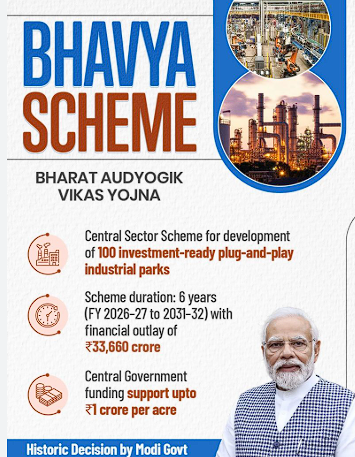
The scheme aims to develop 100 investment-ready, world-class industrial parks across India over a period of six years. It has been approved by the Union Cabinet with an outlay of ₹33,660 crore. The Minister also mentioned that around ₹34,000 crore would help attract large investments and generate direct and indirect employment.
 What is BHAVYA?
BHAVYA stands for Bharat Audyogik Vikas Yojana.
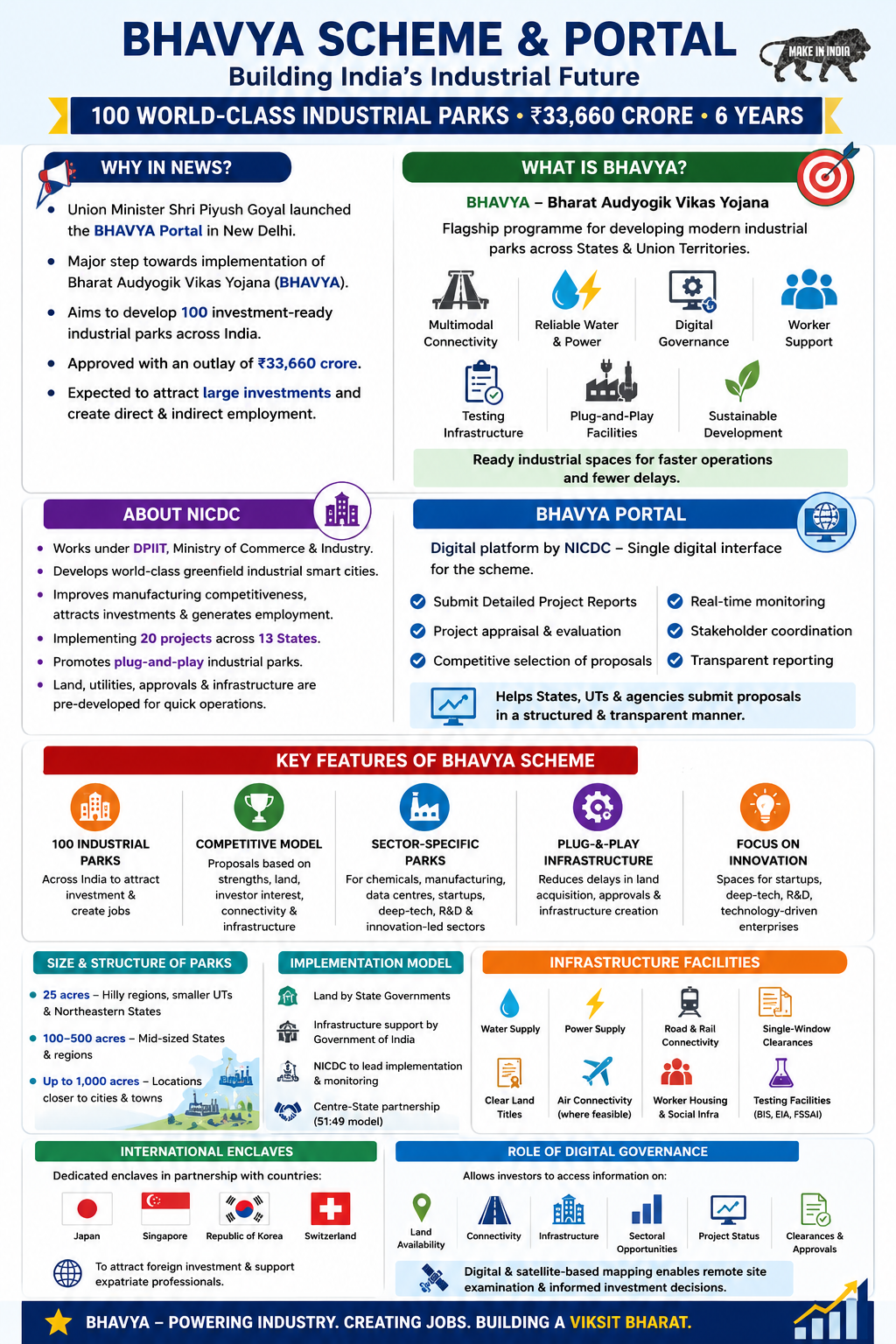
It is the Government of India’s flagship programme for developing modern industrial parks across States and Union Territories.
The aim is to create integrated industrial ecosystems with:
- Multimodal connectivity
- Reliable water and power supply
- Digital governance systems
- Worker-support facilities
- Testing infrastructure
- Sustainable development features
- Plug-and-play industrial facilities
In simple words, BHAVYA aims to provide ready industrial spaces where investors can start operations faster with fewer delays.
National Industrial Corridor Development Corporation Limited
|
What is the BHAVYA Portal?
The BHAVYA Portal is a digital platform developed by the National Industrial Corridor Development Corporation (NICDC).
It will act as a single digital interface for the scheme.
The portal will support:
- Submission of Detailed Project Reports
- Project appraisal and evaluation
- Competitive selection of proposals
- Real-time monitoring of project progress
- Coordination among stakeholders
- Transparent reporting and accountability
It will help States, Union Territories and implementing agencies submit proposals in a structured manner.
Key Features of BHAVYA Scheme
1. Development of 100 Industrial Parks
BHAVYA aims to develop 100 industrial parks across the country to attract investment and create jobs.
2. Challenge-based Competitive Model
States will submit proposals based on:
- Industrial strengths
- Land availability
- Investor interest
- Sectoral potential
- Connectivity
- Infrastructure readiness
The best proposals will be selected through a competitive framework.
3. Sector-specific Industrial Parks
Industrial parks will be designed according to the needs of different sectors such as:
- Chemicals
- Manufacturing
- Data centres
- Startups
- Deep-tech
- R&D
- Innovation-led enterprises
4. Plug-and-Play Infrastructure
- The parks will help investors start operations quickly by reducing delays in land acquisition, approvals and basic infrastructure creation.
5. Focus on Innovation
BHAVYA parks may include dedicated spaces for:
- Startups
- Deep-tech enterprises
- Research and development
- Technology-oriented businesses
- Innovation-led industries
Size and Structure of Industrial Parks
The size of industrial parks will vary according to geography and requirement.
- 25 acres: Hilly regions, smaller Union Territories and Northeastern States
- 100 to 500 acres: Mid-sized States and regions
- Up to 1,000 acres: Locations closer to cities and towns
This flexible model allows industrial parks to be designed according to local needs and land availability.
Implementation Model
The scheme will be implemented through a Centre-State partnership.
- Land will be provided by State Governments.
- Infrastructure support will be provided by the Government of India.
- NICDC will lead implementation and monitoring.
- NICDC will partner with States under a 51:49 model.
The Department for Promotion of Industry and Internal Trade (DPIIT) released operational guidelines for BHAVYA in May 2026.
Infrastructure Facilities in BHAVYA Parks
BHAVYA parks are expected to provide modern industrial infrastructure such as:
- Assured water supply
- Assured power supply
- Road connectivity
- Rail connectivity
- Digital single-window clearances
- Clear land titles
- Air connectivity where feasible
- Worker housing
- Social infrastructure
- Areas for Global Capability Centres
- Testing and quality certification facilities
Modern testing facilities will be developed in partnership with institutions such as:
- Bureau of Indian Standards (BIS)
- Export Inspection Agency (EIA)
- Food Safety and Standards Authority of India (FSSAI)
International Enclaves
The Government may explore dedicated international enclaves within BHAVYA parks in partnership with countries such as:
- Japan
- Singapore
- Republic of Korea
- Switzerland
These enclaves can help attract foreign investors and provide a familiar environment for expatriate professionals working in India.
Role of Digital Governance
The BHAVYA Portal will make the scheme more transparent and efficient.
It will help investors access information on:
- Land availability
- Connectivity
- Surrounding infrastructure
- Sectoral opportunities
- Project status
- Clearances and approvals
Digital and satellite-based mapping of industrial parks will allow investors to examine sites remotely and take informed decisions.
Significance
1. Boost to Manufacturing
BHAVYA can strengthen India’s manufacturing base by providing world-class industrial infrastructure.
2. Employment Generation
The scheme is expected to create large-scale direct and indirect employment.
3. Ease of Doing Business
Plug-and-play industrial parks can reduce delays in land acquisition, approvals and infrastructure development.
4. Competitive Federalism
States will compete by showcasing their strengths, land availability and sectoral potential.
5. Support to MSMEs and Startups
Dedicated spaces for startups, deep-tech, R&D and innovation-led enterprises can support new businesses and MSMEs.
6. Global Value Chain Integration
Modern industrial parks can help India integrate more deeply with global value chains.
7. Balanced Regional Development
Flexible Park sizes can help industrial development reach smaller States, hilly regions, Union Territories and Northeastern States.
8. Support to Viksit Bharat 2047
The scheme supports India’s long-term goal of becoming a developed economy by 2047.
Challenges
- States must provide suitable and dispute-free land.
- Environmental clearances may take time.
- Coordination between Centre, States and agencies is essential.
- Infrastructure must be completed within timelines.
- Industrial parks must attract real investors, not remain underutilised.
- Smaller States may need technical support for preparing DPRs.
- Worker housing and social infrastructure should not be neglected.
- Sustainability must be ensured through water efficiency, clean energy and waste management.
Way Forward
- Ensure transparent and timely selection of proposals.
- Provide handholding support to States for DPR preparation.
- Use the BHAVYA Portal for real-time monitoring.
- Build sector-specific parks based on local strengths.
- Provide strong road, rail, port and airport linkages.
- Develop worker housing, healthcare and skill centres.
- Promote green infrastructure and sustainable industrial practices.
- Link BHAVYA parks with MSMEs, startups and export promotion councils.
- Ensure that international enclaves attract real investment and technology transfer.
Conclusion
The launch of the BHAVYA Portal marks an important step in India’s next phase of industrial infrastructure development. By creating 100 investment-ready industrial parks, the scheme aims to reduce investment delays, improve ease of doing business, attract domestic and foreign investment and generate employment.
If implemented effectively, BHAVYA can strengthen India’s manufacturing ecosystem, deepen integration with global value chains and support the national vision of Viksit Bharat 2047.
Why in News?
India is rapidly expanding its renewable energy capacity, especially solar power. However, the adoption of decentralised solar power through schemes such as PM Surya Ghar Yojana and PM-KUSUM remains below its full potential.
A major reason is that many States already provide free or highly subsidised electricity to households and farmers. As a result, people have less incentive to spend money on rooftop solar panels or solar pumps.
What is Decentralised Solar Power?
Decentralised solar power means electricity generated close to the place where it is used.
Examples include:
- Rooftop solar panels on houses
- Solar pumps used by farmers
- Small solar plants on farmers’ unused land
- Local solar systems connected to the grid
In simple terms, instead of producing all electricity in large solar parks and sending it through long transmission lines, decentralised solar allows households and farmers to become energy producers.
India’s Solar Growth
- India has made strong progress in solar energy.
- Solar power now accounts for nearly 30% of India’s total installed electricity capacity. India added more than 50 GW of solar energy capacity in the last two years. In 2025, India added more solar capacity than any country except China.
- This shows that solar energy is becoming central to India’s clean energy transition.
PM Surya Ghar Yojana
PM Surya Ghar Yojana aims to install rooftop solar units on one crore households.
Main features:
- Rooftop solar support for households
- Free electricity up to 300 units per month
- Cash subsidy for solar equipment
- Encouragement to produce electricity locally
- Reduction in household electricity bills
The scheme is important for urban and semi-urban households.
PM-KUSUM Scheme
PM-KUSUM stands for Pradhan Mantri Kisan Urja Suraksha Evam Utthan Mahabhiyan.
It is aimed at farmers.
Main features:
- Support for small solar plants on unused land
- Installation of standalone solar water pumps
- Grid-connected solar pumps
- Reduction in diesel and electricity use
- Additional income by selling solar electricity
- Support for irrigation needs
The scheme helps farmers become both electricity consumers and producers.

Progress and Gaps
- PM Surya Ghar Yojana and PM-KUSUM have led to around 13 GW of decentralised solar capacity.
- However, the target is around 40 GW by the end of the current financial year. This shows that progress is still below expectation.
- The most successful part of PM-KUSUM has been standalone solar water pumps. More than 10.9 lakh solar pumps have been installed against a target of 14 lakh.
- But progress is uneven across States.
Better-performing States under rooftop solar include:
- Gujarat
- Maharashtra
- Uttar Pradesh
- Kerala
- Rajasthan
These five States account for nearly 70% of rooftop installations.
Why Power Subsidies Slow Solar Adoption
Power subsidies are one of the main reasons for low adoption in some States.
Many State governments provide:
- Free electricity to households
- Highly subsidised domestic power
- Free agricultural power for irrigation pumps
When electricity is already free or very cheap, people do not feel the need to invest in solar equipment.
For example, if a household already gets free electricity, rooftop solar does not appear financially attractive because:
- Solar installation has high upfront cost
- Recovery of investment takes time
- Savings are low when grid electricity is already cheap
- Excess solar power sale may not be enough to attract consumers
The same problem affects farmers under PM-KUSUM. If agricultural power is already free, farmers may not prefer solar pumps unless additional incentives are given.
Examples from States
Punjab
Punjab provides 300 units of free electricity to domestic consumers every month and completely free power for agricultural tubewells. It also spends heavily on power subsidies. As a result, adoption of solar schemes has remained low.
Tamil Nadu, Karnataka and Delhi
These States also have subsidy structures that reduce the financial attraction of rooftop solar.
Gujarat, Kerala and Maharashtra
These States have relatively higher electricity tariffs for some consumers. Therefore, rooftop solar becomes more attractive because households can save more money.
Importance of Decentralised Solar Power
1. Reduces Pressure on Land
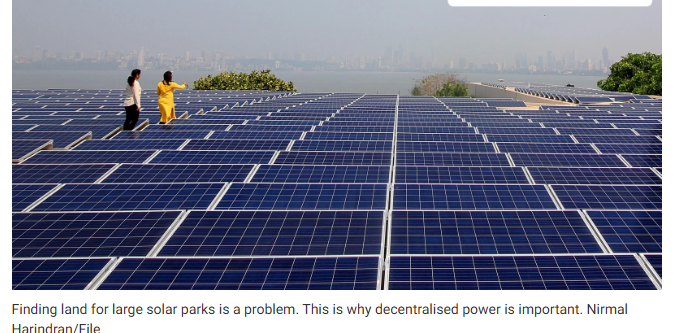
Large solar parks require huge land areas. Finding land is becoming difficult. Rooftop and local solar systems reduce pressure on land.
2. Reduces Power Subsidy Burden
If households generate their own electricity, governments may save money on recurring electricity subsidies.
3. Supports Farmers
Solar pumps can reduce dependence on diesel and unreliable grid power. Farmers can also earn by selling surplus electricity.
4. Helps During Peak Demand
Summer electricity demand is rising due to heatwaves and cooling needs. Solar power is useful during daytime peak demand.
5. Climate Resilience
Decentralised solar can reduce stress on the grid during high-demand periods and improve energy security.
6. Supports Clean Energy Transition
It reduces dependence on fossil fuel-based electricity and helps India meet climate goals.
Link with Heat and Power Demand
- India’s electricity demand is rising sharply during hot months. Earlier, hydropower helped meet additional summer demand, but large hydropower capacity has stagnated.
- In recent peak demand periods, especially during April and May, solar power played a major role in meeting daytime demand.
- In years of low rainfall and high temperatures, decentralised solar becomes more important because:
- Hydropower generation may be affected.
- Cooling demand rises.
- Grid pressure increases.
- Local solar generation can support households and farms.
Challenges
- High upfront cost of rooftop solar systems.
- Free or subsidised grid electricity reduces consumer interest.
- Lack of awareness among households and farmers.
- Uneven progress across States.
- Delays in subsidy disbursal and approvals.
- Net metering and grid connection issues.
- Quality concerns in equipment and installation.
- Limited access to easy credit.
- Need for maintenance support.
Way Forward
- Provide targeted upfront support for poor and middle-class households.
- Offer easy loans and EMI-based solar models.
- Simplify rooftop solar approvals and net metering.
- Encourage States to give one-time solar incentives instead of recurring electricity subsidies.
- Promote solar pumps in areas dependent on diesel irrigation.
- Create local maintenance and repair networks.
- Improve awareness through panchayats, DISCOMs and farmer groups.
- Link solar adoption with reduction in State subsidy burden.
- Promote domestic solar manufacturing.
- Use decentralised solar as part of heatwave and peak demand planning.
Conclusion
Decentralised solar power is essential for India’s clean energy transition. It can reduce dependence on large solar parks, lower power subsidy burdens, support farmers, and help meet rising summer electricity demand. However, free and highly subsidised grid electricity has reduced the financial attraction of rooftop solar and solar pumps in many States. The solution lies in shifting from recurring electricity subsidies to smart, one-time solar incentives. This can make households and farmers energy producers while supporting India’s long-term renewable energy goals.