
Why in News?
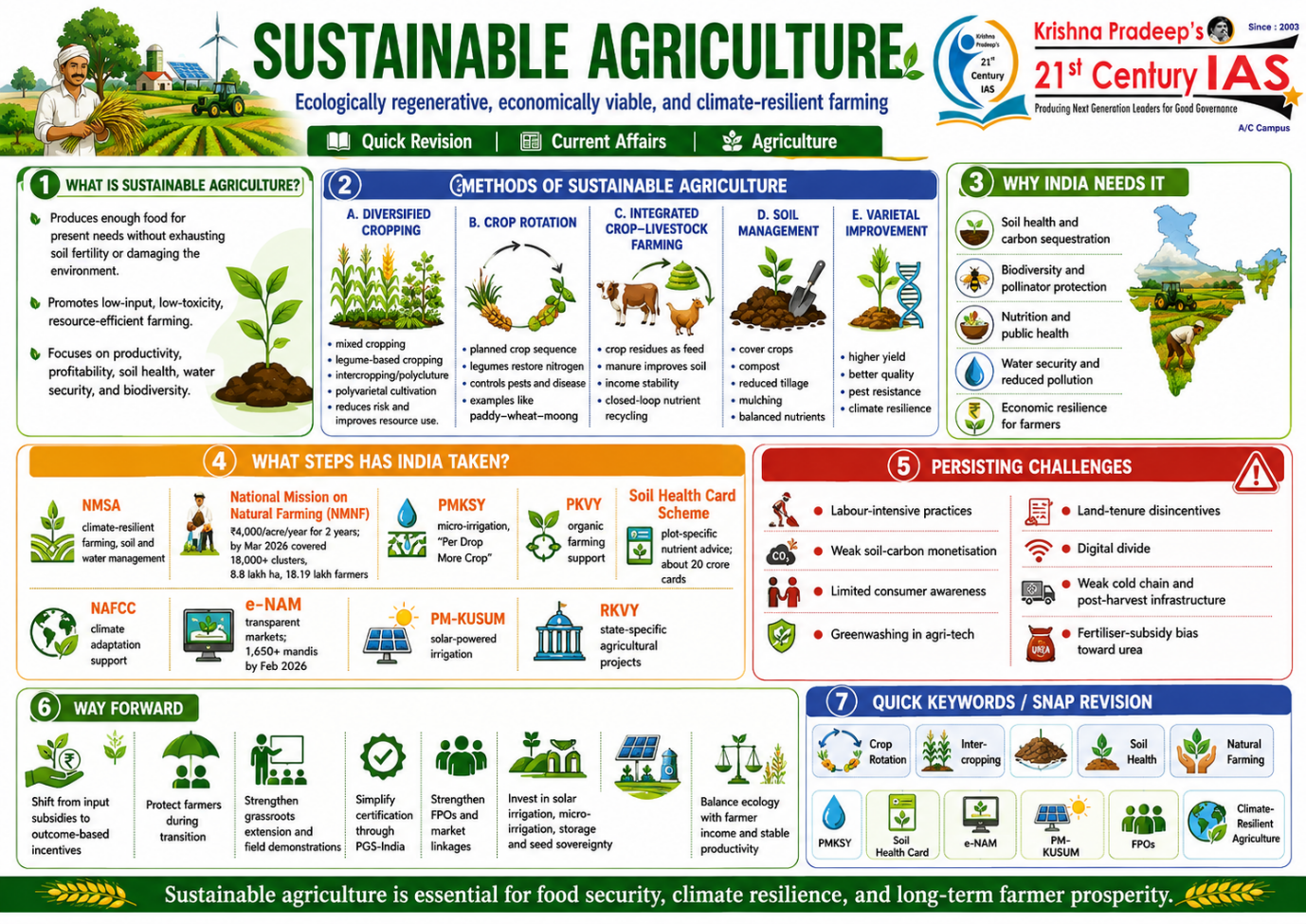
India faces growing pressure to shift towards sustainable agriculture because of climate change, resource-intensive farming and declining ecological health.
The transition requires realigned farm incentives, higher R&D funding, better lab-to-field technology transfer, AI-based weather forecasting, efficient soil and water management, stronger market linkages and recognition of ecosystem services.
What is Sustainable Agriculture?
- Sustainable agriculture is that form of agriculture which attempts to produce sufficient food to meet the needs of present-day population without exhausting soil fertility and irreversibly damaging the environment.
- Sustainable farming systems are those that are least toxic and least energy intensive and yet maintain productivity and profitability i.e. low input agriculture or organic farming.
Methods of Sustainable Agriculture
Sustainable farming methods should be selected according to local topography, soil, climate, pests, available inputs and farmers’ objectives. The major methods are diversified cropping, crop rotation, crop–livestock integration, soil management and varietal improvement.
1. Diversified Cropping
Mixed Cropping
- Risk Reduction: Two or more crops are grown together so that failure of one crop does not cause total crop loss. Crops with different maturity periods, water needs and nutrient requirements improve resource use.
Legume-Based Cropping
- Natural Nitrogen Fixation: Legumes grown with the main crop fix atmospheric nitrogen and improve soil fertility. This reduces chemical-fertiliser use and cultivation costs.
Intercropping and Polyculture
- Resource Complementarity: Different crops, such as cereals and legumes, are grown together to improve nutrient use and reduce pest risks. Polyculture also supports natural predators and may give higher combined yields than monoculture.
Polyvarietal Cultivation
- Genetic Diversity: Different varieties of the same crop are grown together to reduce vulnerability to pests, diseases and climatic stress.
Limitation of Monoculture
- High Input Dependence: Growing a single crop over a large area requires greater use of fertilisers, pesticides and water. Though productive initially, it can create long-term environmental and economic problems.
2. Crop Rotation
Meaning
- Planned Crop Sequence: Different crops are grown successively on the same field to maintain soil fertility, control pests and diseases and reduce soil erosion.
Role of Legumes
- Soil-Nitrogen Restoration: Leguminous crops such as green gram should follow non-leguminous crops. They fix nitrogen and reduce the need for chemical fertilisers.
Principles
- Balanced Sequencing: A legume should follow a non-legume, a low-water crop should follow a high-water crop, and a low-manure crop should follow one requiring more manure.
Major Patterns
- Crop Sequences: Green gram–wheat–moong; groundnut–wheat–moong; arhar–sugarcane–wheat–moong; and paddy–wheat–moong.
Multiple Cropping
- Higher Land Use: Two or three crops may be grown successively within a year. However, continuous intensive cropping without proper nutrient management can reduce long-term productivity.
3. Integrated Crop–Livestock Farming
- Nutrient Recycling: Crop residues provide animal feed, while livestock manure improves soil fertility. This creates a closed-loop farming system.
- Soil Conservation: Crops may be grown on level land and fodder or pasture on slopes, helping reduce soil erosion.
- Income Stability: Livestock can use crop residues during low-rainfall years and provide additional income, cushioning farmers against crop failure and price fluctuations.
4. Soil Management
- Healthy Soil: Productive and disease-resistant crops depend on healthy soil, adequate water and balanced nutrients.
- Cover Crops and Compost: These improve organic matter, soil fertility and biological activity.
- Reduced Tillage: Minimal soil disturbance protects soil structure, moisture and organic carbon.
- Mulching: Dead mulch reduces evaporation, suppresses weeds and improves the soil’s water-holding capacity.
5. Varietal Improvement
- Higher Yield: Improved varieties increase production from limited agricultural land.
- Better Quality: Plant breeding can improve protein quality in pulses, baking quality in wheat, preservation quality in fruits and vegetables and oil quality in oilseeds.
- Biotic-Stress Resistance: Disease- and pest-resistant varieties reduce crop losses and pesticide dependence.
- Abiotic-Stress Tolerance: Climate-resilient varieties can withstand heat, cold, frost, drought and waterlogging, improving production stability.
Why Does India Need Sustainable Agriculture?
- Soil Health and Land Preservation: Practices such as crop rotation and organic manuring restore soil microbes and nutrients. Healthy soil acts as a carbon sink, helping sequester atmospheric carbon and mitigate climate change.
- Biodiversity and Ecosystem Resilience: Sustainable farming promotes agro-biodiversity, mixed cropping and hedgerows. These support natural pest-control cycles and protect pollinators, which are essential for more than 75% of global food crops.
- Nutrition and Public Health: Sustainable agriculture promotes nutrient-dense crops and lowers pesticide residues in the food chain. It therefore supports safer diets and reduces long-term health risks linked to chemical exposure and poor nutrition.
- Water Security and Quality: Drip irrigation and precision farming optimise water use. Reduced dependence on toxic chemicals also prevents contamination of drinking-water sources and protects aquatic ecosystems from nutrient-runoff-induced dead zones.
- Economic Resilience for Farmers: Local inputs such as organic compost and indigenous seeds reduce the input-output cost gap. Diversified production also makes farmers less vulnerable to global input and commodity-price fluctuations.
What Steps Has India Taken?
- National Mission for Sustainable Agriculture: NMSA promotes climate-resilient farming through better soil and water management. Its objective is to maintain long-term ecological balance and agricultural viability under changing climatic conditions.
- National Mission on Natural Farming: Launched in November 2024, NMNF provides ₹4,000 per acre per year for two years to support natural farming and livestock-based bio-inputs. By March 2026, more than 18,000 clusters, 8.8 lakh hectares and 18.19 lakh farmers had been covered.
- Pradhan Mantri Krishi Sinchai Yojana: PMKSY promotes micro-irrigation through drip and sprinkler systems under the motto Per Drop More Crop. It offers subsidies of up to 55% for small and marginal farmers and aims to benefit 22 lakh farmers, especially in water-stressed areas.
- Paramparagat Krishi Vikas Yojana: PKVY provides financial support for organic farming and helps move farmers away from chemical-intensive cultivation. Between 2015 and 2025, organic initiatives covered 15 lakh hectares, formed 52,289 clusters and supported 2.53 million farmers.
- Soil Health Card Scheme: The scheme provides plot-specific nutrient recommendations and discourages blanket application of urea. Around 20 crore cards have been issued using geo-tagged samples, supported by laboratories, portals and a national nutrient map.
- National Adaptation Fund for Climate Change: Established in 2015 and administered by NABARD, NAFCC provides 100% central grants for climate-adaptation projects in vulnerable States and Union Territories. It has sanctioned 30 projects across 27 States and UTs with a total project cost of ₹847 crore.
- Digital Agriculture and e-NAM: e-NAM connects farmers to transparent and wider markets while digital tools support precision farming and real-time crop monitoring. As of February 2026, it had integrated over 1,650 mandis, registered 1.80 crore farmers and 2.72 lakh traders, onboarded 4,724 FPOs, and facilitated trade worth ₹4,82,350 crore involving 13.22 crore metric tonnes of produce.
- PM-KUSUM: The scheme promotes solar-powered irrigation and reduces dependence on diesel pumps. It lowers greenhouse-gas emissions, reduces input costs and allows farmers to sell surplus power to the grid, with support intended for more than 35 lakh farmers.
- Rashtriya Krishi Vikas Yojana: Launched in 2007, RKVY enables States to design and implement location-specific agricultural projects. It promotes decentralised planning and higher investment in agriculture.
What are the Persisting Challenges?
- Labour-Sustainability Paradox: Practices such as mulching, intercropping and manual weed control are more labour-intensive than chemical-based farming. With rural migration and mechanisation levels of only about 40–45% in advanced agricultural regions, these methods may become costly for smallholders.
- Weak Soil-Carbon Monetisation: Soil carbon can provide an additional income stream, but smallholders face high costs for monitoring, reporting and verification. Fragmented landholdings and registration expenses exclude many of the 86% of farmers who are small or marginal from emerging carbon markets.
- Consumer Value Disconnect: Many consumers view organic produce only as a premium health product and do not fully recognise its ecological benefits. Limited awareness reduces willingness to pay and prevents sustainable produce from becoming mainstream.
- Greenwashing in Agri-Tech: Some startups merely optimise chemical delivery while claiming sustainability. This blurs the distinction between improving efficiency within industrial agriculture and genuinely reducing chemical dependence.
- Land-Tenure Disincentives: Tenant farmers on short-term or informal leases have little incentive to invest in long-term practices such as soil restoration and agroforestry. The future benefits often accrue to landowners rather than cultivators.
- Ecosystem-Service Devaluation: Sustainable farms provide public benefits such as groundwater recharge, biodiversity protection and reduced nitrogen runoff, but farmers are rarely compensated. Wildlife activity may be about 30% higher on ecological farms, yet India lacks a broad system of payments for ecosystem services.
- Digital Divide: Although India had over one billion broadband subscriptions by late 2025, smart farming requires stable connectivity, technical literacy and costly equipment. These capabilities remain concentrated among large or corporate farms, widening the sustainability gap.
- Weak Cold Chain and Post-Harvest Infrastructure: Sustainable produce is often highly perishable and lacks dedicated storage and segregated logistics. India loses food worth nearly ₹1.53 trillion annually, while existing supply chains are largely designed for bulk, chemically treated commodities.
- Fertiliser-Subsidy Bias: Urea remains heavily subsidised and price-controlled, making chemical nitrogen cheaper than organic and biological alternatives. The fertiliser-subsidy estimate for 2025–26 was revised upward from ₹1.68 lakh crore to ₹1.86 lakh crore, reinforcing dependence on chemical inputs.
What Measures are Needed?
- Realign Financial Incentives: Support should move from subsidising inputs to rewarding environmental outcomes such as improved soil organic carbon, water conservation and biodiversity. Such result-based incentives can make sustainable practices financially attractive.
- Protect Farmers During Transition: Sustainable or organic conversion may cause a yield decline for three to five years. Direct income support is needed to cushion this transition and prevent farmers from returning to chemical-intensive cultivation.
- Strengthen Grassroots Extension: The seeing-is-believing model should replace classroom-only training. Farmer-to-farmer learning and side-by-side field demonstrations can provide local proof of productivity and cost savings.
- Simplify Certification: Group certification through PGS-India should be expanded and subsidised. Mobile records and blockchain-based traceability can reduce costs and help smallholders access premium urban and export markets.
- Improve Market Linkages: Decentralised, solar-powered cold storage at village or cluster level can reduce post-harvest losses and strengthen bargaining power. Better storage enables farmers to delay sales and seek better prices.
- Strengthen FPOs: Farmer Producer Organisations can aggregate produce, negotiate prices and invest in shared technology such as community composting or laser land levellers. Collective scale can make sustainable farming more commercially viable.
- Invest in Climate-Resilient Infrastructure: Solar irrigation, micro-irrigation, water harvesting and local storage should be expanded. Scaling up PM-KUSUM can reduce fossil-fuel dependence and improve water-use efficiency.
- Promote Seed Sovereignty: Regional seed banks should conserve climate-resilient indigenous varieties. Such seeds often need fewer chemical inputs and are better adapted to local climatic shocks.
- Support Long-Term Research: Studies comparing sustainable and conventional systems should extend over ten years or more. Long-term evidence is necessary to establish profitability, yield stability and ecological benefits.
Way Forward?
- Outcome-Based Support: Agricultural policy must reward environmental services rather than only subsidise fertilisers, power and other inputs.
- Smallholder-Centred Transition: Since most Indian farmers are small or marginal, finance, certification, technology and markets must be designed around their needs.
- Integrated Infrastructure: Research, extension, seed systems, irrigation, cold chains and market platforms must function as a connected ecosystem rather than isolated interventions.
- Ecology–Income Balance: Sustainable farming will succeed only when ecological gains are matched by lower risk, stable productivity, remunerative prices and adequate farmer income.
Conclusion
India must transition towards sustainable agriculture to reduce climate risks and secure long-term food and nutritional security. By shifting from input-based subsidies to ecosystem-oriented incentives, investing in climate-resilient infrastructure, strengthening certification and market access, preserving indigenous seeds and empowering FPOs, India can build an agricultural system that is both ecologically regenerative and economically viable.
Why in News?
Nipah Resurgence: Nipah virus has resurfaced in Kozhikode, where a 43-year-old patient who tested positive is battling for life at Government Medical College Hospital.
The latest case has renewed attention on Kerala’s recurring Nipah risk, ecological vulnerability, zoonotic-disease profile and public-health preparedness.
What Has Been Kerala’s Nipah Outbreak History?
- 2018 Outbreak: Kerala’s first Nipah outbreak identified 23 cases, including 18 laboratory-confirmed cases. The case-fatality rate was 91%, with only two survivors.
- 2019 Spillover: A single case was detected in Ernakulam, and the patient survived.
- 2021 Case: A 12-year-old boy was diagnosed with Nipah in Malappuram.
- 2023 Cluster: Kozhikode reported a cluster of six Nipah cases.
- 2024 Spillovers: Two isolated cases were reported from separate spillover events in Malappuram during July and September.
- 2025 Independent Events: Four cases were recorded in Malappuram and Palakkad. Epidemiological investigations found no links between them, suggesting independent spillovers from the natural reservoir.
- 2026 Resurgence: Nipah has again surfaced in Kozhikode, reinforcing the pattern of recurrent spillovers.
Why is Nipah Recurring in Kerala?
- Natural Reservoir: The Indian flying fox bat, Pteropus medius, has been consistently identified as the natural reservoir of Nipah virus in Kerala. Serological studies and viral detection show that the virus circulates among bat colonies, particularly in northern districts.
- Evidence from Bat Samples: During the 2018 outbreak, nearly 25% of sampled bats tested positive for Nipah viral RNA. Subsequent spillover investigations also detected the virus in bat samples.
- Roosts Near Settlements: Pteropus bats are distributed across Kerala and often roost close to human habitation. A Kerala Forest Research Institute mapping study found that almost all identified roosting sites were near human settlements.
- Persistent Environmental Presence: Repeated spillovers suggest that the virus has established itself within Kerala’s ecological environment. The perennial natural reservoir makes complete prevention of future spillovers difficult.
Why is Spillover Risk Highest Between April and September?
- Seasonal Fruit Availability: Fruit-laden trees become abundant during this period, increasing bat-foraging activity near farms and human settlements.
- Bat Breeding Cycle: Bat breeding and associated behavioural changes coincide with this period, increasing movement and interaction with food sources.
- Viral-Shedding Dynamics: Seasonal changes in viral shedding by bats may raise the chances of environmental contamination and human exposure.
- Recurring Seasonal Pattern: The April–September risk window has remained consistent since Kerala’s first Nipah outbreak in 2018.
What Makes Kerala Vulnerable to Zoonotic Diseases?
- Biodiversity Hotspot: The Western Ghats along Kerala’s eastern flank is one of the world’s richest biodiversity regions. Its tropical rainforest climate supports hundreds of species of birds, reptiles and mammals.
- Limited Protected Area: Only about 1,60,000 sq. km of this rich biosphere is formally protected, leaving extensive zones where human activity and wildlife habitats overlap.
- High Population Density: Dense human settlements, plantations and agricultural lands are located close to forest fringes, increasing human-wildlife interaction.
- Habitat Disturbance: Deforestation, habitat fragmentation, urbanisation and agricultural intensification force wildlife closer to settlements and cultivated food sources.
- Climate-Related Disruption: Climate-driven ecological changes may alter animal behaviour, food availability and disease dynamics, increasing future spillover risk.
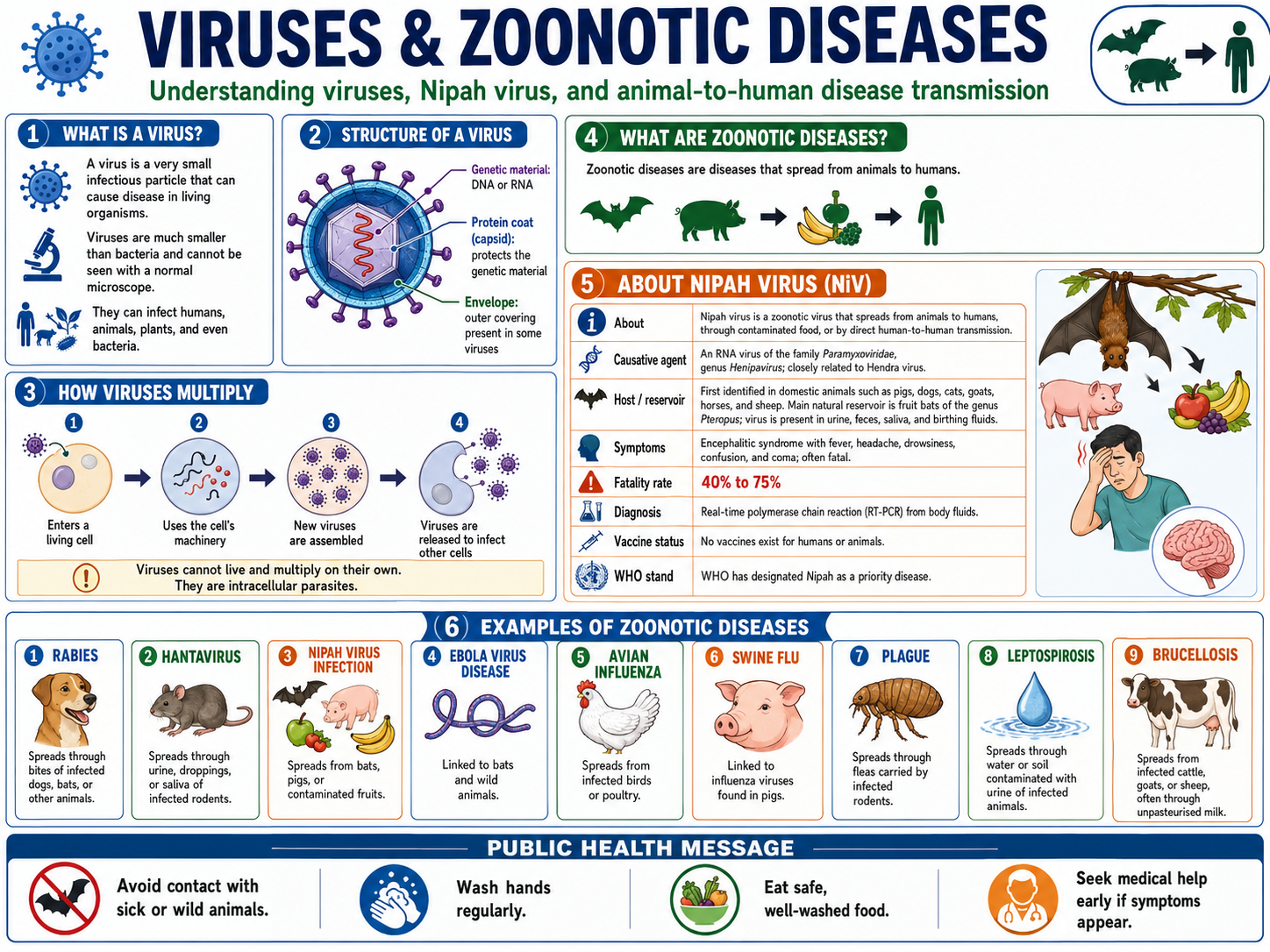 Intensified Human-Wildlife Interface: Kerala’s ecological richness, dense settlement pattern and land-use changes create frequent opportunities for exposure to novel pathogens.
How Do Ecological and Human Factors Intersect?
- Shared Landscapes: Bat roosts, fruit trees, plantations and human settlements often occupy the same geographical space. This proximity increases the probability of contaminated fruit, surfaces or other indirect exposure.
- Habitat Fragmentation: Disturbed habitats push bats and other wildlife towards cultivated areas and settlements in search of food and shelter.
- Agricultural Intensification: Expansion of farms and plantations near forest margins increases contact between wildlife, domestic environments and humans.
- Urbanisation Pressure: Rapid settlement expansion reduces ecological buffers and increases overlap between natural reservoirs and human activity.
- Seasonal Exposure: Bat foraging, fruit availability, breeding and viral shedding come together during the high-risk months, creating favourable conditions for spillover.
Why is Nipah Considered a High-Threat Pathogen?
- High Mortality: Nipah has a severe mortality profile, as demonstrated by Kerala’s 2018 case-fatality rate of 91%.
- Unpredictable Spillovers: Cases may arise independently from the natural reservoir, making outbreaks difficult to predict.
- Human Transmission Risk: The virus can spread between humans, particularly in healthcare settings without adequate infection control.
- Pandemic Potential: The World Health Organization classifies Nipah as a priority pathogen because of its lethality, unpredictability and potential to cause large outbreaks or a future pandemic.
- Kerala’s High-Threat Profile: WHO has advised Kerala to remain vigilant regarding Nipah, Avian Influenza H5N1 and Kyasanur Forest Disease, all of which have high mortality, transmissibility or pandemic potential.
What Other Zoonotic Diseases Affect Kerala?
Kerala’s broader zoonotic-risk profile includes:
- Kyasanur Forest Disease, Leptospirosis, Scrub typhus, Japanese encephalitis, West Nile fever, Rabies, Avian influenza
Nipah is therefore part of a wider landscape of animal-origin diseases linked to Kerala’s ecology and human-wildlife interface.
What Did Kerala Learn from the 2018 Outbreak?
- Nosocomial Transmission Risk: Of the 23 cases identified in 2018, only the index patient contracted the infection in the community. All other cases resulted from nosocomial transmission across three hospitals.
- Need for Clinical Suspicion: The outbreak demonstrated that clinicians must maintain a high index of suspicion when encountering unusual cases of acute encephalitis syndrome or clusters of severe illness.
- Infection-Control Priority: Kerala strengthened standard infection-prevention and control procedures in hospitals to reduce healthcare-associated transmission.
- Clinical Algorithms: The State developed clinical algorithms for emerging viral infections at tertiary-care institutions.
- Diagnostic Strengthening: The experience led to improved diagnostic, laboratory and research capacity for rapid pathogen detection.
What Makes Kerala’s Nipah Response Effective?
- Rapid Index-Case Identification: Kerala’s public-health system has repeatedly demonstrated the ability to identify the first case quickly and initiate containment.
- Coordinated Surveillance: Disease surveillance, clinical monitoring, laboratory diagnosis and public-health action operate in close coordination.
- Early Laboratory Confirmation: Expanded Virus Research and Diagnostic Laboratory networks enable faster confirmation and identification of pathogens.
- Monitoring Encephalitis Cases: The State closely monitors acute encephalitis cases of unknown cause and screens severe respiratory infections.
- Hospital Infection Control: Stronger infection-control practices have reduced human-to-human transmission after the major 2018 outbreak.
- Limited Secondary Spread: Following the initial outbreak, human-to-human transmission has occurred only once, during the 2023 cluster.
- Emergency Management: Intensive health-emergency management allows isolation, contact tracing and containment to begin rapidly.
How is Kerala Strengthening Long-Term Preparedness?
- Community Awareness: The Health Department focuses on reducing bat-human interaction by educating communities about the perennial spillover risk.
- One Health Strategy: Kerala combines human, animal and environmental surveillance to detect zoonotic threats at an early stage.
- Grassroots Surveillance: More than 2.5 lakh trained volunteers track unusual disease patterns and report unusual animal or bird deaths.
- Early Warning Network: Community reporting supports early detection of zoonotic outbreaks such as Nipah and Mpox.
- Nipah Research Centre: Kerala established the One Health Centre for Nipah Research and Resilience in Kozhikode in 2023.
- Resilience Building: The Centre focuses on community awareness, capacity building, spillover reduction and rapid-response preparedness.
- Outbreak Documentation: Every Nipah outbreak in Kerala has been documented to improve future surveillance and response.
- Research Priorities: The State is focusing on epidemiology, sero-surveillance and research into host factors.
Conclusion
Kerala’s Nipah risk arises from the intersection of a permanent bat reservoir, dense human settlement, rich biodiversity, habitat disturbance and seasonal ecological conditions. Complete prevention of spillovers may not be possible, but Kerala has significantly strengthened its ability to detect cases early, prevent hospital transmission and contain outbreaks.
Its experience shows that One Health surveillance, community participation, rapid laboratory diagnosis, infection control and sustained research are central to managing recurrent zoonotic threats.