Why in News?
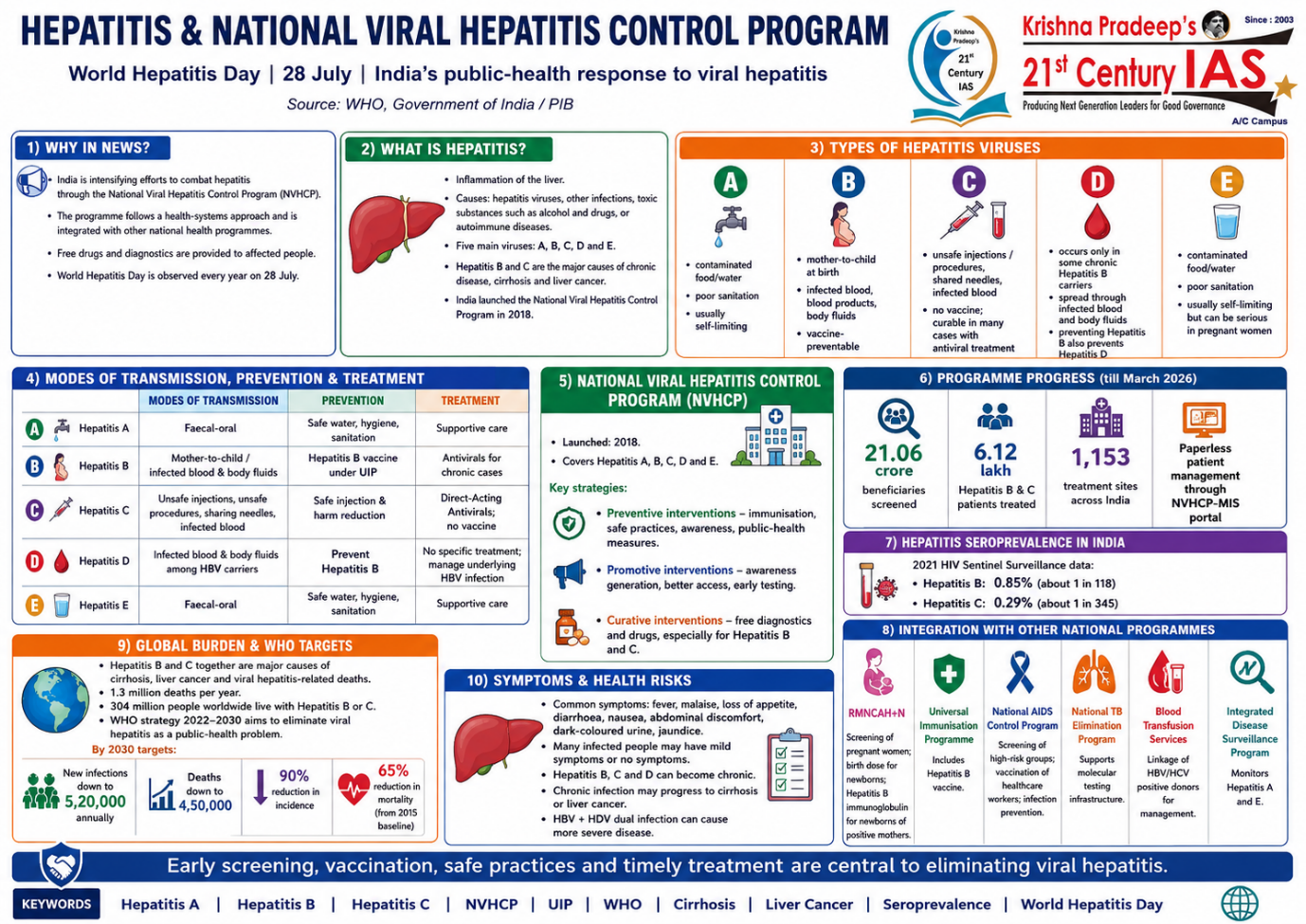
India is intensifying its efforts to combat hepatitis through the National Viral Hepatitis Control Program. The programme has adopted a health systems approach and is integrated with various national health programmes to prevent infection and provide services such as free drugs and diagnostics to affected people.
World Hepatitis Day is observed every year on 28 July to raise awareness about viral hepatitis, which can cause severe liver disease and liver cancer.
What is Hepatitis?
- Hepatitis is an inflammation of the liver. It may be caused by hepatitis viruses, other infections, toxic substances such as alcohol and drugs, or autoimmune diseases.
- There are five main hepatitis viruses: A, B, C, D and E.
- Among these, Hepatitis B and Hepatitis C are the most common causes of chronic disease and can lead to cirrhosis and liver cancer.
- Hepatitis has been recognised as a public health problem in India. In 2018, the Government launched the National Viral Hepatitis Control Program to provide screening and treatment services.
Types of Hepatitis Viruses
1. Hepatitis A
- Usually spreads through contaminated food or water.
- Often linked with poor sanitation and lack of safe drinking water.
- Generally self-limiting.
2. Hepatitis B
- Commonly transmitted from mother to child at birth.
- Can also spread through infected blood, blood products and body fluids.
- Vaccine-preventable disease.
3. Hepatitis C
- Mainly spreads through unsafe injections, unsafe medical procedures, sharing of needles or syringes, and contact with infected blood.
- There is no vaccine for Hepatitis C.
- It can be cured in many cases through proper antiviral treatment.
4. Hepatitis D
- Occurs only among some chronic Hepatitis B carriers.
- It spreads through infected blood and body fluids.
- Preventing Hepatitis B also helps prevent Hepatitis D.
5. Hepatitis E
- Spreads through contaminated food or water.
- Linked with poor sanitation and unsafe drinking water.
- Usually self-limiting, but can be serious in pregnant women.
Modes of Transmission, Prevention and Treatment
| Hepatitis Virus | Causes / Transmission | Prevention and Treatment |
| Hepatitis A | Faecal-oral route through contaminated food/water; poor sanitation | Safe drinking water, hygiene and sanitation; usually self-limiting with supportive care |
| Hepatitis B | Mother-to-child transmission at birth; infected blood, blood products and body fluids | Hepatitis B vaccine under Universal Immunisation Programme; chronic cases managed with antiviral medication as per guidelines |
| Hepatitis C | Unsafe injections, unsafe procedures, sharing needles/syringes, infected blood and body fluids | Harm reduction measures and safe injection practices; no vaccine; treated with Direct-Acting Antiviral drugs |
| Hepatitis D | Infected blood and body fluids; occurs among some chronic HBV carriers | Prevention of Hepatitis B also protects against Hepatitis D |
| Hepatitis E | Faecal-oral route through contaminated food/water; poor sanitation | Safe drinking water, hygiene and sanitation; usually self-limiting with supportive care |
National Viral Hepatitis Control Program
- The National Viral Hepatitis Control Program was launched in 2018 to combat hepatitis through screening, diagnosis and treatment services.
- The programme deals with Hepatitis A, B, C, D and E.
Key Strategies
The programme follows three major approaches:
1. Preventive Interventions
Prevention is promoted through immunisation, safe practices, awareness and public health measures.
2. Promotive Interventions
The programme focuses on awareness generation, increasing access and encouraging early testing.
3. Curative Interventions
Free diagnostics and drugs are provided to people in need, especially for management of Hepatitis B and C.
Programme Progress
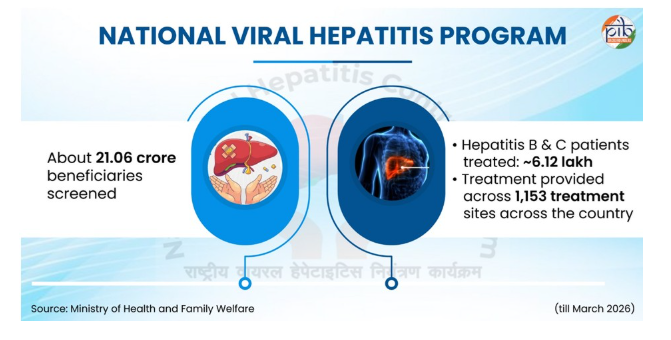
- About 21.06 crore beneficiaries were screened.
- Around 6.12 lakh Hepatitis B and C patients were treated.
- Treatment was provided through 1,153 treatment sites across the country.
The programme also uses a paperless system of recording and reporting through the NVHCP-MIS portal for patient management and monitoring.
Hepatitis Seroprevalence in India
Seroprevalence refers to the share of people who test positive for a disease in a sample survey.
According to India’s 2021 HIV Sentinel Surveillance data:
- Around 0.85% of people tested positive for Hepatitis B.
- Around 0.29% tested positive for Hepatitis C.
This is approximately:
- 1 in 118 people for Hepatitis B
- 1 in 345 people for Hepatitis C
Integration with Other National Health Programmes
India’s hepatitis strategy is not isolated. It is linked with several national health programmes.
1. Reproductive, Maternal, Newborn, Child, Adolescent Health and Nutrition Programme
This includes:
- universal screening of pregnant women for Hepatitis B
- Universal Immunisation Programme
- ensuring Hepatitis B birth dose to newborns
- Hepatitis B immunoglobulin to newborns of positive pregnant women, along with Hepatitis B birth dose within 24 hours of birth
2. Universal Immunisation Programme
- The Universal Immunisation Programme is one of India’s major public health initiatives.
- It provides free immunisation against major diseases and includes the Hepatitis B vaccine. The programme aims to protect newborns and pregnant women through life-saving vaccines.
3. National AIDS Control Program
- The National AIDS Control Program supports screening of high-risk groups for Hepatitis B and C through facility-based and outreach services.
- It also supports Hepatitis B vaccination of healthcare workers and infection prevention among high-risk groups who test negative.
4. National Tuberculosis Elimination Program
- The National Tuberculosis Elimination Program supports the use of existing machines for molecular testing.
5. Blood Transfusion Services
- Blood transfusion services help link Hepatitis B and C positive donors for further management.
6. Integrated Disease Surveillance Program
- Hepatitis A and E are usually acute, symptomatic and outbreak-prone. They are monitored through the Integrated Disease Surveillance Program.
Global Hepatitis Burden and WHO Targets
According to the WHO-related content, Hepatitis B and C are major global public health concerns.
Key global facts:
- Hepatitis B and C together are among the most common causes of liver cirrhosis, liver cancer and viral hepatitis-related deaths.
- They cause an estimated 1.3 million deaths per year.
- Around 304 million people worldwide live with Hepatitis B or C.
The WHO Global Health Sector Strategy on HIV, Viral Hepatitis and Sexually Transmitted Infections, 2022–2030 aims to eliminate viral hepatitis as a public health problem.
By 2030, the strategy aims to reduce:
- new hepatitis infections to 5,20,000 annually
- hepatitis-related deaths to 4,50,000
This represents:
- 90% reduction in incidence
- 65% reduction in mortality compared to 2015
Without urgent and sustained action, viral hepatitis is projected to cause additional new infections, liver cancer cases and deaths by 2030.
Symptoms and Health Risks
Many people infected with Hepatitis A, B, C, D or E may show only mild symptoms or no symptoms at all.
Common symptoms may include:
- fever
- malaise
- loss of appetite
- diarrhoea
- nausea
- abdominal discomfort
- dark-coloured urine
- jaundice
Hepatitis B, C and D can also become chronic infections. Chronic infection may later develop into cirrhosis or liver cancer.
Hepatitis D is found only in people already infected with Hepatitis B. Dual infection of HBV and HDV can cause more serious disease and faster progression to cirrhosis and cancer.
Significance of India’s Approach
1. Health Systems Approach
India’s strategy links prevention, screening, diagnosis, treatment and monitoring.
2. Free Diagnostics and Drugs
The availability of free services reduces financial barriers for patients.
3. Integration with Existing Programmes
Linking hepatitis control with immunisation, maternal health, HIV, TB and blood transfusion services improves coverage.
4. Focus on Early Detection
Screening helps identify infections before they progress to severe liver disease.
5. Maternal and Newborn Protection
Screening of pregnant women and timely Hepatitis B birth dose help prevent mother-to-child transmission.
6. Digital Monitoring
The NVHCP-MIS portal supports patient management and programme monitoring.
Challenges
1. Asymptomatic Nature of Infection
Many people do not show early symptoms, leading to delayed diagnosis.
2. Chronic Disease Burden
Hepatitis B and C can progress to cirrhosis and liver cancer.
3. Awareness Gap
Public awareness about transmission, prevention and treatment remains important.
4. Safe Practices
Unsafe injections, unsafe procedures and infected blood exposure continue to be concerns.
5. Sanitation Link
Hepatitis A and E are linked to contaminated food/water and poor sanitation.
Way Forward
India should continue strengthening hepatitis control through expanded screening, universal vaccination, free diagnostics and treatment, infection prevention, safe blood practices and sanitation measures. Integration with maternal health, immunisation, HIV, TB and blood transfusion services should be deepened. Awareness campaigns around World Hepatitis Day can improve testing, reduce stigma and promote early treatment.
Conclusion
India’s fight against hepatitis is based on a comprehensive public health model combining prevention, screening, treatment, immunisation, surveillance and digital monitoring. The National Viral Hepatitis Control Program, along with integration across national health programmes, is helping India move towards the 2030 goal of combating viral hepatitis. Continued awareness, early diagnosis and accessible treatment will be essential to reduce hepatitis-related liver disease and deaths.
Why in News?
As the Commonwealth Games 2026 are being held in Glasgow from 23 July to 2 August 2026, India has entered another important phase in its sporting journey. This is India’s 19th Commonwealth Games appearance, continuing a legacy that began in 1934.
India’s Sporting Transformation
- Sport is no longer viewed only as recreation. It is increasingly seen as a tool for national pride, youth development, social unity and international recognition.
- India’s greatest sporting strength lies in its youth. Around 65% of India’s population is below 35 years of age. Recognising this demographic potential, the Ministry of Youth Affairs and Sports has been expanding programmes for mass participation and elite performance.
- The Union Budget 2026–27 allocated a record ₹4,479.88 crore to the Ministry of Youth Affairs and Sports, compared to ₹1,219 crore in 2013–14. This reflects the increasing policy priority given to sports development.
Khelo India Programme
The Khelo India Scheme was launched in 2017 to create a strong foundation for Indian sports.
It brought together three earlier schemes:
- Rajiv Gandhi Khel Abhiyan
- Urban Sports Infrastructure Scheme
- National Sports Talent Search Scheme
The programme aims to build a complete sporting ecosystem by supporting grassroots participation, infrastructure development, athlete training, competitions, sports science and talent identification.
Five Pillars of Khelo India
The Khelo India Scheme follows a comprehensive approach based on five major pillars.
1. Training Centres
The programme establishes training centres at different levels to identify talented athletes and guide them towards professional excellence.
2. Capacity Building
It focuses on building the capacity of coaches and support staff through dedicated development programmes.
3. Sports Science and Technology
Khelo India promotes the use of sports science, psychology, nutrition and advanced technology to improve athlete performance.
4. Competitions and Leagues
The scheme organises competitions and leagues to build a vibrant sporting culture and provide competitive exposure.
5. Sports Infrastructure
It supports development of sports infrastructure for both training and competitive events.
Key Achievements of Khelo India
As of July 2026, Khelo India has achieved important progress.
| Area | Achievement |
| Sports infrastructure projects approved | 349 |
| Total investment in infrastructure projects | ₹3,176 crore |
| Khelo India Centres established | 1,067 |
| Academies supported | 267 |
| Khelo India Athletes supported | 2,745 |
The programme provides athletes with coaching, equipment, medical care and monthly out-of-pocket allowance. It is helping create a strong pipeline of future champions.
Khelo India Games: Stage for Future Champions
- The Khelo India movement entered a major phase with the launch of the Khelo India School Games in 2018 in New Delhi.
- From 2019, the event was renamed the Khelo India Youth Games after the Indian Olympic Association joined the initiative.
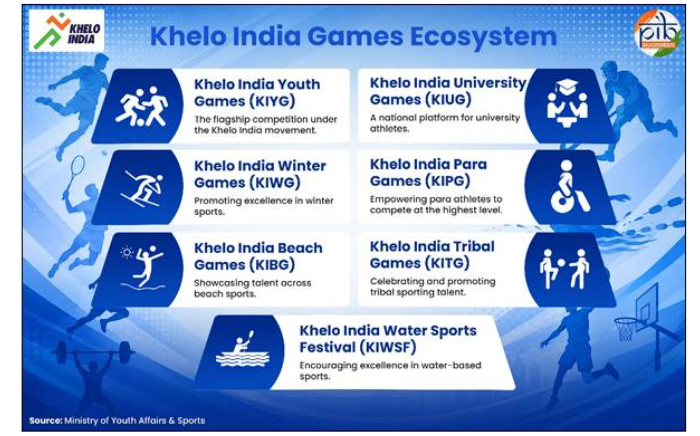
The Khelo India Games have expanded over time:
| Year | Event Introduced |
| 2018 | Khelo India School Games |
| 2019 | Khelo India Youth Games |
| 2020 | Khelo India University Games and Khelo India Winter Games |
| 2023 | Khelo India Para Games |
| 2025 | Khelo India Beach Games and Khelo India Water Sports Festival |
| 2026 | Khelo India Tribal Games |
Since 2018, more than 63,000 athletes have participated in the Khelo India Games. These competitions give young athletes a national platform to compete, improve and prepare for higher levels.
Supporting Initiatives for Sporting Excellence
1. Target Olympic Podium Scheme
- The Target Olympic Podium Scheme was launched in September 2014 to improve India’s performance at the Olympic and Paralympic Games.
- It was revamped in April 2018 with a dedicated technical support team.
TOPS supports athletes through:
- foreign training
- international competitions
- coaching camps
- specialised equipment
- monthly stipend
As of April 2026, TOPS supports:
| Category | Number Supported |
| Core Athletes | 51 |
| Para Core Athletes | 52 |
| Development Athletes | 130 |
TOPS played an important role in India’s medal-winning performances at the Tokyo 2020 and Paris 2024 Olympic Games.
2. KIRTI
Khelo India Rising Talent Identification (KIRTI) identifies and nurtures sporting talent among children aged 9 to 18 years.
It uses:
- Talent Assessment Centres
- standardised assessment protocols
- Artificial Intelligence
- data analytics
- advanced IT tools
KIRTI aims to ensure transparent and merit-based selection. It also seeks to build a long-term talent pipeline to help India become a top 10 sporting nation by 2036 and a top 5 sporting nation by 2047.
3. Sports Goods Manufacturing
The Union Budget 2026–27 announced a dedicated initiative for sports goods manufacturing with an allocation of ₹500 crore.
Its objectives include:
- expanding domestic manufacturing capacity
- promoting research and innovation in equipment design
- advancing material sciences
- strengthening India’s role in global sports supply chains
- generating employment in manufacturing and allied sectors
This initiative links sports development with Make in India, employment and industrial growth.
India’s Rise on the Global Sporting Stage
India’s improved sporting ecosystem is reflected in its performance at major international events.
1. Olympic Games
| Year | Host City | Indian Athletes | Medals Won |
| 2016 | Rio de Janeiro | 117 | 2 |
| 2020 | Tokyo | 119 | 7 |
| 2024 | Paris | 117 | 6 |
India’s Olympic performance improved significantly from 2 medals in Rio 2016 to 7 medals in Tokyo 2020, followed by 6 medals in Paris 2024.
2. Paralympic Games
| Year | Host City | Indian Athletes | Medals Won |
| 2016 | Rio de Janeiro | 19 | 4 |
| 2020 | Tokyo | 54 | 19 |
| 2024 | Paris | 84 | 29 |
India’s Paralympic rise has been remarkable, with Paris 2024 becoming India’s best-ever Paralympic campaign.
3. Asian Games
| Year | Host City | Indian Athletes | Medals Won |
| 2014 | Incheon | 541 | 57 |
| 2018 | Jakarta | 570 | 69 |
| 2023 | Hangzhou | 655 | 107 |
The Hangzhou 2023 Asian Games became a landmark edition, with India recording its highest-ever medal tally of 107 medals.
4. Commonwealth Games
| Year | Host City | Indian Athletes | Medals Won |
| 2014 | Glasgow | 215 | 64 |
| 2018 | Gold Coast | 218 | 66 |
| 2022 | Birmingham | 210 | 61 |
India has remained a strong performer at the Commonwealth Games, especially in sports such as weightlifting, wrestling, badminton, table tennis and athletics.
Commonwealth Games 2026
The Commonwealth Games 2026 are being held in Glasgow from 23 July to 2 August 2026.
Key facts:
- athletes from 74 countries are participating
- the Games include a 10-sport programme
- there are six fully integrated Para Sports
- events are hosted at four venues
- India has sent a 124-member contingent
- the contingent includes 78 male and 46 female athletes
As of 27 July 2026, India had won four medals: one gold, two silver and one bronze. Indian athletes continue to compete in several events.
Significance
1. Builds a Strong Sporting Culture
Khelo India encourages mass participation and creates sporting opportunities from school to university and beyond.
2. Strengthens Grassroots Talent Identification
Khelo India Centres, KIRTI and local training structures help identify talent at an early age.
3. Supports Elite Performance
TOPS helps high-performing athletes prepare for Olympic and Paralympic success through targeted support.
4. Promotes Inclusivity
Khelo India Para Games, Tribal Games, Beach Games and University Games expand opportunities across different groups and regions.
5. Uses Science and Technology
AI, data analytics, sports science, nutrition and psychology are increasingly used to improve athlete performance.
6. Links Sports with Economy
Sports goods manufacturing creates opportunities in domestic production, innovation and employment.
7. Enhances National Pride
International sporting success unites citizens and strengthens India’s global image.
Challenges
1. Grassroots Access Gaps
Sports facilities are still unevenly distributed across regions.
2. Coaching Quality
India needs more trained coaches, physiotherapists, sports psychologists and performance analysts.
3. Athlete Nutrition and Health
Long-term athlete development requires sustained nutrition, medical care and injury management.
4. Rural-Urban Divide
Many talented athletes in rural areas still face barriers in accessing professional training.
5. Infrastructure Maintenance
Creating infrastructure is not enough; facilities must be maintained and used effectively.
6. Transition to Elite Level
India must ensure that young athletes identified at grassroots level receive continuous support till elite competition.
Way Forward
India should strengthen the link between school sports, university competitions, district-level training centres, academies and elite athlete support. Sports science, nutrition, mental conditioning and injury prevention must be made accessible beyond metropolitan centres. KIRTI’s data-driven talent identification should be expanded across more States and Union Territories. Sports goods manufacturing should be linked with innovation, quality standards and global supply chains.
A long-term athlete development model will be essential if India wants to become a leading sporting nation by 2036 and 2047.
Conclusion
India’s sporting journey is moving from isolated success to a structured national ecosystem. The Khelo India programme, supported by TOPS, KIRTI, sports infrastructure and manufacturing initiatives, is creating pathways from grassroots participation to international excellence. With sustained investment, scientific training and inclusive access, India can build a generation of athletes capable of competing confidently on the world stage.