Why in News?
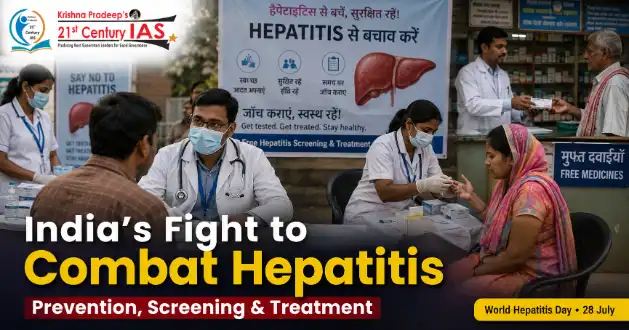
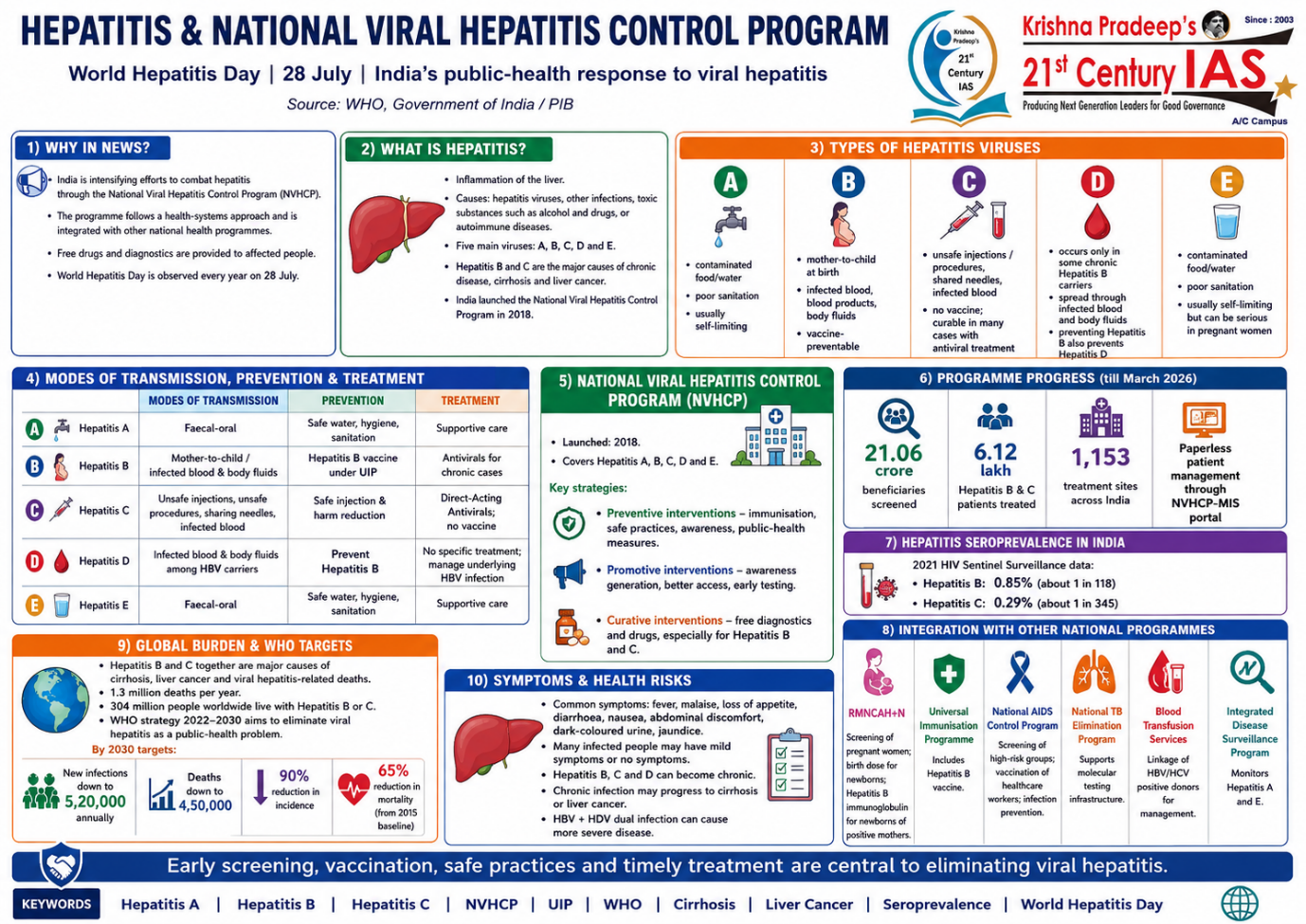
India is intensifying its efforts to combat hepatitis through the National Viral Hepatitis Control Program. The programme has adopted a health systems approach and is integrated with various national health programmes to prevent infection and provide services such as free drugs and diagnostics to affected people.
World Hepatitis Day is observed every year on 28 July to raise awareness about viral hepatitis, which can cause severe liver disease and liver cancer.
What is Hepatitis?
- Hepatitis is an inflammation of the liver. It may be caused by hepatitis viruses, other infections, toxic substances such as alcohol and drugs, or autoimmune diseases.
- There are five main hepatitis viruses: A, B, C, D and E.
- Among these, Hepatitis B and Hepatitis C are the most common causes of chronic disease and can lead to cirrhosis and liver cancer.
- Hepatitis has been recognised as a public health problem in India. In 2018, the Government launched the National Viral Hepatitis Control Program to provide screening and treatment services.
Types of Hepatitis Viruses
1. Hepatitis A
- Usually spreads through contaminated food or water.
- Often linked with poor sanitation and lack of safe drinking water.
- Generally self-limiting.
2. Hepatitis B
- Commonly transmitted from mother to child at birth.
- Can also spread through infected blood, blood products and body fluids.
- Vaccine-preventable disease.
3. Hepatitis C
- Mainly spreads through unsafe injections, unsafe medical procedures, sharing of needles or syringes, and contact with infected blood.
- There is no vaccine for Hepatitis C.
- It can be cured in many cases through proper antiviral treatment.
4. Hepatitis D
- Occurs only among some chronic Hepatitis B carriers.
- It spreads through infected blood and body fluids.
- Preventing Hepatitis B also helps prevent Hepatitis D.
5. Hepatitis E
- Spreads through contaminated food or water.
- Linked with poor sanitation and unsafe drinking water.
- Usually self-limiting, but can be serious in pregnant women.
Modes of Transmission, Prevention and Treatment
| Hepatitis Virus | Causes / Transmission | Prevention and Treatment |
| Hepatitis A | Faecal-oral route through contaminated food/water; poor sanitation | Safe drinking water, hygiene and sanitation; usually self-limiting with supportive care |
| Hepatitis B | Mother-to-child transmission at birth; infected blood, blood products and body fluids | Hepatitis B vaccine under Universal Immunisation Programme; chronic cases managed with antiviral medication as per guidelines |
| Hepatitis C | Unsafe injections, unsafe procedures, sharing needles/syringes, infected blood and body fluids | Harm reduction measures and safe injection practices; no vaccine; treated with Direct-Acting Antiviral drugs |
| Hepatitis D | Infected blood and body fluids; occurs among some chronic HBV carriers | Prevention of Hepatitis B also protects against Hepatitis D |
| Hepatitis E | Faecal-oral route through contaminated food/water; poor sanitation | Safe drinking water, hygiene and sanitation; usually self-limiting with supportive care |
National Viral Hepatitis Control Program
- The National Viral Hepatitis Control Program was launched in 2018 to combat hepatitis through screening, diagnosis and treatment services.
- The programme deals with Hepatitis A, B, C, D and E.
Key Strategies
The programme follows three major approaches:
1. Preventive Interventions
Prevention is promoted through immunisation, safe practices, awareness and public health measures.
2. Promotive Interventions
The programme focuses on awareness generation, increasing access and encouraging early testing.
3. Curative Interventions
Free diagnostics and drugs are provided to people in need, especially for management of Hepatitis B and C.
Programme Progress
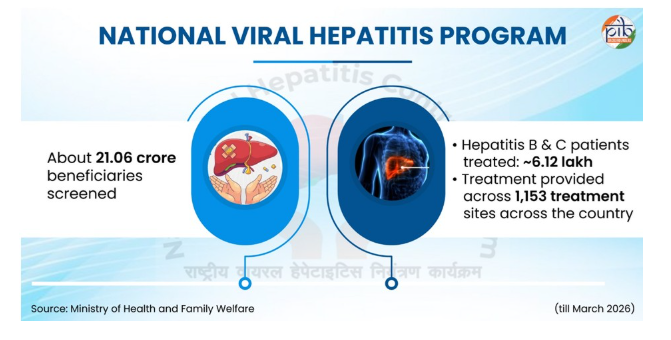
- About 21.06 crore beneficiaries were screened.
- Around 6.12 lakh Hepatitis B and C patients were treated.
- Treatment was provided through 1,153 treatment sites across the country.
The programme also uses a paperless system of recording and reporting through the NVHCP-MIS portal for patient management and monitoring.
Hepatitis Seroprevalence in India
Seroprevalence refers to the share of people who test positive for a disease in a sample survey.
According to India’s 2021 HIV Sentinel Surveillance data:
- Around 0.85% of people tested positive for Hepatitis B.
- Around 0.29% tested positive for Hepatitis C.
This is approximately:
- 1 in 118 people for Hepatitis B
- 1 in 345 people for Hepatitis C
Integration with Other National Health Programmes
India’s hepatitis strategy is not isolated. It is linked with several national health programmes.
1. Reproductive, Maternal, Newborn, Child, Adolescent Health and Nutrition Programme
This includes:
- universal screening of pregnant women for Hepatitis B
- Universal Immunisation Programme
- ensuring Hepatitis B birth dose to newborns
- Hepatitis B immunoglobulin to newborns of positive pregnant women, along with Hepatitis B birth dose within 24 hours of birth
2. Universal Immunisation Programme
- The Universal Immunisation Programme is one of India’s major public health initiatives.
- It provides free immunisation against major diseases and includes the Hepatitis B vaccine. The programme aims to protect newborns and pregnant women through life-saving vaccines.
3. National AIDS Control Program
- The National AIDS Control Program supports screening of high-risk groups for Hepatitis B and C through facility-based and outreach services.
- It also supports Hepatitis B vaccination of healthcare workers and infection prevention among high-risk groups who test negative.
4. National Tuberculosis Elimination Program
- The National Tuberculosis Elimination Program supports the use of existing machines for molecular testing.
5. Blood Transfusion Services
- Blood transfusion services help link Hepatitis B and C positive donors for further management.
6. Integrated Disease Surveillance Program
- Hepatitis A and E are usually acute, symptomatic and outbreak-prone. They are monitored through the Integrated Disease Surveillance Program.
Global Hepatitis Burden and WHO Targets
According to the WHO-related content, Hepatitis B and C are major global public health concerns.
Key global facts:
- Hepatitis B and C together are among the most common causes of liver cirrhosis, liver cancer and viral hepatitis-related deaths.
- They cause an estimated 1.3 million deaths per year.
- Around 304 million people worldwide live with Hepatitis B or C.
The WHO Global Health Sector Strategy on HIV, Viral Hepatitis and Sexually Transmitted Infections, 2022–2030 aims to eliminate viral hepatitis as a public health problem.
By 2030, the strategy aims to reduce:
- new hepatitis infections to 5,20,000 annually
- hepatitis-related deaths to 4,50,000
This represents:
- 90% reduction in incidence
- 65% reduction in mortality compared to 2015
Without urgent and sustained action, viral hepatitis is projected to cause additional new infections, liver cancer cases and deaths by 2030.
Symptoms and Health Risks
Many people infected with Hepatitis A, B, C, D or E may show only mild symptoms or no symptoms at all.
Common symptoms may include:
- fever
- malaise
- loss of appetite
- diarrhoea
- nausea
- abdominal discomfort
- dark-coloured urine
- jaundice
Hepatitis B, C and D can also become chronic infections. Chronic infection may later develop into cirrhosis or liver cancer.
Hepatitis D is found only in people already infected with Hepatitis B. Dual infection of HBV and HDV can cause more serious disease and faster progression to cirrhosis and cancer.
Significance of India’s Approach
1. Health Systems Approach
India’s strategy links prevention, screening, diagnosis, treatment and monitoring.
2. Free Diagnostics and Drugs
The availability of free services reduces financial barriers for patients.
3. Integration with Existing Programmes
Linking hepatitis control with immunisation, maternal health, HIV, TB and blood transfusion services improves coverage.
4. Focus on Early Detection
Screening helps identify infections before they progress to severe liver disease.
5. Maternal and Newborn Protection
Screening of pregnant women and timely Hepatitis B birth dose help prevent mother-to-child transmission.
6. Digital Monitoring
The NVHCP-MIS portal supports patient management and programme monitoring.
Challenges
1. Asymptomatic Nature of Infection
Many people do not show early symptoms, leading to delayed diagnosis.
2. Chronic Disease Burden
Hepatitis B and C can progress to cirrhosis and liver cancer.
3. Awareness Gap
Public awareness about transmission, prevention and treatment remains important.
4. Safe Practices
Unsafe injections, unsafe procedures and infected blood exposure continue to be concerns.
5. Sanitation Link
Hepatitis A and E are linked to contaminated food/water and poor sanitation.
Way Forward
India should continue strengthening hepatitis control through expanded screening, universal vaccination, free diagnostics and treatment, infection prevention, safe blood practices and sanitation measures. Integration with maternal health, immunisation, HIV, TB and blood transfusion services should be deepened. Awareness campaigns around World Hepatitis Day can improve testing, reduce stigma and promote early treatment.
Conclusion
India’s fight against hepatitis is based on a comprehensive public health model combining prevention, screening, treatment, immunisation, surveillance and digital monitoring. The National Viral Hepatitis Control Program, along with integration across national health programmes, is helping India move towards the 2030 goal of combating viral hepatitis. Continued awareness, early diagnosis and accessible treatment will be essential to reduce hepatitis-related liver disease and deaths.