
Why in News?
The 13th edition of the Global Terrorism Index 2026 reported that global terrorism declined in 2025, with terrorism-related deaths falling by 28% and terrorist incidents declining by 22%. However, the report cautions that terrorism is becoming more concentrated, decentralised, adaptive and digitally driven, creating new challenges for global and regional security.

Recent Global Terrorism Trend
Recent Global Terrorism Trend (2025)
- Global terrorism fatalities declined to about 5,582 deaths in 2025.
- Around 2,944 terrorist incidents were recorded worldwide.
- 81 countries showed measurable improvement in their domestic security situation.
- Overall, global data indicates a positive trend with fewer terrorist attacks and deaths.
However, the Threat Still Remains
- The decline does not mean terrorism has been defeated.
- Terrorist groups are becoming more adaptive, changing their methods and strategies.
- Terrorism is becoming geographically concentrated, with violence focused in fragile conflict zones.
- As a result, the world is becoming unevenly unsafe:
- Safer in many stable countries.
- More dangerous in conflict-affected and politically unstable regi
What is Terrorism?
There is no universally accepted legal definition of terrorism because countries differ politically and strategically on how to define it.
However, most definitions contain three common elements:
- Use or threat of violence
- Targeting civilians or non-combatants to create fear
- Political, ideological or religious objective
The United Nations broadly describes terrorism as criminal acts intended to cause death or serious injury, spread terror among the public, or compel governments or international organisations to act.
In India, a terrorist act is defined under Section 15 of the Unlawful Activities (Prevention) Act, 1967. The Bharatiya Nyaya Sanhita, 2023 also defines acts threatening India’s sovereignty, unity, integrity, security or economic stability as terrorist acts.
Why Declining Numbers Do Not Mean a Safer World
The fall in total incidents hides deeper structural risks.
Complacency Trap
Nearly 70% of global terrorism-related deaths are concentrated in Pakistan, Burkina Faso, Nigeria, Niger and the Democratic Republic of the Congo. The Sahel region of Sub-Saharan Africa alone accounts for over half of global terrorism fatalities. This concentration may create a false sense of security in stable regions.
Conflict-Governance Nexus
Around 99% of terrorism-related deaths occur in countries affected by armed conflict or political instability. Terrorism thrives where governance is weak, institutions collapse and extremist groups fill the security vacuum.
Decentralised Threats
Terror groups increasingly rely on lone-wolf attacks, small autonomous cells and online radicalisation. In the West, 93% of fatal terrorist attacks over the past five years were reportedly carried out by lone actors.
Digital Radicalisation
Social media, encrypted platforms and algorithm-driven online spaces have become force multipliers for extremist recruitment and self-radicalisation.
Emerging Trends in Global Terrorism
1. Geographical Concentration
Terrorism is now concentrated in fragile states and conflict zones rather than evenly spread across the world.
2. Border-Centric Terrorism
More than 60% of terrorist attacks occur within 100 km of international borders. Such zones enable cross-border infiltration, arms trafficking, terror financing and recruitment.
3. Adaptive Terror Networks
Modern terror groups fragment into smaller units, exploit local grievances and adapt quickly to counter-terrorism pressure.
4. Dominance of Major Networks
The global terrorist landscape is increasingly shaped by a few major organisations such as Islamic State, JNIM, TTP, Lashkar-e-Taiba and Al-Shabaab.
5. Geopolitical Conflicts as Catalysts
Conflicts in West Asia and continuing regional tensions can create conditions for extremist resurgence and new radical groups.
Terrorism and India’s Internal Security
India faces a complex terrorism threat because of geography, cross-border hostility, cyber vulnerabilities and internal fault lines.
Cross-Border Terrorism and Proxy Warfare
Pakistan-sponsored cross-border terrorism remains India’s foremost security challenge. Groups such as Lashkar-e-Taiba and Jaish-e-Mohammed have been linked to major attacks including the 2001 Parliament attack, 2016 Uri attack and 2025 Pahalgam attack.
Urban Terrorism
Indian cities remain vulnerable to mass-casualty attacks, lone-actor violence, improvised explosives and attacks on crowded public spaces.
Internal Insurgencies
Security challenges continue in Jammu & Kashmir, the Northeast and Left-Wing Extremism-affected regions, where extremist groups exploit local grievances.
Cyber Terrorism
Terrorist organisations use cyberspace for propaganda, recruitment, financing and operational planning. Cryptocurrencies and the dark web have made tracking terror financing more difficult.
Terror Financing and Organised Crime
Drug trafficking, counterfeit currency, hawala networks and arms smuggling continue to sustain terrorist ecosystems.
Maritime Security Threats
India’s 7,500-km coastline remains vulnerable to infiltration, arms smuggling and maritime terrorism, requiring stronger coastal surveillance.
India’s Counter-Terrorism Doctrine
India’s counter-terrorism approach is based on zero tolerance, intelligence-led prevention and calibrated response.
Zero-Tolerance Policy
India rejects any distinction between terrorists and their sponsors and maintains that no cause can justify terrorism.
Proactive and Pre-emptive Response
India’s doctrine now emphasises preventive intelligence, precision operations and calibrated retaliation.
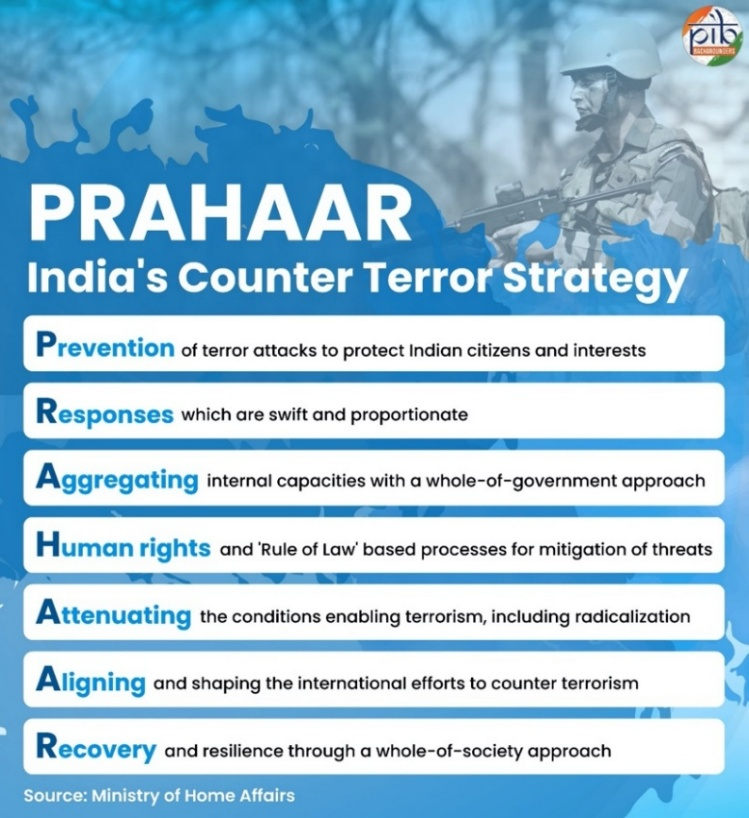
PRAHAAR Framework
The PRAHAAR Framework marks a shift from reactive containment to intelligence-led, pre-emptive deterrence. It also decouples terrorism from religion, ethnicity or civilisation and treats terrorism as a security threat rather than a community identity issue.
Four Pillars of India’s Counter-Terror Policy
Pillar 1: Legislative Empowerment
India has strengthened its legal framework to investigate, prosecute and punish terrorism.
Important reforms include:
- UAPA Amendment Act, 2019: enabled designation of individuals as terrorists and expanded investigative powers.
- NIA Amendment Act, 2019: expanded NIA’s jurisdiction, including offences outside India affecting Indian interests.
- PMLA Amendments: strengthened action against terror financing through hawala, cryptocurrencies and illicit assets.
- BNS, 2023: defined terrorism and organised crime, with strict punishments for terrorist acts, recruitment, training, harbouring and financing.
- Arms Amendment Act, 2019: strengthened penalties for illegal arms trafficking and improved firearm traceability.
Pillar 2: Institutional Strengthening
India has upgraded counter-terror institutions and intelligence systems.
Key institutional mechanisms include:
- National Investigation Agency: India’s premier counter-terror investigation agency, strengthened through special courts, regional offices and better funding.
- 53 Special NIA Courts: for faster prosecution of terror-related cases.
- National Terror Database Fusion and Analysis Centre: for improved terror-data analysis.
- Multi-Agency Centre: apex intelligence-sharing platform connecting 28 agencies.
- Cyber Multi-Agency Centre: launched to improve cyber threat monitoring.
- NATGRID: integrates immigration, banking, telecom and travel databases.
- CCTNS 2.0: AI-enabled police data-sharing platform.
- Police Modernisation: over ₹6,300 crore allocated during 2021–2026 for weapons, surveillance, forensic infrastructure and secure communication.
Pillar 3: Operations Against Cross-Border Terrorism
India has adopted calibrated operational responses against cross-border terror infrastructure.
Important examples include:
- Surgical Strikes, 2016
- Balakot Air Strike, 2019
- Operation Sindoor, 2025
These actions indicate India’s shift towards swift, precise and proportionate retaliation against cross-border terrorism.
Pillar 4: Multilateral and Diplomatic Counter-Terror Architecture
India has expanded international cooperation against terrorism.
Key measures include:
- FATF membership since 2010 to counter terror financing.
- Hosting the No Money for Terror Conference, 2022.
- Proposal of the Comprehensive Convention on International Terrorism at the UN in 1996.
- Use of UNSC mechanisms for global terrorist designation.
- Joint Working Groups on Counter-Terrorism with 27 countries and 5 multilateral forums.
- BHARATPOL, 2025, connecting Indian law enforcement agencies with INTERPOL.
- Delhi Declaration, 2022, focusing on misuse of drones, digital technologies, social media and online terror financing.
Outcomes of Counter-Terrorism Reforms
India’s counter-terror reforms have produced visible outcomes in security management.
- Terrorist-initiated incidents in Jammu & Kashmir declined from 228 in 2018 to 12 in 2025.
- Civilian and security force casualties declined sharply.
- Stone-pelting has remained near zero since 2022.
- Strikes and shutdowns have largely disappeared, improving public life and governance.
- Improved security has supported infrastructure, tourism, employment and investment in Jammu & Kashmir.
- Enhanced intelligence and technology-driven surveillance have helped foil terror plots before execution.
- Since the 2013 Hyderabad blasts, India has witnessed very few major urban terrorist attacks.
Policy Measures Needed
1. Shift from Reaction to Prevention
Counter-terrorism must focus on early warning, intelligence fusion, digital monitoring and disruption of terror financing before attacks occur.
2. Strengthen Borderland Governance
Since many attacks occur near borders, frontier regions need better roads, policing, surveillance, administrative presence and local development.
3. Counter Digital Radicalisation
Social media platforms, encrypted networks, dark web channels and AI-driven propaganda must be monitored through lawful and rights-based cyber capabilities.
4. Disrupt Terror Financing
India must strengthen action against hawala, counterfeit currency, narcotics, arms smuggling, cryptocurrencies and organised crime networks.
5. Improve Maritime and Coastal Security
Coastal radar chains, port security, fisher-community intelligence and maritime domain awareness must be upgraded.
6. Deepen International Cooperation
Terrorism is transnational. Intelligence sharing, extradition, joint investigations and FATF-based financial monitoring must be strengthened.
Conclusion
The decline in global terrorism numbers should not lead to complacency. Terrorism is becoming more concentrated, decentralised, digital and border-centric. For India, the threat remains serious because of cross-border terrorism, cyber radicalisation, organised crime linkages and maritime vulnerabilities. India’s shift towards zero tolerance, legal strengthening, institutional coordination, precision response and global cooperation has improved internal security. However, long-term success will depend on dismantling the structural drivers of terrorism — conflict, weak governance, porous borders, online radicalisation and terror financing.
Why in News?
“White Gold: India’s Cotton Story – From Seed to Shirt”, highlighting India’s cotton economy, its historical importance, production strength, MSP support, productivity mission, digital procurement, branding through Kasturi Cotton Bharat, and the role of cotton in agriculture, textiles, exports and rural livelihoods.
Importance of Cotton in India
Cotton occupies a unique position in India’s agricultural and industrial economy. It connects farmers, ginners, spinning mills, handlooms, textile factories, exporters and consumers.
Cotton is called “White Gold” because of its high economic importance. It supports:
- around 6 million cotton farmers
- another 40–50 million people in cotton processing, trade and related activities
- textile manufacturing
- exports of fibre, yarn, fabric and garments
- rural livelihoods and industrial employment
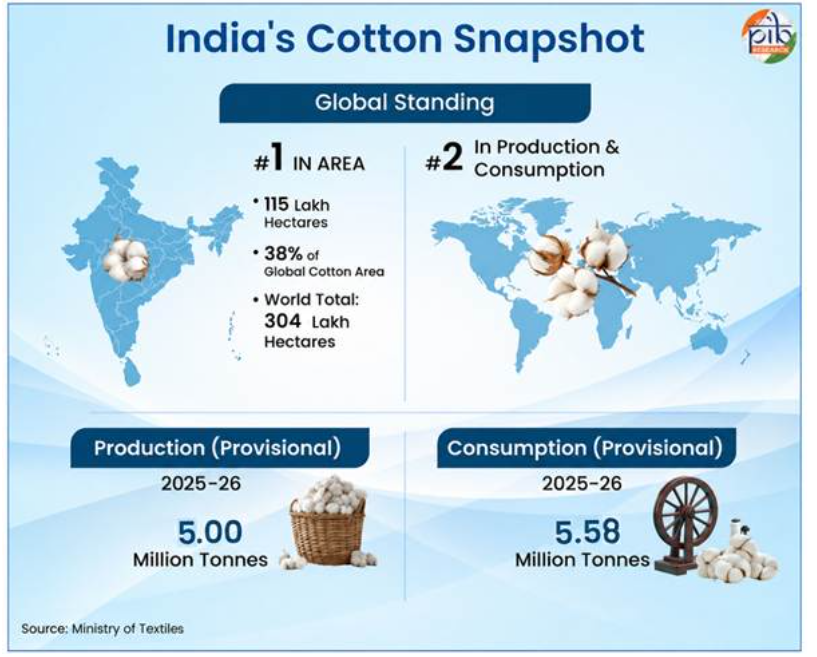
India is the only country cultivating all four recognised cotton species. It ranks first globally in cotton acreage and second in cotton production and consumption.
Historical Evolution of India’s Cotton Sector
- India’s association with cotton goes back thousands of years. The subcontinent was historically known for cotton textiles and traded fabrics across Eastern and European markets.
- In ancient times, cotton cloth also functioned as a medium of exchange, showing its economic value.
The modern cotton textile industry developed in the 19th century with textile mills in:
- Kolkata
- Mumbai
- Ahmedabad
- Ahmedabad later became famous as the “Manchester of India.”
- During the Swadeshi movement, Indian cotton mills gained importance as part of resistance to British goods. Global demand during the World Wars further boosted India’s cotton textile industry. By the period before Independence, cotton cloth production had expanded significantly.
Cotton Species Cultivated in India
India cultivates all four recognised cotton species:
| Cotton Species | Common Name |
| G. Arboreum | Asian cotton |
| G. Herbaceum | Asian cotton |
| G. Barbadense | Egyptian cotton |
| G. Hirsutum | American upland cotton |
Among these, G. Hirsutum accounts for nearly 90% of hybrid cotton production in India. All Bt cotton hybrids currently cultivated in the country belong to this species.
What is Bt Cotton? Bt cotton is a genetically modified cotton crop that contains genes from Bacillus thuringiensis, a naturally occurring soil bacterium. These genes provide resistance against bollworms, a major pest affecting cotton cultivation. Bt cotton was commercially introduced in India in 2002. It helped:
improve farm incomes after adoption |
Cotton Classification by Staple Length
Cotton is also classified on the basis of staple length, which determines fibre quality and end use.
| Staple Category | Staple Length |
| Short Staple | 20 mm and below |
| Medium Staple | 20.5 mm to 24.5 mm |
| Medium Long Staple | 25.0 mm to 27.0 mm |
| Long Staple | 27.5 mm to 32.0 mm |
| Extra-Long Staple | 32.5 mm and above |
Extra Long Staple cotton is especially important because it supports high-quality textile production.
Geographical Spread of Cotton Cultivation
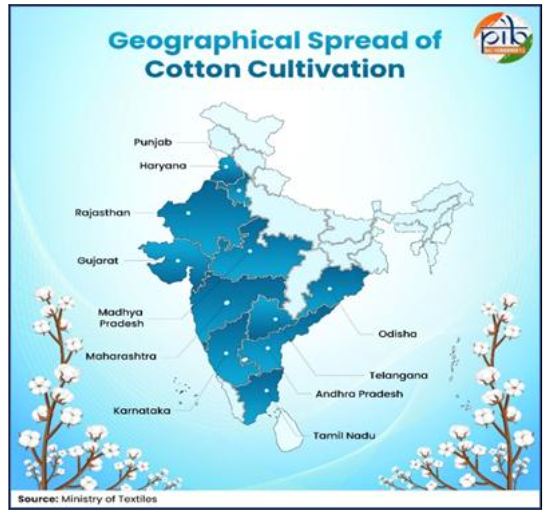
Cotton production in India is concentrated in 9 major States across three agro-ecological zones.
| Zone | Major Cotton-Growing States |
| Northern Zone | Punjab, Haryana, Rajasthan |
| Central Zone | Gujarat, Maharashtra, Madhya Pradesh |
| Southern Zone | Telangana, Andhra Pradesh, Karnataka |
Cotton is also grown in Odisha and Tamil Nadu.
India’s Cotton Strength: Area, Production and Consumption
India ranks first in the world in cotton cultivation area, with 114.84 lakh hectares under cotton. This accounts for around 38% of global cotton area.
A large portion of India’s cotton is dependent on rainfall:
- 62% grown in rain-fed regions
- 38% grown under irrigated conditions
India ranks second globally in cotton production and consumption, showing the strength of both its farming base and textile industry.
| Cotton production is measured in bales.1 bale = 170 kg |
| Cotton Indicator | Data |
| Cotton production, 2024–25 | 297.24 lakh bales |
| Cotton production, 2025–26 provisional | 290.91 lakh bales |
| Domestic consumption, 2025–26 | 328 lakh bales |
| India’s global cotton area share | Around 38% |
| India’s rank in area | 1st |
| India’s rank in production and consumption | 2nd |
The source highlights India’s major role in global fibre/cotton production, noting nearly 19% in one summary and around 23% in the sector discussion.
Cotton Exports and India’s Trade Footprint
- India remains an important player in the global cotton trade.
- In 2024–25, India exported around 18 lakh bales, equivalent to 0.31 million metric tonnes. This accounted for about 3.37% of total world exports.
- In value terms, cotton exports reached US$ 11.49 billion in FY25.
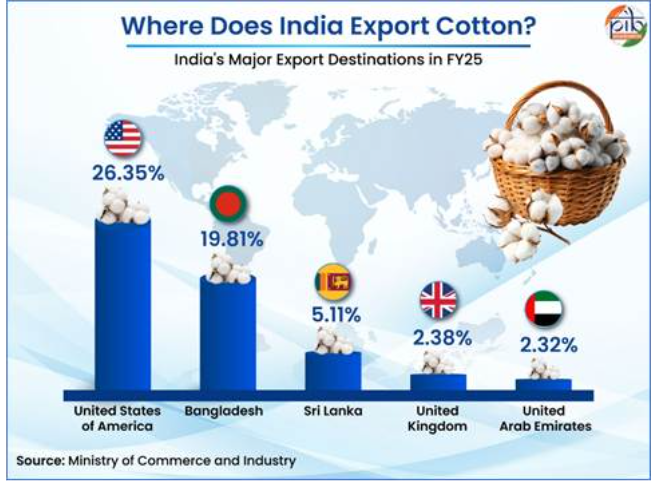
Major destinations for Indian cotton fabrics and made-ups exports include:
| Export Destination | Share |
| United States | 26.35% |
| Bangladesh | 19.81% |
| Sri Lanka | 5.11% |
| United Kingdom | 2.38% |
| United Arab Emirates | 2.32% |
This shows the diversified international demand for Indian cotton and cotton-based textile products.
MSP Operations and Role of CCI
The Minimum Support Price system protects cotton farmers when market prices fall below the announced support price.
Before every cotton year, which runs from October to September, MSP is recommended by the Commission for Agricultural Costs and Prices and announced for:
- Medium Staple cotton
- Long Staple cotton
The aim is to ensure that farmers receive at least 50% return over production costs.
The Cotton Corporation of India is the central nodal agency for cotton procurement under MSP operations.
| Indicator | Data |
| Procurement centres, 2024–25 | 508 |
| Procurement centres, 2025–26 | 571 |
| Districts covered | 152 |
| Cotton-growing States covered | 11 |
Mission for Cotton Productivity
The Mission for Cotton Productivity was launched in 2025–26 as a five-year mission to raise cotton output and strengthen the cotton sector.
| Feature | Details |
| Mission period | Five years |
| Financial provision | ₹5,659.22 crore |
| Coverage | Nearly 24 lakh hectares |
| Districts | 140 districts |
| States | 14 cotton-producing States |
| Expected beneficiaries | Around 32 lakh farmers |
| Production target | Increase from 297 lakh bales to 498 lakh bales by 2031 |
The mission focuses on:
- research and innovation
- climate-resilient varieties
- pest-resistant varieties
- high-yielding cotton varieties
- Extra Long Staple cotton
- advanced breeding
- biotechnology tools
- field-level extension support
The mission is aligned with the 5F vision:
Farm → Fibre → Factory → Fashion → Foreign
Special Project on Cotton under NFSM
Since 2023–24, a Special Project on Cotton has been implemented under the National Food Security Mission.
It focuses on large-scale technology demonstrations suited to different agro-ecological zones.
The project covers 8 major cotton-growing States and promotes three key technologies:
- High-Density Planting System
- Closer Spacing Planting System
- Production technology for Extra Long Staple cotton
The objective is to improve:
- productivity
- fibre quality
- farmer incomes
Field demonstrations recorded:
- about 40% yield gain under High-Density Planting System
- more than 32% yield gain under Closer Spacing Planting System
Kapas Kisan App
The Kapas Kisan mobile application has been introduced to digitise and simplify MSP procurement.
The app enables cotton farmers to:
- self-register
- book procurement slots
- use a four-week rolling slot system
- receive Aadhaar-linked payments
- get real-time SMS updates
- avoid long queues at procurement centres
More than 41 lakh farmers have registered on the app so far.
The app has made cotton procurement:
- more transparent
- more efficient
- paperless
- farmer-friendly
Kasturi Cotton Bharat
Kasturi Cotton Bharat is a flagship initiative to improve the global value and branding of Indian cotton through traceability, certification and quality assurance.
It is implemented through a partnership involving:
- Ministry of Textiles
- Cotton Corporation of India
- Cotton Textiles Export Promotion Council
- trade and industry bodies
Certification covers:
- Long-staple cotton of 28 mm or more
- Extra Long Staple cotton of 35 mm or more
Testing is done through NABL-accredited agencies.
The initiative uses:
- QR-based certification
- blockchain technology
- end-to-end traceability
- branding
- sustainability practices
- awareness workshops
- Kasturi Villages
It seeks to position Indian cotton as a global symbol of purity, quality and sustainability.
Cotton Beyond the Loom
Cotton is not only used for clothing. It also generates valuable by-products.
Raw cottonseed consists of roughly:
- one-third lint
- two-thirds seed
Cottonseed contains about 18% edible oil. The remaining meal is used as nutritious feed for:
- cattle
- poultry
- fish
Cottonseed oil is often called “heart oil” because it contains nearly 50% essential polyunsaturated fatty acids, compared to about 30% in many traditional oils.
Other cotton by-products include:
- deoiled cake for animal feed
- linters
- hulls
- dried cotton stalks used as rural biomass fuel
- short-staple fibres used in absorbent and surgical cotton
Thus, cotton supports nutrition, livestock, rural energy, healthcare and industry.
Significance of India’s Cotton Sector
1. Livelihood Security
Cotton supports millions of farmers and workers across the agricultural and textile value chain.
2. Textile Industry Backbone
Cotton is a core input for spinning, weaving, garment manufacturing and exports.
3. Export Earnings
Cotton fibre, yarn, fabrics and garments contribute to foreign exchange earnings.
4. Rural Industrialisation
Cotton links agriculture with ginning, processing, spinning, handlooms and textile units.
5. Farmer Income Support
MSP procurement protects farmers during market downturns.
6. Global Competitiveness
Kasturi Cotton Bharat, traceability and certification improve India’s quality image in global markets.
Challenges
- Large dependence on rain-fed cultivation
- Low productivity compared to India’s large cotton area
- Pest risks such as pink bollworm
- Need for better quality and fibre uniformity
- Price volatility in domestic and global markets
- Limited awareness of modern planting systems
- Need for stronger export competitiveness
- Climate stress and rainfall variability
- Need for better traceability and branding
Way Forward
India should focus on increasing cotton productivity through climate-resilient varieties, pest-resistant seeds, biotechnology, High-Density Planting System, closer spacing and Extra Long Staple cotton promotion. MSP operations should be supported with digital tools like the Kapas Kisan App. Quality improvement through Kasturi Cotton Bharat, QR-based certification and blockchain traceability should be scaled up. Cotton policy should integrate the full farm-to-fibre-to-fashion-to-foreign value chain.
Conclusion
India’s cotton story reflects both continuity and change. From ancient textile trade and the Swadeshi movement to modern missions, digital procurement and quality branding, cotton remains deeply woven into India’s agricultural and industrial economy. With improved productivity, MSP support, technology adoption, traceability and value addition, India can strengthen farmer incomes, textile competitiveness and global leadership in the cotton economy.