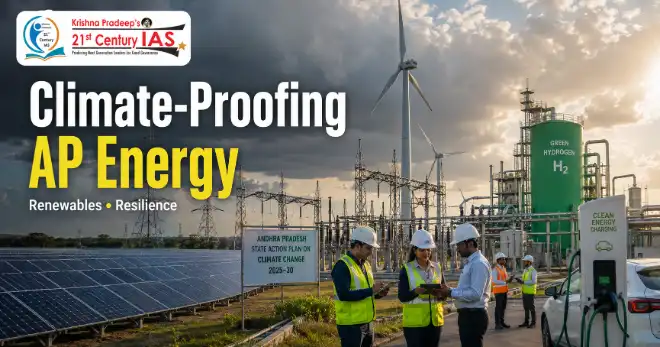
Q. India’s energy transition must balance energy security, sustainability and affordability. Discuss.
(GS Paper III – Energy Security / Infrastructure / Environment)
Introduction:
India’s energy demand is rising due to economic growth, urbanisation and industrialisation. Therefore, India is expanding energy capacity while trying to ensure energy security, clean transition and affordable access. As of July 2026, India’s total installed power capacity reached around 552 GW, and non-fossil capacity stood at 300.50 GW, more than 54% of total installed capacity.
Body
1. Energy Security
- Coal remains important: Coal meets nearly 55% of India’s primary energy needs and supports over 70% of electricity generation.
- Domestic production: Higher coal production reduces dependence on imports.
- Import reduction: Coal imports by thermal power plants declined by about 27.4% in FY2025-26.
- Offshore exploration: The Samudra Manthan Scheme aims to strengthen offshore oil and gas exploration.
- Nuclear expansion: India aims to raise nuclear capacity to 100 GW by 2047, improving long-term clean baseload power.
2. Sustainability
- Solar growth: Solar capacity reached 164.59 GW, making it the largest component of India’s renewable energy capacity.
- Wind energy: India ranks fourth globally in wind power capacity.
- Hydropower: Hydro supports grid stability as solar and wind expand.
- Green Hydrogen Mission: Targets 5 MMT green hydrogen production by 2030.
- GOBARdhan: Converts organic waste into Compressed Biogas, supporting circular economy and clean fuel.
3. Affordability and Access
- PM Surya Ghar: Promotes rooftop solar and reduces household electricity bills.
- PMUY and LPG expansion: LPG coverage increased from 55.9% in 2014 to 107.2% in 2026.
- Clean cooking: Wider LPG access improves health, dignity and household energy security.
4. Key Challenges
- Continued dependence on coal.
- Intermittency of solar and wind power.
- Need for storage and grid modernisation.
- High cost of green hydrogen and emerging technologies.
- Land, finance and transmission constraints.
- Need to keep energy affordable for households, farmers and industries.
Way Forward
- Adopt a diversified energy mix.
- Expand battery storage, pumped hydro and smart grids.
- Promote domestic manufacturing of solar, wind, electrolysers and storage systems.
- Strengthen bioenergy and waste-to-energy systems.
- Ensure responsible coal transition.
- Keep energy policies people-centric and affordable.
Conclusion:
India’s energy transition must not be seen only as a shift from fossil fuels to renewables. It must ensure reliable supply, affordability, sustainability and self-reliance. A balanced strategy combining coal, renewables, nuclear, bioenergy, green hydrogen and emerging technologies can make India’s energy system resilient and future-ready.
Q. Natural farming is increasingly being viewed as a resilience imperative rather than merely an ideological proposition. Discuss.
(GS Paper III – Agriculture / Environment / Food Security)
Introduction:
Natural farming, or Prakritik Kheti, is a chemical-free farming system based on local biodiversity, on-farm biomass and natural biological processes. In the context of fertiliser import dependence, climate variability and rising input costs, it is being viewed as a resilience strategy for Indian agriculture.
Body
Why Natural Farming is Important
- Input sovereignty: It reduces dependence on imported fertilisers and market-bought inputs.
- Soil health: Practices like Jeevamrutha, mulching and crop diversity improve soil microbes and organic matter.
- Climate resilience: Mulching, Waaphasa and diversified cropping reduce water stress and crop failure risk.
- Farmer income: Lower input costs can protect small farmers from debt cycles.
- Circular economy: Crop residue, cattle dung and biomass are recycled within the farm.
- Public health: Reduced agrochemical exposure benefits farmers, consumers and ecosystems.
Challenges
Natural farming faces yield uncertainty, transition-period risks, labour burden, weak certification, market gaps and lack of crop-specific protocols. Sudden shifts may affect food security, as seen in global examples of poorly planned ecological transitions.
Way Forward
India should adopt a phased approach. Cluster-based “living landscapes” should be supported with Bio-input Resource Centres, FPOs, Krishi Sakhis, KVKs, soil testing, transition finance, crop insurance and market linkages. ICAR and State Agricultural Universities must generate region-specific scientific evidence.
Conclusion:
Natural farming can strengthen India’s agricultural resilience only if it is supported by institutions, science and markets. The aim should not be abrupt replacement of conventional agriculture, but a gradual, farmer-centred transition towards low-input, climate-resilient and sustainable farming.