Mains Practice Questions for the Day
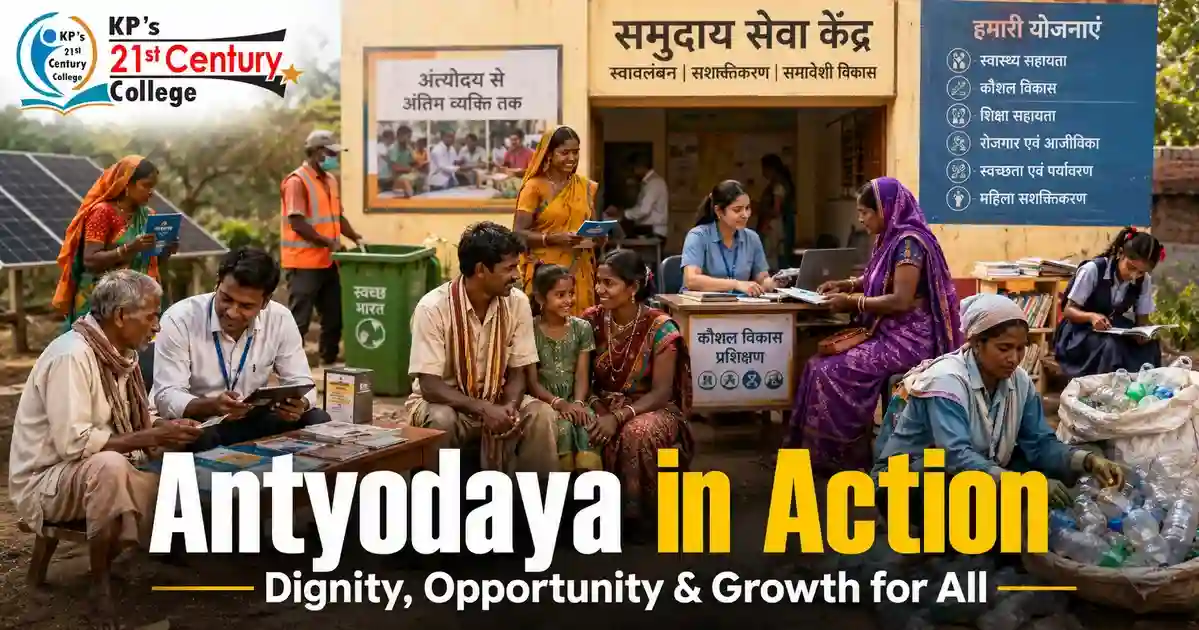
- Q. Antyodaya-based governance seeks to move beyond welfare distribution towards dignity, capability and sustainable livelihoods. Discuss with reference to recent programmes for India’s marginalised communities.
- Q. The global memory-chip shortage demonstrates how technological transformation can create new sources of inflation and supply-chain vulnerability. Discuss its implications for India.
Q. Antyodaya-based governance seeks to move beyond welfare distribution towards dignity, capability and sustainable livelihoods. Discuss with reference to recent programmes for India’s marginalised communities.
(GS Paper III: Inclusive Growth, Skill Development, Financial Inclusion and Livelihoods)
Introduction:
Antyodaya means prioritising the poorest and most vulnerable person in development. Recent welfare policy has increasingly adopted a saturation and convergence approach, combining housing, education, skills, health, infrastructure, credit and livelihoods. Programmes for tribal groups, Scheduled Castes, OBCs, minorities and sanitation workers reflect this wider shift.
Body
Tribal Inclusion
- PM-JANMAN targets 75 PVTG communities through housing, roads, water, health, mobile connectivity and skilling.
- PM-JUGA integrates 17 ministries to fill infrastructure gaps in tribal-majority villages.
- Van Dhan Vikas Kendras promote value addition to forest produce and tribal entrepreneurship.
- Tribal Research Institutes preserve languages, indigenous knowledge and cultural traditions.
Scheduled Caste Empowerment
- PM-AJAY promotes integrated development in SC-majority villages.
- Its interventions include housing, LPG, electricity, health protection, skills and SHGs.
- SHREYAS supports higher education, research, coaching and overseas studies.
- SHRESHTA provides residential education opportunities to meritorious SC students.
Skills and Financial Inclusion
- PM-DAKSH provides certified skill training to SCs, OBCs, EBCs, nomadic groups and sanitation workers.
- VISVAS lowers borrowing costs through interest subsidy and promotes entrepreneurship.
- Women and rural beneficiaries form a major share of its coverage.
Minority and Sanitation Worker Welfare
- PM VIKAS integrates skilling, entrepreneurship and cultural preservation for minority communities.
- NAMASTE promotes mechanised sanitation, PPE kits, health insurance and institutional recognition for sewer workers and waste pickers.
Significance
These programmes:
- Replace fragmented schemes with convergence.
- Promote capabilities rather than only cash assistance.
- Strengthen dignity, employment and social participation.
- Improve last-mile delivery in remote and excluded regions.
Challenges and Way Forward
Implementation gaps, documentation barriers, low awareness and weak market access remain concerns. Greater community participation, social audits, local-language delivery, digital inclusion and outcome-based monitoring are required.
Conclusion:
Antyodaya can become the foundation of inclusive development when welfare creates capability, dignity and self-reliance. Effective last-mile delivery will be essential to place marginalised communities at the centre of Viksit Bharat @2047.
Q. The global memory-chip shortage demonstrates how technological transformation can create new sources of inflation and supply-chain vulnerability. Discuss its implications for India.
( GS Paper III – Indian Economy, Inflation, Science and Technology, Semiconductors, Supply Chains and Digital Economy)
Introduction:
The rapid expansion of artificial intelligence has sharply increased demand for High Bandwidth Memory used in data centres. Global manufacturers are consequently shifting limited production capacity away from conventional DRAM, which is used in smartphones, computers and household appliances. This has raised electronic-component prices and created a new source of supply-side inflation in India.
Body
Impact on Inflation
- Electronics such as smartphones, laptops, televisions, refrigerators and storage devices are recording repeated monthly price increases.
- Although these products account for only around 1% of India’s CPI basket, persistent increases can gradually raise headline and core inflation.
- Unlike food inflation, memory-chip inflation may continue for several years because expanding semiconductor capacity requires time and heavy investment.
- Monetary tightening alone cannot resolve such inflation because its source is a global supply constraint.
Impact on Consumers and Industry
- Memory costs have risen from below 10% to over 40% of the production cost of some low-end smartphones.
- Manufacturers may raise prices, cut specifications or reduce the supply of budget products.
- Price-sensitive consumers may postpone purchases and use older devices for longer.
- This can widen the digital divide, particularly for students, rural households and small businesses.
- Longer device lifetimes may also create cybersecurity risks when older products stop receiving updates.
Strategic Implications for India
- India’s dependence on imported memory chips exposes domestic inflation and manufacturing to global market shocks.
- Weak long-term procurement commitments by Indian firms may reduce their access during shortages.
- Higher component costs can affect electronics manufacturing, export competitiveness and the government’s digital-inclusion goals.
Way Forward
- Expand the India Semiconductor Mission beyond assembly towards chip fabrication, memory technology and research.
- Encourage long-term contracts and diversified sourcing by Indian manufacturers.
- Build partnerships with major semiconductor-producing economies.
- Support affordable educational devices and strengthen repair-and-reuse systems.
- Closely monitor the contribution of electronics to core inflation.
Conclusion:
The memory-chip shortage illustrates that digital transformation can generate traditional economic pressures. India needs a combined strategy of supply-chain diversification, domestic technological capacity and consumer protection to ensure that the AI revolution does not undermine price stability or inclusive digital growth.