Why in News?
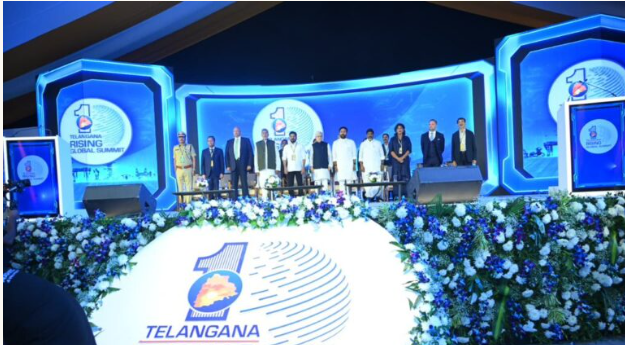
The Telangana government has decided to institutionalise the Telangana Rising Global Summit as its flagship annual investment promotion event.
Chief Minister A. Revanth Reddy directed officials to organise the second edition in December 2026 at Bharat Future City. The summit will seek to attract global investments and strengthen Telangana’s position as an international business destination.
What is the Telangana Rising Global Summit?
- It is Telangana’s flagship global investors’ summit.
- It brings together:
- Global investors
- Industry leaders
- Policymakers
- Technology companies
- Financial institutions
- Senior executives of multinational corporations
- The summit aims to showcase Telangana’s:
- Investment opportunities
- Industrial policies
- Skilled workforce
- Digital infrastructure
- Emerging urban projects
- The government plans to hold it every year at Bharat Future City.
Objectives of the Annual Summit
- Attract domestic and foreign investment.
- Promote Telangana as a global business destination.
- Showcase the development of Bharat Future City.
- Bring senior executives from Fortune 500 companies to the State.
- Generate employment and economic opportunities.
- Encourage investments in high-growth and technology-driven sectors.
- Improve Telangana’s visibility among global investors.
First Telangana Rising Global Summit
- The first summit was held on December 8–9, 2025.
- It was organised after the Congress government revived the practice of holding a major global investors’ meeting.
- The summit secured prospective investment commitments worth ₹5.75 lakh crore.
- It was described as the highest mobilisation of investment commitments in Telangana’s history.
- The response encouraged the government to convert the summit into an annual event.
About Bharat Future City
- Bharat Future City is a major planned urban development project on the outskirts of Hyderabad.
- It is spread across more than 30,000 acres.
Land-use Pattern
| Component | Area | Proposed Use |
| Core urban zone | 15,000 acres | AI, IT, manufacturing, education and healthcare clusters |
| Green and ecological zone | 15,000 acres | Urban forests, green spaces and eco-tourism |
- It is planned as a modern, sustainable and technology-driven city.
- The headquarters of the Future City Development Authority was inaugurated on June 10, 2026.
- The campus of Young India Skills University is nearing completion.
Role of the Future City Development Authority
- The Future City Development Authority is responsible for planning and developing Bharat Future City.
- Its functions include:
- Urban planning
- Infrastructure development
- Coordination with investors
- Cluster development
- Environmental planning
- Monitoring of major projects
- The authority will work with the Industries and Information Technology Departments to organise the annual summit.
Priority Investment Sectors
The summit will focus on attracting investment in the following sectors:
- Artificial Intelligence
- Information Technology
- Advanced Manufacturing
- Healthcare and Life Sciences
- Deep Technology
- Digital Infrastructure
- Clean Energy
- Financial Services
- Tourism and Eco-tourism
- Education and Skill Development
Telangana Rising 2047 Vision
- The summit is aligned with the Telangana Rising 2047 Vision.
- The vision aims to make Telangana:
- A $1 trillion economy by 2034
- A $3 trillion economy by 2047
- It seeks to promote:
- Innovation-led growth
- Global investment
- Urban development
- Employment creation
- Sustainable infrastructure
- Human capital development
Why Annual Investment Summits Matter
- They provide a common platform for government and industry.
- They help States present projects directly to investors.
- They can improve global visibility and investor confidence.
- They support sector-specific partnerships and technology transfer.
- They encourage competition among States to improve infrastructure and governance.
- They can create investment pipelines for long-term industrial development.
However, signed commitments must be converted into projects, production and employment.
Challenges
- Investment commitments may not always become actual projects.
- Land acquisition and clearances can delay implementation.
- Infrastructure must be completed before large-scale industrial activity begins.
- Investors require policy continuity and regulatory certainty.
- Skilled manpower must match the needs of advanced industries.
- Rapid development can affect local communities and the environment.
- Water, energy, mobility and waste-management systems must support the proposed city.
- Excessive incentives can create a fiscal burden on the State.
Way Forward
- Establish a transparent system to track each investment commitment.
- Publish regular data on investments grounded, projects completed and jobs created.
- Ensure single-window, time-bound approvals.
- Complete trunk infrastructure before allotting land.
- Link Young India Skills University with industries coming to Future City.
- Maintain stable and predictable industrial policies.
- Protect green zones and follow sustainable urban planning principles.
- Promote investments across different districts of Telangana.
- Focus on project execution rather than only signing memoranda of understanding.
Conclusion
Institutionalising the Telangana Rising Global Summit can strengthen the State’s investment promotion strategy and establish Bharat Future City as an international business and innovation hub.
The first summit’s ₹5.75 lakh crore investment commitments demonstrate strong investor interest. However, the success of the annual event will ultimately be measured by the conversion of commitments into functioning projects, quality employment, sustainable infrastructure and inclusive regional development.
Why in News?
The Government highlighted the progress of major welfare programmes aimed at ensuring dignity, opportunity and growth for deprived and marginalised communities.
The approach is based on Antyodaya, or prioritising the person at the last mile. It covers tribal communities, Particularly Vulnerable Tribal Groups, Scheduled Castes, Other Backward Classes, Economically Backward Classes, minorities, nomadic groups, sanitation workers and waste pickers.
Antyodaya as a Governance Framework
Antyodaya means the rise and welfare of the poorest and most disadvantaged person.
The approach reflects Mahatma Gandhi’s idea that public policy should be judged by whether it benefits the weakest person. It seeks to move governance:
- From fragmented welfare to convergent delivery
- From limited coverage to saturation
- From symbolic inclusion to substantive equality
- From welfare dependency to skills and livelihoods
- From remote administration to last-mile service delivery
Tribal habitations, aspirational districts and remote settlements are increasingly being placed at the centre of development planning.
Tribal Communities at the Centre of Development
Tribal communities possess rich cultural traditions, indigenous knowledge and strong community institutions. However, many habitations historically lacked:
- Roads and transport
- Housing
- Drinking water
- Electricity
- Healthcare
- Education
- Digital connectivity
- Employment opportunities
Recent interventions seek to bridge these gaps through coordinated action across ministries.
Pradhan Mantri Janjati Adivasi Nyaya Maha Abhiyan
PM-JANMAN
- PM-JANMAN was launched in November 2023.
- It targets 75 Particularly Vulnerable Tribal Group communities.
- It covers 18 States and one Union Territory.
- It includes 11 interventions implemented by nine ministries.
- Total budgetary outlay: ₹24,104 crore.
Major Interventions
- Pucca housing , Road connectivity , Piped drinking water , Electrification , Mobile medical units , Anganwadi centres , Hostels , Mobile towers , Multipurpose centres Van Dhan Vikas Kendras , Vocational skilling
Van Dhan Vikas Kendras
Van Dhan Vikas Kendras support tribal communities in:
- Collection of minor forest produce , Processing and value addition , Packaging and branding , Marketing , Local employment generation , Entrepreneurship development
The training is being supported by:
- National Institute for Entrepreneurship and Small Business Development
- Indian Institute of Entrepreneurship
- TRIFED
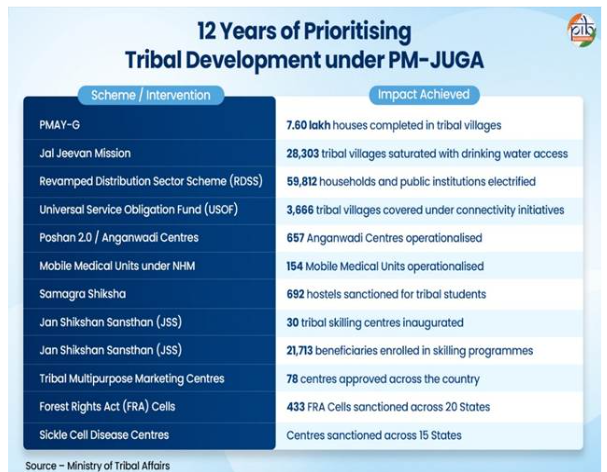
PM-JUGA / Dharti Aaba Janjatiya Gram Utkarsh Abhiyan
The Dharti Aaba Janjatiya Gram Utkarsh Abhiyan, now known as PM-JUGA, was launched in October 2024.
- It brings together the efforts of 17 ministries.
- It focuses on tribal-majority villages and PVTG habitations.
- It shifts tribal development from isolated interventions to coordinated mission-mode delivery.
Support to Tribal Research Institutes
Tribal Research Institutes document and preserve:
- Tribal languages ,Oral histories , Cultural traditions ,Indigenous knowledge Community practices ,Traditional medicine , Forest rights and livelihoods
- TRIs are supported across 29 States and Union Territories.
- They undertake research, publications, archives, museums, festivals and outreach activities. Their work is also supported through the Tribal Research, Information, Education, Communication and Events scheme.
- Research institutions involved include IITs, IIMs, AIIMS, TERI and the Bhasha Research Institute.

Justice and Dignity for Scheduled Castes
The Scheduled Caste development strategy combines:
- Village infrastructure , Education , Skill development, Livelihood opportunities Financial inclusion , Social dignity , Targeted budgetary support
Pradhan Mantri Anusuchit Jaati Abhyuday Yojana
PM-AJAY
- Launched in 2021.
- Focuses on integrated development of SC-majority villages.
- Supports infrastructure, skills and livelihoods.
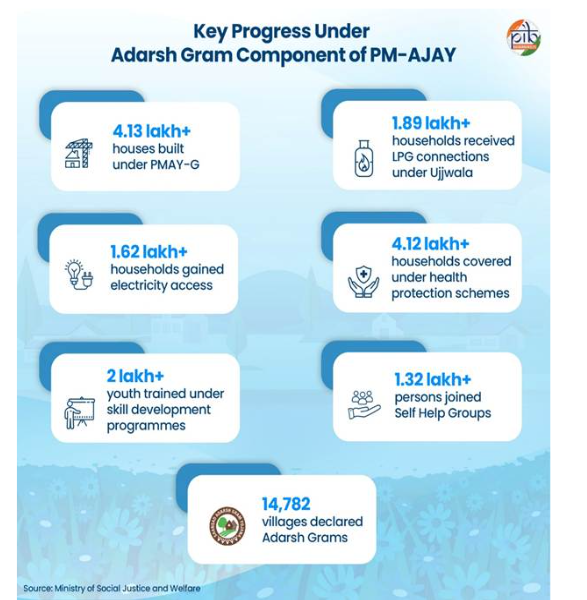
- Its Adarsh Gram component follows an area-based approach.
- It uses convergence, village plans and gap-filling assistance.
SHREYAS
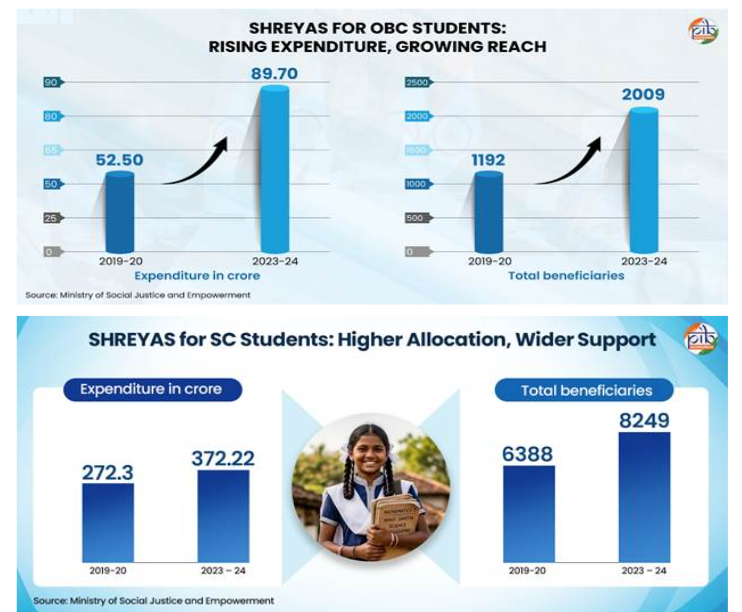
Scholarships for Higher Education for Young Achievers Scheme was launched in February 2019.
It supports SC, OBC and EBC students in:
- Higher education , Research , Competitive examinations , Overseas studies
Progress in 2025–26
- Top Class Education supported 4,156 SC students in IITs, IIMs, AIIMS, NITs and other premier institutions.
- 30% of seats were reserved for SC girls.
- Free Coaching Scheme assisted 990 students.
- National Overseas Scholarship supported 72 students.
- Research scholarships benefited:
- 4,153 SC scholars
- 1,969 OBC scholars
SHRESHTA
Scheme for Residential Education for Students in High Schools in Targeted Areas was launched in June 2022.
It supports SC students from low-income families studying in Classes IX to XII.
Two Modes
- Mode I: Admission of meritorious SC students to private residential schools through the National Entrance Test for SHRESHTA.
- Mode II: Support to residential schools run by voluntary organisations and institutions.
Eligible SC students with annual family income up to ₹2.5 lakh can appear for NETS.
PM-DAKSH
Pradhan Mantri Dakshta Aur Kushalta Sampann Hitgrahi Yojana was launched in 2020–21.
It provides free and certified skill training linked with wage employment and self-employment.
Beneficiaries
- Scheduled Castes—no income ceiling
- OBCs—family income up to ₹3 lakh
- EBCs—family income up to ₹1 lakh
- Denotified and Nomadic Tribes—no income ceiling
- Sanitation workers and waste pickers—no income ceiling
More than 2.08 lakh beneficiaries have been trained.
VISVAS Yojana
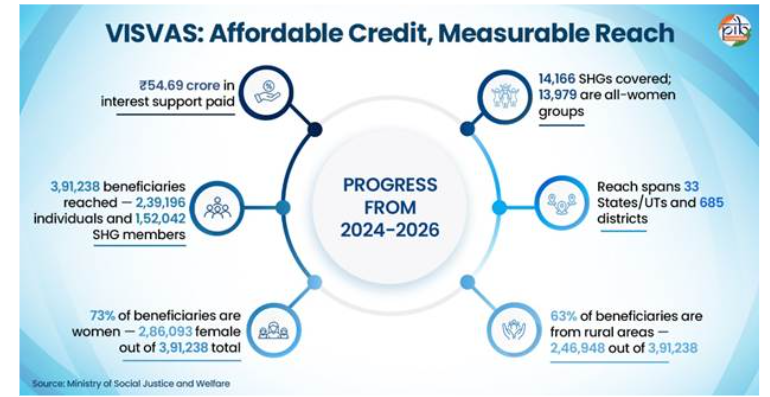
Vanchit Ikai Samooh aur Vargon ko Aarthik Sahayata Yojana provides affordable credit to:
- Scheduled Castes
- Other Backward Classes
- Safai Karmacharis
The scheme offers an interest subsidy of up to 5% per annum on eligible loans through Direct Benefit Transfer.
PM VIKAS
Pradhan Mantri Virasat Ka Samvardhan was launched in 2025 for the educational, economic and social development of minority communities.
It converges five earlier schemes:
- Seekho Aur Kamao , USTTAD ,Hamari Dharohar , Nai Roshni , Nai Manzil
Focus Areas
- Industry-oriented skill development , Employment , Entrepreneurship , Leadership
- Cultural preservation
Training covers areas such as:
- Airline cabin crew , Gardening and nursery management , Traditional hand embroidery , Graphic design ,Electrician work , Drone research and development Healthcare Agriculture , Media and entertainment
NAMASTE
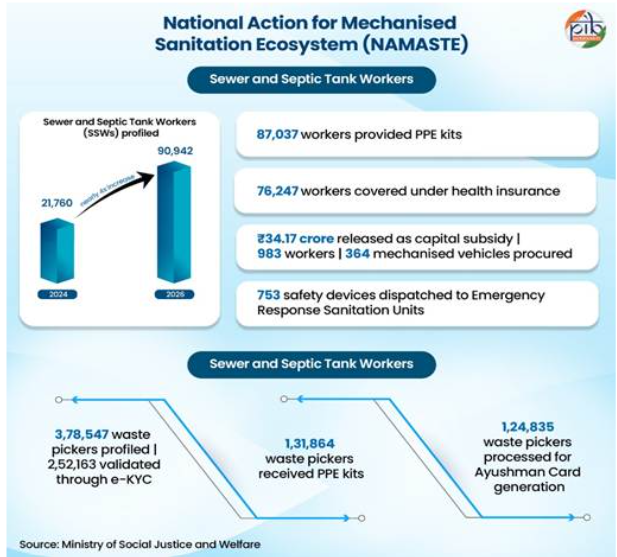
The National Action for Mechanised Sanitation Ecosystem seeks to ensure safety and dignity for sewer and septic-tank workers.
Significance of the Antyodaya Approach
- Places vulnerable communities at the centre of development.
- Promotes convergence across ministries.
- Improves access to education, health, housing and infrastructure.
- Protects tribal culture and indigenous knowledge.
- Supports women-led livelihoods and SHGs.
- Promotes financial inclusion and entrepreneurship.
- Strengthens dignity and safety for sanitation workers.
- Links welfare with skills, employment and enterprise.
- Supports the goal of Viksit Bharat @2047.
Key Challenges
- Uneven implementation across States and districts
- Gaps in awareness and beneficiary identification
- Delays in infrastructure completion
- Shortage of trained field-level personnel
- Digital and documentation barriers
- Difficulty in reaching remote tribal habitations
- Need for better outcome monitoring
- Risk of excluding migrant, nomadic and undocumented groups
- Weak market linkages for tribal and community products
- Persistent discrimination and social exclusion
Way Forward
- Adopt saturation-based coverage in every eligible habitation.
- Strengthen Gram Sabha and community participation.
- Improve convergence between ministries and State governments.
- Use local languages for awareness and service delivery.
- Expand market access for tribal and SHG products.
- Strengthen social audits and outcome monitoring.
- Ensure safe technology and mechanisation for sanitation workers.
- Improve scholarships, hostels and digital learning access.
- Protect tribal land, culture and intellectual traditions.
- Link welfare schemes with sustainable jobs and enterprises.
Conclusion
Antyodaya represents a shift from viewing disadvantaged communities as passive welfare recipients to recognising them as active participants in national development.
Programmes such as PM-JANMAN, PM-JUGA, PM-AJAY, SHREYAS, SHRESHTA, PM-DAKSH, VISVAS, PM VIKAS and NAMASTE combine infrastructure, education, skills, credit, livelihoods and dignity. Continued progress will require transparent implementation, community participation and strong last-mile delivery so that social justice becomes a lived reality within Viksit Bharat @2047.
Why in News?
- Prices of smartphones, laptops, TVs, refrigerators, washing machines, ACs, batteries, earphones, and storage devices are rising due to a global shortage of memory chips.
- Semiconductor firms are prioritizing advanced High Bandwidth Memory (HBM) for AI and data centres, reducing the supply of conventional memory chips used in consumer electronics.
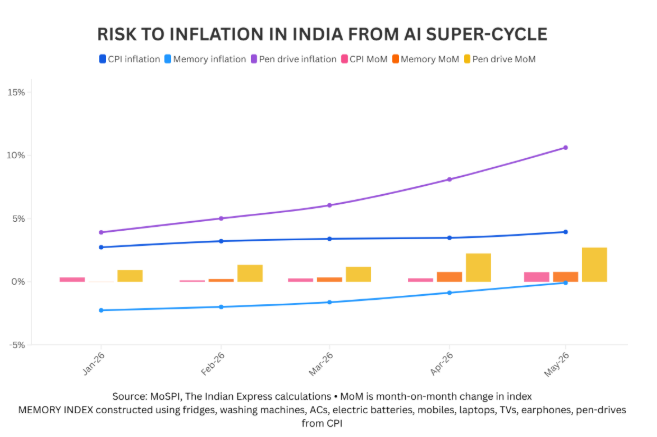
- Though these products account for only about 1% of India’s CPI basket, their sustained price increases are contributing to higher retail and core inflation.

What are Memory Chips?
Memory chips are semiconductor components that store data and provide quick access to information required by electronic devices.
They are used in:
- Smartphones and laptops
- Servers and data centres
- Televisions and household appliances
- Electric batteries and medical devices
- Pen drives and hard disks
- Artificial intelligence systems
RAM
Random Access Memory temporarily stores data that a processor needs immediately. It allows applications and operating systems to function quickly.
DRAM
Dynamic Random Access Memory is the common working memory used in smartphones, computers and servers. It is relatively affordable and widely used.
How the AI Boom Created a Shortage
The global AI investment boom has increased demand for data centres and advanced computing systems.
Supply-chain mechanism
AI expansion → More data centres → Higher HBM demand → Production capacity shifted from conventional DRAM → Memory shortage → Higher component prices → Cost passed to consumers
Major manufacturers such as Samsung, SK Hynix and Micron are increasingly allocating production capacity to advanced memory because it offers higher profit margins.
Since semiconductor production capacity is limited, every production line or wafer used for AI-oriented memory reduces the capacity available for ordinary consumer electronics.
DRAM and HBM: Key Difference
| Feature | DRAM | HBM |
| Full form | Dynamic Random Access Memory | High Bandwidth Memory |
| Main use | Phones, PCs and ordinary servers | AI processors and data centres |
| Structure | Conventional memory chips | Chips stacked vertically |
| Data transfer | Moderate | Very high |
| Cost | Relatively lower | Significantly higher |
| Demand driver | Consumer electronics | Artificial intelligence |
HBM is placed close to AI processors and enables much faster data movement. It is therefore essential for training and running AI models.
Impact on Consumer Electronics
Rising memory-chip costs are affecting several consumer products:
- Smartphones
- Personal computers
- Tablets
- Smart televisions
- Refrigerators
- Washing machines
- Air conditioners
- Headphones and earphones
- Pen drives and hard disks
The price index of pen drives and hard disks increased sequentially in 15 of the previous 16 months under the CPI series with 2023–24 as the base year.
Memory prices have more than tripled since October 2025, substantially increasing production costs.
Impact on India’s Inflation
The affected electronics currently have a relatively small weight in the CPI basket. Therefore, their contribution to headline inflation remains limited.
However:
- Price increases have continued for several consecutive months.
- Monthly price increases for several appliances are approaching or exceeding 1%.
- Pen drives and hard disks are recording monthly increases close to 3%.
- Persistent increases can raise core inflation, which excludes food and fuel.
- The shortage may continue for three to five years, making the pressure structural rather than temporary.
The RBI expects CPI inflation to average around 5.9% in the final quarter of 2026, close to the upper limit of its 2–6% tolerance band.
Why Budget Devices are More Affected
Budget electronics operate with smaller profit margins. Therefore, a rise in component costs has a greater impact on their retail price.
- Memory earlier accounted for less than 10% of the total cost of a low-end phone.
- It has now increased to more than 40%.
- Memory may account for around 43% of the Bill of Materials of smartphones priced below ₹20,000.
- The total component cost of such devices may rise by as much as 25% in 2026.
What is Bill of Materials?
The Bill of Materials is the total cost of all components and materials required to manufacture a product. It generally excludes marketing, distribution and taxation costs.
Likely Industry Response
Electronics manufacturers may respond by:
- Increasing retail prices
- Reducing production of low-end models
- Lowering non-essential specifications
- Delaying new product launches
- Concentrating on premium products
- Reducing expected shipment targets
Global PC shipments are projected to decline, while smartphone sales may also contract sharply. Consumers are expected to retain devices for longer periods because replacement costs are rising.
Structural Nature of the Shortage
The shortage is not merely a temporary disruption.
- AI companies are signing multi-year supply agreements.
- Some buyers are pre-funding new semiconductor capacity.
- Cloud companies are securing long-term memory supplies.
- Conventional memory capacity is being redirected towards AI servers.
- Building new semiconductor fabrication capacity requires large investment and several years.
Analysts therefore expect demand to exceed supply for at least three to five years.
India-Specific Concerns
Dependence on Imports
India depends heavily on imported memory chips. Global shortages and price increases are therefore directly transmitted to domestic manufacturers.
Weak Long-Term Procurement
Some Indian electronics manufacturers have not provided chip suppliers with clear long-term demand commitments. This can reduce their priority in an extremely tight global market.
Impact on Digital Inclusion
Higher prices for affordable phones and computers may reduce access among:
- Low-income households
- Students
- Small businesses
- Rural users
- First-time digital consumers
Challenges
- Semiconductor fabrication is capital-intensive.
- Memory-chip technology is concentrated among a few global companies.
- New factories require skilled labour, reliable power and ultrapure water.
- India currently lacks a strong domestic memory-chip ecosystem.
- Rising costs may reduce demand for affordable electronics.
- Firms must balance higher component costs with consumer price sensitivity.
- Monetary policy cannot directly remove a semiconductor supply shortage.
Way Forward
- Strengthen the India Semiconductor Mission and domestic chip manufacturing.
- Develop semiconductor packaging, testing and memory-related capabilities.
- Encourage Indian manufacturers to enter long-term supply agreements.
- Create strategic partnerships with major chip-producing countries.
- Support research in semiconductor design, materials and memory technology.
- Diversify sources of chip imports.
- Provide targeted support for affordable educational and digital devices.
- Promote repairability, software support and safe reuse of older devices.
- Monitor the effect of electronics prices on core inflation.
Conclusion
The global memory-chip shortage shows that the AI revolution has economy-wide consequences. Production capacity diverted towards advanced AI memory is raising the cost of ordinary electronics and gradually adding to inflation in India.
The immediate challenge is to secure adequate memory supplies and protect affordable digital access. In the long term, India must build domestic semiconductor capabilities, strengthen strategic procurement and diversify supply chains. This is essential for price stability, digital inclusion and technological self-reliance.