Why in News?
All 33 crest gates of the Tungabhadra dam near Hosapete in Karnataka were replaced and dedicated to the public on June 25, 2026.The replacement followed the washout of Gate No. 19 during the 2024 monsoon, which exposed vulnerabilities in the ageing dam system.
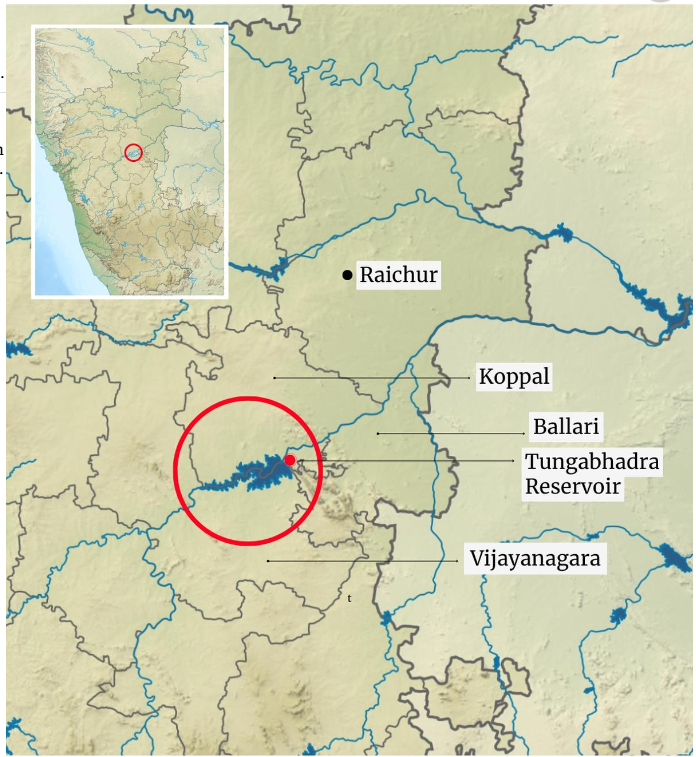
Origin and Course
- The Tungabhadra is formed by the confluence of:
- Tunga River
- Bhadra River
- Both originate in the Western Ghats and meet near Shivamogga in Karnataka.
- The river flows for about 531 km and joins the Krishna at Sangamaleshwaram in Andhra Pradesh. The Krishna later enters the Bay of Bengal at Hamsaladeevi.
- The Tungabhadra depends mainly on the south-west monsoon.
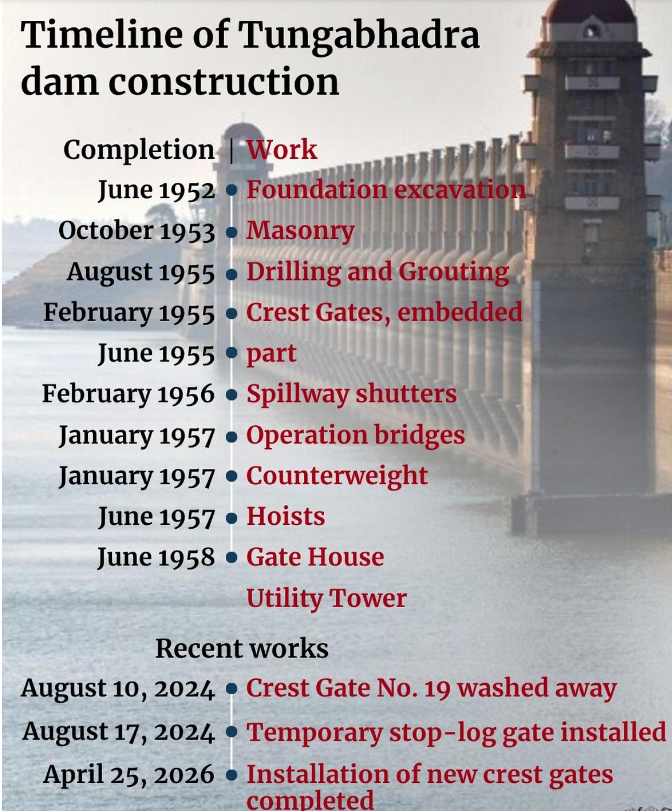
Tungabhadra Dam Project
- The dam was constructed near Hosapete in Karnataka’s Vijayanagara district and commissioned in the early 1950s.
It is an inter-State project serving:
- Karnataka
- Andhra Pradesh
- Telangana
The reservoir irrigates more than 16 lakh acres through the Left Bank and Right Bank canal systems. It also supports:
- Drinking-water supply
- Hydroelectric power
- Fisheries
- Tourism
- Rural livelihoods
The project is a lifeline for drought-prone areas of northern Karnataka and Rayalaseema.
Tungabhadra Board
- The Tungabhadra Board manages the common inter-State project.
Major Functions
- Regulates water releases, implements tribunal directions, Maintains the dam and reservoir, Records water flows and losses, Regulates the Right Bank canals, Supports irrigation and power generation
The Board has helped prevent frequent disputes through institutional regulation.
Water-Sharing Arrangement
- The Krishna Water Disputes Tribunal, constituted in 1969, fixed the broad sharing arrangement in 1976.
Broad Ratio
- Karnataka: 65%
- Undivided Andhra Pradesh: 35%
Major Allocations
- Karnataka: 151.49 tmcft
- Undivided Andhra Pradesh: 78.51 tmcft
- Telangana’s share: 15.9 tmcft
- Andhra Pradesh’s assured allocation from the dam: 32 tmcft
- The Tribunal supported the continuation of the Tungabhadra Board until an alternative institutional mechanism is created.
Emerging Water-Sharing Disputes
Upper Bhadra Project
- Karnataka’s Upper Bhadra lift-irrigation project is located upstream of the reservoir.
- Andhra Pradesh argues that it may intercept water before it reaches the dam and affect irrigation supplies to:
- Anantapur
- Kadapa
- Kurnool
- Andhra Pradesh approached the Supreme Court in 2023 challenging the project and its clearances.
Telangana’s Concern
- Telangana claims that it is not receiving its full allocation of 15.9 tmcft and faces a shortfall of about 5–6 tmcft.
- It has also argued that excess withdrawals may reduce downstream flows into the Srisailam reservoir.
Significance of the Tungabhadra Project
- Supports agriculture across three States
- Provides drinking water
- Strengthens drought resilience
- Supports hydroelectricity and fisheries
- Influences downstream Krishna-basin reservoirs
- Demonstrates tribunal-based inter-State water governance
Conclusion
The Tungabhadra reservoir is a vital inter-State lifeline for Karnataka, Andhra Pradesh and Telangana. Its long-term sustainability depends on safe infrastructure, transparent water accounting, respect for tribunal allocations and effective cooperation among the riparian States.