Why in News?
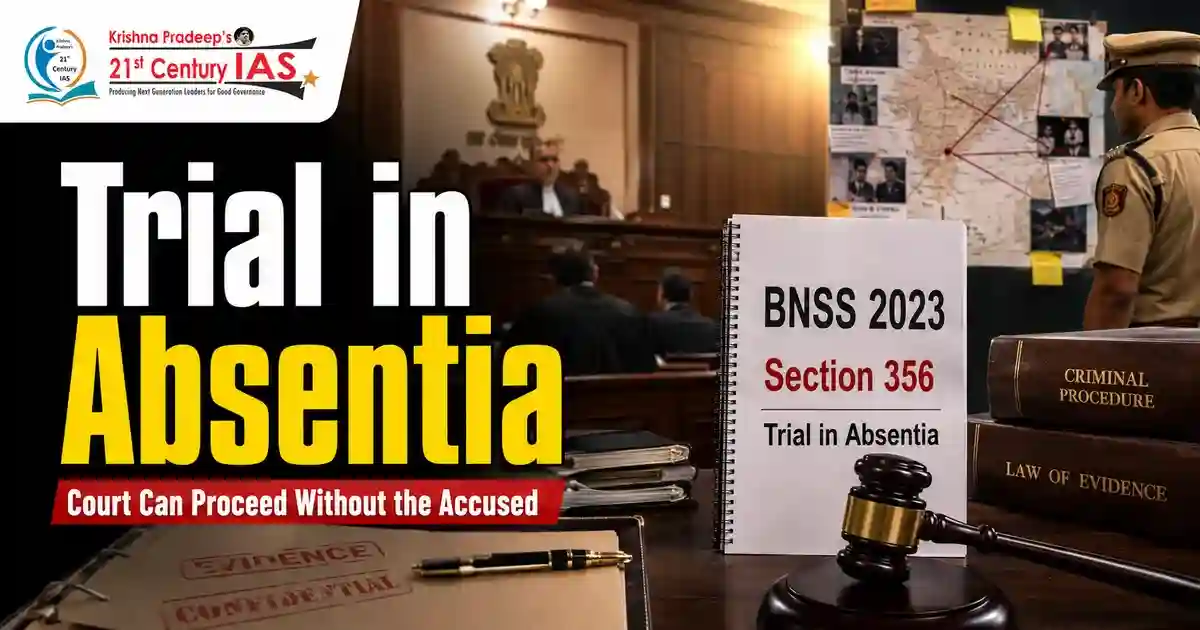
A Special NIA Court in Jammu issued a non-bailable warrant against Hafiz Saeed, Pakistan-based chief of the proscribed terror outfit Lashkar-e-Taiba, in connection with the Pahalgam terror attack investigation.
Since Hafiz Saeed is unlikely to appear before an Indian court, the National Investigation Agency may seek a trial in absentia under Section 356 of the Bharatiya Nagarik Suraksha Sanhita, 2023, which replaced the Code of Criminal Procedure, 1973.
What is Trial in Absentia?
Trial in absentia means a criminal trial conducted in the absence of the accused.
In ordinary criminal law, the presence of the accused is important because the accused has the right to:
- Know the charges
- Hear prosecution evidence
- Cross-examine witnesses
- Present defence
- Be represented by a lawyer
However, when an accused deliberately absconds and avoids trial, the justice system may be delayed for years. To address this, BNSS allows trial in absentia in limited and serious cases.
Legal Position under BNSS
Section 356 of BNSS
Section 356 of the Bharatiya Nagarik Suraksha Sanhita provides that if a person declared as a proclaimed offender has absconded to evade trial and there is no immediate possibility of arrest, the court may proceed with the trial in the accused’s absence.
The court must:
- Record reasons in writing
- Treat the absence as a waiver of the right to be present
- Proceed with inquiry, trial and judgment as if the accused were present
This provision is important in cases where accused persons are outside India or deliberately avoiding the court process.
Who can be Tried in Absentia?
- Trial in absentia does not apply to every accused person.
- It applies only to a proclaimed offender under Section 84 of BNSS.
Under Section 84(4), a person may be declared a proclaimed offender if:
- A proclamation has been issued against him
- He is accused of a serious offence
- The offence is punishable with:
- Imprisonment of 10 years or more
- Life imprisonment
- Death penalty
- He fails to appear at the specified place and time
- The court conducts necessary inquiry before declaring him a proclaimed offender
Thus, trial in absentia is limited to serious offences, not minor criminal cases.
How is BNSS Different from CrPC?
Under the earlier CrPC, there were limited provisions for dealing with absconding accused persons.
| Provision under CrPC | Purpose |
| Section 82 | Proclamation against absconding accused |
| Section 299 | Recording evidence in absence of absconding accused |
| Section 317 | Dispensing with personal attendance in limited cases |
- However, the CrPC did not permit a full-fledged trial in absentia.
- This meant that many serious cases remained pending for years because the accused could not be arrested or produced before the court.
- The BNSS has changed this by allowing a full trial in absentia in specific cases involving proclaimed offenders.
Procedural Safeguards under Section 356 BNSS
The law includes several safeguards to protect the accused’s right to fair trial.
1. Two Warrants of Arrest
- Before trial in absentia can begin, the court must issue two consecutive warrants of arrest.
- There must be a gap of at least 30 days between the two warrants.
2. Public Notice
A notice must be published in a local or national newspaper, giving the accused 30 days to appear before the court.
3. Notice at Last Known Residence
The notice must also be displayed at the accused’s last known place of residence.
4. Intimation to Relative or Friend
A relative or friend of the accused must be informed about the trial.
5. Waiting Period after Framing of Charges
The trial cannot begin immediately.
It can start only after 90 days from the date of framing of charges. This gives the accused enough time to appear before the court.
6. State-appointed Defence Lawyer
If the absconding accused does not have legal representation, the court must appoint a defence lawyer at the State’s expense.
This protects the constitutional principle of fair trial.
7. Audiovisual Recording
Witness deposition and examination may be recorded through audiovisual electronic means.
These recordings must be preserved to maintain transparency and help future review.
What Happens if the Accused Later Appears?
If the accused later appears before the court or is arrested, the court may allow him to cross-examine prosecution witnesses.
This is important because cross-examination is a core element of a fair trial.
Thus, the law tries to balance:
- Need for speedy justice
- Rights of victims
- National security concerns
- Accused’s right to fair trial
Why was Trial in Absentia Introduced?
Trial in absentia was introduced to address delays caused by absconding accused persons.
It is especially relevant in:
- Terrorism cases
- Cross-border offences
- Organised crime
- Cases involving fugitives
- National security offences
In such cases, the accused may deliberately avoid appearing before Indian courts. Without trial in absentia, justice may remain blocked indefinitely.
Significance of Trial in Absentia
1. Strengthens Criminal Justice System
It prevents accused persons from defeating justice by simply absconding.
2. Useful in Terror Cases
It is useful where accused persons are located outside India and cannot be easily extradited.
3. Ensures Speedy Trial
It prevents long pendency of serious criminal cases.
4. Supports Victim Justice
Victims and families need closure. Trial in absentia helps avoid indefinite delay.
5. Strengthens National Security
In terrorism and cross-border conspiracy cases, it helps India move forward with prosecution even when the accused is beyond physical reach.
Concerns and Challenges
1. Risk to Fair Trial
Trying an accused in his absence may affect his ability to personally defend himself.
2. Quality of Defence
A State-appointed lawyer may not always have full instructions from the accused.
3. Evidence Scrutiny
The absence of the accused may weaken effective cross-examination.
4. Misuse Concerns
The provision must not be used casually. It should be limited to serious cases where the accused is deliberately avoiding trial.
5. International Enforcement
Even after conviction, enforcement may remain difficult if the accused is in another country.
Way Forward
- Courts must strictly follow all safeguards under Section 356 BNSS.
- Trial in absentia should be used only in serious cases involving proclaimed offenders.
- State-appointed defence lawyers must be competent and independent.
- Audiovisual records must be preserved properly.
- India should strengthen extradition and mutual legal assistance mechanisms.
- The provision should be used to support justice, not to weaken due process.
Conclusion
Trial in absentia under Section 356 of BNSS is a major reform in India’s criminal justice system. It allows courts to proceed against proclaimed offenders who deliberately evade trial. However, because it affects the accused’s right to be personally present, the provision must be applied with strict safeguards. If used carefully, it can help India deal with terrorism, fugitives and cross-border crimes while maintaining the constitutional commitment to fair trial and rule of law.