Why in News?
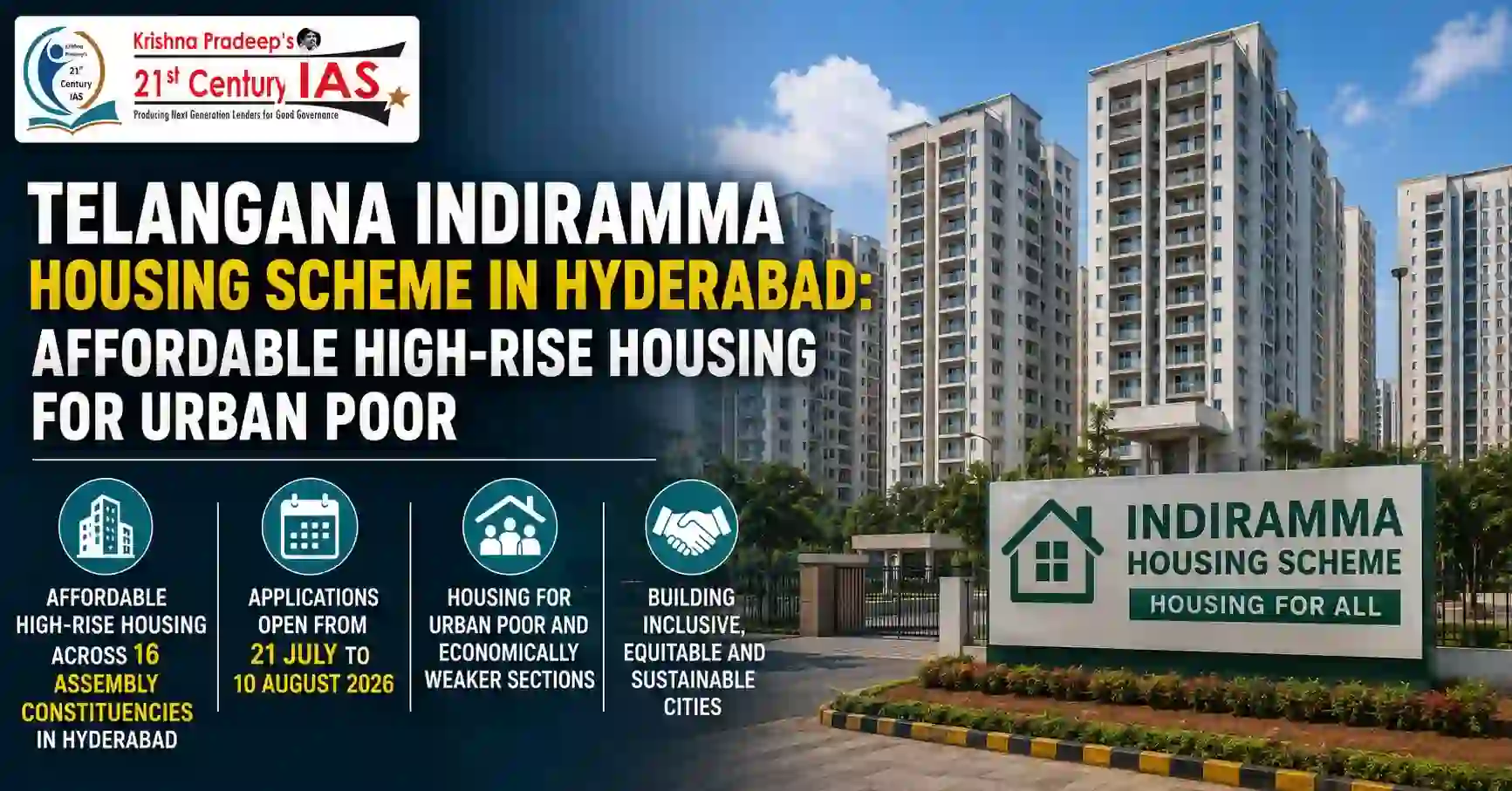
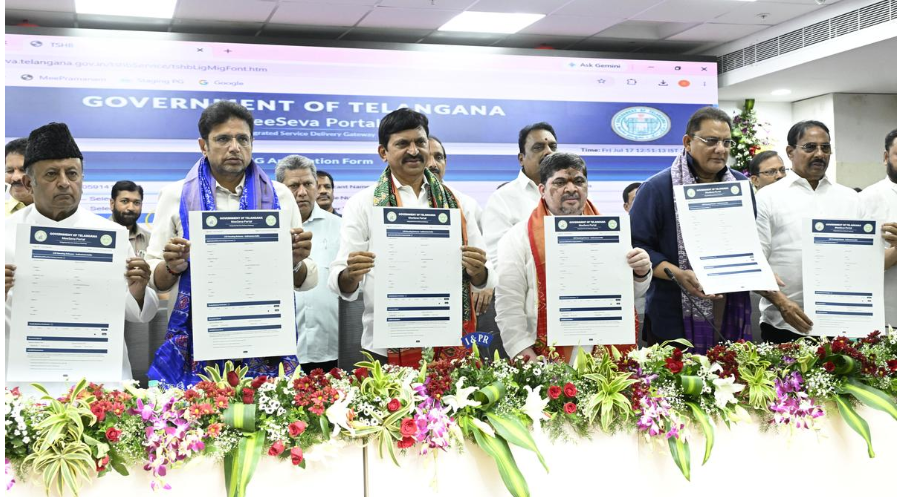
The Telangana government launched the Indiramma Housing Scheme for Hyderabad Core Urban Region (CURE) on 20 July 2026. The scheme aims to construct affordable houses in high-rise buildings across 16 Assembly constituencies in Hyderabad, with applications open from 21 July to 10 August 2026.
About the Indiramma Housing Scheme in Hyderabad
- The Indiramma Indlu Housing Scheme in Hyderabad is an affordable housing initiative aimed at providing flats to eligible residents of the Core Urban Region.
- The houses will be constructed in multi-storey towers. Each flat will have a carpet area of 400 square feet and a built-up area of 528 square feet.
- The scheme was launched at the Dr. B.R. Ambedkar Telangana State Secretariat in Hyderabad.
Key Features of the Scheme
- The scheme applies to Hyderabad CURE area.
- Houses will be built in high-rise buildings.
- Flats will have 400 sft carpet area and 528 sft built-up area.
- The government aims to construct one lakh affordable houses in one year.
- The scheme has initially been launched in 16 Assembly constituencies based on land availability.
- It will be extended to other constituencies soon.
- No separate charges will be collected for land.
- The State Cabinet approved construction of these houses in May 2026.
- The government has indicated that a separate announcement for Middle Income Group people may be made soon.
Eligibility Criteria
Applicants must satisfy the following conditions:
- The applicant should be a resident of Hyderabad CURE area for the last 10 years.
- The applicant or the family should not own a house, flat or plot within the Outer Ring Road or CURE area.
- Annual household income should be up to ₹6 lakh.
- The applicant should not have received similar housing benefits earlier.
- False declaration, suppression of facts or duplicate applications may lead to rejection.
This eligibility framework is intended to ensure that the scheme benefits genuinely housing-deprived urban households.
Application Procedure
Applications will be received from 21 July to 10 August 2026.
Applicants can submit forms through:
- MeeSeva Centres
- MeeSeva portal
- MeeSeva WhatsApp service: 8096958096
The application must be submitted along with:
- ₹100 application fee
- ₹10,000 Earnest Money Deposit
The ₹10,000 EMD will be refunded if the applicant is not selected. If selected, the EMD will be adjusted into the beneficiary’s contribution.
Selection and Verification Process
- The selection process has multiple stages to ensure transparency.
- First, applications will be scrutinised by checking documents and payment details. After this, a 360-degree verification will be conducted to examine income, family details and duplicate applications.
- If demand is higher than the available number of flats, beneficiaries will be selected through a lottery system.
After selection, the process will include:
- Provisional allotment
- Field verification
- Stage-wise payments
- Registration
- Final handover of the flat
This process seeks to reduce duplication, prevent false claims and ensure fair allotment.
Financial Structure
The estimated cost of constructing a 528 sft flat is ₹11 lakh.
The cost-sharing structure is:
| Component | Amount |
| Government subsidy | ₹5 lakh |
| Beneficiary contribution | ₹6 lakh |
| Total estimated cost | ₹11 lakh |
The beneficiary contribution of ₹6 lakh can be paid in four instalments:
- ₹1 lakh
- ₹2 lakh
- ₹2 lakh
- Balance amount
The government has clarified that land charges will not be collected from beneficiaries.
Conclusion
The launch of the Indiramma Housing Scheme in Hyderabad CURE area is an important urban welfare measure by the Telangana government. By providing ₹5 lakh subsidy, constructing 528 sft built-up flats, and using a structured application and verification process, the scheme aims to expand affordable housing in Hyderabad. Its success will depend on transparent beneficiary selection, timely construction, affordability of beneficiary contribution and effective post-allotment management.
Why in News?
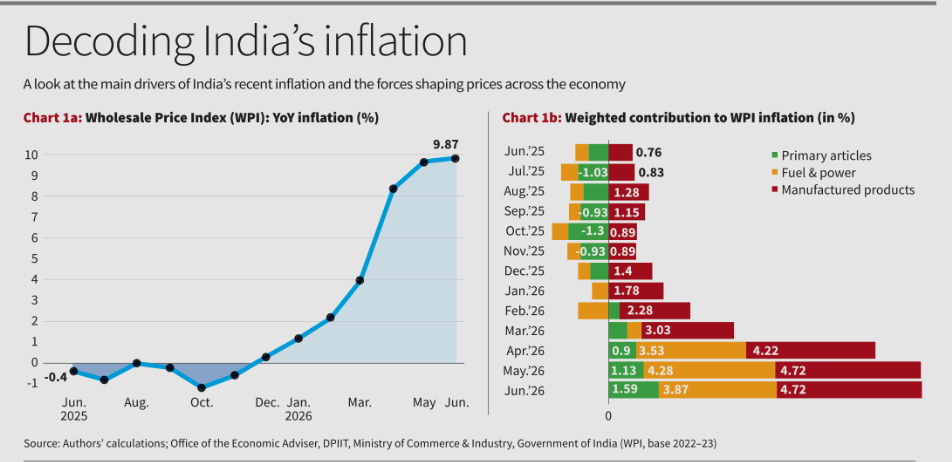
India has recently witnessed a sharp rise in inflation, with Wholesale Price Index inflation hovering close to 10% in June. The rise has been mainly driven by higher fuel and power prices, manufactured goods inflation, and food price pressures arising from supply-side shocks such as weak monsoon conditions.
What is Inflation?
- Inflation refers to the rate at which the general price level of goods and services rises over a period of time. It reduces the purchasing power of money, meaning people have to spend more to buy the same quantity of goods and services.
- According to the International Monetary Fund, inflation measures the rate of increase in prices over a given period. It may refer to overall price rise or price rise in specific goods and services.
In India, inflation is important because it directly affects:
- Cost of living
- Household consumption
- Savings and investment decisions
- Real wages
- Fiscal policy
- Monetary policy
- Poverty and inequality
How Inflation is Measured in India
- India measures inflation primarily through the Consumer Price Index (CPI) and the Wholesale Price Index (WPI). In 2026, the Government also introduced a comprehensive Producer Price Index (PPI) framework to gradually replace WPI over the next five years in line with global best practices.
| Index | Meaning | Key Features |
| Consumer Price Index (CPI) | Measures changes in retail prices paid by consumers | Base Year: 2024 (current official series); |
| Wholesale Price Index (WPI) | Measures price changes at the wholesale (producer) level | Base Year revised to 2022–23 (effective June 2026); covers Primary Articles, Fuel & Power, and Manufactured Products; compiled by the Office of Economic Adviser, DPIIT. WPI will continue only for five years before being phased out. |
| Output Producer Price Index (OPPI) | Measures prices received by producers for goods sold | New index (Base Year: 2022–23) introduced in June 2026; reflects producer prices excluding taxes and trade margins; aligned with international standards. |
| Input Producer Price Index (IPPI – Trial) | Measures prices paid by producers for production inputs | New trial index (Base Year: 2022–23); compiled using purchasers’ prices to track input cost inflation. |
| Service Producer Price Index (Service PPI) | Measures producer prices for selected services | New quarterly index (Base Year: 2022–23) covering Banking, Insurance, Pension Funds, Securities Transactions, Railways, Air Passenger Transport, and Telecom. |
| Monetary Policy Committee (MPC) –
MPC is a statutory body that decides India’s benchmark policy interest rate, mainly the repo rate, to achieve the inflation target. About Monetary Policy
Primary Objective
Legal Basis
Function of MPC
Composition
Decision-Making
Institutional Support
Significance
|
Recent Inflation Trend in India
Inflation in India had remained relatively low for more than a decade, except during the COVID-19 pandemic. However, the recent trend shows a renewed rise.
The WPI inflation rate was negative or close to zero until December of the previous year. It began rising sharply from March and moved close to 10% by June.
WPI has three major components:
- Primary articles: food, minerals and other basic commodities
- Fuel and power: petroleum products, electricity and related energy costs
- Manufactured products: industrial goods produced in factories
The recent rise has been mainly driven by fuel and power and manufactured products, while food prices have also contributed through supply-side stress.
Structural Difference Between Food and Industrial Prices
A useful way to understand inflation is through the structural approach associated with economist Michal Kalecki.
Primary Commodity Prices
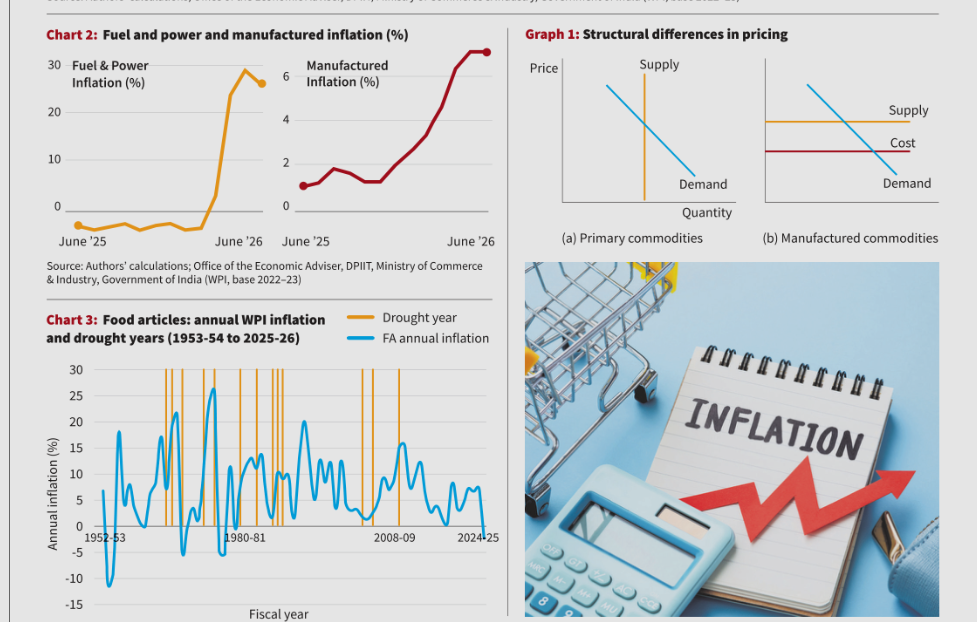
- Primary commodity prices, especially food prices, are strongly affected by demand-supply mismatch. Agricultural supply is often fixed in the short run because output depends on monsoon, soil, irrigation and crop cycles.
A poor monsoon or drought can reduce supply and raise prices sharply.
Manufactured Product Prices
- Industrial prices are usually cost-determined. Factories often operate below full capacity, so if demand rises, producers can increase output without immediately raising prices.
- Prices of manufactured goods rise mainly when input costs increase, such as fuel, raw materials, electricity or transport costs.
- This distinction is important because it shows that all inflation cannot be treated as demand-driven inflation.
Major Reasons for the Recent Inflation Rise
1. Rise in Fuel and Power Prices
Fuel and power prices are closely linked to international crude oil prices. Since India imports a large share of its crude oil requirement, higher global oil prices create imported inflation.
Fuel affects the economy in two ways:
- It directly raises petrol, diesel and energy prices.
- It indirectly raises transport, logistics and production costs.
This cost increase is passed on to manufactured goods, creating cost-push inflation.
2. Manufactured Goods Inflation
- Manufactured goods inflation has risen largely because of higher input costs, especially fuel and power.
- In India, wage costs are not usually the main driver of manufactured inflation because workers have limited bargaining power. Instead, material costs such as oil, electricity, transport and industrial inputs create the inflationary impulse.Thus, when fuel prices rise, manufactured goods prices also tend to rise.
3. Food Price Pressures
- Food inflation has been linked to supply shocks such as inadequate monsoon conditions and the impact of El Niño on agricultural production.
- When rainfall is poor, crop output may fall. Since food supply cannot be increased immediately, prices rise quickly.
- Past drought years also show that weak monsoon conditions are often accompanied by significant food inflation. A drought may not be the only cause of food inflation, but it is a strong trigger for food price rise.
4. Supply-Side Nature of Inflation
The recent inflation surge does not appear to be mainly due to excess demand or overheating of the economy.
Instead, it has been driven by:
- Fuel cost rise
- Imported oil price pressure
- Higher production costs
- Food supply shocks
- Monsoon-related agricultural stress
This makes the current inflation largely cost-push and supply-shock driven.

Policy Measures Needed
1. Strengthen Irrigation Infrastructure
Food prices should be made less dependent on monsoon fluctuations. India needs greater investment in irrigation, water storage, watershed management and climate-resilient agriculture.
2. Use Countercyclical Indirect Tax Policy
When crude oil prices rise sharply, the government can temporarily reduce customs and excise duties on fuel to prevent full pass-through to consumers and producers.
3. Review Inflation Targeting Framework
A narrow inflation-targeting approach may be less effective when inflation is driven by food and fuel supply shocks. Policy response should combine monetary, fiscal and supply-side measures.
4. Improve Agricultural Supply Chains
Better storage, cold chains, logistics and market linkages can reduce volatility in food prices.
5. Monitor Imported Inflation
Since fuel prices are externally determined, India needs a strategy to manage oil price shocks through reserves, taxation policy and energy diversification.
Significance for Economy and Society
Impact on Consumers
Inflation reduces purchasing power, especially for poor and middle-income households.
Impact on Producers
Rising fuel and input costs increase production expenses and may reduce profit margins.
Impact on Real Wages
If nominal wages do not rise with inflation, real incomes decline.
Impact on Monetary Policy
The Reserve Bank of India uses CPI inflation for monetary policy decisions, but supply-driven inflation cannot be solved only through interest rate changes.
Impact on Competitiveness
If domestic prices rise faster than trading partners, Indian goods may become less competitive internationally.
Conclusion
India’s recent inflation rise is mainly a supply-side and cost-push phenomenon, driven by higher fuel costs, manufactured goods inflation and food price pressures from weak monsoon conditions. Treating it only as excess demand would lead to an incomplete policy response. A more effective strategy requires irrigation investment, food supply-chain reforms, countercyclical fuel taxation, energy diversification and a broader inflation management framework. Inflation control must therefore combine price stability with protection of livelihoods and productive capacity.
Why in News?
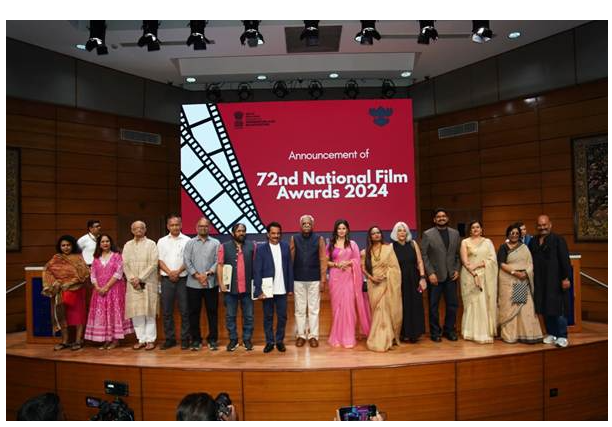
The winners of the 72nd National Film Awards for the year 2024 were announced by PIB Delhi on 18 July 2026. The awards recognised achievements across feature films, non-feature films and writings on cinema. Article 370 won the Best Feature Film, Bhangaar won the Best Non-Feature Film, and Ram-Nami won the Best Documentary.
About National Film Awards
- The National Film Awards were established in 1954 and are among the most prestigious film awards in India. The awards are presented by the President of India and aim to recognise excellence in Indian cinema.
- The first awards were given for the films of 1953. Initially, they were called State Awards and included two President’s Gold Medals, two certificates of merit, and silver medals for regional films. Over time, the number and scope of awards expanded.
- Separate awards for artists and technicians were instituted in 1968 for films of 1967. Nargis Dutt and Uttam Kumar were the first recipients of the Best Actress and Best Actor awards, then called Urvashi and Bharat awards respectively.
The awards are given in three broad sections:
- Feature Films
- Non-Feature Films
- Best Writing on Cinema
The awards aim to encourage films of aesthetic excellence, technical excellence, and social relevance, while promoting unity, integrity and appreciation of India’s cultural diversity.
Key Highlights of the 72nd National Film Awards
The 72nd National Film Awards recognised cinema across languages, genres and formats.
Major highlights include:
- Best Feature Film: Article 370
- Best Non-Feature Film: Bhangaar
- Best Documentary: Ram-Nami
- Best Actress in Leading Role: Yami Gautam for Article 370
- Best Actor in Leading Role: Mammootty for Bramayugam and Kartik Aaryan for Chandu Champion
- Best Debut Director: Randeep Hooda for Swatantrya Veer Savarkar
- Best Popular Film Providing Wholesome Entertainment: Kalki 2898 AD
- Major recognitions also went to Pushpa: The Rule Part-02, Stree 2, Amaran, Bhool Bhulaiyaa 3, Committee Kurrollu and 35-Chinna Katha Kaadu.
The awards were announced by Shri Jayaraj, Chairperson of the Feature Film Jury; Shri Aseem Sinha, Chairperson of the Non-Feature Film Jury; and Shri A. Chandrasekhar, Chairperson of the Best Writing on Cinema Jury.
Feature Film Awards List
| No. | Category | Film / Language | Awardee |
| 1 | Best Feature Film | Article 370 / Hindi | Producer: Jio Studios & B62 Studios; Director: Aditya Suhas Jambhale |
| 2 | Best Debut Film of a Director | Swatantrya Veer Savarkar / Hindi | Director: Randeep Hooda |
| 3 | Best Popular Film Providing Wholesome Entertainment | Kalki 2898 AD / Telugu | Producer: Vyjayanthi Movies; Director: Nag Ashwin Singireddy |
| 4 | Best Feature Film Promoting National, Social and Environmental Values | Captain Miller / Tamil | Producer: Sathya Jyothi Films; Director: Arun Matheswaran |
| 5 | Best Children’s Film | 35-Chinna Katha Kaadu / Telugu | Producer: S Originals & Waltair Productions Pvt. Ltd.; Director: Nanda Kishore Emani |
| 6 | Best Direction | Amaran / Tamil | Director: Rajkumar Periasamy |
| 7 | Best Actor in a Leading Role | Bramayugam / Malayalam; Chandu Champion / Hindi | Mammootty; Kartik Aaryan |
| 8 | Best Actress in a Leading Role | Article 370 / Hindi | Yami Gautam |
| 9 | Best Actor in a Supporting Role | Bhakshak / Hindi | Sanjay Mishra |
| 10 | Best Actress in a Supporting Role | Maharaja / Tamil; Mithya / Kannada | Sachana Namidass; Ropashree Varkady |
| 11 | Best Child Artist | Mithya / Kannada; 35-Chinna Katha Kaadu / Telugu; Onko Ki Kothin / Bengali | Athish S. Shetty; Arundev Pothula; Riddhiman Banerjee, Tapomoy Deb, Gitashree Chakraborty |
| 12 | Best Male Playback Singer | Gharat Ganpati / Marathi | Abhay Jodhpurkar for “Navasachi Gauri Mazi” |
| 13 | Best Female Playback Singer | A. R. M / Malayalam | Vaikom Vijayalakshmi for “Angu Vaana Konilu” |
| 14 | Best Cinematography | Bramayugam / Malayalam | Shehnad Jalal |
| 15 | Best Screenplay |
| Original: Bandreddi Sukumar;
Adapted: Yogesh Deshpande; Dialogue: Venky Atluri |
| 16 | Best Sound Design | Bhool Bhulaiyaa 3 / Hindi | Manas Choudhury |
| 17 | Best Editing | Amaran / Tamil | R. Kalaivannan |
| 18 | Best Production Design | Kalki 2898 AD / Telugu | Nitin Zihani Choudhary |
| 19 | Best Costume Design | Pushpa: The Rule Part-02 / Telugu | Deepali Noor & Sheetal Sharma |
| 20 | Best Make-up | Committee Kurrollu / Telugu | P. Ravi Kumar |
| 21 | Best Music Direction | Article 370 / Hindi; Amaran / Tamil | Songs: Shashwat Sachdev; Background Music: G. V. Prakash Kumar |
| 22 | Best Lyrics | Maidaan / Hindi | Manoj Muntashir for “Jaane Do” |
| 23 | Best Choreography | Stree 2 / Hindi | Vijay Ganguly for “Aaj Ki Raat” |
| 24 | Best Action Direction | Maharaja / Tamil | Stunt Choreographer: Anl Arasu |
Best Feature Films in Schedule VIII Languages
| Language Category | Film | Producer / Director |
| Best Assamese Film | Juiphool | Producer & Director: Jadumoni Dutta |
| Best Bengali Film | Chalchitra Ekhon | Producer: Anjan Dutt Production; Director: Anjan Dutt |
| Best Gujarati Film | Maaran | Producer: Cineman Productions Limited; Director: Abhishek Jain |
| Best Hindi Film | Srikanth | Producer: Super Cassettes Industries Pvt. Ltd. & Chalk N Cheese Films Production LLP; Director: Tushar Hiranandani |
| Best Kannada Film | Mithya | Producer: Paramvah Pictures & KRG Studios; Director: Sumanth Bhat |
| Best Konkani Film | Mog Asum | Producer: Flowing Mandovi Films LLP, R S Creations, Kathputlee Arts and Films Pvt. Ltd.; Directors: Radheshyam Pipalwa & Agnelo Angelo Braganza |
| Best Malayalam Film | Feminichi Fathima | Producer: 1001 Stories & AFD Cinemas; Director: Fasil Muhammed |
| Best Manipuri Film | Sunita | Producer: Skyline Pictures, Khuman Leipak Pictures, H. M. Production & Cultural Society Khuman Maheikol Production; Director: Yumnam Ajit Singh |
| Best Marathi Film | Mukkam Post Bombilwadi | Producer: Vivek Films & Mayasabha Karamanuk Mandali LLP; Director: Paresh Mokashi |
| Best Odia Film | Lahari | Producer: Jhilik Motion Pictures; Director: Amartya Bhattacharyya |
| Best Tamil Film | Raayan | Producer: Sun TV Network Limited; Director: Dhanush |
| Best Telugu Film | Committee Kurrollu | Producer: Pink Elephant Pictures & Shree Radha Damodara Studios; Director: Yadhu Vamsee |
Best Feature Films in Non-Schedule VIII Languages
| Language Category | Film | Producer / Director |
| Best Garhwali Film | Dholi | Producer: SC Pharmachem Pvt. Ltd.; Director: Dinesh P. Bhonsle |
| Best Tulu Film | IMBU | Producer: Pichchar Studio; Director: Shivadhwaj Shetty |
Special Mention – Feature Films
| Film | Recognition |
| Captain Miller | Actor: Dhanush |
| Meiyazhagan / Tamil | Film Sound Mix Engineer: Suren G. |
Telugu Cinema at the 72nd National Film Awards
Telugu cinema received recognition across popular, children’s, technical and language categories.
| Category | Telugu Winner |
| Best Popular Film Providing Wholesome Entertainment | Kalki 2898 AD |
| Best Children’s Film | 35-Chinna Katha Kaadu |
| Best Child Artist | Arundev Pothula — 35-Chinna Katha Kaadu |
| Best Original Screenplay | Bandreddi Sukumar — Pushpa: The Rule Part-02 |
| Best Dialogue Writer | Venky Atluri — Lucky Baskhar |
| Best Production Design | Nitin Zihani Choudhary — Kalki 2898 AD |
| Best Costume Design | Deepali Noor & Sheetal Sharma — Pushpa: The Rule Part-02 |
| Best Make-up | P. Ravi Kumar — Committee Kurrollu |
| Best Telugu Film | Committee Kurrollu |
Non-Feature Film Awards
| No. | Category | Film / Language | Awardee |
| 1 | Best Non-Feature Film | Bhangaar / Marathi & English | Producer & Director: Sumira Roy |
| 2 | Best Debut Film of a Director | Angen / Santhali | Director: Ravi Raj Murmu |
| 3 | Best Biographical / Historical Reconstruction / Compilation Film | Kakori / Hindi | Producer: KSR Brothers & Minti Mishra; Director: Kamlesh K. Mishra |
| 4 | Best Arts / Culture Film | Main Nida / Hindi | Producer: Sampreshan Multimedia Pvt. Ltd.; Director: Atul Pandey |
| 5 | Best Documentary | Ram-Nami / Hindi | Producer: BBP Studio Virtual Bharat Pvt. Ltd.; Director: Bharatbala Ganapathy |
| 6 | Best Non-Feature Film Promoting Social and Environmental Values | Piplantri: A Tale of Eco Feminism / Hindi, Rajasthani & English | Producer: Johnsons Suraj Films International; Director: Suraj Kumar |
| 7 | Best Animation Film | Touched as Water / Silent | Producer: JB Productions; Director & Animator: Joshy Benedict |
| 8 | Best Short Film up to 30 minutes | Hamsafar / Marathi | Producer: Anushka Motion Pictures and Entertainments; Director: Abhijeet Arvind Dalvi |
| 9 | Best Direction | Statue of Unity – Ekta ka Prateek / Hindi | Director: Aanand L. Rai |
| 10 | Best Cinematography | Life in Loom / English, Tamil, Hindi, Assamese & Bengali | Cinematographer: Edmond Ranson |
| 11 | Best Sound Design | Blue / Tamil | T. S. Hari Hara Sudhan |
| 12 | Best Editing | NDA / Hindi | Editor: Manvir Jasrotia |
| 13 | Best Music Direction | Parat 41°chya Magavar / On the Trail of 41° / Marathi | Shivpal Singh Kang |
| 14 | Best Narration / Voice Over | Little Planet: A Tale of Frogs / English | Narrator: Soundarya Jayachandran |
| 15 | Best Script | Obur / Hindi & Kashmiri | Script Writer: Faraz Ali |
| 16 | Special Mention | Bhadra-Kali Natakam / Malayalam; Chola Dora aur Sui / Hindi | Directors: Ananda Jyothi / Jose Antony; Jaymin Modi & Lokesh Ghai |
Best Writing on Cinema Awards
| Category | Winner |
| Best Book on Cinema | Naaniruvude Nimagaagi Naadiruvude Nanagaagi: Kannada Cinemada Thathva matthu Rajakeeya |
| Language | Kannada |
| Author | Kenchanuru Pradeep Kumar Shetty |
| Publisher | Mirror Pusthaka |
| Medal & Cash Prize | Swarna Kamal and ₹1,00,000 each |
| Category | Winner |
| Best Film Critic | Sanjeev Shrivastava |
| Language | Hindi |
| Medal & Cash Prize | Swarna Kamal and ₹1,00,000 |